



It was waiting to happen. Only the “when” was not clear. The buildings in the industrial areas of the National Capital Region (NCR), with their glitzy interiors, could not camouflage the simmering anger of workers inside any longer. When what started as a small bubble of frustration took on the force of a volcanic eruption, fuelled by the oppressive conditions imposed by hostile employers and abetted by compliant governments, nothing could put a lid on it.
Thus, in mid-April, workers poured out of their factories, striking work in the industrial area of the New Okhla Industrial Development Authority (Noida) in Uttar Pradesh, fully conscious of the reprisals and the heavy hand of the state that would come into play as the official reaction to their action. But it was a moment that the workers truly owned, and there was no factory that was unaffected.
There was no coordinated action, no direct union involvement. Yet, it seemed like magic. As per some official reports, workers across 82 factories struck work protesting against the 12-hour, 7-day working week and the harsh and unsafe working conditions within the factories, all for a measly monthly wage of Rs.11,000 to Rs.12,000. The immediate spark was the news that the Haryana government had revised the minimum wage rates for unskilled, semi-skilled, and skilled categories. Consequently, a factory with a unit in the industrial belt of Gurugram (Haryana) revised its wage rates, whereas its plant in another part of the NCR, in Noida, did not.
State governments are required to notify revised wage rates and dearness allowance (DA) rates from time to time. But the last time the Uttar Pradesh government revised rates was 12 years ago. Now, things are bad, with LPG cylinders costing Rs.4,000 in the black market and room rent rates no less than Rs.5,000. “Only our lives are cheap. And everything else, expensive. The rates of gas, room rent, the thali at the dhaba, and even tea have increased but not our wages. We live in one-room hovels paying between Rs.4,000 and Rs.5,000.
How are we to survive on wages of Rs.11,000 while working for 12 hours every day of the week? After ESI [Employees’ State Insurance] and PF [Provident Fund] deductions, we get a mere Rs.9,000 in hand. The cost of living in Gurugram and Noida is similar. Why weren’t our wages revised?” asked a worker. The fight, he said, is for an eight-hour working day, double pay for overtime work, and wages commensurate with inflation. Their primary demand is similar wages for similar categories of workers in the NCR.
News of the wages having been revised in the neighbouring State spread like wildfire. The inevitable happened. GautamBuddha Nagar district, which encompasses Noida as well as Greater Noida, saw a spontaneous uprising like never before. For the well-off living in these parts, the sight of hundreds of workers on the streets was just another inconvenience. For four full days, from April 9 to 13, workers owned the roads. They struck work, refusing to go back. One of the automotive companies with units across the NCR whose workers had struck work put out a statement that the problem was not specific to its unit but was systemic. There was an attempt by industry to play the strikes down.
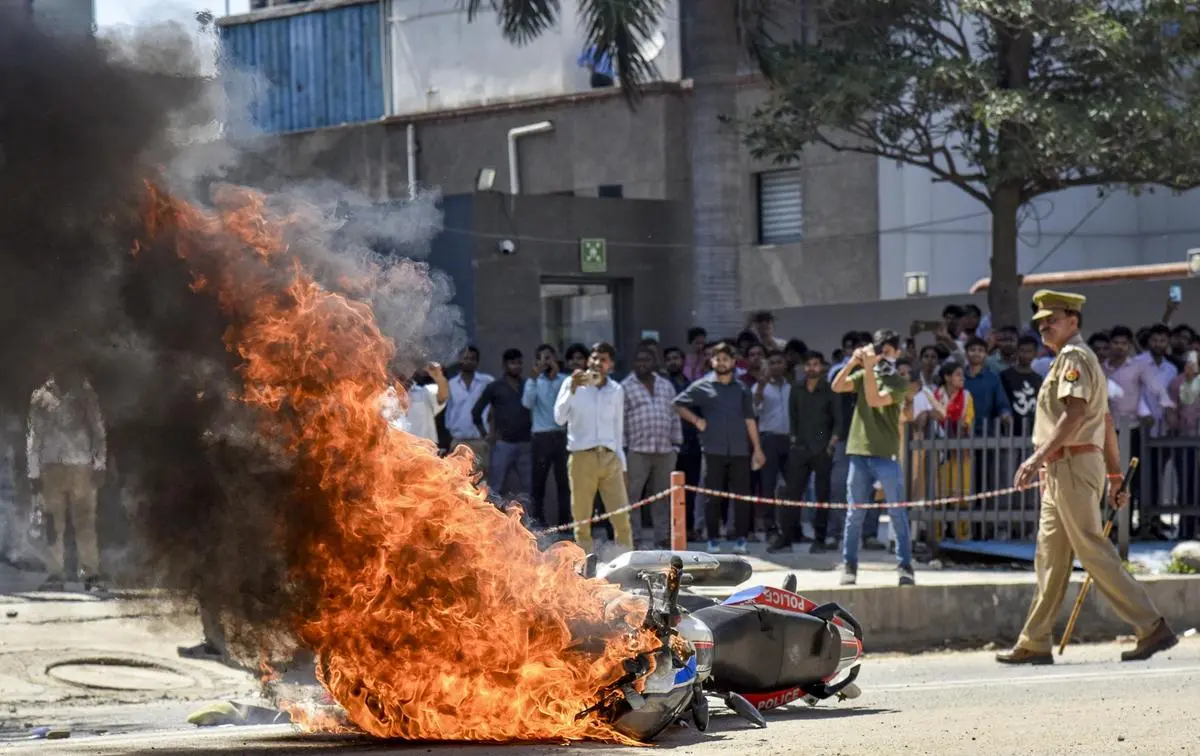
A police bike set on fire during a protest demanding wage hikes, in Noida on April 13, 2026. | Photo Credit: PTI
The Uttar Pradesh administration, meanwhile, swung into action. Rather than listening to the genuine demands, it cracked down on union leaders of major central unions and several ordinary activists. Several leaders of the Centre of Indian Trade Unions (CITU) were placed under house arrest from April 9. People like Gangeshwar Dutt Sharma, district secretary of the CITU, were put under a 13-day house arrest, which ended on April 20. Their phones were confiscated by the police, making it impossible for anyone to get in touch with them. Laptops were seized from other activists, including farmers’ leaders who had lent their support.
Thousands detained, including innocent bystanders
The administration went into overdrive. Police barricades were put up in several places to prevent free movement, particularly of delegations of political parties. A team led by the CPI(M) general secretary M.A. Baby was stopped and allowed to proceed only after it sat on the road demanding a meeting with higher officials. Several members of the CPI(M) and the CITU and smaller unions like the Mazdoor Bigul were detained in different district jails and their whereabouts were unknown. Their offices were sealed. Between April 13 and April 17, more than a thousand people, including innocent bystanders, were picked up—many just randomly—by the Noida Police and detained in jails across the district. They were picked up from residential areas, marketplaces, and workplaces. In a letter to Police Commissioner Laxmi Singh, Rajya Sabha MP John Brittas wrote that he had information of 350 juveniles and 800 adults detained at a single jail in Kasna. “The exercise of police powers must be firmly anchored in legality, proportionality and accountability,” he wrote. He also expressed concern at the curtailment of legitimate trade union activities protected under law.
The Uttar Pradesh administration, notorious for its crackdown on protests, was clearly leaving nothing to chance. Many women workers were lathicharged: even though the administration and police denied such incidents, there was video evidence circulated on social media that showed the police trying to disperse crowds and beating up women in the process. Just as during the historic farmers’ protest in 2020–21, rumours were circulated that opposition parties and a Pakistan connection were behind these spontaneous protests. Even police authorities had no qualms about peddling such theories.
A delegation of the All India Lawyers Union (AILU) visited the Kasna jail to provide legal assistance to the detainees. Despite their efforts, members of delegation could not get an official record of the total number of detainees. They spoke to around 100 detainees, and as per their accounts, there were two sets of detentions. First, on April 13 and April 14 when policemen, including officers in plain clothes, picked up many bystanders, including children returning from tuitions.
The second round of detentions was carried out between April 15 and April 17 when several workers, including women, were picked up from their workplaces. Domestic workers were also detained. The AILU delegation found that the families of those arrested had not been informed of their whereabouts. “The actions of the police and administration severely violate constitutional safeguards and settled law and guidelines of the Supreme Court regarding arrests,” the lawyers’ body noted.
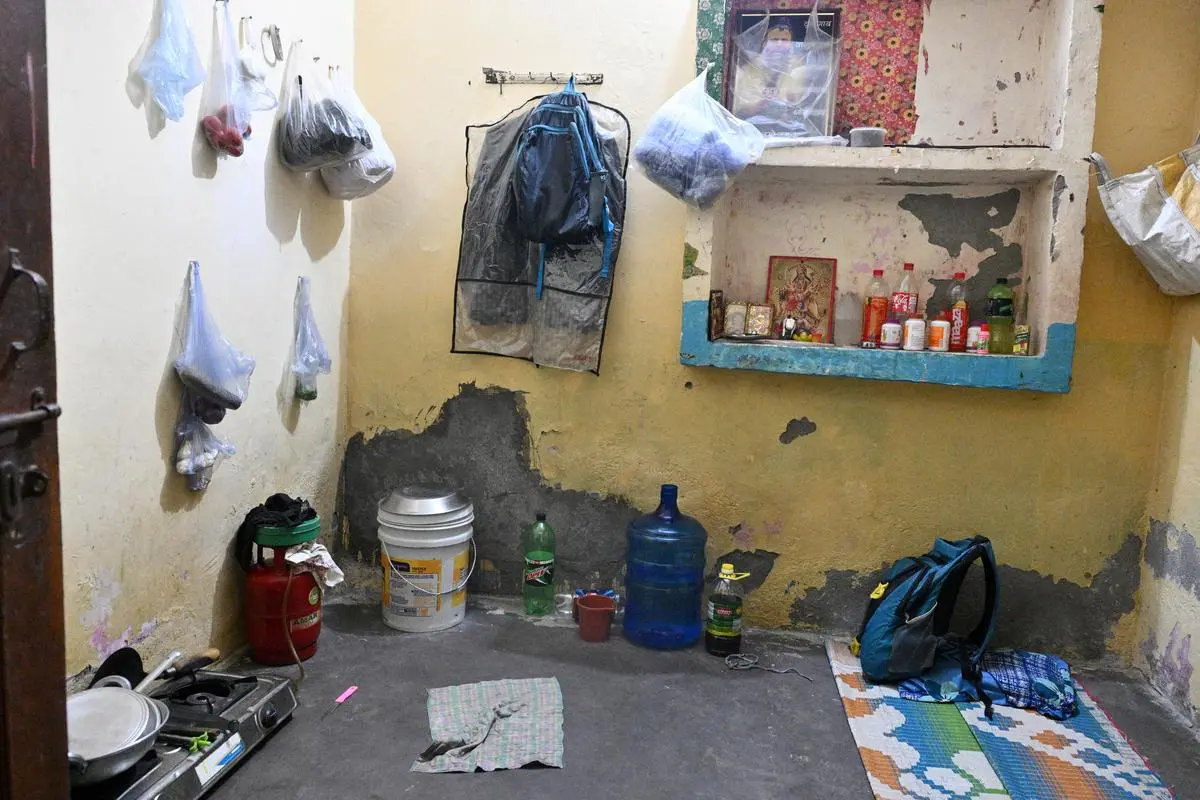
The rented room of a worker who was at the protest, in Nagla Charan Dass, Phase-2, Noida, on April 15, 2026. “We live in one-room hovels paying Rs.4,000-5,000. How are we to survive on wages of Rs.11,000?” asked one worker. | Photo Credit: Shashi Shekhar Kashyap
P.V. Aniyan, Delhi’s CITU general secretary, was picked up on April 17 at 10:30 am in front of the District Magistrate’s office. He and a few others were taken to the Dankaur Police Station on the route to Agra. He was released in the evening after the CPI(M) general secretary’s dharna demanding the release of all detainees, including party leaders.
“They asked us to open our phones and laptops. In my laptop, I had various memoranda, including one I had drafted and addressed to the Prime Minister. They finally released us in the evening. In Noida, all our district leadership is under the watch of the police. We called for an all-India protest on April 16 against the police repression. It was a success. Workers struck work. The movement is not going to die. The wages are so low,” Aniyan told Frontline.
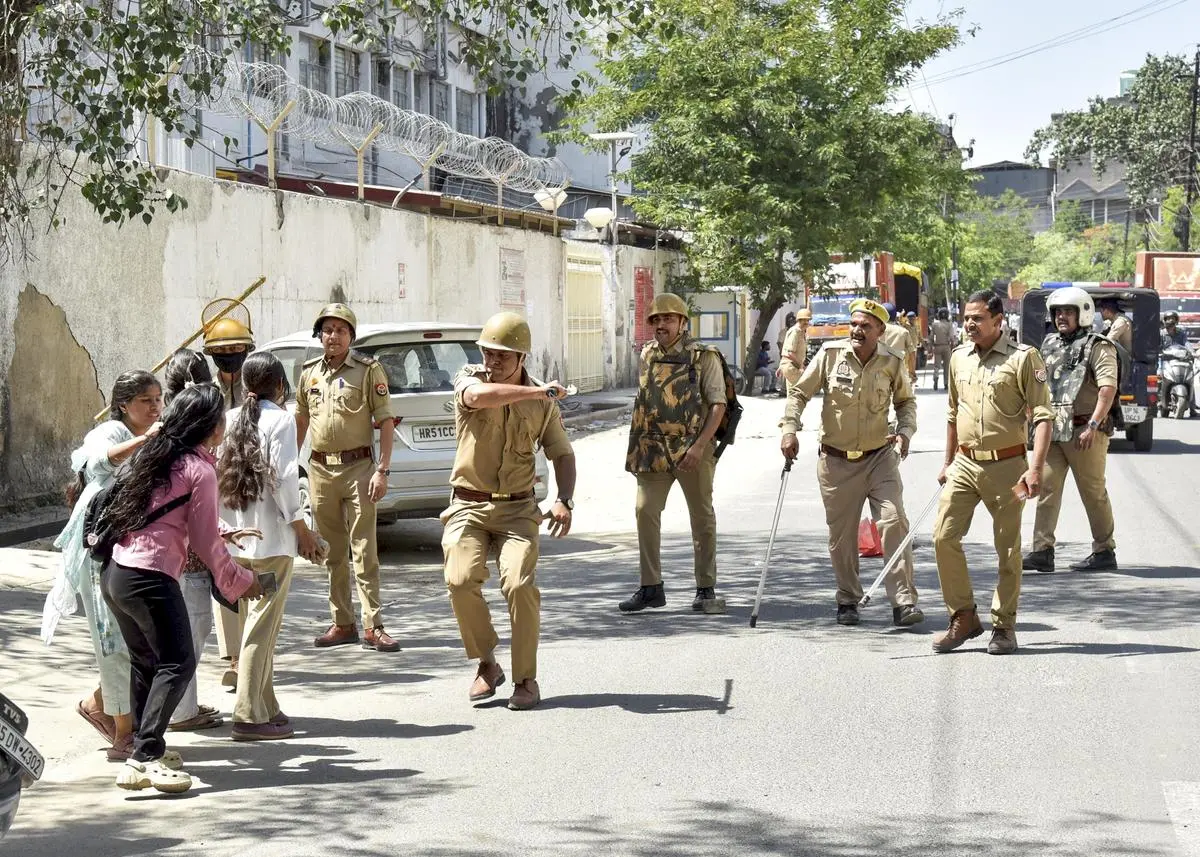
A confrontation between protesters and police personnel in Noida on April 13. | Photo Credit: PTI
The DA is supposed to be revised every six months, but Aniyan said that from 2014 onwards this had not been done at rates adjusted for inflation. The quantum of hike used to be 7 per cent but now it is close to 2 per cent only. “The majority of them are contract workers who are getting the minimum wages declared by the State, so they are very much part of the organised sector. There is an overhang of the unorganised sector too. There are factories with lots of women workers as well. There are some units with 11,000 workers. Their conditions—working and living—are below subsistence levels. But there is a palpable change now. Earlier, we used to approach workers telling them that the minimum wages are low; now the workers themselves tell us that the minimum wages are low. This kind of awareness has come,” Aniyan said.
As the protests escalated and detentions intensified, the RSS-affiliated Bharatiya Mazdoor Sangh (BMS) seemed to feel compelled to react. In a carefully drafted statement, it said the recent incidents of labour unrest in Manesar and Noida were a matter of serious concern. Disagreeing with the other central trade unions about a uniform wage structure, it said that “the idea of a uniform wage structure across the country is neither practical nor economically sustainable”.
The current unrest, it agreed, reflected the “genuine concerns of workers” wherein “issues such as wage disparities within similar industrial clusters, rising cost of living, excessive contractualization and lack of effective grievance redress mechanisms have contributed to dissatisfaction. Where these concerns are ignored or delayed, they inevitably manifest in unrest.”
It condemned irresponsible action on the part of the workers, referring to the stray incidents of violence, and called on industry to take corrective measures. Interestingly, it also called upon the government to strengthen tripartite mechanisms to resolve disputes before they could reach flashpoints.
The revised rates fall short of demands
Sensing that the anger of the workers was unlikely to abate despite the police repression, the Uttar Pradesh government constituted a high-powered committee on April 13 but without involving any central trade unions. It claimed that it had included workers’ representatives but did not share details. It notified revised wage rates on April 17, to be implemented retrospectively from April 1.
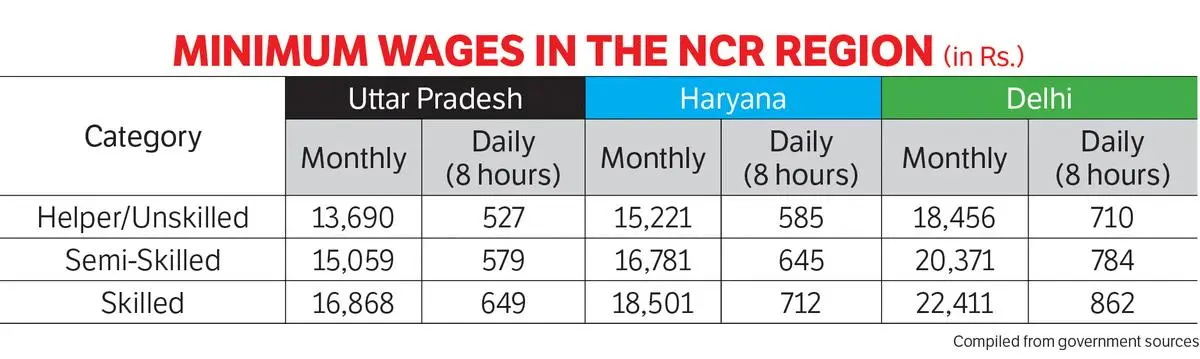
All cities in the State were clubbed into three categories, and wages were notified accordingly. The revised wages in Category 1 districts like Ghaziabad and GautamBuddha Nagar are Rs.13,690 for unskilled workers, Rs.15,059 for semi-skilled, and Rs.16,868 for skilled.
Artists, intellectuals back NCR workers, urge talks over police action
A group of artists, writers, and public intellectuals has stepped into the widening industrial unrest across Delhi NCR, backing a petition that asks governments in Uttar Pradesh, Haryana, and Delhi to treat the protests as a matter of labour rights rather than policing. Initiated by actor-publisher Sudhanva Deshpande, the statement has drawn more than 300 signatories, including T. M. Krishna, Naseeruddin Shah, Ratna Pathak Shah, Mallika Sarabhai, K. Satchidanandan, Githa Hariharan, Anand Patwardhan, M. K. Raina, and Neha Dixit. The protest, the petition says, is a constitutional right, and the state’s approach has drifted toward criminalisation, with reports of violence, denial of due process, and restrictions on access to legal aid and families. Deshpande, announcing the campaign on April 26, called it an attempt to redirect attention in a volatile media cycle that sidelines labour questions. The signatories call for the immediate release of those detained, and for a formal mechanism that would allow workers’ representatives to negotiate with authorities in a binding way.
In Category 2 districts, the rates are Rs.13,006 for unskilled workers, Rs.14,306 for semi-skilled, and Rs.16,025 for skilled. The wages in the Category 3 districts are even lower: Rs.12,356 for unskilled workers, Rs.13,590 for semi-skilled, and Rs.15,224 for skilled. There is a further distinct difference between the wages in Haryana, Delhi, and Noida. The revised rates fall far short of the demand for wage parity in the industrial areas of the NCR comprising parts of Haryana and Rajasthan. Trade unions like the CITU rejected the wage notification on the grounds that it was unscientific.
It said that the so-called high-powered committee did not consult any representatives of the workers who had protested against low wage rates and poor working conditions and had demanded overtime rates. Under Section 7 of the Minimum Wages Act, 1948, it is mandatory to constitute a tripartite “state minimum wage consultation board”, and Section 5(1) of the Act requires a special tripartite committee to be constituted, listing all 87 employment categories entitled to similar wages. Uttar Pradesh CITU leaders maintained that the BJP government had failed to constitute the “state minimum wage consultation board”. Besides, it is mandatory by law to revise minimum wages every five years.
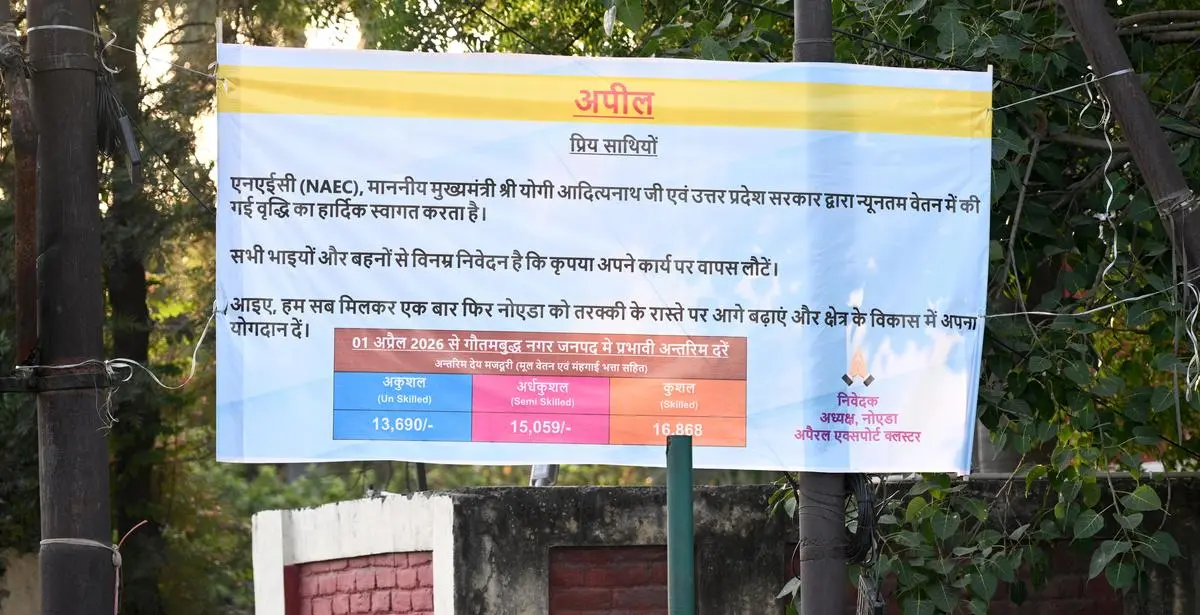
A banner installed by the Noida Apparel Export Cluster (NAEC) in Nagla Charan Dass, Phase-2, Noida, on April 15, 2026, notes the revised wages. It reads: “The NAEC welcomes the increase in minimum wage by Chief Minister Adityanath and the government of Uttar Pradesh. We humbly request all brothers and sisters to return to work. Let us once again take Noida forward on the path of progress and contribute to the development of the region.” | Photo Credit: Shashi Shekhar Kashyap
Resentment among the industrial working class started brewing from February although it reached a flashpoint only in April. On February 12, all central trade unions barring the BMS called for a nationwide strike against the Labour Codes, the privatisation of the public sector, and other issues. It was successful in several States and partially successful in others. Workers in the industrial areas of the NCR too participated. One of the main demands was that minimum wages be increased to Rs.26,000; this has been a consistent demand of trade unions for quite some time.
A trade union leader told Frontline that a rumour was spread, most probably by government agencies, that minimum wages would be revised to between Rs.20,000 and Rs.30,000 once the Labour Codes are implemented. The Central government also made big declarations through advertisements as to how life would improve for workers under the Labour Codes. The codes came into effect from April 1. Nothing has changed in material terms for the industrial workforce. The protests first started at a refinery in Barauni district, Bihar, in the first week of February.
The demands were basic: higher minimum wages, better working conditions, and social security. When the demands were not met, the workers followed up with protests in April. Meanwhile, in February, contract workers from Larsen and Toubro at the ArcelorMittal Nippon Steel plant in Hazira, Surat, went on protest on similar demands. The protests led to police action. On February 23, far from Surat, thousands of contract workers at the Indian Oil Corporation Ltd (IOCL) refinery in Panipat, Haryana, staged protests demanding better safety measures, timely wage payments, better working conditions, and an eight-hour working day. While the number of workers on the IOCL payroll was 1,000, there were 30,000 on contract. As in Noida, there was police repression against the protests.
In the first week of April, labour unrest also erupted in parts of the industrial township of Manesar, Haryana. Here, contractual workers in garment and automotive firms demanded the implementation of the new wage rates announced by the State government. Around 55 workers, including 20 women, were arrested. The administration accused two unions—the Inquilabi Mazdoor Union and the Automobile Industrial Contract Workers’ Union—of instigating clashes between workers and the police. The State units of central unions like the CITU and the All India Central Council of Trade Unions condemned the arrests and the police action.
The worker’s protests that erupted in February and April should not be viewed as isolated incidents. They are outward expressions of deep working-class resentment against an economic system that has prioritised profit over equity. The actual producers of value are now demanding their due.
Also Read | Pushing workers to the edge
Also Read | On the endemic contradictions in India’s path to modernisation of agriculture