








Days before the 2016 Assembly election in West Bengal, the ruling All India Trinamool Congress found itself in troubled waters. Having already been battered by the multi-crore Saradha scam, the Trinamool was dealt another blow when a sting operation by Narada News, aired just three weeks before the election, showed several of its top leaders, including Ministers and MPs, accepting cash on camera.
In a desperate move, Chief Minister Mamata Banerjee exhorted the electorate to vote as though she herself was contesting in all 294 seats in the State. And it worked. The Trinamool returned to power with a huge majority of 211 seats against a combined force of the Left and the Congress. It was as much a vote for her as it was a vote against the CPI(M), which ruled the State from 1977 until 2011.
Ten years later, with her party facing a severe anti-incumbency sentiment and reeling under allegations of rampant corruption, misrule, and nepotism, Mamata once again implored the electorate to vote as if she herself was contesting in every seat. This time, the mandate went overwhelmingly against her as her party fell to the BJP after three consecutive terms in power, and she lost from her own constituency of Bhabanipur.
The rejection was emphatic. With just 80 seats going to the Trinamool, it was not even a close contest, as most people had expected it to be. “People did not vote for us, that is why we lost,” said the losing Trinamool candidate from Purbasthali Uttar, Vasundhara Goswami.
For Mamata, one of the biggest mass leaders in Bengal’s political history, it was a moment of reckoning. After trouncing her opponents in each and every election since 2009, her apparent invincibility finally shattered in the face of a huge groundswell of public resentment, the extent of which neither she nor her party leadership could fully gauge.
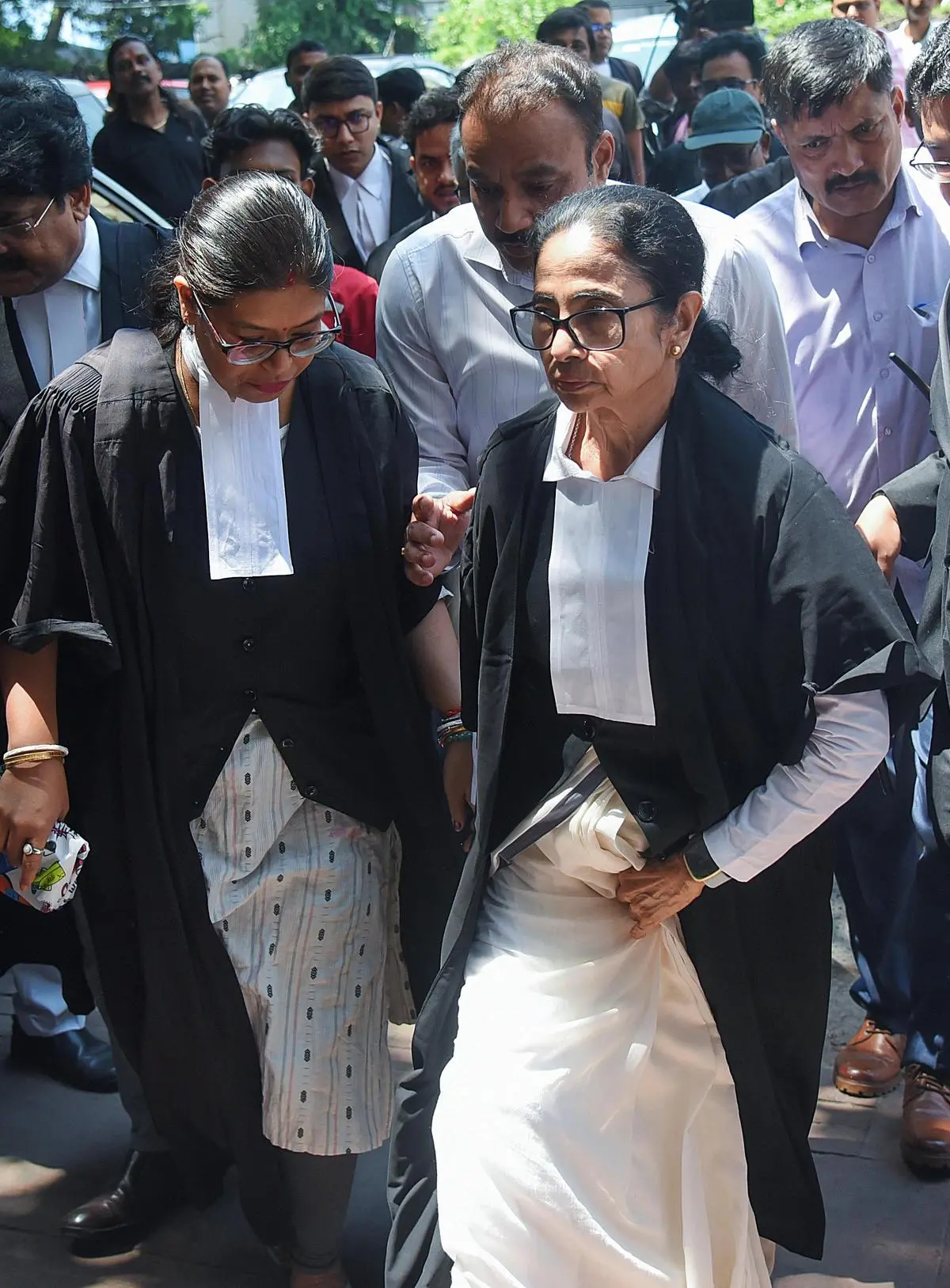
Mamata Banerjee arrives at the Calcutta High Court to argue her case on post-poll violence, in Kolkata on May 14, 2026. | Photo Credit: Saikat Paul/ANI
The dramatic reversal of her political fortunes and the sharp dip in her own popularity and credibility have raised questions about Mamata’s future in politics. Not only was the Trinamool unable to hold on to any of its strongholds in south Bengal and Kolkata, it also lost a sizeable chunk of its most committed voters among women and Muslims, leaving the party without any captive support base any more.
Mamata—who had never shied away from playing the communal card ever since she came to power in 2011—had for a long time been assured of the support of Muslims, who account for more than 30 per cent of the population of the State. This support was further consolidated with the rise of the BJP in 2019, and by holding on to a sizeable section of the Hindu votes through her numerous welfare schemes, Mamata enjoyed a clear edge over the saffron party. The 2026 election results seem to show that Mamata no longer enjoys a monopoly over the Muslim votes, and a large section of her Hindu voters, too, abandoned her.
Pointing out that it will be difficult for her to turn things around in the immediate future, the psephologist and academic Biswanath Chakraborty told Frontline: “The Hindu vote polarisation will pose a serious problem for Mamata Banerjee. Of the 80 Trinamool candidates that have won, more than 70 are from Muslim-dominated areas, and when she embarks on her political campaigns with them, Trinamool may be tagged a pro-Muslim party like the Samajwadi Party or the Rashtriya Janata Dal. This may facilitate greater Hindu polarisation in favour of the BJP.”
Not bound by party loyalty or ideology
Moreover, one of the most oft-repeated political prophesies of Bengal has been that if the Trinamool should ever lose, the entire party would disintegrate. Time and again, it has been seen that a large section of Trinamool workers and leaders are not bound to the party by ties of either loyalty or ideology. This was most evident during the 2021 Assembly election when, faced with the possibility of defeat, many high-profile leaders defected to the BJP just ahead of the election, and then, following the BJP’s defeat, returned one by one to the Trinamool.
This time, too, almost immediately after the results were declared, some of the most prominent faces of the Trinamool turned upon their own party and its top leaders—Mamata and her nephew and heir apparent, Abhishek Banerjee—with unexpected viciousness. Kohinoor Mazumdar, Trinamool spokesperson and vice president of the Trinamool Chhatra Parishad (the student wing of the party), alleged that in many cases Trinamool workers themselves destroyed their party offices in an attempt to facilitate their entry into the BJP. “Who destroyed the party offices? Does the BJP have enough workers to do that? Those who were Trinamool activists in the afternoon, trashed the party offices to prove themselves to be BJP supporters,” said Mazumdar.
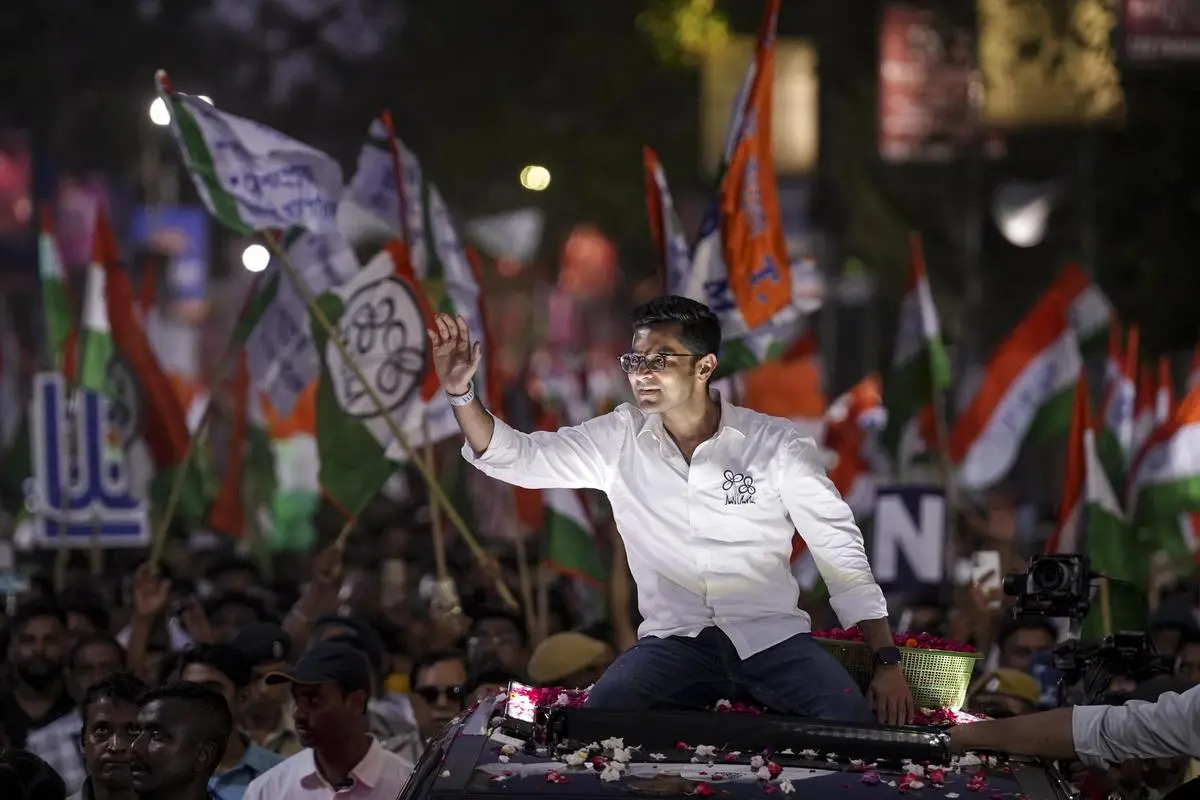
Trinamool leader Abhishek Banerjee during a roadshow ahead of the Assembly election, in Howrah district, on April 25, 2026. | Photo Credit: PTI
Riju Dutta, national spokesperson of the party, known to have been be close to Abhishek until recently, even thanked the BJP for protecting him and his family after the election and alleged that his own party and his boss, Abhishek, were indifferent to his situation after the results were declared. “I was like Abhishek’s mongrel.... But my erstwhile master is such a big leader that even after being his mongrel for the past 13 years, he did not once enquire how me and my family were holding out. But I was suspended from the party [for 6 years] for thanking the BJP for ensuring no harm came to my family,” said Dutta. Even among the party’s grassroots workers and foot soldiers, there were signs of panic-driven desertions—either from the party itself or from their neighbourhoods—amid fears of retaliatory action.
Most members within the Trinamool have been blaming Abhishek for the defeat while also holding Mamata responsible for deferring to his decisions all the time. “The situation was different when Mamata was directly involved in the party affairs. The moment she left it to Abhishek, and he placed the reins in the hands of I-PAC [the political consultancy firm that has been working with the Trinamool since 2019], the situation went out of control,” said a Trinamool source.
According to sources, Mamata’s control over her own party was curtailed as Abhishek began to run its affairs in a corporate style. However, for all the power that Abhishek enjoyed within the party, he had neither any mass support nor much credibility due to the many allegations of corruption levelled against him.
According to the veteran political analyst Biswajit Bhattacharya, the situation looks bleak for Mamata now. “Once a party loses, it tends to disintegrate. Mamata’s main challenge now is the 2029 Lok Sabha [election]. But at 71 years, and with no strong political successor, it will be very difficult for her to revive the party,” said Bhattacharya. He pointed out that in Bengal’s political tradition, the electorate allows a party a long period in power, but when it decides to throw the party out, it is not easily given a chance to return.
“The Congress went out of power in 1977 and could not come back; the Left Front lost in 2011 and is yet to recover.... Mamata’s organisation stands out for the lure of financial benefits and a strong system of beneficiaries, rather than any ideology. And today, she does not have the power to create beneficiaries any more,” said Bhattacharya.
Scams and scandals overshadowed the good that Mamata’s govt did
The evil that defeats politicians does live after them; the good is oft interred with their bones. It is not that Mamata’s rule was all bad. Her welfare schemes helped ameliorate poverty-driven distress; encouraged girls to remain in schools; and relief was disbursed irrespective of party allegiance. But the rampant corruption in every strata of social activity, the misrule, the repeated crimes against women, the unchecked violence during and after elections, the culture of threat and menace through syndicates controlled by party bigwigs, the extortion, the land-grabbing, the rise of communal polarisation due to her perceived brand of appeasement politics, and the overall lack of development and industrial growth overshadowed whatever good her government did.
However, even if the party was tainted with scams and scandals, Mamata’s own image remained largely clean, until the brutal rape and murder of an on-duty doctor at the State-run R.G. Kar Medical College and Hospital in 2024. The government was seen as trying to “cover up” the crime, and for the first time, aspersions were cast not just on the ruling party but also on Mamata herself. “Mamata’s rule was seen as a symbol of corruption, lawlessness, and nepotism. It will be very difficult for her to launch an agitation on the issue of democracy and misrule, given her own track record,” said Biswanath.
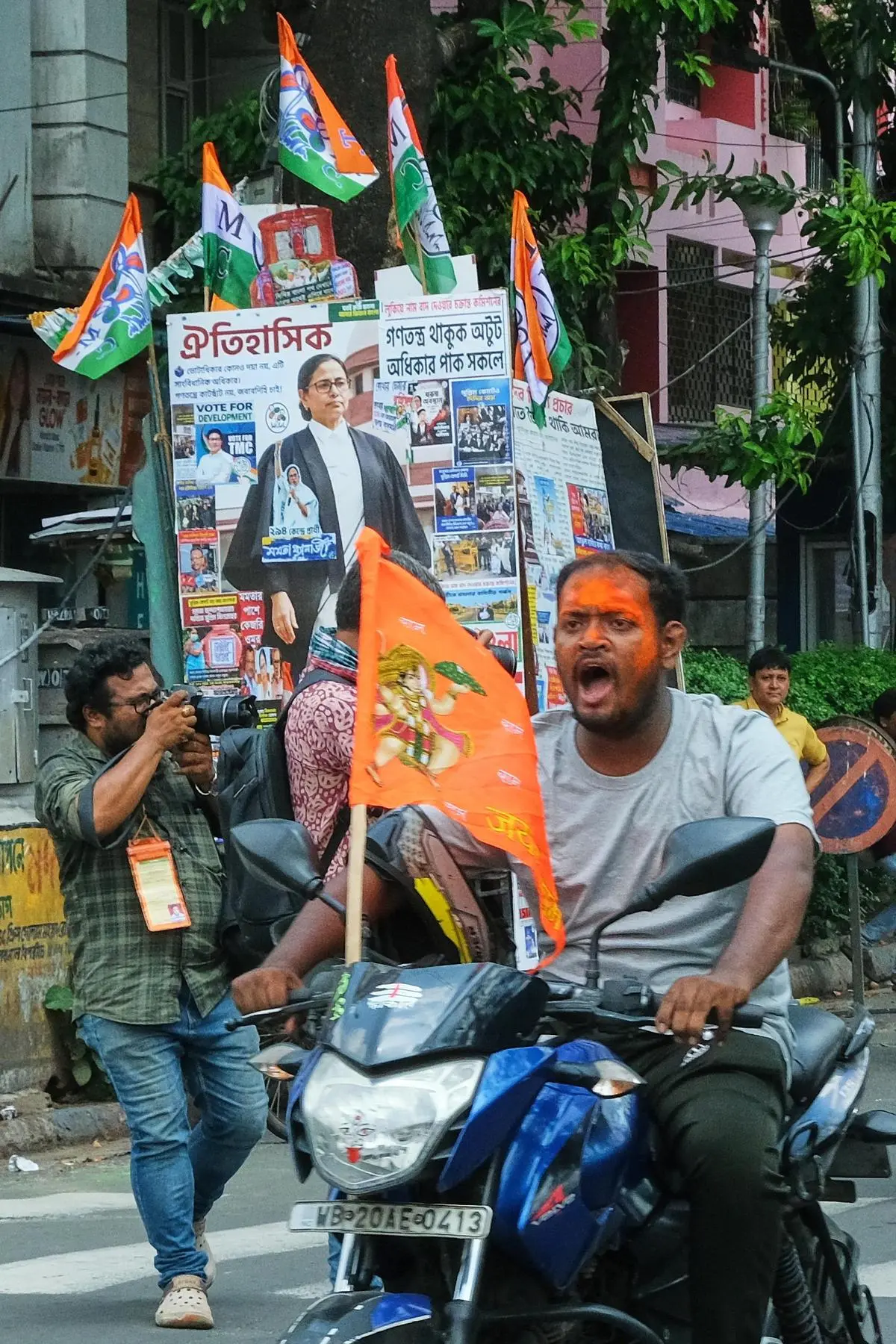
A BJP supporter celebrating the party's early lead in the election, in Kolkata on May 4, 2026. | Photo Credit: Ananya Das/AP
Mamata found that out for herself when, donning a lawyer’s cloak, she moved the High Court on the issue of post-election violence and was heckled inside the premises. Moreover, with Trinamool leaders, including a former Minister, being arrested on corruption and intimidation charges, and the new government wasting no time in bringing to the fore the financial irregularities of the previous regime, Mamata has very little to fight the BJP with at the moment.
However, although subdued after defeat, Mamata remains defiant. She has maintained that she did not lose and that the BJP “looted 100 seats” through unfair means, including the Special Intensive Revision of the electoral rolls (in which 27 lakh voters’ names were deleted due to the controversial “Logical Discrepancy” clause). Several independent investigations are alleging other discrepancies: the unusually high speed of voting during certain hours and the last-minute ejection of Trinamool workers from counting rooms where their candidate was leading and the result then showing that they lost.
Mamata, in fact, refused to submit her resignation as Chief Minister, as per electoral tradition. On the very day that the new BJP government was being sworn in (May 9), Mamata called for the establishment of a united front against the BJP. “Even if you mention Leftist, I have no problem. I want to [make this] move with everyone,” said Mamata.
But Mamata’s history of tactical tergiversations have made others wary. CPI(M) Central Committee member Sujan Chakraborty told Frontline: “The Left has always maintained that it will have no truck with communal and corrupt forces. Does she have any credibility any more? Did she not once say that BJP was her natural ally?”
The Congress, according to sources, has not totally ruled out the possibility of a future tie-up. “It will depend on the graciousness of our leader, Rahul Gandhi. Our vote share is at present at 3 per cent, and we will obviously try and see what we can hope to gain from the present situation,” said a senior Congress source.
As of now, the prospects do not look too bright for the mercurial Mamata. But time and again, she has proved everybody wrong and returned from the brink of political oblivion.
And, as Bhattacharya pointed out, Mamata’s situation also impacts national politics. “Two of the biggest pillars against the saffron juggernaut—M.K. Stalin and Mamata Banerjee—have fallen. There may now be no check on the BJP’s overrunning attitude in Parliament and outside, not at least for a while.”
Also Read | Deconstructing the Bengal ‘miracle’
Also Read | Managed democracy, made in Bengal