


It was a cold December night in 1939. A remote hamlet called Parapram in Kannur’s Pinarayi village was making its tryst with history. A group of Malabar’s Congress Socialist Party (CSP) leaders gathered secretly at the local Vivekananda Vayanasala. The venue was chosen to evade British surveillance. Surrounded on three sides by the Ancharakandi river and lacking motorable roads, Parapram offered natural protection.
Inside the modest library, the entire CSP leadership transformed itself into the first unit of the Communist Party of India (CPI) in the region that would later become Kerala. Among those present were E.M.S. Namboodiripad, A.K. Gopalan, P. Krishna Pillai, and around 40 other comrades who would shape Kerala’s politics and society.
Kerala’s communist movement emerged more than a decade after the party’s birth in India. Yet the Malayali comrades created history in 1957 by becoming the first communists in the country—and among the earliest in the world—to come to power through democratic elections. The rise of the red flag in Kerala stunned the whole world. The State was even compared to Yan’an, cradle of the Chinese Revolution.
At the height of the Cold War, Kerala’s communist experiment alarmed anti-communist forces globally. The CIA’s controversial role in the agitation against Kerala’s first communist government, dismissed in 1959 by the Congress government led by the then Prime Minister, Jawaharlal Nehru, has since been widely documented.
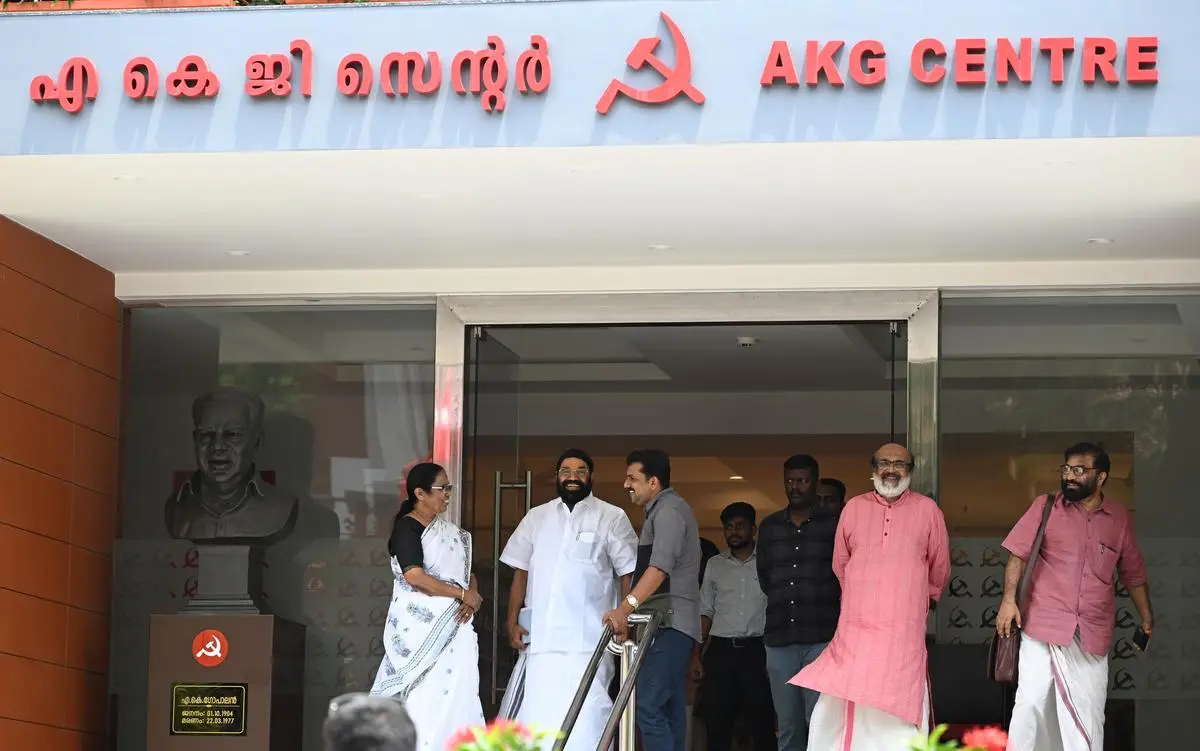
Senior CPI(M) leaders K.K. Shailaja, Thomas Isaac, and V.N. Vasavan and others outside AKG centre after a party secretariat meeting, in Thiruvananthapuram on May 12. | Photo Credit: Nirmal Harindran
Later, West Bengal and Tripura followed Kerala in electing communist governments and even provided them longer uninterrupted tenures. Yet after the Left collapsed everywhere else, Kerala alone remained its enduring bastion. Following the CPI(M)-led Left Democratic Front’s (LDF) victory in 2016, The Washington Post described Kerala as one of the few places on earth “where a communist can still dream”. The LDF returned to power again in 2021 for an unprecedented second consecutive term.
Today, however, that dream appears deeply shaken. The 2026 Assembly election may rank among the gravest setbacks suffered by Kerala’s Left. For the first time, the LDF’s vote share slipped below 40 per cent. CPI(M) candidates lost in strongholds once considered impregnable, including seats where the party had survived even during earlier electoral routs.
The significance of the defeat extends beyond Kerala. It coincides with the centenary of India’s communist movement. For the first time in five decades, no major Left party governs any State in the country.
Why did this happen? Kerala’s familiar anti-incumbency instinct, temporarily suspended in 2021, returned with force. Yet the scale of voter fatigue cannot be explained merely by governance failures. The two governments led by Pinarayi Vijayan maintained relatively high growth rates and per capita income despite floods, the pandemic, and a hostile Central government. Corruption levels, too, remained comparatively restrained.
Unlike the later Left Front years in West Bengal under Buddhadeb Bhattacharjee, criticised for embracing a strongly neoliberal path, the Vijayan government attempted a model combining infrastructure growth with welfare spending and public sector support.
The deeper political damage lay elsewhere. The CPI(M)’s attempts to retain its eroding Hindu support alienated minorities without significantly consolidating Hindu votes. The most controversial aspect of this strategy was Vijayan’s public closeness to Vellappally Natesan, leader of the SNDP Yogam, an influential Ezhava organisation that has historically formed the backbone of the Left.
Natesan was widely perceived as stridently anti-Muslim because of his repeated attacks on the Muslim League. Yet Vijayan repeatedly defended him, earning for himself the image of one practising “soft Hindutva”. Natesan openly admired both Vijayan and Prime Minister Narendra Modi. His son, Tushar Vellappally, heads the Bharath Dharma Jana Sena, a constituent of the BJP-led National Democratic Alliance (NDA).
The LDF also made overtures to the Nair Service Society (NSS), the traditionally anti-Left Nair organisation. These moves were meant to halt the BJP’s gradual erosion of the CPI(M)’s Hindu vote base. Instead, they produced a double whammy: minorities drifted decisively towards the Congress-led United Democratic Front (UDF) while Hindu consolidation behind the Left remained limited.
Exit poll data suggested dramatic swings among Muslim and Christian voters in favour of the UDF, while the LDF gained only marginally among dominant Hindu communities except the Scheduled Castes. The party thus lost its carefully cultivated image as Kerala’s secular anchor without securing a compensatory Hindu consolidation. Another major factor was the growing perception of arrogance and extravagance among the leadership. Vijayan’s long official motorcades, his brusque comments even against party workers, and the increasingly combative political culture around the government deepened public resentment.
At the core of the debacle, however, lies the near eclipse of internal democracy within the Kerala CPI(M). Vijayan’s rise transformed the party. As State secretary for 17 years and Chief Minister for a decade, he stamped out factionalism and centralised authority to an unprecedented degree. His methods not only made him an effective crisis manager and administrator but also narrowed the space for dissent and insulated the leadership from ground realities.
Even the CPI(M) Polit Bureau increasingly appeared dependent on Vijayan as the sentinel of the country’s last surviving red bastion. While all other CPI(M) Ministers in the 2016 Cabinet were denied tickets in 2021, Vijayan alone was exempted from the party’s age bar of 75 and returned as Chief Minister.
The unprecedented second consecutive term appears to have convinced the LDF that the mandate was an unrestricted licence. It failed to recognise that the 2021 verdict was shaped by the extraordinary circumstances of the COVID-19 pandemic, when voters rallied behind governments seen as decisive and stable.
The first indication came when Vijayan dropped all CPI(M) Ministers, except himself, from his previous Cabinet, including K.K. Shailaja, who had earned acclaim for her handling of the pandemic.
Political lapses
Several decisions of his second term thereafter appeared striking not merely for their rigidity but also for their political misjudgement. Foremost among these was the stubborn push for the hugely expensive and environmentally contentious semi-high-speed rail project, accompanied by suppression of protests by residents resisting the acquisition of their land. (On May 20, 2026, the new Kerala government decided to scrap the project. Chief Minister V.D. Satheesan said that all the land acquired for the project would be denotified.)
Equally damaging was the government’s refusal to engage with Accredited Social Health Activists (ASHA) workers—poorly paid grassroots health volunteers—who staged a prolonged agitation demanding higher honorariums.
For many traditional Left sympathisers, these episodes became symbolic of a government growing increasingly insensitive. Critics began invoking the Nandigram and Singur incidents, the twin controversies that fatally damaged the Left Front government in West Bengal. Many pointed out that while it had taken Bengal’s Left 34 uninterrupted years in office to accumulate such resentment, Kerala’s Left had managed to do so within a decade.
So much so that even prominent Left sympathisers such as the poet K. Satchidanandan, who headed the government-appointed Kerala Sahitya Akademi, openly called for the LDF’s defeat, arguing that only an electoral setback could cleanse the movement of distortions accumulated during its long years in power.
History offers many examples of how excessive centralisation gradually produces leader-centric systems incapable of self-correction. Feedback loops weaken as subordinates fear conveying uncomfortable truths. The result is policy misjudgment, and a growing disconnect from reality.
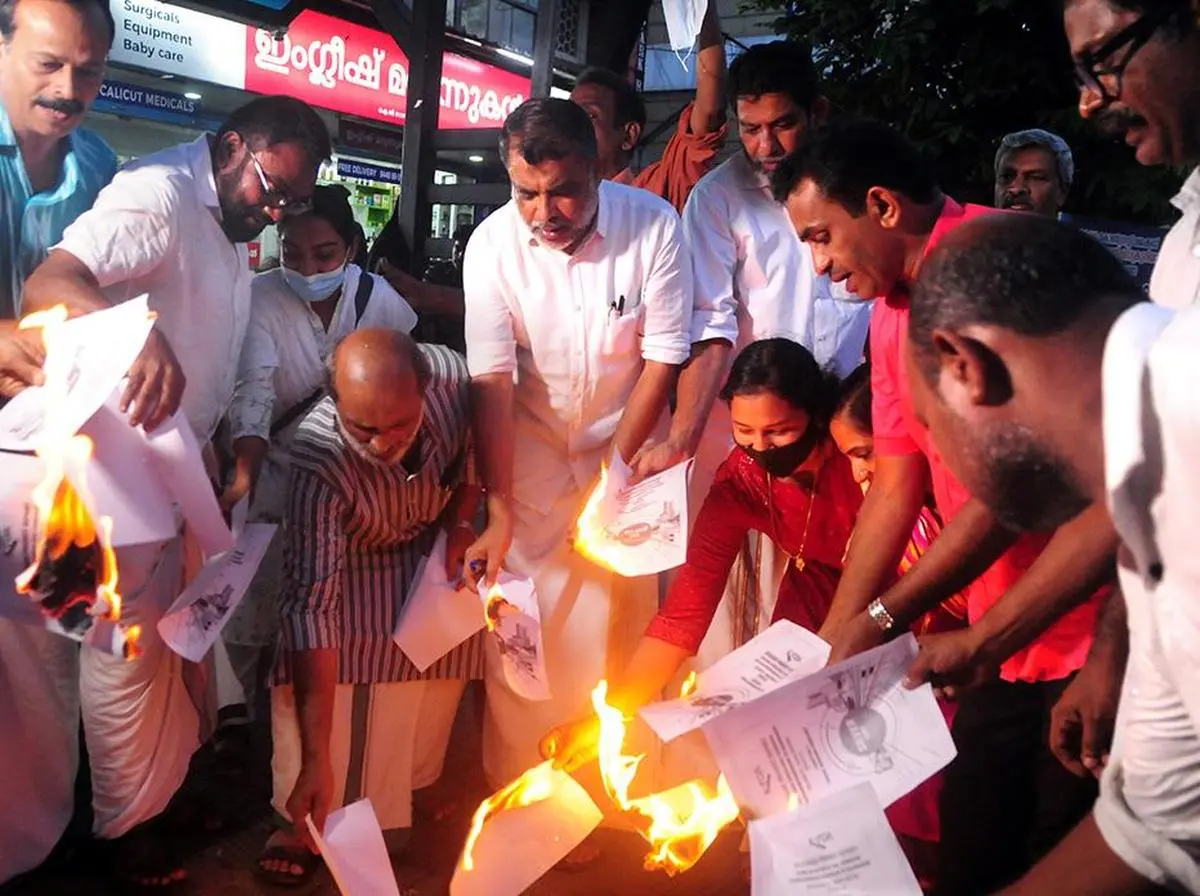
Activists staging a protest against Silver Line by burning a copy of the Detailed Project Report of the rail project, in Kozhikode in July 2022. | Photo Credit: K. Ragesh
Leon Trotsky, the Bolshevik revolutionary turned critic of Joseph Stalin, described this process as “substitutionism”: the party organisation substitutes itself for the membership, the Central Committee substitutes itself for the organisation, and finally one leader substitutes himself for the Central Committee. Internal dissent is delegitimised as factionalism while loyalty increasingly replaces competence.
As Hannah Arendt observed, authoritarian systems often end up rewarding mediocrity because unquestioning loyalty becomes more valuable than intelligence or creativity. Although it would be unfair to draw direct parallels between a communist party functioning for decades within a vibrant democracy like India and authoritarian systems elsewhere, there are nevertheless cautionary lessons worth noting—not only for communist parties but for all political formations, many of which have not been immune to authoritarian temptations.
The road ahead
The decline of Kerala’s Left does not necessarily mean the end of the movement. The social foundations that once sustained it—struggles for equality, welfare, secularism, and social justice—remain deeply relevant in Kerala. But the 2026 verdict suggests that a movement born in secrecy at a tiny riverside library in Pinarayi can no longer survive merely on the memory of its glorious past. Without internal democracy, ideological clarity, and the capacity for self-renewal, even the strongest political fortresses eventually crumble.
Yet the first signals from the CPI(M) after the historic rout are anything but reassuring. While the Congress high command eventually chose the younger and more popular V.D. Satheesan (62) as Chief Minister, the CPI(M) once again fell back on Vijayan (81) as Leader of the Opposition despite his age, health concerns, and the scale of the debacle.
Nevertheless, it is difficult to miss a faint silver lining amid the dark clouds. According to reports, 7 of the 18 members of the Polit Bureau opposed the State secretariat’s recommendation to select Vijayan as the opposition leader. In the district committee meetings, both Vijayan and State secretary M.V. Govindan were heavily slammed for the debacle, with comrades demanding answers.
Blaming a few individuals alone for such cataclysmic setbacks risks overlooking the deeper and more complex processes that produced them.
Yet holding leaders accountable is often the necessary starting point for any serious course correction. Whether the present dissent marks the beginning of genuine introspection and renewal or is merely another murmur before the old order reasserts itself may determine the future of the Left in the land where it once made history.
M.G. Radhakrishnan, a senior journalist based in Thiruvananthapuram, has worked with various print and electronic media organisations.
Also Read | Finally, Kerala brings good news for Congress
Also Read | Do voters reward government performance?