






For a decade now, April has been commemorated as Dalit History Month. Inspired by Black History Month in the US, it marks the birth anniversaries of revolutionaries such as B.R. Ambedkar and Jyotirao Phule. While it recognises the contributions made by them and countless others to secure women’s and Dalit’s rights in India, it also brings to the fore the setbacks suffered in the exercise of these fundamental rights.
These ongoing challenges are evident in recent reports of women in intercaste unions in Gujarat enduring violence and a public backlash, revealing the disturbing forms that caste endogamy takes in practice and the systemic overhaul it calls for. One such case is that of Kinjal Rabari—a well-known Gujarati folk singer based in Radhanpur in Gujarat’s Patan district, cherished by her fans as “Koyal Kanti” (koel-voiced)—who found herself at the centre of public scrutiny following her intercaste marriage to Ashok Chaudhary, which she announced on social media. Her decision defied familial and community expectations, escalating tensions between the Rabari and Chaudhary communities, and she began receiving online threats of abduction and murder. In a video on social media, she appeared distraught as she appealed to Harsh Sanghvi, Gujarat’s Home Minister, for protection and indicated her intent to seek legal recourse.
Meanwhile, a meeting between leaders of the Rabari and Chaudhary communities resolved that Kinjal was to be “returned” to her natal family. She was sent back. Kinjal deleted all her previous social media posts and released another video stating she had “lost her way” and was now happily reunited with her family.
Her return was not impulsive; it was the result of an orchestrated and sustained effort by her community. Reports indicated that the Rabari community issued a 24-hour ultimatum, with its leaders stating they would “know what to do” if she did not return.
Going by a social media post, the community called for a mobilisation of its youth to trace her whereabouts. A message read: “This woman is a well-known artiste of the Rabari community, but she has done things that have brought the community shame. Today, on 10/03/2026, she has absconded with a boy from another community. According to our information, this woman has gone to Abu (Rajasthan). All brothers are requested to help us find her. This message is for all the Rabari brothers living in Abu (Rajasthan). Please help us reach the truth. They have tarnished the name of [our] society. The photo below is of the boy she ran away with....”
Near-total impunity of community leaders
Kinjal’s case is part of a sustained and age-old assault on women’s autonomy, perpetrated by self-declared community leaders who operate with near-total impunity. The reactions of the Chaudhary community leaders to the notice asking for Kinjal’s coerced return to her natal family equally elucidate this. Following her return, Ashok Chaudhary’s family released a video appeal in which they said that in exchange for them having “returned” Kinjal with “full respect”, the Rabari community should now facilitate the “return” of another woman, Kanku Chaudhary.
Kanku left her home in 2024 to marry Mahadev Rabari. The couple lived largely unaffected by their communities and even welcomed a son, now a year old. But this appeal from Ashok Chaudhary’s family reignited tensions. Kanku appealed to community leaders in a video to not break up her family and leave her child without parents. Yet, a large Chaudhary gathering was convened after which members of the community gathered in huge numbers at Kanku’s village with the intent of forcibly bringing her back.
A rapid escalation followed as clashes broke out between the two communities and an agitated mob of an estimated 1,000 people began pelting stones, vandalising over two dozen vehicles, and blocking a national highway for nearly three hours. Authorities registered an FIR against 16 people and apprehended around 60 individuals.
These episodes may well resemble the script of a film in which the site of caste violence transforms into a police camp: violence that the administration and law enforcement, however, always fail to pre-empt.
In another incident, the popular folk singer Aarti Sangani faced a backlash after she married Devang Gohel, a musician from a “lower” caste. The couple claimed that they suffered financial losses after many of their professional engagements were deliberately cancelled.
In 2025, a more gruesome case was recorded. Chandrika Chaudhary, an 18-year-old woman from Banaskantha district—who had cleared NEET (National Eligibility cum Entrance Test, the entrance exam for undergraduate medical courses)—was killed by her father, allegedly with the assistance of her uncles, in what appeared to have been an “honour” killing over her intercaste relationship.
She had fled with her partner, Haresh, in May that year, prompting her relatives—alongside the local police—to track them down in Rajasthan on June 12. Haresh was arrested, while Chandrika was taken back to her natal home. On June 17, her final Instagram message to Haresh conveyed her desperation: “Come and take me away, otherwise my family will get me married against my will. If I refuse, they will kill me. Save me.”
Her partner filed a habeas corpus petition before the Gujarat High Court. However, on the date scheduled for her appearance, the court was informed that she had died of natural causes. Meanwhile, among their community, her family claimed that she had died by suicide, and in an apparent attempt to avert scrutiny, they cremated her swiftly. However, according to the charge sheet pertaining to the case, she appears to have been first sedated and then strangled to death. The document noted that the family had insisted that she marry under the community’s reciprocal endogamous system.
Speaking to Frontline, Jharna Pathak, assistant professor at Gujarat Institute of Development Research and secretary of the Ahmedabad Women’s Action Group, noted that the practice of nullifying marriages is deeply entrenched in Gujarat, particularly in north Gujarat. The region, she observed, is extremely conservative: “Even a cursory look at social indicators—be it literacy rates, child mortality, or female foeticide—reveals the extent of backwardness in the area. Caste control, especially in north Gujarat, remains profoundly entrenched.”
Women exchanged in marriages
Pathak cited the example of Sata Pratha: a regressive custom common among communities in the region where women are exchanged reciprocally in marriage. In its simplest form, a family consents to marry their daughter into another family only if the latter offers them their daughter in return. To secure this exchange, children are often married off at a very young age, curtailing their education and going against the fundamental rights of the girls.
The most damaging dimension of this arrangement, however, is its cascading or “domino effect”. If a marriage is fractured or culminates in divorce, the correspondingly paired marriage is also likely to dissolve under familial pressure, irrespective of the couple’s compatibility. Women in such arrangements are, therefore, often unable to extricate themselves from abusive circumstances. For, should a woman leave an abusive husband, her brother’s marriage may be jeopardised in retaliation. This may effectively close any avenue of escape.
Kinjal’s case garnered media attention largely because of her public profile, but despite the attention, the perpetrators in her case went on with impunity, largely unfettered by any fear of consequences. Pathak said: “Kinjal had posted on social media that her life was under threat and had appealed for protection, but the system did not take any cognisance. Ideally, the police should have intervened immediately. Similarly, in Kanku’s case, when she released a video seeking help, the authorities ought to have extended the necessary protection and initiated action against those threatening her.”
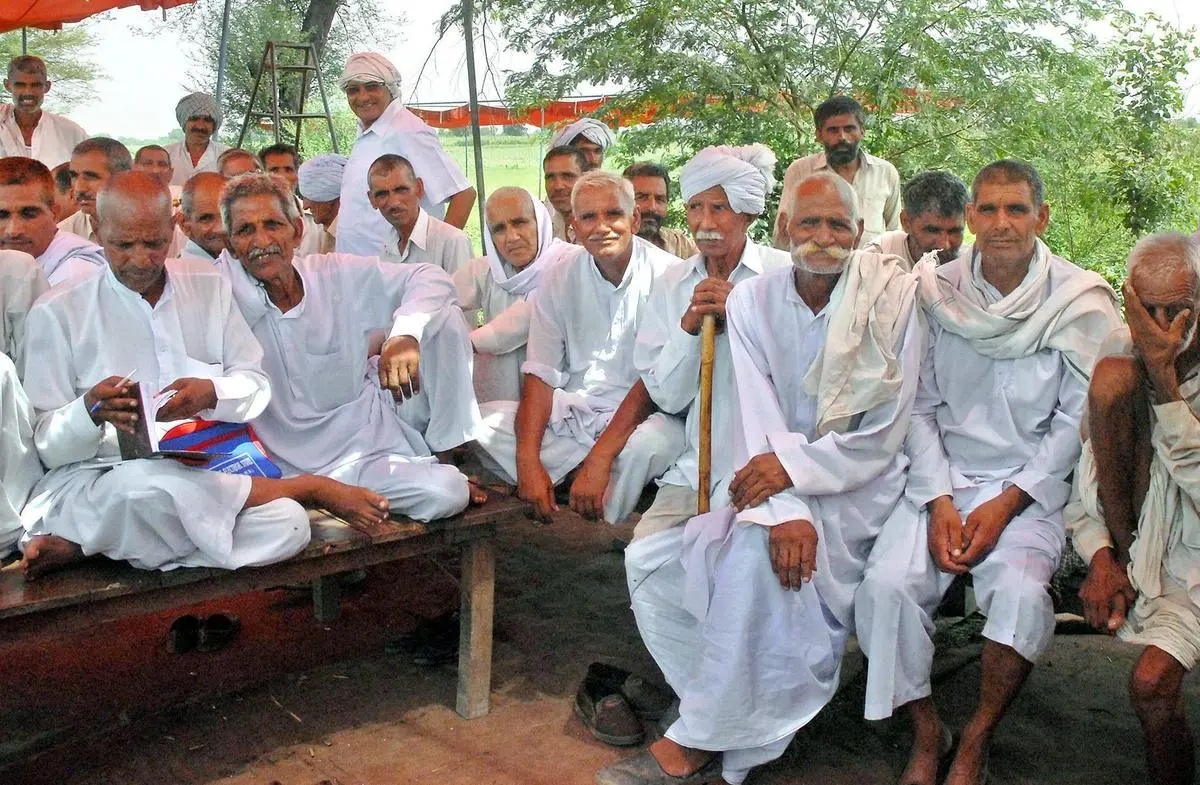
Members of a “khap panchayat” demanding the expulsion of a family who they claim violated gotra norms, in Dharana village, Jhajjar district, Haryana, on August 3, 2009. | Photo Credit: Anu Pushkarna
Pathak added that persistent inaction effectively confers legitimacy upon such actors: “This is how caste operates. These communities remain confined within their echo chambers, constantly seeking to assert dominance. This is precisely why the Chaudharys went after Kanku. They saw themselves as having lost ground after Kinjal [returned] and so declared their intent to bring back Kanku. For them, a woman’s body amounts to nothing more than a transactional object.” She underscored that women from these communities who, unlike Kinjal, have no social capital often do not even think of marrying outside their caste, let alone actually do so.
Frontline reached out to the Gujarat State Commission for Women for comments but did not receive a response as of going to press. Queries to the National Commission for Women also did not elicit a response.
In 2018, the Supreme Court ruled that the state is constitutionally obligated to protect intercaste and interreligious couples from violence and harassment. The court declared any interference by family members or the so-called khap panchayats (community councils) in the consensual marriage of two adults “absolutely illegal”.
The response of Gujarat’s ruling political establishment to these brazen attacks on women’s autonomy has notably been inadequate. In March, the State Assembly led by the BJP passed the Uniform Civil Code (UCC) Bill. The proposed UCC mandates the registration of all marriages and live-in relationships and stipulates uniform conditions for a valid marriage. It prescribes the minimum age of marriage as 21 years for men and 18 years for women. The rules, however, mandate that within 10 days after the documents are cleared, parents on both sides are to be notified of the marriage either physically or digitally.
While the Bill awaits the President’s assent, it has already elicited as many as 127 suggestions and objections from the public.
Jignesh Mevani, a social activist and the Congress MLA from Vadgam, asserted that obstructing intercaste marriages remains central to preserving Brahminical patriarchy. “If one were to examine anthropological material, it becomes evident that practices of endogamy emerged nearly 1,900 years ago. Since then, it has effectively remained central to the ideological project of organisations such as the BJP and the RSS to ensure the absence of interreligious and intercaste marriages in society. This is precisely why one witnesses pervasive moral policing by [these] groups,” he told Frontline.
An organised apparatus
In Gujarat, the violation of women’s constitutional rights appears to be facilitated by an organised apparatus that effectively operates at the perpetrators’ disposal.
Navchetan Trust (also known as Navchetana) is an organisation that specifically targets women who have left their families to marry someone of their choice or marry outside their caste or religion. Babu Bajrangi, a former leader of the Bajrang Dal’s Gujarat wing, has served as the president of Navachetana. In 2007, a Tehelka sting operation captured him claiming to have orchestrated the Naroda Patiya massacre during the 2002 Gujarat riots. The existence of organisations like Navchetana run by individuals such as Bajrangi suggests the presence of a structured syndicate that polices, controls, and ultimately curtails women’s autonomy.
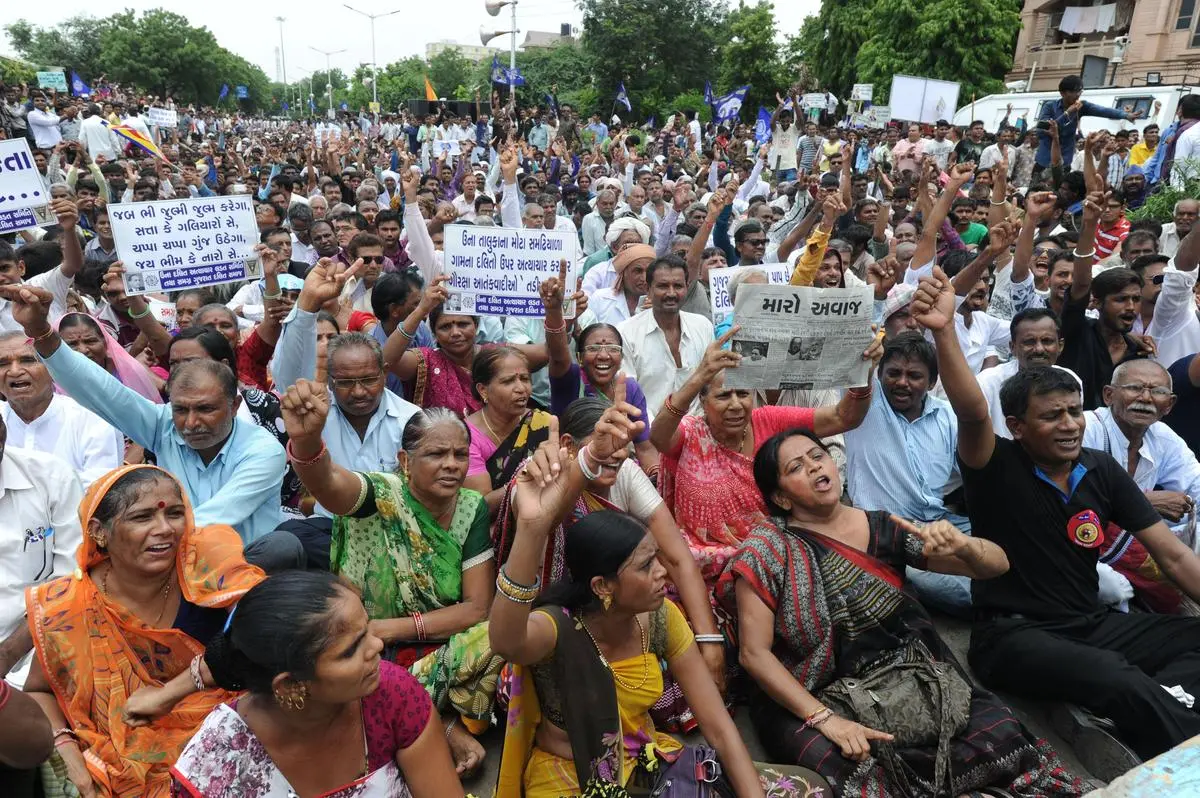
At a protest against caste violence following the Una Dalit atrocity, in Ahmedabad on July 31, 2016. | Photo Credit: Vijay Soneji
The BJP has over time even enlisted community influencers to disseminate these ideas. Mevani contended that the proposed UCC Bill mirrors the BJP’s casteist and feudal orientation.
But he added that the responsibility must also rest with the administration: the police must remain neutral and extend support to women and couples entering intercaste marriages. For this, a broader cultural reform spearheaded by citizens and the political class is essential.
Mevani said: “We should have textbooks with more progressive content, and as a society, we must embrace the agenda of annihilation of caste. When the objective is to dismantle caste, it will naturally entail the acceptance of intercaste marriages. Unfortunately, that is not the case in India; we, as a society and as a nation, are yet to confront and feel genuine shame over this anachronistic institution called caste.”
Some experts also criticised the judiciary’s silence, asking why the courts had not taken suo motu cognisance of such cases. In her video, Kinjal questioned why the norms governing choice in marriage applied only to daughters and not sons. Historically, women have functioned as the primary bearers of caste purity.
Pathak explained that caste was effectively reproduced through women, who are not perceived as having an independent caste identity but are assigned the caste of the men in their lives: first, the father and then the husband. When a woman enters an intercaste marriage, the system faces the prospect of ceding control over her, which it is unwilling to concede.
Over the years, the Supreme Court has repeatedly reiterated that the right to marry is integral to the Right to Life and Personal Liberty under Article 21. It has now been nearly 72 years since the enactment of the Special Marriage Act, 1954, which enables marriage between two consenting adults irrespective of religion or caste.
Then why do such constitutional safeguards collapse so readily on the ground? As Pathak said, this right did not emanate organically from society; rather, it was constitutionally enshrined without a corresponding social transformation. Society, she argued, remains insufficiently sensitised, unable to comprehend the very idea of choice or consent.
According to Pathak, the number of such cases would only increase as more women get access to education and step outside the confines of their homes. The onus, therefore, lies on society to evolve, to align itself with women’s aspirations and to accord them the autonomy they seek over their own lives.
Also Read | Is there any ‘honour’ in killing?
Also Read | Can love fix what subclassification could not?