


惯性聚合 高效追踪和阅读你感兴趣的博客、新闻、科技资讯
阅读原文 在惯性聚合中打开

推荐订阅源

大猫的无限游戏
大猫的无限游戏
S
SegmentFault 最新的问题
量子位
A
Arctic Wolf
L
Lohrmann on Cybersecurity
钛媒体:引领未来商业与生活新知
钛媒体:引领未来商业与生活新知
WordPress大学
WordPress大学
V
Vulnerabilities – Threatpost
博客园 - Franky
C
Cyber Attacks, Cyber Crime and Cyber Security
The Cloudflare Blog
Last Week in AI
Last Week in AI
The Hacker News
The Hacker News
I
Intezer
J
Java Code Geeks
P
Privacy International News Feed
OSCHINA 社区最新新闻
OSCHINA 社区最新新闻
S
Secure Thoughts
Cisco Talos Blog
Cisco Talos Blog
阮一峰的网络日志
阮一峰的网络日志
S
Securelist
Security Latest
Security Latest
奇客Solidot–传递最新科技情报
奇客Solidot–传递最新科技情报
小众软件
小众软件
Jina AI
Jina AI
有赞技术团队
有赞技术团队
人人都是产品经理
人人都是产品经理
博客园_首页
酷 壳 – CoolShell
酷 壳 – CoolShell
T
The Exploit Database - CXSecurity.com
雷峰网
雷峰网
T
Tenable Blog
www.infosecurity-magazine.com
P
Privacy & Cybersecurity Law Blog
Simon Willison's Weblog
博客园 - 【当耐特】
T
Threat Research - Cisco Blogs
让小产品的独立变现更简单 - ezindie.com
MongoDB | Blog
MongoDB | Blog
D
DataBreaches.Net
N
News | PayPal Newsroom
Google Online Security Blog
K
Kaspersky official blog
H
Help Net Security
宝玉的分享
宝玉的分享
罗磊的独立博客
Webroot Blog
Webroot Blog
月光博客
月光博客
B
Blog RSS Feed
Recorded Future
Recorded Future

Latest Issue | Current Issue - Frontline Magazine | Frontline

Exploring the Intersections of Identity, Geopolitics, and Mental Health in New Indian Publishing Notes from Ginza Shihodo Shop: A Quietly Healing Read Migrant crisis to war shock: India’s fragile safety nets India Hit by Hormuz Crisis as Iran War Sends Oil Prices Soaring Why the Iran War and Internal Contradictions Signal the End of Dollar Hegemony West Asia Volatility and India’s Economic Vulnerability Amidst Domestic Political Rhetoric The Great Nicobar Project: Documenting the Costs of "Haste Dressed Up as Vision" Beyond Statist Tropes: How Kinship and Trade Redefine the Himalayan Borderlands Defining Modern Hinduism: Rajmohan Gandhi on the Shift from Ethic to Identity Inside ODI Art Centre: Preserving Odisha’s living heritage Noida Unrest and the Reality of India’s Workers Intercaste Marriage Violence in India: Who Protects Women? How the Supreme Court hardened UAPA bail rules in Delhi riots case BJP’s Women’s Reservation Push Faces Opposition Revolt Purvanchal Emerges as Key Battleground for UP Election 2027 Ketaki Sheth’s Flashback: Rare Glimpses of Film Sets Tulika at 30: Radhika Menon on Children’s Books in India Can the Stage Contain Theyyam’s Wildness? This Is Where the Serpent Lives: Power, class, and desire NCR Worker Protests: Low Wages, State Crackdown Gaza Genocide Blueprint: B’Tselem’s Yair Dvir Speaks Will Didi prevail over Delhi? Punishing the South: Modi’s Delimitation Plan and the Politics of Control India Census 2027: Who Gets Counted—and How? SIR West Bengal Voter Exclusion Case 2026 Healthcare’s Breaking Point India’s Elderly Boom: Care Gaps and Policy Failures AI chatbots fill mental health gaps in India, but risks grow Substandard Drugs in India: The Hidden Public Health Threat India Healthcare Costs Crisis: Who Pays the Price? ASHAs hold India’s fragile health system together but are woefully underpaid Occupational Health Crisis in India: Silicosis and Beyond Techno-Elitism vs. Universal Care: The Growing Access Gap in India’s Health Revolution India’s Health System: The Broken Promise of Primary Care Partha Chatterjee’s For a Just Republic and the Limits of the People-Nation Why Jerry Pinto’s 'A Good Life' is Essential Reading for India’s Evolving Healthcare System Ambedkar Caste Critique: Justice Beyond Reform India’s Missing Middle: Trapped Between Health Insurance and Care Hungary Election 2026: Orbán Defeated, Magyar Wins Big Sewage, Neglect, and Governance Failure Mark India's Water Crisis The Hidden Ecosystem Inside our Homes Women’s Health in India: Inequality by Design Absolute Jafar: Nostalgia and restlessness in frames Anita Nair’s Why I Killed My Husband Review: Powerful Themes, Uneven Storytelling Iran War Ceasefire Signals a Shift Toward Multipolar Deterrence How Deepti Priya Mehrotra’s Walking Out, Speaking Up Recovers the Radical History of Indian Feminist Agitprop Lalit’s Lyrical Shift Writing New History China’s rise tests US power but avoids global confrontation Why The Dig Fails to Unearth the Material Reality of Keeladi Archaeology Ferdino Rebello on Goa land protests, TCP Act, and casino politics John Irving on Queen Esther, Politics, and the Writing Process Inside the Studios of Contemporary Indian Artists Hind Rajab and the Limits of Representation in Cinema How Muslims and Tea Tribes may Decide Assam Elections Tamil Nadu Election 2026: How Gender and Gen Z Voters are Reshaping the Dravidian Power Struggle Inside BJP’s Strategy to Win Puducherry Assembly Flesh Review: A stark, experimental Booker winner LDF, UDF, BJP Rework Kerala Campaigns Amid Gulf Crisis Assam election 2026: Polarisation shapes BJP vs Congress fight Tamil Nadu 2026 Elections: New Forces and Voter Trends West Bengal election arithmetic favours Trinamool, says Biswanath Chakraborty Electoral Roll Purge and Political Polarisation Shape Bengal’s High-Stakes Election Kerala Election: LDF, UDF in Tight Battle Lakshadweep Land Acquisition 2026: Constitutional Concerns and Tribal Displacement on Agatti Island Gurmeet Ram Rahim Acquitted in Ram Chandra Chhatrapati Murder Case, Questions Persist US-Israel Iran war: how religion and politics are colliding Trump Iran War Fallout: Strategy Unravels Fast Moral Collapse and the Crisis of Justice UP’s ‘Half Encounter’ Policing Faces Sharp Judicial Rebuke Women of Mathematics Exhibition 2026: Rewriting Science’s Gender Gap Pop History meets Romila Thapar: A Review of Speaking of History From Kerosene Lamps to Electric Lights in Palluruthy Gen Z Wave Propels Balen Shah and RSP to Power in Nepal Chipko Movement and Power of Nonviolent Resistance Right to Recall: Accountability Tool or Political Risk? Mani Shankar Aiyar Attacks Tharoor’s Stand on US Power and Iran War India Poverty Rate Debate 2026: 5% or 24%? Beyond Global Islam: Faisal Devji on the Crisis of Modern Muslim Sovereignty and the Fall of Khamenei The Paradox of Preservation: Why India’s Ajanta Caves Face a 50-Year Countdown to Disappearance Inside Kochi-Muziris Biennale 2025: Art in the Everyday Tamil Nadu 2026: Can Vijay and Seeman Challenge Dravidian Politics? Iran–Israel War Escalates, Shaking Security Across the Gulf George Saunders’ Vigil: A Dark Meditation on Death Why Amitav Ghosh’s Ghost-Eye Fails to Convince How Iran’s Shi'ite Ideology Shapes its War with the US and Israel A French 'grandmother' brings alive the early days of Santiniketan INDIA Bloc Leadership Debate Puts Rahul Gandhi Under Spotlight Iran War 2026: US Strategy and Global South Crisis Called by the Hills: Anuradha Roy’s Himalayan memoir Governor’s Office Reform: Tamil Nadu Panel Seeks Federal Reset How the US–Israel War on Iran Defied International Law India, Israel and Iran: The Tightrope After Modi’s Trip Rafale Expansion vs Tejas Setback: India’s Air Power Crossroads How Sankar reshaped Calcutta in popular fiction R. Nallakannu Dies at 101: CPI’s Resistant Voice How the Absence of Shame is Reshaping Indian Democracy M.K. Stalin Can Unite Opposition Against Hindutva Meghalaya Rat-Hole Mining: A Deadly Economy in Plain Sight Kumar Shahani: Visionary filmmaker who pushed Indian cinema’s boundaries
The Granular Reality of Rebuilding After Partition: A Review of Bhawana Somaaya’s Farewell Karachi
Ranjana Sengupta · 2026-05-13 · via Latest Issue | Current Issue - Frontline Magazine | Frontline

Farewell Karachi,” the film critic Bhawana Somaaya writes, “is an ode to my family and an ode to a city that my parents called their motherland.” While her book is subtitled “A Partition Memoir” and is certainly an ode to her family, the Karachi and Partition segments, though figuring prominently in the beginning, become less central fairly quickly. Yet the title is not entirely a misnomer for you could argue, as Somaaya seems to suggest, that the reverberations of Partition inform the whole story and that those who undergo such an experience can never be free of it.

Somaaya was born long after the family were forced to uproot themselves from Karachi, but the collective trauma communicated itself to her and became part of her life too. “Partition involves a sense of displacement, even if you haven’t experienced it,” she writes, explaining how it engenders a sense of “recurrent insecurity”. To borrow from the title of a Kiran Desai novel, this inheritance of loss comes through in Somaaya’s detailed, quotidian evocation of her family’s life in pre-Partition Karachi: a world that she learnt about from her parents and older siblings, yet one that clearly figured prominently in family lore. Their large, multigenerational joint family, which hailed from the Lohana community, inhabited a sprawling house in Karachi and could trace their roots in Sindh back five generations and a hundred years.

In Somaaya’s telling, the family was presided over by her grandfather and lived and ate together. The men went to work (they oversaw sawmills and owned a construction business), while the chores were amicably shared between the wives. The pace of life was calm and predictable. In the hot Karachi summers, everyone slept out on the terrace. There were family picnics to Manora Island, storytelling sessions by grandmothers and aunts, and joyous celebrations of festivals. Partition ended this idyllic existence.
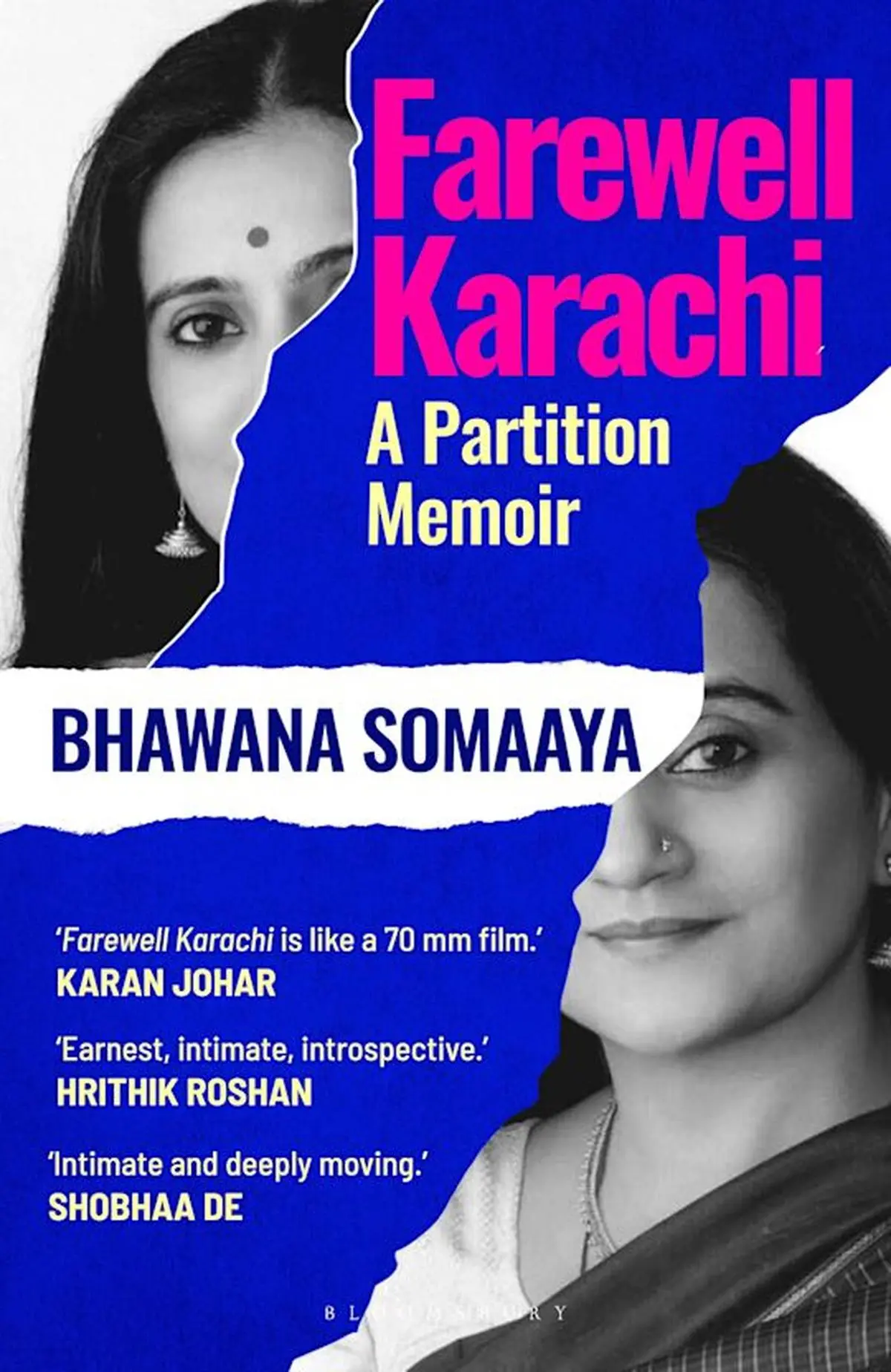
In Farewell Karachi, the drama of Partition segues into the story of the family’s post-Partition existence and what it actually meant on a day-to-day basis to go from complete security to total uncertainty.

In Farewell Karachi, the drama of Partition segues into the story of the family’s post-Partition existence and what it actually meant on a day-to-day basis to go from complete security to total uncertainty. | Photo Credit: By special arrangement

Farewell Karachi: A Partition Memoir

By Bhawana Somaaya

Bloomsbury India
Pages:188
Price: Rs. 450

Like so many others, the Somaayas thought it would pass: “Karachi had no history of violence,” they reasoned. But after August 1947, it was now another country, and when the riots began, the decision was taken to leave. On September 22, 1948, the family managed to board a packed, chaotic steamer that would take them to the port town of Mandvi in Kutch, India. The family first settled in Burj, before shifting to Bombay, where Somaaya’s father’s office—he worked for Burmah Shell—was located.

The initial months in Burj were hard. Her father returned to Karachi to secure his transfer orders from Burmah Shell and sell the family home. He received only a pittance for the property, leading him to observe sadly that their once-trusted friends had turned into “vultures”. Meanwhile, his delayed return meant the family in India had to resort to selling Somaaya’s mother’s jewellery to make ends meet.

These are all familiar Partition stories: the brutal uprooting, the betrayals, the terrible journeys, and the uncertainty that did not end in India. Instead, there was endless struggle and an intense, unremitting sadness for the world that was lost. Farewell Karachi gives these well-trodden tropes a granular reality.

Of course, we also know that it all worked out, not just for the Somaayas but for multitudes of others. Their father’s job took them to Bombay, where they moved houses frequently in what was an unfamiliar and alien city. Eventually, it became their home: they bought their own flat, put down strong roots, survived, and thrived.

Somaaya has six sisters and two brothers; the youngest by a long margin, she has written this book as a hymn to large family life. Her father worked long hours to provide for the family, their mother nurtured them, her sisters were married off, and her brothers were educated. It is a familiar tale, but told with warmth and authenticity, even if Somaaya remains reticent about the tensions, disagreements, and power struggles of family life.

There are many delightful period details, though: her brother Mahendra standing in front of a mirror, for instance, carefully fixing his Dev Anand “puff” to his satisfaction; listening to Chhaya Geet on the radio and watching Phool Khilen Hain Gulshan Gulshan on TVreading her parents’ local library books—brightly coloured paperbacks with smudgy print of Perry Mason, Pearl S. Buck, Daphne du Maurier, and Somerset Maugham. Mahendra sent them gifts from Germany, which are a peephole into India during the licence-permit raj: voile fabric, crockery, cutlery, cameras, spectacle frames, knives; the bigger items that were sent through sea mail included camp cots, refrigerators, dinner sets, and washing machines!

Somaaya tells us little about her personal life other than the known facts of her being a successful film critic, the editor of Screen magazine, and the author of biographies of Amitabh Bachchan and Hema Malini. She does drop some tantalising glimpses of 1960s and 1970s Bollywood: “I was well acquainted with movie culture. I could sniff a struggler from his swagger, categorise a star by his brand of sunglasses, ice buckets, cigarettes, umbrellas and hand mirrors.” Alas, she does not tell us more.

This is an involving read: the drama of Partition segues into the story of the family’s post-Partition existence and what it actually meant on a day-to-day basis to go from complete security to total uncertainty and the grinding effort and iron determination it took to rebuild an acceptable life. 

Ranjana Sengupta is an editor and the author of Delhi Metropolitan: The Making of an Unlikely City.

Also Read | Writing Partition: A violent birth

Also Read | Of love, loss, and redemption