


In a one-sentence conclusion, one could say that the recently concluded Iran war ceasefire shifts the world slightly toward a multipolar, deterrence-based order where endurance, risk tolerance, and disruption power matter more than overwhelming military strength.
Indeed, the ceasefire between the US and Iran should best be understood not as a decisive victory for either side but as a strategic outcome that tilts in Iran’s favour while leaving the US with a narrow tactical gain and ambiguous political optics.
Militarily, the US demonstrated clear air superiority and the ability to project force at range with limited risk to personnel. Yet, this advantage remained inherently bounded. It produced pressure but not capitulation, disruption but not strategic transformation. Iran absorbed strikes, preserved core capabilities, avoided regime-threatening damage, and crucially forced a pause without conceding publicly on its central positions. In doing so, it converted survival under pressure into strategic leverage.
The political optics compound this imbalance. The US entered the confrontation with maximalist rhetoric and implicit deadlines, yet accepted a temporary ceasefire absent visible Iranian concessions. Even if intended as a pragmatic off-ramp, the sequencing matters.
Narrative shift
When a stronger military power escalates, threatens, and then pauses without extracting concrete commitments, the visual narrative shifts. Ambiguity itself becomes a form of advantage for the weaker party. Iran can plausibly claim that it resisted pressure, avoided escalation, and compelled negotiations on a more equal footing. The US can claim deterrence and de-escalation, but the absence of a clearly defined concession blurs the perception of success.
In geopolitical signalling, such ambiguity often benefits the actor whose objective was simply to endure. At the tactical level, the US achieved a limited military success. It demonstrated operational reach, surveillance dominance, and the ability to strike with precision. However, the confrontation simultaneously exposed American vulnerabilities. Iran showed that it could threaten regional shipping, pressure energy markets, mobilise proxy deterrence, and create escalation risks disproportionate to its conventional strength.
The episode underscored the fact that while the US can strike Iran, it cannot do so without accepting systemic regional consequences. That realisation narrows the credibility of future coercive threats. Tactical superiority remained American. Escalation leverage appeared more balanced.
The broader regional effect may be the most consequential. West Asia now sees a state that confronted US military pressure, absorbed it, and emerged without collapse. This shifts perceptions of risk. Regional actors recalibrate not only on the basis of battlefield metrics but on demonstrated resilience too. Iran appears harder to coerce, more willing to absorb punishment, and capable of imposing indirect costs.
Lessons learnt from war
The lesson drawn across capitals is not that Iran is militarily dominant but that military confrontation with Iran carries uncertain and potentially destabilising consequences. Deterrence is shaped as much by perceived endurance as by firepower, and Iran enhanced that perception.
Israel finds itself in the most difficult position. The confrontation intensified Iranian hostility while simultaneously validating Iran’s narrative of resistance. If the goal was to weaken Iranian posture, the result instead may have entrenched it. Iran is both angrier and more confident, its deterrent credibility strengthened by survival. Israel now faces an adversary that feels vindicated, less isolated, and more central to regional calculations. The strategic environment becomes more volatile. Deterrence may hold, but the political temperature is higher and escalation thresholds are less predictable. As of writing this, markets are down again as, within hours of the ceasefire, Israel launched waves of coordinated airstrikes across Lebanon, targeting sites across Beirut, the Bekaa Valley, and southern Lebanon, producing the deadliest day of the conflict and signaling that the Iran ceasefire did not extend to Lebanon. The escalation now carries a sense of urgency, even desperation.
So, who won? The answer is layered. Iran is the strategic winner. The US is the limited tactical winner. Israel emerges as the biggest loser. The overall outcome tilts toward Iran while leaving the US with ambiguous political optics. Iran survived military pressure, made no visible concessions, forced a ceasefire before decisive escalation, increased regional deterrence, and emerged more feared rather than weakened.
The US demonstrated air superiority and precision strike capability and avoided boots on the ground, but achieved no strategic transformation and extracted no clear concession.
Israel now faces an enraged and more confident Iran, with regional perception shifting toward the idea that confrontation has strengthened Iran rather than weakened it.
Geopolitical effects
The second order geopolitical effects reinforce this tilt. China benefits quietly as US attention returns to West Asian instability and energy route vulnerability strengthens China’s diversification logic. Russia gains from divided western focus, higher energy volatility, and strengthened alignment with Iran. Türkiye’s strategic autonomy is validated as both sides require regional balancing. Oman’s mediation relevance increases, reinforcing the role of middle power diplomacy over institutional frameworks. Saudi Arabia and the United Arab Emirates experience unease rather than relief. War avoidance is welcome, but an emboldened Iran complicates long-term deterrence.
Europe avoids escalation but faces a weakened perception of the US’ coercive credibility. India sees mixed outcomes, balancing energy risk against multipolar advantage. Pakistan gains modest diplomatic relevance. Lebanon becomes more unstable as Iranian influence appears strengthened.
Inside Iran, the picture is more complex. The diaspora becomes more polarised. Dissidents and protesters will likely lose space as nationalism strengthens regime legitimacy. The Iranian public experiences a psychological win but material uncertainty. Iranian women face a more difficult reform environment as security narratives crowd out domestic liberalisation debates. Iran the state gains strategically even as Iranian society faces ambiguous or negative internal consequences.
Meanwhile, continuing hostilities in Lebanon reinforce Iran’s newfound realization that its most powerful strategic lever is not nuclear enrichment but controlled aggression and chokepoint disruption of maritime and commodity flows through the Strait of Hormuz. Even without closure, Iran’s calibrated pressure, inspection threats, and fee structures over the Strait of Hormuz expand Tehran’s influence over global oil pricing, shipping risk, and downstream markets including fertilizers, petrochemicals, and helium. The war demonstrated that merely tightening perceived control can move markets, which effectively converts geography into a persistent deterrent and bargaining chip. In this sense, Iran emerges with a scalable instrument that can be applied gradually, denied diplomatically, and reversed tactically, giving it leverage that is economically global, politically ambiguous, and more usable than overt nuclear escalation. In simple terms, even with disputes, the Strait of Hormuz was officially free for passage prior to the war, and now it is an even better outcome for Iran as it has become subject to Iranian fee structure and disruption tactics in a comprehensive way.
The third order effects extend beyond the region. International institutions appear reactive rather than decisive. Major power confrontation again unfolded outside multilateral enforcement, reinforcing a system where power politics outruns institutional authority.
Palestine will likely become further marginalised as strategic focus shifts upward toward Iran deterrence. As Israel prioritises Iran containment over Palestinian diplomacy, Arab states will grow more cautious. The Palestinian issue becomes less central diplomatically and more frozen politically.
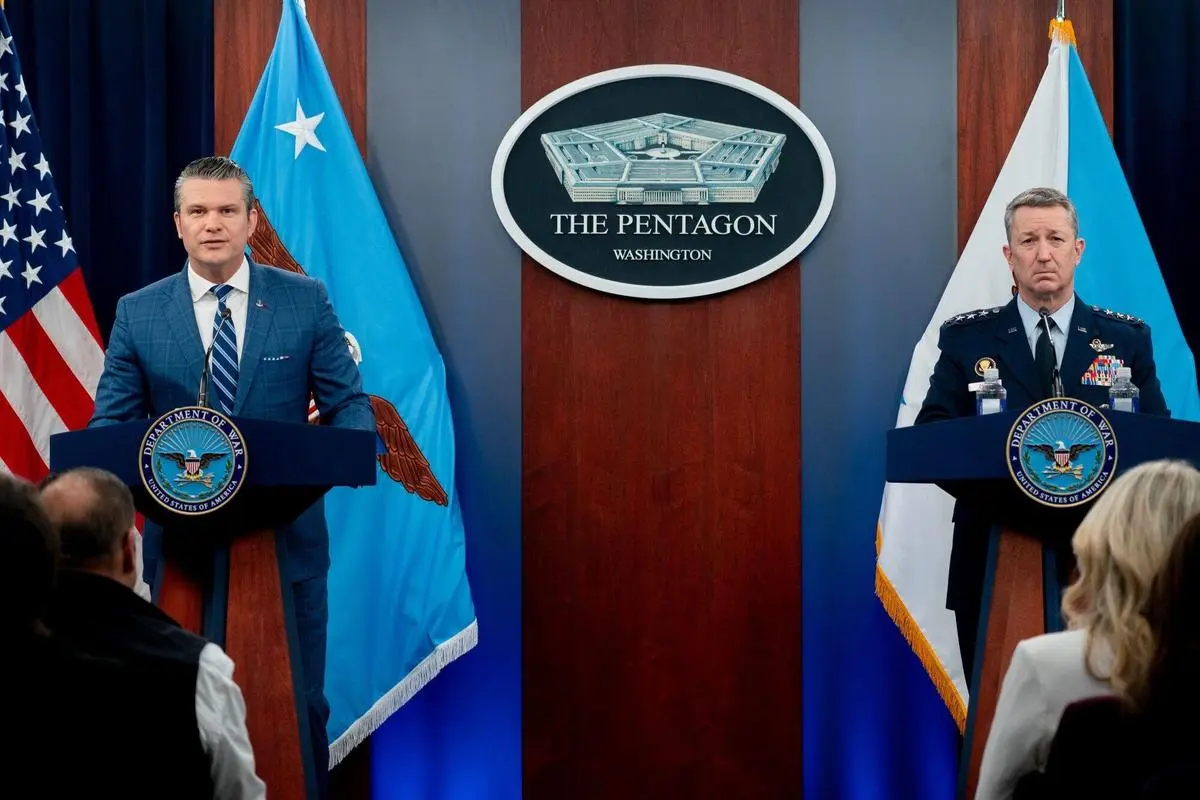
Pete Hegseth, US Secretary of Defence, and John D. Caine, Chairman of the Joint Chiefs of Staff, at a news conference at the Pentagon in Arlington, Virginia, on April 8, 2026, after the US and Iran agreed to a two-week ceasefire. | Photo Credit: STEFANI REYNOLDS/BLOOMBERG
Oil politics may be the most structurally significant shift. The crisis reinforces the enduring leverage of the Strait of Hormuz. Iran gains influence through disruption potential rather than export volume. Saudi Arabia, Russia, US shale producers, and Iran all benefit from risk premiums. Oil importers face uncertainty. The geopolitical premium returns to energy markets, strengthening deterrence through economic vulnerability.
The ripple effects reach Asia and Europe. China draws lessons about US preference for limited coercion and the power of endurance, slightly emboldening its strategic calculus regarding Taiwan without fundamentally changing the equation. Russia benefits from diluted Western attention and strengthened anti-sanctions narratives, marginally improving its position in Ukraine. Ukraine faces a slightly less favourable strategic environment but not a decisive shift.
The secondary effects of the Iran war ripple outward into Europe and the Ukraine theatre by reshaping energy security, diplomatic bandwidth, and deterrence calculations. A tighter Gulf risk premium strengthens oil and gas prices, complicating Europe’s fragile post-Ukraine energy adjustment and weakening the economic pressure mechanism that underpins sanctions regimes. Any renewed volatility diverts political attention in Washington and European capitals, dilutes unity, and raises insurance and shipping costs that feed directly into inflation. This also alters the logic of the Prioritised Ukraine Requirements List (PURL) type understanding of ‘buy, send, replenish European-American military hardware for Ukraine’ schemes built around stability and supply predictability, since markets now price in strategic chokepoints and state leverage more heavily. The result is a Europe that faces higher structural costs, reduced policy flexibility on Ukraine, and a geopolitical environment where endurance and supply control matter as much as battlefield outcomes.
Where India stands
For India, it is a neutral though not a great look. India’s position in the aftermath of the Iran war ceasefire reflects a careful but limited exercise of its strategic autonomy. In the immediate term, the end of hostilities has delivered clear domestic benefits, as easing oil prices have reduced inflationary pressures, stabilised the rupee, and provided relief to households and industry.
The government is likely to present this as a result of its restrained and non-escalatory approach. Politically, however, this restraint is contested, with critics arguing that India’s neutrality amounted to passivity at a moment that required stronger leadership. The international implications are more significant.
The emergence of Pakistan as a visible diplomatic intermediary in brokering the ceasefire has raised its global profile and sharpened questions about India’s ability to translate its relationships into influence. While India continues to maintain ties with Israel, Iran, and western partners, it has not demonstrated the capacity to shape outcomes in a high-stakes crisis.
The episode also highlights a structural vulnerability, as dependence on the Strait of Hormuz leaves India exposed to external shocks, reinforcing the need to diversify energy sources and supply routes. The result is a position that remains stable but not decisive, with economic relief at home and diplomatic continuity abroad but limited evidence of a more assertive global role.
When endurance becomes power
Taken together, three broader conclusions emerge. First, endurance increasingly beats escalation. States that absorb pressure without collapsing gain leverage. Second, ambiguity favours revisionist actors, allowing them to claim success without formal concessions. Third, military superiority no longer guarantees political victory. The US demonstrated overwhelming operational capability, yet outcomes were negotiated rather than imposed.
The ceasefire, therefore, represents more than a pause. It marks a subtle but meaningful shift toward a multipolar deterrence order in which resilience, disruption capacity, and risk tolerance shape outcomes as much as conventional dominance. No decisive battlefield victory occurred, yet perceptions often more durable than material damage tilted toward Iran, which converted survival into influence.
The US demonstrated force but not transformation. Israel emerged strategically worse off, and its standing now at its lowest around the world, including in the US polls. The region recalibrated its risk calculus. The world moved slightly but perceptibly toward a system where endurance itself becomes power.
Manav Sachdeva serves as the Global Humanitarian & Food Security Goodwill Ambassador, India, for Ukraine President Volodymyr Zelenskyy’s Office.
Also Read | India can’t ‘wait and watch’ oil shocks
Also Read | Why the Iran conflict is not just about geopolitics