





Work occupies a significant portion of human life, yet its profound impact on health and well-being remains poorly understood in India. According to the ILO, more than two million workers die each year globally from work-related accidents and diseases. In India alone, nearly 48,000 workers die annually because of occupational hazards.
The Planning Commission’s Report for the Twelfth Five Year Plan (2012–2017) stated grimly: “Occupational Health and Safety cover for the unorganised sector can well be said as non-existent.”
The ILO and the WHO define occupational health thus: “The promotion and maintenance of the highest degree of physical, mental and social well-being of workers in all occupations by preventing departures from health, controlling risks, and adapting work to people, and people to their jobs.”
Given the intensity and duration of exposures at work, occupational hazards frequently extend into homes and surrounding environments.
Yet many occupational illnesses escape detection because there are long periods when the illness remains latent, there is difficulty in distinguishing occupational from non-occupational diseases, and reporting systems are inadequate.
Occupational health and safety constitute an interdisciplinary field that aims to engage with workplace accidents, injuries, and illnesses. One of the ways in which occupational hazards were sought to be addressed in India was through the creation of Employees’ State Insurance Corporation (ESIC), which provides medical and cash benefits for injuries or occupational diseases.
However, over the 74 years since the establishment of ESIC in 1952, the organised sector has shrunk while the unorganised sector has grown and inter-State migrations have increased. The ESIC covers mostly industrial and factory workers from the formal sector and leaves the vast majority of informal-sector workers out of the safety net.
Informal-sector workers, the overwhelming majority
According to the National Commission for Enterprises in the Unorganised Sector, headed by Arjun Sengupta, over 90 per cent of the country’s workforce is engaged in the informal sector. These workers, including those in illegal and unrecognised mines, remain largely unprotected despite the Inter-State Migrant Workmen (Regulation of Employment and Conditions of Service) Act. Workplace safety is currently a major concern as four new Labour Codes have replaced previous laws.
Across India, millions of workers begin their day in environments filled with dust, chemicals, noise, heat, and hazardous materials. These conditions form the invisible backdrop of the nation’s economic growth, yet the people who endure them remain neglected and unprotected.
Informal-sector workers (92 per cent of the workforce) often face poor ventilation, continuous dust exposure, hazardous chemicals, radiation, noise, and heat. These workers—innumerable migrant miners, stone crushers, construction workers, ramming-mass operators, slate pencil makers, and agate polishers—do not always have access to personal protective equipment and work under very limited or no medical surveillance.
Hazardous dust, the bane of mine workers
People working in mines are exposed to hazardous dust; they suffer from silicosis, pneumoconiosis, asbestosis, and occupational cancers. Hearing loss, dermatitis, and metal poisoning are some of the other risks. There can be exposure to mercury, lead, chromium, zinc, and many more metals. Industrial workers suffer due to noise, heat, dust, radioactive substances, and hazardous chemicals. Machines with unguarded moving parts, high-pressure systems, and crushing points can put workers at risk.

Salt-pan workers in Kothapatnam of Prakasam district in Andhra Pradesh. | Photo Credit: KOMMURI SRINIVAS
Informal-sector workers remain outside the purview of occupational safety mechanisms. The Employees’ State Insurance (ESI) Act largely excludes informal-sector labour, while existing laws suffer from weak enforcement and lack of institutional capacity. Many workers in hazardous chemical, glass, and cracker industries still lack adequate coverage. Although India has the National Policy on Safety, Health and Environment at Workplace (2009) and laws such as the Mines Act and the Factories Act, enforcement remains sporadic and weak.
Compounding the problem is the absence of systematic efforts by authorities to collect reliable data on occupational injuries, illnesses, and deaths. For instance, an undated report by the ESIC estimates 17 million non-fatal occupational injuries annually in India—17 per cent of the global total—and 45,000 fatal injuries, or 45 per cent of the world’s share. Yet the report does not specify the period of the study.
These figures are reproduced in a study titled “Morbidity Profile, Economic Impact, and Social Security Scheme Utilisation of Occupational Injuries in a Tertiary Care Hospital in Bangalore, Karnataka”, which itself draws on a 1999 study for global estimates and a 2017 publication for India-specific data. Such inconsistencies point to a deeper problem: the absence of an actively maintained, regularly updated national database on occupational injuries, diseases, and related deaths.
Silicosis patients and women who have lost their husbands to the disease, in Arampura Mahu village in Karauli district in Rajasthan. | Photo Credit: ROHIT JAIN PARAS
A similar pattern of uneven data is visible in estimates of exposure to silica dust. In 1999, the Indian Council of Medical Research put the number of workers exposed at 3 million; by 2018, government figures suggested that over 10 million workers were at risk. A media report in September 2024 suggested that 52 million workers would be exposed to silica dust by 2025 and were at risk of contracting silicosis. According to the National Institute of Occupational Health (NIOH), workers in over 90 different occupations can be exposed to silica.
Victims of silicosis
The Ministry of Labour & Employment and the Directorate General of Mines Safety (DGMS) have revealed that over 2,35,447 mine workers are at risk of silicosis in 44,155 mines across States and Union Territories. A national survey by the National Institute of Miners’ Health found a 40 per cent prevalence of silicosis among mine workers, affecting 94,000 individuals. A primary investigation by the Union government estimated the total number of exposed workers in 21 States and Union Territories who are likely to be affected by silicosis to be 3,19,821, as of April 2017.
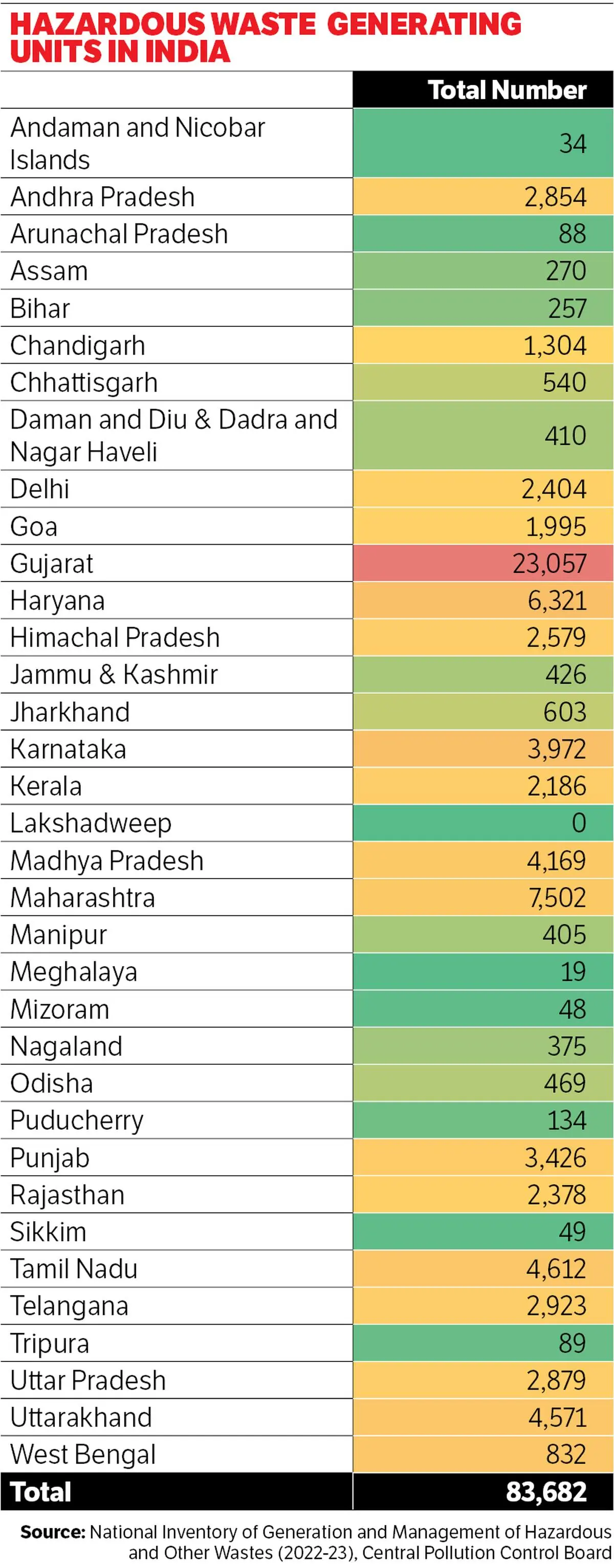
A 1985 study by the NIOH in Mandsaur, Madhya Pradesh, revealed shockingly high mortality among slate pencil workers, with 35 being the average age of death. Misdiagnosis of silicosis as tuberculosis (TB) compounds the crisis, leading to wrong treatment, denial of compensation, and continued disease progression. People living near, but not working in, slate pencil factories showed a significant 12.6 per cent prevalence of silicosis, 6.3 per cent of silico-tuberculosis, and 8.2 per cent of conditions with features of TB. The NIOH study also showed high levels of silica-containing dust in the vicinity of these factories.
Three decades later, a committee constituted by the Supreme Court in August 2016 on silicosis in Madhya Pradesh stated that airborne dust levels were 40 to 50 times higher than the permissible level.
Many workers who migrated from Madhya Pradesh to neighbouring Gujarat and Rajasthan in search of work have died of silicosis and other occupational illnesses.
According to a study by the Silicosis Peedit Sangh (silicosis victims’ union) released in 2017 and updated in December 2025 (“Destined to Die”, Volumes 1-5), in Madhya Pradesh alone a total of 3,442 confirmed cases were found across six districts (Dhar, Jhabua, Alirajpur, Mandsaur, Vidisha, Panna); of these, 1,467 died in the past two decades. Of those who died, 65 per cent were aged between 19 and 35. Small children who travelled with their parents to the hazardous factories were exposed to silica dust and contracted silicosis, which went undetected for a while. These children also lost one or both of their parents to silicosis.
In Uttar Pradesh, 78 cases of silicosis were identified by December 2025 in two districts, Lalitpur and Mahoba. Families spent a lot of money on the medical treatment of multiple members. Many of them sold off agricultural land and livestock and took on the burden of high-interest loans.
Plight of stone-crushers
A study titled “Respiratory Ailments of Stone Crusher Workers in Bundelkhand Region of Uttar Pradesh” by Mahendra Kumarupadhyay and Surya Kant Chaturvedi, published in the October 2016 issue of International Journal of Science and Research, states that dust from stone-crushing pollutes the environment. Covering Bharat Koop, Banda, and Kabrai, the study shows most crushers lack dust control. Workers suffer from cough, weight loss, fever, and chest pain and have an increased TB risk. People over 35 with at least five years of work behind them were more susceptible to tuberculosis.
The Union government, meanwhile, confirmed that more than 27 lakh people were diagnosed with TB in 2024, with over 3 lakh deaths. The government admitted that it was not able to prevent the incidence of TB because the sources of dust and infection could not be controlled.
For two decades, the Supreme Court has been monitoring silicosis-related cases, with the active involvement of the National Human Rights Commission (NHRC). The court’s interventions have successfully ensured documentation of the extent of suffering caused by silicosis: 3,99,810 cases from 17 States, according to the Silicosis Peedit Sangh (as of 2017). The court has also mandated that the legal heirs of informal-sector workers who have died of silicosis should receive compensation in the range of Rs.3 lakh to Rs.5 lakh.
The court’s final order, on August 6, 2024, mandates that industries should meet specific minimum standards to prevent silicosis, stipulating closure for non-compliance. Further, the NHRC is directed to oversee the compensation process across States. This legal framework has transformed silicosis from a hidden occupational hazard to a strictly regulated environmental and human rights priority, holding industries accountable for workplace safety.
Government agencies often lack the manpower, equipment, or mandate to conduct regular dust monitoring. The DGMS, in an affidavit dated June 29, 2019, asserted that it was not possible to measure airborne silica levels in mines during inspections because of manpower and resource shortages. It suggested that the Central Pollution Control Board inspect all polluting industries and mines and provide a status report on steps taken to ensure the closure of polluting industries and mines that do not maintain permissible dust levels. Many mines are illegal, according to the committee constituted by the Supreme Court.
According to the DGMS, the scale of non-compliance regarding safety measures is huge: the number of violations detected was 3,958 in a total of 14,064 mines inspected. Only 3,076 notices were served under Section 22A (1) of the Mines Act, and such notices can hardly be said to act as deterrents. This complete absence of accountability enables abuse of labour and environmental norms.
A brick-kiln worker under a scorching sun, in Krishna district of Andhra Pradesh. Many migrant workers, including women, from Chhattisgarh and Odisha work in brick kilns in Andhra Pradesh. | Photo Credit: G.N. RAO
Misdiagnosis, lack of early detection technologies, and non-mandatory health check-ups result in unreliable surveillance data. Government worker registration systems currently fail to record occupational exposures, rendering silica-exposed informal-sector workers invisible to policymakers and health programmes.
In 2023–24, the ESIC’s income from contributions reached Rs.25,185.04 crore, while total expenditure on benefits remained significantly lower, at approximately Rs.14,520 crore. Financial gaps persist despite significant collections. According to the latest figures available on the National DMF Portal, a sum of Rs.1,44,322 crore was collected between 2015 and 2026 under the District Mineral Foundation fund. However, a decade after the fund’s creation, the unspent amount remains high, at Rs.81,025 crore (56.14 per cent).
A minute scrutiny of expenditure from the DMF—including performance audits carried out by the Comptroller and Auditor General of India—suggests that money has been spent on infrastructure projects that have facilitated extractive industries, rather than being channelled into projects that could bring about real change in the lives of mine workers and mining-affected communities.
The Union government should actively work on prevention of occupational hazards. For the unorganised sector, which employs people in industries and mines, a separate strategy focussed on early detection of occupational health hazards, medical management of cases, and penal action against erring factories and mines should be developed. There is an urgent need to develop a national programme on occupational health.
Amulya Nidhi is a public health expert with over two decades of experience in advocacy, campaign-building, and action research. He is one of the National Convenors of Jan Swasthya Abhiyan India and has led campaigns on unethical clinical trials and occupational hazards.
Also Read | Patriarchy’s health wreck needs women in charge now
Also Read | Patriarchy’s health wreck needs women in charge now