








From Maya Darpan to Tarang, Sahani’s legacy is marked by experimentation, intellectual complexity, and a lifelong dialogue with realism and the avant-garde.
With the passing away of Kumar Shahani, Indian cinema has perhaps lost the last of its self-consciously avant-garde filmmakers. The term “avant-garde” is used too loosely in India but such work does not merely try to do something imagined to be experimental or new. Underlying it is the sense that the “true” purpose of art cannot be known and it is hence entirely for each artist or filmmaker to stretch its boundaries. Mimesis, since it is only an imitation of appearances, is non-committal about art’s true objective but in India traditional art has had a defined purpose which is not to capture things in their appearances but in their essence, the emphasis being on the emotions associated with standard situations. In cinema, this has led not only to the truisms of popular cinema but also the social messages of art cinema. The avant-garde is radical in intent which is not the same thing as transmitting radical political messages. Shahani’s radicalism was therefore different from, say, Mrinal Sen’s.
Shahani along with Mani Kaul benefitted from the parallel cinema movement of the 1970s which came out of the state’s interventions through the FFC/NFDC during Indira Gandhi’s early radical phase. Both had been students of Ritwik Ghatak at the FTII and Shahani especially was deeply influenced.
But looking at Shahani’s Maya Darpan (1972) now, one wonders if these breaks were a good thing for these gifted students. A filmmaker needs to demonstrate his or her syntactic competence before progressing to cinematic experimentation but Maya Darpan seems like the work of someone unaccustomed to filmic communication. Maya Darpan was based on a Hindi story by Nirmal Verma, one of the giants of the Nai Kahani movement. Shahani has named three gurus—Ritwik Ghatak, the Marxist historian D.D. Kosambi, and the minimalist French filmmaker Robert Bresson—and he may have admired the gurukul system since he learned from each of them personally and not only from their respective works. Still, he is only taken up with some of their ideas and one cannot detect parasitical dependencies in his films. Shahani also appears fleetingly in Bresson’s Une Femme Douce (1969).
Political statements
After struggling for 12 years to find finance for his next film, Shahani made Tarang (1984), perhaps the film he will be most remembered by. This film is set in a business family with a patriarch at its head and the politics within it. It is a more conventional film but is much more a realised work than Maya Darpan. The patriarch Sethji (Shriram Lagoo) made his money from war profiteering and his business is now run in India by his son-in-law Rahul (Amol Palekar) who does not see things the same way as the old man. The Sethji has a nephew named Dinesh (Girish Karnad) in England and the plan now evolved is for the company to import machinery from abroad and profit illegally through differential invoicing and stashing away the foreign currency in Swiss bank accounts. Rahul is a nationalist at heart and believes that the requisite items of machinery can be acquired locally or designed in-house. The Sethji’s daughter Hansa is unresponsive to her husband Rahul and tacitly drives him into the arms of Janakibai (Smita Patil) the widow of a worker, before taking her own life.

A poster of Maya Darpan | Photo Credit: By Special Arrangement
Tarang is an ambitious film because there are few political aspects of society about which it has no statements to make and few contradictions it does not acknowledge. Shahani, for example, puts in a party scene in which well-dressed but inebriated men discuss art and political action. The Sethji’s handyman Patel is shown to be now so hard-nosed that he is unwilling to draw a moral line anywhere, but at a drunken moment he reveals that he was once involved in the freedom struggle and received a bullet injury for his pains. We could see this alongside the Sethji profiteering from the War before 1947. Janakibai herself is perennially short of money and she doubles as a streetwalker on the city waterfront.
Many of these “statements” from Shahani may seem too deliberate—some owe to contemporary Communist theorising about India’s social classes—but they are still based on astute political observations and Tarang is more complex than many other films from the 1980s about family businesses and trade union politics—Shyam Benegal’s Kalyug (1981) and Govind Nihalani’s Aaghat (1985). Not all of Shahani’s intellectual devices succeed but there is one that works admirably well and is intellectually reminiscent of Ghatak’s sequence in Subarnarekha (1965) where a song is rendered in an abandoned WWII airfield.
Much as he might be inclined to deny it, Shahani is dealing with a realist narrative in Tarang. The problem with realist storytelling in Indian cinema arises out of the narrative representing nothing more than itself and its space remaining shut off to winds from the real world because of its distance from mimesis. Shahani puts in sequences in Tarang where the space of the action suddenly opens out to include the real world, which seems to intrude abruptly. The most important one involves Hansa’s last moments in her room facing a bay. The camera, which has been following her, abruptly detaches itself and chooses to focus on the seashore opposite and we see a nameless woman rambling along without an apparent purpose but we imagine, also in distress. This expansion of narrative space can be said to be working towards a larger vision although the spectator responds to what he or she sees on the screen only after some reflection.
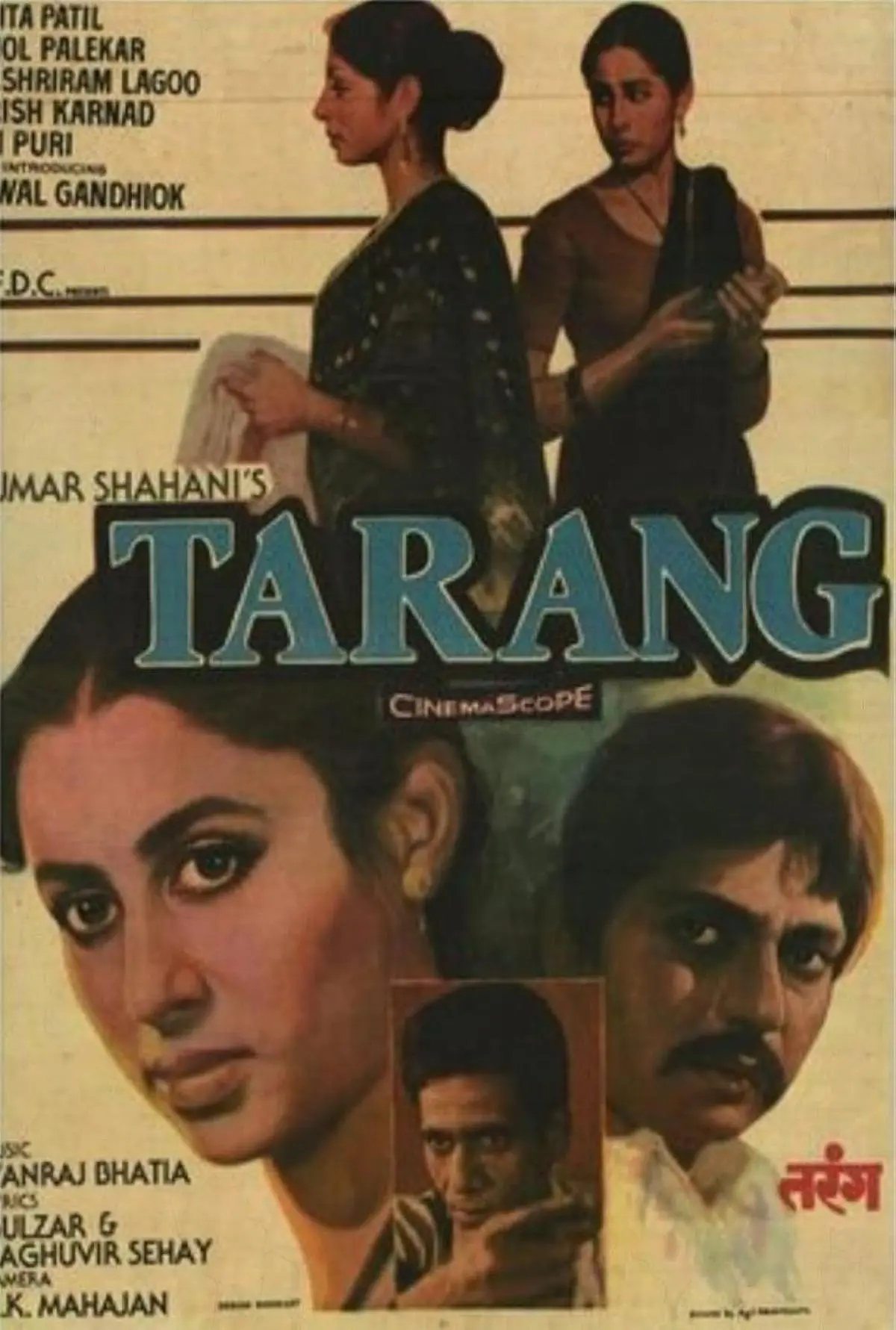
Tarang is an ambitious film because there are few political aspects of society about which it has no statements to make and few contradictions it does not acknowledge | Photo Credit: By Special Arrangement
Shahani was deeply informed by western literature, and Kasba (1991), which was based on a Chekhov story (“In the Gully”), is also quite successful. He was also articulate (at the verbal level) and highly charismatic but hardly lucid in his writing. The words “epic” and “melodrama” feature prominently in his utterances, but we are uncertain about their meaning. For instance, his references to Ghatak’s films as “melodrama” can even seem misplaced to someone only familiar with its standard connotations. Melodrama imposes a covert moral order upon the world (the “moral occult” in Peter Brooks’ words) but one hardly finds Ghatak reassuring us in this manner (as, for instance, in Meghe Dhaka Tara, 1960). Ghatak uses theatrical emoting but the story is rarely knit together by coincidences, rewards and punishment as in a story like Great Expectations (1861), which is classical melodrama. Popular melodramas (like Raj Kapoor’s Awaara, 1951) are also different from Ghatak’s films. They too are epic and draw from the oral tradition in their delineation of larger-than-life characters and emotions, their tendency to knit disparate happenings into a unifying resolution. In the Indian film context at least, neither “epic” nor “melodrama” seem like particularly laudable attributes.
Sometime in the 1980s Shahani and Kaul criticised Satyajit Ray (Shahani compared his films to magazine fiction perhaps because he adapted Sunil Ganguly and Shanker). Ray was not avant-garde but through a careful study of classical Hollywood narration had arrived at an intelligent kind of art cinema that India has been subsequently unable to reproduce. Ray responded to Shahani and Kaul in kind, and criticised their awkwardness and inadequate mastery of filmmaking craft. Although both these avant-garde stalwarts have since passed on, a cult around their work flourishes, one that is still implacably hostile to Ray’s kind of realist cinema. Some members of the cult are filmmakers while others are theorists but they share Shahani’s lack of intellectual lucidity and struggle to make themselves intelligible.
Either Kumar Shahani had better teachers or he was a better student than those of the cult that survives him.
M.K. Raghavendra is a writer on cinema, culture and politics. He won the Swarna Kamal for Best Film Critic in 1997 and received a Homi Bhabha Fellowship in 2000 to research popular cinema. He has published five academic books on cinema through Oxford University Press, Bloomsbury, and Routledge.
Also Read | From revolution to realism, the multifaceted legacy of Mrinal Sen