





Is the number of poor people in India closer to 75 million or 342 million? The difference, more than a quarter of a billion lives, depends on where the poverty line is drawn.
Over the past year, this question has surfaced repeatedly in Parliament. Members from both Houses and across parties have asked the government whether India’s official poverty benchmarks reflect current prices, consumption patterns, and economic realities (Rajya Sabha Unstarred Questions No. 950, July 2025; No. 784, February 2025). However, the government’s replies have largely sidestepped the issue, offering standardised responses that fall short of Parliament’s own requirements for accountability and transparency.
At the centre of the debate is a basic distinction between what different poverty lines are meant to capture. According to the World Bank’s latest Poverty and Equity Brief for India, extreme poverty, measured at $3.00 per person per day (2021 purchasing power parity), fell from about 27 per cent in 2011–12 to 5.3 per cent in 2022–23. Nearly 270 million people moved above this threshold over the period. This is a significant achievement. But this benchmark measures bare survival, not economic security.
The World Bank uses different poverty lines for different income levels because what constitutes deprivation changes as economies develop. For lower-middle-income countries like India, the relevant threshold is $4.20 per day. At this level, 23.9 per cent of India’s population, around 342 million people, were poor in 2022–23.
Poor and nearly poor
The gap between 5 per cent and 24 per cent is not a contradiction. It reflects two different policy questions. The lower figure shows success in reducing extreme deprivation. The higher figure captures the size of India’s economically vulnerable population, namely households that have escaped destitution but remain exposed to falling back into poverty due to inflation, health shocks, job losses, and climate risks. Parliament has repeatedly asked whether the government recognises this distinction and whether it plans to update monetary poverty lines accordingly. These questions remain unanswered.
Instead of engaging with monetary poverty, government replies consistently invoke the National Multidimensional Poverty Index (MPI), stating that it is “the only methodology” currently used to measure poverty. Across different parliamentary questions spanning months, the responses are near-identical (see Rajya Sabha Questions No. 2379 in 2024 and No. 784, 1267, 950 in 2025; and Lok Sabha Questions No. 508, 3131, 496, 4169 in 2025). Notably, when the government was specifically asked in Rajya Sabha Unstarred Question No. 2379 dated December 16, 2024, whether any official poverty line exists beyond the Tendulkar Committee definition, the question was left unanswered. This omission creates uncertainty about the current official basis for poverty estimation in India.
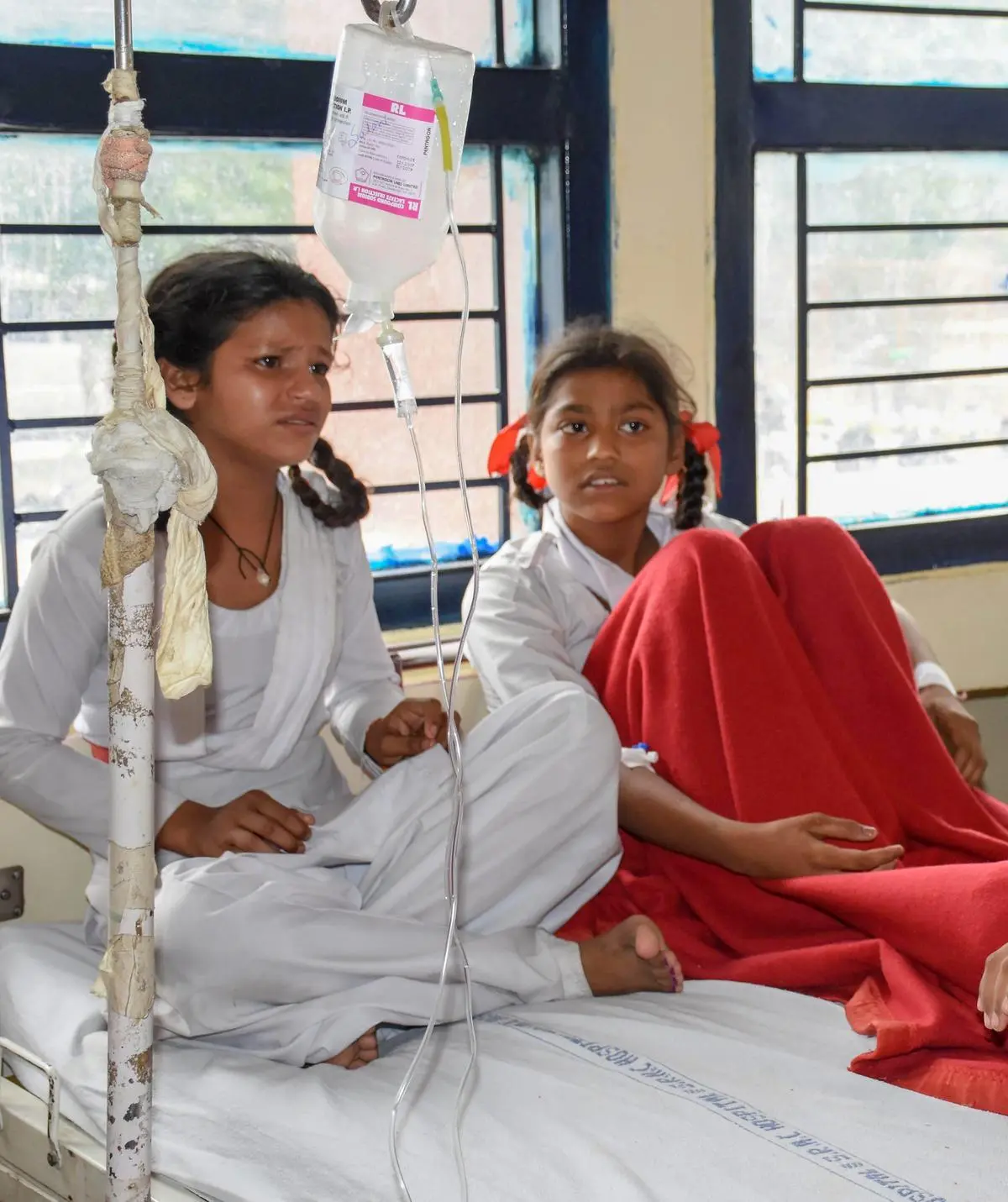
India’s economically vulnerable population comprises households that have escaped destitution but remain exposed to falling back into poverty due to inflation, health shocks, job losses, and climate risks. In the photograph, students undergo treatment at a hospital, in New Delhi on July 11, 2018, after 25 of them fell ill on consuming a mid-day meal at a government school in Delhi's Narela area. | Photo Credit: PTI
The MPI is an important policy tool that tracks deprivations in health, education, housing, sanitation, and basic services. It helps policymakers understand why people are deprived and where interventions are needed. But it was not designed to replace income- or consumption-based poverty measures. Even the Oxford Poverty and Human Development Initiative (OPHI), which, along with the Human Development Report Office of the United Nations Development Programme, co-developed the global MPI, is clear that multidimensional measures are meant to complement, not substitute, monetary poverty estimates. Lower-middle-income countries such as Bhutan and Vietnam, which are comparable to India, publish parallel estimates. They understand that asking “Can people afford basic needs?” requires different data from “Do people have access to schools and toilets?”
Definitions needed for sharper policy
International practice increasingly reflects this distinction. Countries such as those in the EU report relative income poverty rates alongside other indicators of material and social exclusion, rather than relying on a single headline figure. India too should perhaps move towards a dashboard approach—reporting an updated absolute poverty line aligned with lower-middle-income standards, together with income-based and multidimensional indicators—rather than treating any one metric as definitive.
By treating the MPI as a replacement, the government avoids a simple but unavoidable question: what level of income or consumption is considered sufficient to be non-poor in today’s India? Answering this is crucial to designing targeted cash transfers, setting minimum wages, or even determining who qualifies for subsidised food. This deflection also obscures important methodological changes behind recent poverty estimates.
The latest Household Consumption Expenditure Survey adopted a Modified Mixed Reference Period, which shortens recall periods for frequently purchased items such as food. This methodological shift likely improves accuracy as people remember yesterday’s purchases better than last month’s. But it also mechanically raises measured consumption and lowers poverty headcounts compared with earlier surveys. There is nothing wrong with improving survey design, but statistical credibility requires transparency, especially when methodological changes coincide with claims of historic poverty reduction.
Even within the MPI framework, the official narrative remains selective. The OPHI recommends tracking not only headline multidimensional poverty but also moderate multidimensional poverty, that is, households that suffer multiple deprivations but fall just below the standard cut-off.
18.7 per cent of the population vulnerable
These households are not the poorest of the poor but remain structurally vulnerable. The global MPI 2024 noted that while 16.4 per cent (233.6 million people) are MPI poor in India, an additional 18.7 per cent (266.3 million people) are vulnerable to multidimensional poverty. Therefore, focussing only on headline MPI reductions repeats the same problem seen in monetary poverty debates: celebrating exits from the lowest category while overlooking a large population living just above it.

Dharmendra Kumar, who works as a clerk at Pragati Maidan—which houses the main venue of the G20 Summit—with his wife Khusboo Devi, and their children inside their newly rented one-room house after their old house was razed to the ground during a demolition drive by the authorities near the summit venue, in New Delhi, on July 1, 2023. | Photo Credit: ADNAN ABIDI/REUTERS
Beyond the technical debate, there is also a procedural concern here. Lok Sabha Secretariat guidelines (OM No.19/10/XV/XV/2013-Q) require ministries to answer each part of a parliamentary question separately and clearly. They explicitly caution against “clubbing” replies in ways that obscure responses to specific sub-questions. Yet in several cases, distinct questions on poverty-line revision, methodological disparities, and harmonisation have been collapsed into a single generic response labelled “(a) to (d)” (eg, see Rajya Sabha PQ No. 784, February 10, 2025).
The guidelines are clearer still on another point: ministries are advised not to merely refer members to websites in their replies. Parliamentary answers are expected to contain the information itself, since online material is dynamic and cannot substitute for an authenticated response on the floor of the House. Despite this, recent replies, including those in Rajya Sabha PQ No. 1267, March 10, 2025, routinely end by pasting links to NITI Aayog MPI reports instead of addressing the questions asked. These are not minor procedural lapses. They undermine Parliament’s constitutional role in holding the executive accountable.
The debate over whether India’s poverty rate is 5 per cent or 24 per cent is not merely methodological. It directly shapes eligibility for support, fiscal targeting, and the scale of the social safety net. A framework anchored only to extreme poverty risks overlooking millions who live just above the $3.00-a-day but below any reasonable standard of economic security. As India moves towards its goal of becoming a developed country by 2047, poverty definitions must evolve accordingly; a Viksit Bharat cannot rest on a benchmark designed to capture bare survival.
The forthcoming National Household Income Survey (NHIS), scheduled for 2026, offers an opportunity to recalibrate this framework. As the first pan-India survey focussed explicitly on household incomes, it could provide a foundation for adopting a dashboard approach by combining an updated absolute poverty line aligned with lower-middle-income standards with complementary income-based indicators. In doing so, the NHIS can complement existing multidimensional measures and provide a more robust benchmark for defining non-poverty in contemporary India. This would help ensure that headline poverty reductions function as a reliable guide for public policy and meaningful parliamentary accountability.
Kumar Rajesh is a former LAMP Fellow (2015-16) and is currently a Chevening Scholar and an MPP candidate at the London School of Economics and Political Science.
Also Read | India is haunted by an unprecedented economic deprivation