





Zionist Israel is the only modern state midwifed by terrorism and which has adopted assassinations, treachery, and territorial expansion (“Eretz Yisrael”) as official policy. The most recent and egregious proof of this is its assassination of Iran’s revered Supreme Leader Ayatollah Ali Khamenei, five of his family members, and many Iranian nuclear scientists and military commanders, all while the Oman-mediated talks about the Iranian nuclear programme were ongoing and progressing well.
The reputable Stockholm International Peace Research Institute in Sweden has reported that Israel had “at least 90 nuclear bombs on January 1, 2026”. Yet, it attacked Iran—a country that is bound by a fatwah to not acquire nuclear weapons and is a Non-Proliferation Treaty signatory (which Israel is not)—on the grounds that Iran’s uranium enrichment programme could lead to it acquiring nuclear weapons and posing an “existential threat” to Israel! On the basis of this same specious argument, Israel destroyed Iraq’s Osirak nuclear reactor in 1981 and fed US and European allies with fake intelligence to impel them to attack Iraq in March 2003, Libya in December 2011, and Iran in June 2025.
To decipher Israel’s terrorism, treachery, and assassination traits, one must trace the antecedents of its Zionist founders.
On August 25, 1933, the Zionist Federation of Germany signed the Haavara Agreement with the Nazi government for the emigration of 60,000 German Jews, along with a portion of their assets, to Palestine.
In December 1940, the Zionist paramilitary group Lehi (also known as the Stern Gang) submitted a formal proposal to the Nazi regime (through its naval attaché at Ankara) stating that it would “recruit 40,000 Jews from Nazi occupied eastern Europe to support Germany in its war against the Allied Powers if it would enable creation of a Jewish state in Palestine”.
Most members of the Zionist Federation of Germany were from the “Zibur” (Zionist leadership) and hailed from Nazi-occupied east Europe. Among them were those who became Israeli Prime Ministers: David Ben-Gurion (born in Płońsk, Poland), Moshe Sharett (Kherson, Ukraine), Levi Eshkol (Orativ, Ukraine), Golda Meir (Kyiv, Ukraine), Menachem Begin (Brest-Litovsk, Belarus), and Yitzhak Shamir (Ruzhinoy, Belarus).
Four former Prime Ministers—Ben-Gurion, Begin, Shamir, and Ariel Sharon—were active members of the Lehi, Haganah, and Irgun terrorist gangs. Their most shocking terror acts were the assassination of Lord Moyne (Walter Edward Guinness), British Minister for the Middle East, in Cairo, on November 6, 1944; the bombing of the King David Hotel in Jerusalem on July 22, 1946, which killed 91 British military and civilian officers and staff; the assassination of Count Folke Bernadotte on September 17, 1948, for his peace proposals as UN mediator, which placed Jerusalem under international control and allowed Palestinian refugees to return to their homes; the Deir Yassin massacre on April 9, 1948, in which 240 residents of this Arab village, including women and children, were killed.
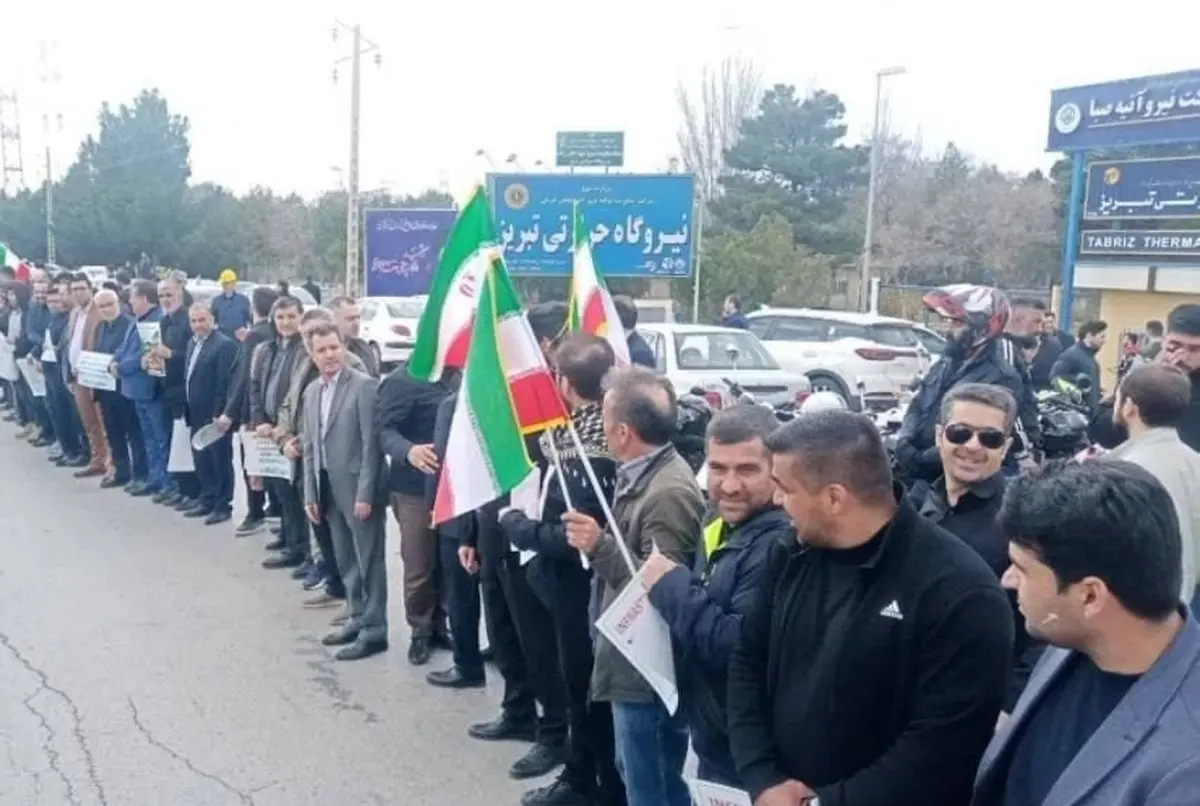
People make a “human chain” in Tabriz, Iran, to defend the city’s infrastructure against threatened US-Israeli attacks, on April 7, 2027. | Photo Credit: X/IRIB (Islamic Republic of Iran Broadcasting)
Revulsed by this massacre, 25 eminent Jewish intellectuals, including Albert Einstein, Rabbi Jessurun Cardozo, and Hannah Arendt wrote a letter to The New York Times on December 4, 1948, averring: “Among the most disturbing phenomena of our times is the emergence in the newly created state of Israel of the ‘Freedom Party’ (Tnuat Haherut), a political party closely akin in its organization, methods, political philosophy and social appeal to the Nazi and Fascist parties.... It was formed out of the membership and following of the former Irgun Zvai Leumi, a terrorist, right-wing, chauvinist organization in Palestine....
“On April 9, terrorist bands attacked the peaceful village [of Deir Yassin]... [killing] most of its inhabitants, 240 men, women, and children.... But the terrorists, far from being ashamed of their act... invited all the foreign correspondents present in the country to view the heaped corpses.”
Ronen Bergman, in his book Rise and Kill: The Secret History of Israel’s Targeted Assassinations, reveals that since its founding, Israel has assassinated 2,700 of its “enemies”. This book was published in 2018. The number is now likely over 3,000.
Israel’s agency for assassinating its “enemies” is the Mossad. Its director reports only to the Prime Minister. Its present annual budget is $2.75 billion.
In early 2025, an amazingly sinister Zionist project—involving honey trapping political, diplomatic, and corporate VVIPs with “sex vacations”—came to light. Its prime architect, Jeffrey Epstein, was allegedly a Mossad agent. Among his many alleged clients were US President Donald Trump, former US President Bill Clinton, Andrew Mountbatten-Windsor (formerly, Prince Andrew), the British politician Peter Mandelson, the US philanthropist Bill Gates, and former US Secretary of the Treasury Larry Summers. The aircraft that ferried them to the secluded Little St James Island in the US’ Virgin Islands was nicknamed in the media as “Lolita Express”. The “servicing” of every VVIP was fully videorecorded to ensure compliance with subsequent Mossad demands.
Donald Trump and his wife Melania are mentioned 38,000 times in the Epstein files. Also mentioned are Donald Trump’s sex “frolics”.
The malignancy that Israel’s Zibur founders gestated by collaborating with the genocidal Nazi regime has now metastasised into a global scourge that has infected the highest levels of US and west European polities. Sadly, it has also infected India.
Modi’s visit to Israel
In a July 9, 2017, email, Epstein wrote: “The Indian Prime Minister Modi took advice and danced and sang in Israel for the benefit of the US president. They had met a few weeks ago... it worked ! [sic].” This was a reference to Prime Minister Narendra Modi’s July 4-6, 2017, visit to Israel.
During Modi’s February 24-25, 2026, visit to Israel, he “sang and danced” even more than on his previous visit. The bilateral relationship was elevated to a Special Strategic Partnership for Peace, Innovation, and Prosperity, wherein the two countries committed “to integrating India’s and Israel’s advancements in AI, cyber security... biotechnology, agriculture and water management, defence platforms, and space exploration”.
This partnership was signed just two days before Israel’s treacherous attack on Iran, and at a time when India holds the chairmanship of the BRICS (Brazil, Russia, India, China, and South Africa) grouping, of which Iran is an important member. It was a grave betrayal not only of BRICS’ objectives but also of India’s vital interests, as it used to import almost 12 per cent of its oil requirements from Iran until 2018.
It is also pertinent to point out here that on the date this partnership was signed, if Israeli Prime Minister Benjamin Netanyahu had landed in any of the over 100 UN member countries or in New York City, he would have been arrested as a genocidal criminal in consideration of the International Criminal Court’s arrest warrants against him.
On May 13, the eve of the BRICS Foreign Ministers’ meeting in New Delhi, Netanyahu’s office revealed that he made a secret visit to the UAE on March 26, when the war against Iran was at its height. Greatly embarrassed by this revelation, UAE Foreign Minister H.H. Sheikh Abdullah bin Zayed Al Nahyan strongly denied its occurrence, but Iran’s Foreign Minister Abbas Araghchi asserted that its intelligence agency had confirmed it.
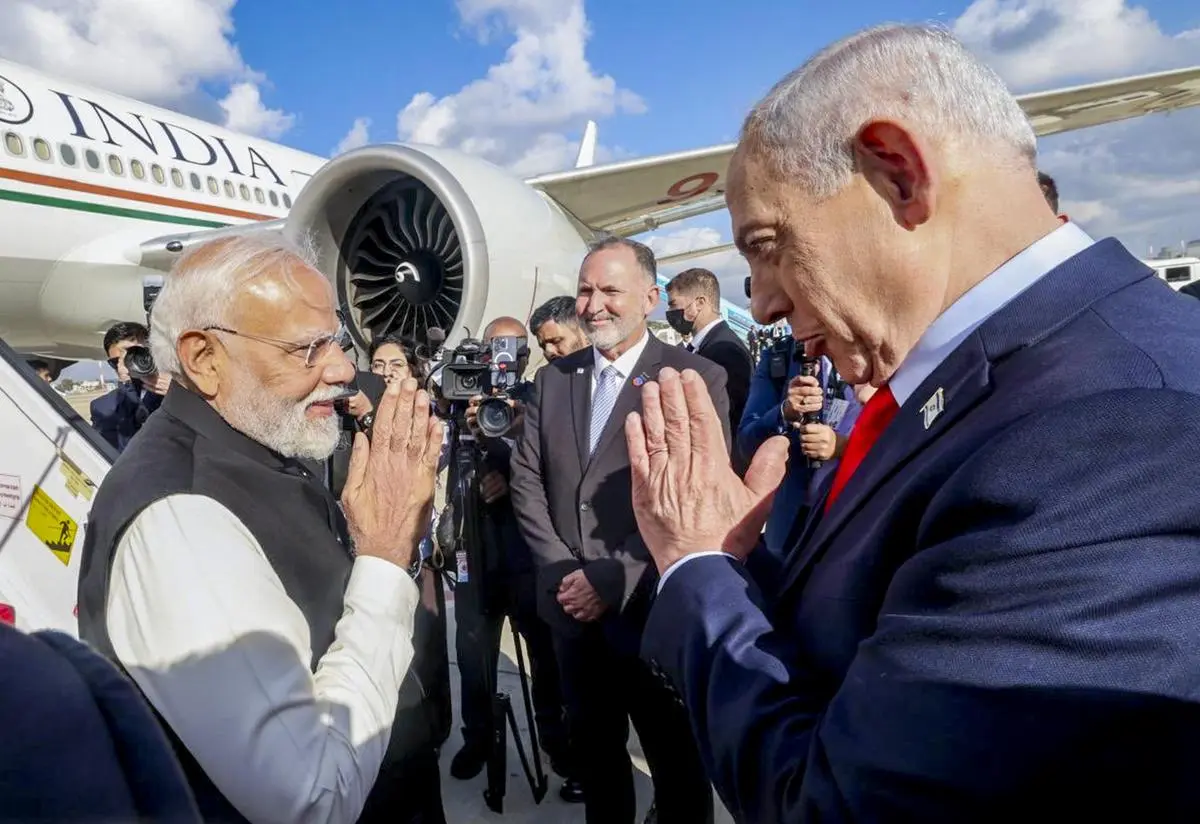
Prime Minister Narendra Modi with Israeli Prime Minister Benjamin Netanyahu during Modi’s visit to Israel. Image posted on February 26, 2026. | Photo Credit: @MEAIndia/X via PTI Photo
On May 15, Modi made a three-hour stopover in the UAE, en route for five European countries. After “substantive talks” with UAE President Mohamed bin Zayed Al Nahyan, Modi signed a special strategic partnership with the UAE on energy and maritime security. This has brought Modi closer to Zionist Israel than before, but it has lowered his stature in BRICS as most of its members strongly support Iran and condemn Israel and the US’ February 28 attack on Iran, carried out with the UAE’s collusion. Another tragic outcome is that Pakistan and not India has played the peacemaker role in the war.
As far back as 2004, the Australian writer John Pilger, in an article titled “The Unmentionable Source of Terrorism” in New Statesman, wrote: “A creation, then guardian of the west’s empire in the Middle East, the Zionist state remains the cause of more regional grievance and sheer terror than all the Muslim states combined.... the Israeli army, a terrorist organisation by any reasonable measure, is protected and rewarded in the west.”
In June 2025, UN Special Rapporteur for Palestine Francesca Albanese wrote on X: “My generation was taught Nazism is the greatest evil; and so it was.... Today, a state starving millions/shooting children for sport, shielded by democracies and dictators alike, is the new abyss of cruelty.”
Iranian strategy
That despite the devastating Israeli-US attack on it, Iran has neither collapsed nor surrendered but strongly retaliated with strikes on its attackers’ strategic assets is an amazing achievement. Its geographical size, mountainous terrain, and intrepid, deeply patriotic population (93 million people in 1.65 million sq km) have enabled this. So have the wide spectrum asymmetric warfare strategy it devised, the tailored weapons it produced, the secure storage bunkers it built, and the intelligence networks or militias it trained and equipped in Gaza, Lebanon, Iraq, and Yemen, to assist Iran whenever necessary. Its people’s deep patriotism and fearlessness was evident in the human chains they formed on the bridges that were likely to have been bombed by the US and Israel.
In its present confrontation, Iran has played its strategic cards skilfully. After initially firing low-cost drones and conventional missiles, it expended the high-cost Patriot, David’s Sling, and THAAD interceptors. It then launched successive waves (100 by April 15) of its hypersonic missiles with cluster “bomb” payloads. As Israel’s entire territory is only 22,000 sq km, every part of it is within a three-minute reach of Iran’s Mach 12 hypersonic missiles (Mach is a unit of speed; Mach 12 hypersonic weapons travel at 12 times the speed of sound). Also within reach of its missiles are all US strategic assets in Gulf countries.
Satellite images have clearly established the substantial damage Iran has inflicted on the US’ and Israel’s strategic assets. The former has lost 16 aircraft (including fighter jets and tankers) and 12 MQ-9B Reaper drones. Its bases in Qatar, Kuwait, and Saudi Arabia have been so severely damaged that an “emergency dispersal of personnel” had to be made. Two of its aircraft carriers had to be “moved out of the war zone” because of “accidental fires” on them.
Israel’s reported losses are 18 unmanned aerial vehicles, two Hermes 900 drones, and hundreds of its land-armour assets: Merkava tanks, armoured vehicles, and bulldozers. Its Nevatim airbase, Haifa naval base, Dimona Nuclear Research Centre, Eilat port, Ashdod port, Ben Gurion Airport, Bazan Oil Refinery, and electricity and desalination plants have all suffered substantial damage.
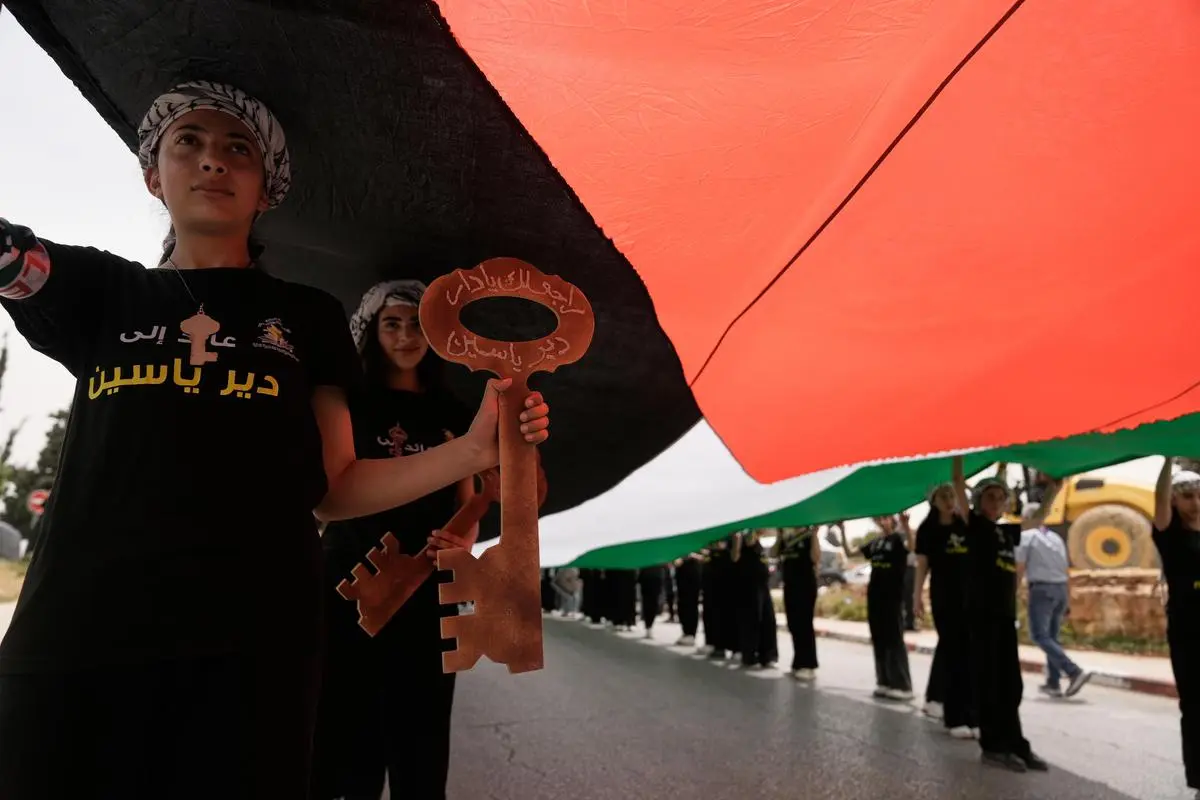
Students carrying a Palestinian flag and mock keys of the homes their families left behind (this one reads: "Deir Yassin; I am going back"), at event commemorating the Nakba Day, in Ramallah on May 12, 2026. | Photo Credit: Majdi Mohammed/AP Photo
Iran’s blocking of the Hormuz Strait, permitting only those ships that pay for its oil in Chinese yuan, is another clever move. An Asia Times article titled “Iran’s Hormuz yuan play is a direct hit on the petrodollar” said that the move “would represent a deliberate attempt to fuse military geography with monetary strategy”.
The more the petrodollar is replaced, the more difficult will servicing the enormous US national debt become. US debt rose from $34.5 trillion in January 2024 to $39.5 trillion in January 2026, since when it has probably risen further by $0.3 trillion. The US’ belligerent “close ally” Israel is primarily responsible for this.
The reputable Jewish historian Ilan Pappe, who has written many books since his 2006 The Ethnic Cleansing of Palestine, has titled his latest book Israel on the Brink (2025). Facts pertinent to this description of Israel are on March 31, 2026, the Bank of Israel reported that the 30-month multifront war had cost 177 billion shekels ($58 billion); since January 2024, Israel’s exports of polished diamonds have plummeted by 36 per cent; its tourist arrivals have dropped by 90 per cent, the losses from which are $3.4 billion; 1,50,000 Israelis, many of them hi-tech professionals, have exited Israel since January 2024; between October 2023 and April 2026, 942 Israel Defense Forces (IDF) soldiers were killed in Gaza and Lebanon, 60 died by suicide, and 80,000 were being treated for post-traumatic stress disorder; the ultra-orthodox Haredi Jews have been ceaselessly protesting IDF attempts to recruit them.
Peace in Israel, and Palestinian freedom
As Israel’s multifront wars are making its cities look more and more like Gaza, its citizens are increasingly craving for peace. Prominent among them is Mika Almog, former Prime Minister Shimon Peres’ granddaughter. She works with a coalition called It’s Time, with 50 peacebuilding organisations. As its director, she regularly organises workshops, music concerts, and peace events with the stated aim of galvanising Israelis and Palestinians towards a shared vision of peace and harmony.
Abroad, pro-Palestinian events, many led by Jewish Voice for Peace and Rabbis for Palestine, have been held in over 200 US, European, Asian, African, and Latin American cities in the last two years.
In October 2025, 174 countries voted in favor of Palestinian self-determination in the UN General Assembly. Just four countries—the US, Israel, Micronesia, and Nauru—voted against this. This scenario is quite similar to that in South Africa on the eve of the collapse of its Apartheid regime in February 1990 and the release of its long imprisoned “terrorist” leader. Some months thereafter, South Africa was transformed from a “pariah state” into a “rainbow coalition” with universal adult franchise. President Nelson Mandela was hailed as the “conscience of mankind”.
On December 4, 1997, Mandela declared: “Our freedom is incomplete without the freedom of the Palestinians.” During his five-year tenure, he consistently aligned the Palestinian struggle with that against apartheid in diverse parts of the world.
The great tragedy of the Jews is that after centuries of wanderings and massacres in many, mainly Christian, lands (six million Jews were killed in Germany!), when they finally secured a “homeland”, their leaders led them into it shackled with Zionism’s ideology and not with Judaism’s ennobling tenets, particularly those of Prophet Isaiah who had urged: “[Nations] shall beat their swords into plowshares, and their spears into pruning hooks; nation shall not lift up sword against nation, neither shall they learn war anymore.”
Jerusalem is deeply sacred in Judaism, Christianity, and Islam. Most sacred places of the followers of all three religions are within walking distance of each other. If Israel embraces Judaism’s noble precepts, Jerusalem would emerge as the world’s prime venue for religious pilgrimage and as an icon for interreligious harmony. If this happens, Iran can take some credit for the transformation by effectively countering US and Israel’s ultra hi-tech armed forces with low-cost asymmetric warfare tools and a fearless, highly patriotic people with deep faith in the Almighty.
Pascal Alan Nazareth has served in India’s diplomatic missions in Tokyo, Rangoon, New York, Lima, and London, and as High Commissioner to Ghana and Ambassador to Egypt and Mexico. An author of two books on Gandhi, he is also an U Thant Peace Award laureate.
Also Read | The merchants of war
Also Read | The enablers of Israel