





What must a book on archaeology do? What must it talk about, what must it show and tell, and what should it avoid? These are questions I have been thinking about after reading Sowmiya Ashok’s The Dig. Archaeology, like all things human, is political. Food, language, customs, religion, love, cinema, art are all political, as is the question of our past. And so a book on archaeology must necessarily talk about the politics of the past. But how do you do that without presenting the past?
I was a student of archaeology and film production at the University of Bristol in 2010. The course required me to shadow the production of Time Team, a television show that had become a cult classic since its first appearance in the mid-1990s. Scores of children and adults who watched it went on to become archaeologists themselves. Central to the show was Mick Aston, a professor of archaeology in Bristol University, and a personal hero.
On the sidelines of a shoot for an episode of Time Team at a Neolithic site at the bottom of a reservoir, Mick talked to me for an hour about what archaeologists must do. He urged me to go to my city, my neighbourhood, my community and tell its story. To give the people of that place a way to connect with the past and thus with each other. What he said reinforced something I think about often: we are all migrants, and all our stories are stories of moving, of finding a place we can temporarily call our own. And it is important that archaeology helps people do exactly that.
Mick’s one-on-one lecture burned deep into me and has stayed with me since. It is also how I judge any work that talks about history. The Dig wades fully into the political, personal, regional, and national currents that emerge from our past. Except, the actual archaeology is thin on the ground. Keeladi occupies very little space in the book.
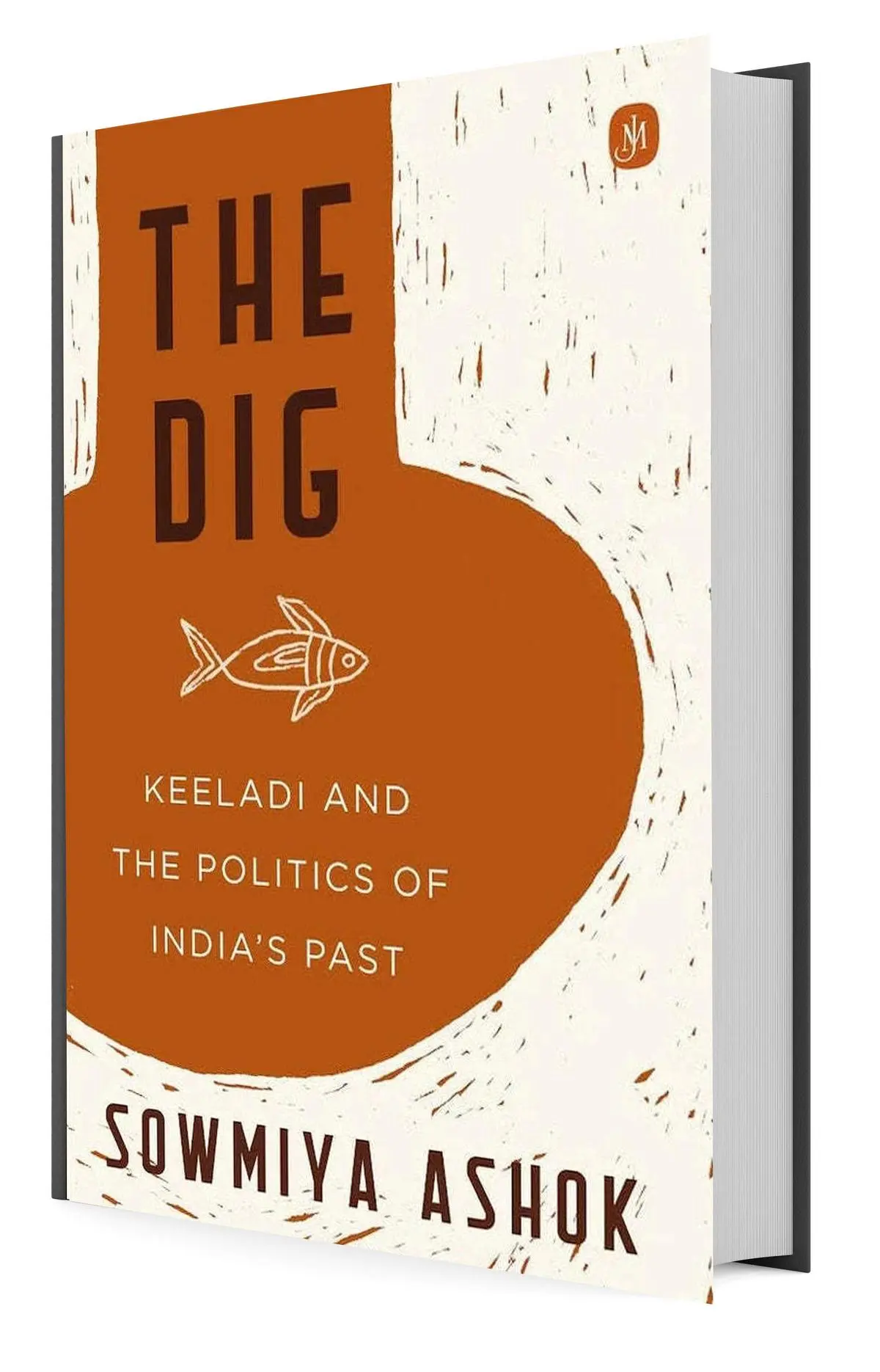
The Dig resembles how India and Indian governments thought of museums, where there is no attempt to curate the artefacts or present a story and where interpretations tend to be subject to the conservator’s fancy.
The Dig
Keeladi and the Politics of the Past
By Sowmiya Ashok
Hachette
Pages: 320
Price: Rs.799
The book begins with the archaeologist who first excavated the site but soon drifts away to present various debates about where the Indian people came from. We get fleeting visions of why Keeladi was dug, what came out of the ground, who put it all together, who pieced the stories together, and who told that story to the world. But these glimpses are often drowned out by Sowmiya’s travels and her attempts to understand the larger picture. As a reporter’s diary, the text is successful. However, for a book called The Dig, the dig does not feature much.
Pots. Pans. Rubbish. Brick. Sewers. Rice. Bones. Beads. Each one of these could tell us a lot about Keeladi. There are brief hints of individuals, but should we not be told these stories first before we get down to other matters?
Meant for a different audience, a different reader?
At various points, the book feels like it was written for an international audience, someone whose only context for Keeladi is that it is somewhere in India:
“Maharaja, the lorry driver, excitedly interrupted to reveal he had been eavesdropping. He told the archaeologists about the grove from where he routinely transported coconuts to the wholesale market. He had seen many broken pieces of terracotta pots on the ground there.
“The thing about archaeological discoveries is that they are often serendipitous. A chance finding while stepping on thorns, asking a passer-by, or cycling the same route every weekend. In this case, a man named after a king overheard a stray conversation.”
Maharaja is not the name of a specific king; at best, it is a category label. While this kind of writing can be seen as interesting, it ends up diluting the story: that of Keeladi. And that occurs throughout the book.
Potsherds are an archaeology classic. In many ways, the potter is the first professional in human history. For the first time, humans had more food than they needed for survival, so the question of storing and preserving arose. Pots—red ware, red and black ware, painted grey—tell us about who we are. Were they turned on a wheel or pieced together by hand? Was the clay substantiated with “inclusions” such as stone and metal? What were the decorations on them? Of the potsherds found across Tamil Nadu and Keeladi in particular, there is one amazing fact: many of them bear personal names.
Potters usually leave a scratch or a mark as a signature, placed when the clay is still “wet”, before it has been fired in a kiln. But what is special about Keeladi is that many of the potsherds have what is known as “post-firing” inscriptions, where users of the pot have put their names on it after purchase. This is a rare practice, not often seen in Indian archaeology.
This immediately tells us two things: first, that literacy was widespread. The common woman or man could and did write their names on their own property. This is an observation that has been made by several people, including those who reported the findings. The Dig, however, does not dwell on this important insight.
Second, and this should be relatable to every person who has a plate or tumbler at home with a name or initial inscribed on it, this practice of putting names on pots and pans has continued all the way to the present, over 3,000 years. Even today, in the streets of Tamil Nadu, you can spot a skilled artist outside a store selling “eversilver” utensils using a tiny chisel or nail and a hammer to inscribe the user’s name on the rim. Such comparisons bring Keeladi alive for us but are not there in the book. Perhaps the book is meant for a different audience, a different reader?
The author describes eating at various restaurants in Madurai. Journalism tells you that these add local colour, but here it may end up as exoticisation. Using your own experiences to situate a larger practice is good, and yes, the people of Keeladi did eat goat, chicken, cows, fish, and more. Perhaps the book could have explored how the scientists and archaeologists arrived at their conclusions; how the presence of cattle bones, especially those that are cut in certain ways that could not have been natural, indicate that they had been consumed by humans; how the presence of certain kinds of proteins in the layers of human bones tell us that the individual was indeed someone who ate suvarotti (goat spleen). Could we have spent a little time questioning where ideas of food taboos come from, given that the people of Keeladi had a closer relationship to the food they were raising and eating?
Once we contextualise the dig itself, the materiality of the evidence, it is easier to interpret the politics. If politics alone is the aim, why even talk about Keeladi? We have, as the State goes to the polls, a thousand issues to flag. We do not have to go to a controversial site and talk of language, caste, religion, north, and south—and incidentally say it also shows how city-building happened.
We could, instead, begin with the site itself, where we discovered a city on the banks of a river, a city of people who made bangles out of shells and made iron in crucibles and shaped wood and made dice out of stone and made pots and wrote their names on pots. This was some of the earliest post-firing writing, which means literacy was quite common. Incidentally, this is the same time that the Ganga was being urbanised, and there was no writing there. Which means literacy was better here, in the south, than there in the north.
Again, one could make the argument that such a book would be for a different reader. And so, the question is, who is the reader of this book called The Dig?
I have a pet peeve. Mohenjo-Daro, Harappa, Lothal, Dholavira, Rakhigarhi, Kot Diji, and more, are cities of the Indus Valley Civilisation, not “Harappan” cities. The first city of the Indus to be discovered was Harappa, but very soon, archaeologists and enthusiasts unearthed many more, and the grandest of them: Mohenjo-Daro.
There is a tendency to flatten the past, not just with the Indus cities, but all of Indian, Indic culture, where everything is seen from a Delhi-centric, Hindu/Indic lens. This is something that Sowmiya points out, too, in her book. It is then a little ironic that she herself falls for it, by calling Mohenjo-Daro a Harappan city. This is like saying Bombay is a “Delhi city” because Delhi is what the Western world knows better.
Sowmiya presents us with a lot of great material. But in many ways, The Dig resembles how India and Indian governments thought of museums, where there is no attempt to curate the artefacts or present a story and where interpretations tend to be subject to the conservator’s fancy. In this book, too, we go from one place to another, following the journalist along as she tries to make sense of the archaeology. But our view is hindered by the presenter, by what she thinks is important to present. And it seems that Keeladi itself is not. What could have really helped the book is a second round of edits, some tightening of passages and ideas, and a deeper engagement with the actual archaeology. I do wish this book had given us more Keeladi and the potsherds first and then showed us how they were pieced together.
Nadika Nadja is a writer and researcher with interests in history and archaeology, gender, the Internet, and technology. She writes on cinema, society, and technology and dreams of building a wooden yacht.
Also Read | Excavations at Keeladi open a new window into old times
Also Read | Tamil Nadu’s discoveries rewrite the Iron Age timeline and South India’s past