


Is “Hindu” a noun or an adjective? Does it signify a landmass, a race, or a set of qualities? Rajmohan Gandhi opens his concise and unsettling book, Do You Know Your Hinduism?: Notes for Modern-day Hindus, with these questions. He writes: “…most of the time ‘Hindu’ is employed as a noun, not as an adjective. The word is used for an individual or an organisation. Or for another ‘thing’. Not for an act. We speak of a Hindu temple, a Hindu locality, a Hindu school, a Hindu political party. Or, of the Hindu community. Not generally, of a Hindu ‘gesture’.”
This is a provocative assertion, more so because he places it alongside Christianity and Islam. He notes that we do not possess Hindu equivalents for expressions such as “Christian charity” or “Muslim faith”. Elaborating, he observes: “A ‘Muslim faith’ in God is taken as a faith unaffected by revolutions or disappointments. A ‘Christian act’ is a charitable or considerate act. A Sikh langar is a meal for everyone. In contrast, ‘Hindu’ is only occasionally used as an adjective. For the rest of the time, Hindu denotes the races bound up with India that is Bharat….”
Attempting a definition, Rajmohan Gandhi turns to D.S. Sarma, a scholar associated with the Ramakrishna Mission, who in 1966 described Hinduism as “at times seeming a religion more of birth and race than that of belief… an ‘ethnic religion’ which grew along with the nation that gave birth to it”. Is “Indianness”, then, the only defining quality of Hinduism?
This line of thought carries one to a 1917 speech by Sarojini Naidu. Addressing Muslim youth, she spoke of Islamic qualities: “Brotherhood is the fundamental doctrine that Islam taught—brotherhood of civic, intellectual, and spiritual life… leaving other creeds free to offer their worship. This is what we call modern toleration, the larger outlook, civilisation; the real understanding of those sources that bind human hearts to one another.”
Islam is also associated with sacrifice and patience: sabr. The capacity to endure, to resist injustice without surrender, whether one sees it in Gaza or Iran, is often traced to this ethical reservoir. Similarly, zakat—the obligation to share one’s earnings even with non-Muslims—marks it as a religion of care. Giving is intrinsic to Islam; service and neighbourliness are woven into Christianity. Sikhism, the youngest among these traditions, is recognised by its open langars, often the first to appear in moments of global distress. Rajmohan Gandhi’s question, then, acquires urgency: can we identify comparable qualities that the word “Hindu” evokes?
Hindus frequently argue that, because their religion lacks a single founding text or prophet, it is naturally liberal and pluralistic. But does the worship of many gods automatically yield a respect for pluralism? While many Hindus resist the label “pagan”, they take pride in polytheism. As Gurcharan Das has noted, these are not “jealous” gods: one may turn to different deities on different days. This allows for a certain flexibility. Yet its obverse is a relationship with the divine that may appear transactional, suggesting, perhaps, not freedom but the absence of a binding commitment to a single ethical demand.
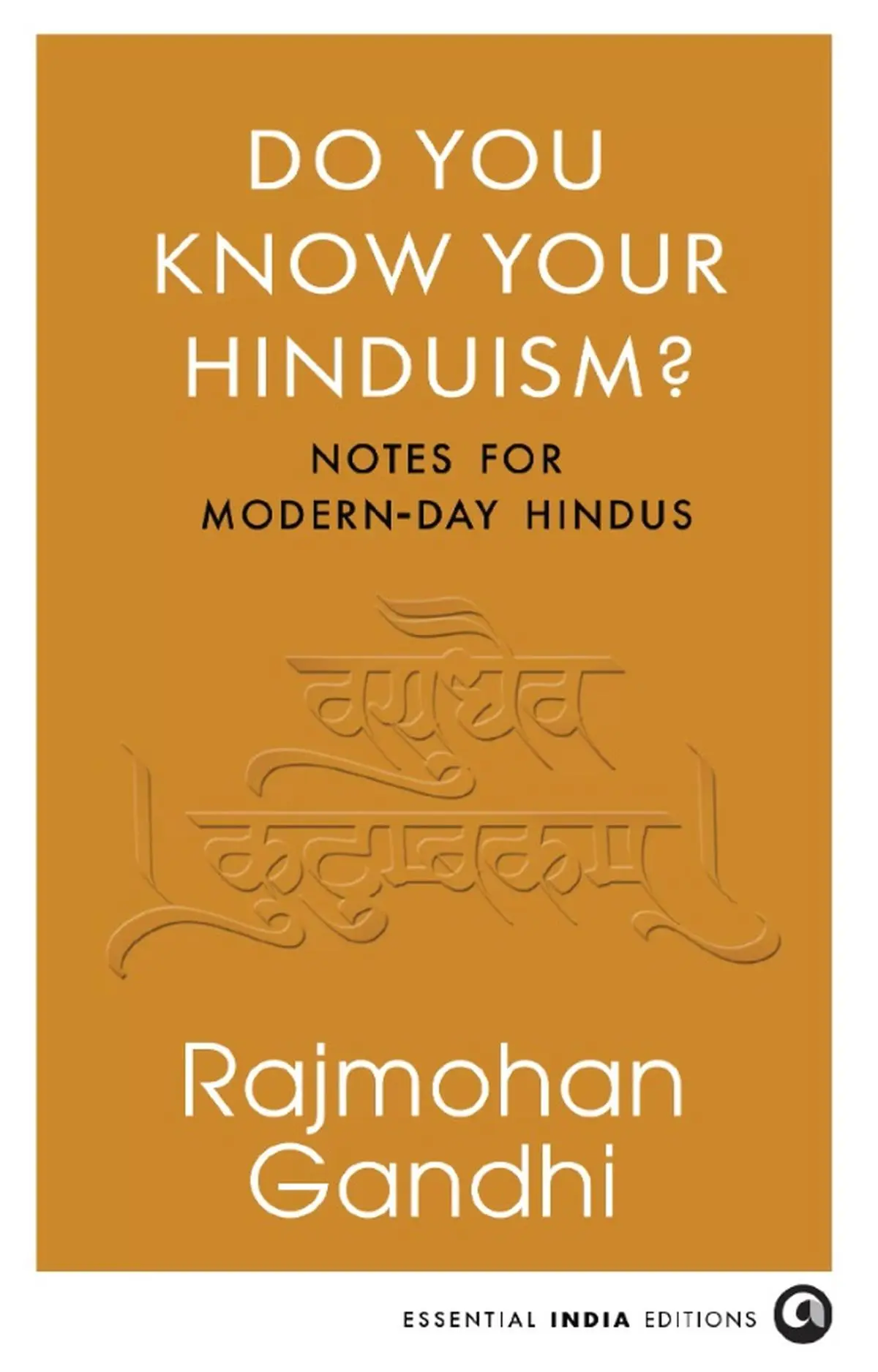
This bookis essential reading for Hindus of all kinds but especially for those who are taking Hinduism on the path of Hindutva.
Do you know your Hinduism?
Notes for Modern-day Hindus
By Rajmohan Gandhi
Aleph Book Company
Pages: 168
Price: Rs.499
It is also said that Hinduism’s greatness lies in its non-proselytising character. It lets others be. But this, too, can be read otherwise: as a closing of doors, as a reluctance—or inability—to reach out, to draw others into its fold through the force of its values.
A religion, however, is also known by those who embody it. For a long time, Hinduism found its public face in figures such as Mahatma Gandhi, Swami Vivekananda, Vinoba Bhave, and C. Rajagopalachari. Their moral stature lent Hinduism a certain radiance; their virtues were taken to be Hindu virtues. But who speaks for Hinduism today? Do the Shankaracharyas represent it? Or does Mohan Bhagwat? Do Narendra Modi or Yogi Adityanath embody its finest possibilities?
One has seen popes across the world speaking against hatred, urging compassion, and aligning themselves with the vulnerable. Hindu religious leaders, more often than not, appear to speak in the language of division and hostility. What does this say about the condition of the faith?
A religion may also be understood through the questions its adherents ask. What are the questions that occupy Hindus today? One persistent question remains that of Partition. It is as if Partition left an unhealed wound upon the Hindu psyche. Rajmohan Gandhi engages with this in a separate chapter. Yet one wonders whether such engagement will satisfy those who continue to harbour resentment against his grandfather, hating Mahatma Gandhi for not sacrificing his life to prevent the division of India. He points out that those who wanted the Mahatma to fast to stop Partition were themselves not opposed to it. All they wanted was an India that was free of Muslims or where Muslims had to live like second-class people.
These are not merely theological concerns. Rajmohan Gandhi’s central anxiety is about the public conduct of those who call themselves “modern Hindus”.
The push for centralisation
What, then, is modern Hinduism? One must first recognise that it is undergoing transformation. It appears to be moving towards becoming a more centralised, God-centric religion, seeking, perhaps, the cohesion and strength associated with Islam and Christianity. There are those among Hindus who feel that their tradition’s multivocality is a weakness, that it must acquire a centre to become powerful.
Since the late 20th century, a project led by the RSS has sought to place Ram at the centre. Ram Navami is now celebrated in regions where it once had little presence, such as Bengal and parts of South India. One recalls a slogan heard in West Bengal not long ago: “No Durga, no Kali, only Ram and Bajrangbali.”
The Gita is increasingly projected as the Text; Ram as God; Krishna, almost, as a prophet. Through “Krishna Niti”, adherents are instructed on how to navigate the world, not always through truth but through strategic half-truths and cunning, often justified by invoking Krishna’s counsel to Arjuna and the Pandavas.
There is an irony here. Those who are reshaping Hinduism in this direction seem willing to abandon what they themselves have celebrated as its distinctive strength: its “plurality”, its “absence of a single centre”.
Rajmohan Gandhi suggests that Hinduism is entering a new phase as a global religion. Hindus are spreading across the world in large numbers: partly because they are numerically dominant and economically better placed in India and partly because they face less global hostility than Muslims, who continue to encounter Islamophobia. Even as Muslims experience discrimination and violence within India, and have more reasons to leave India, it is Hindus who settle abroad in increasing numbers. They may worship India as their motherland, yet do not find that pull strong enough to keep them here. They seek their futures elsewhere.
India, for such Hindus, is their spiritual land. And the countries they have made their own are their worldly abode. Is their loyalty divided then? Have those countries asked them to cut their ties with India to prove their commitment to their new homes? Are they told, as they tell Muslims and Christians of India, that they do not have the first right on America, England, or Canada?
In Western societies, Hindus are largely accepted as equals. They enjoy religious freedom, cultural visibility, and political participation. They build temples; they rise to high office, even to the positions of Prime Minister or Vice President. But is this a reflection of Hinduism’s inherent greatness or of the openness of Western societies? And what are we to make of the contradiction wherein some who enjoy these freedoms abroad support the denial of similar freedoms to Muslims and Christians in India?
In places like New Jersey, one has seen processions featuring bulldozers, now charged symbols of violence against Muslims in India. In London, Hindu groups have been implicated in communal tensions. Reports of caste discrimination continue to surface within institutions where Hindus hold influence. What image of Hinduism travels outwards through these actions?
Rajmohan Gandhi asks: “Is the world watching the Hindu race’s growth with curiosity? With gladness? With hope? Or, with concern, fear, or even hostility?” The answer is not comforting.
Religions must change. Antiquity alone cannot be the ground of pride. Hindus often speak of rising “Hinduphobia”. But Rajmohan Gandhi turns the question inwards: might the conduct of Hindus themselves—their endorsement of Hindutva politics—be contributing to this estrangement?
Do you know your Hinduism? is essential reading. For Hindus of all kinds but especially for those who are taking Hinduism on the path of Hindutva. It does not accuse so much as it asks, quietly and insistently. It asks those who take pride in their “Hinduness” to articulate the qualities that might justify that pride. And it leaves us with a final, unsettling question: will “Hindu” remain a noun, marking identity alone, or will it, one day, become an adjective, signifying a recognisable ethic, a way of being that can be named in action?
Apoorvanand teaches Hindi at Delhi University and writes literary and cultural criticism.
Also Read | Homogeneity is alien to Hinduism: Manu S. Pillai
Also Read | Hindutva’s foreign roots