


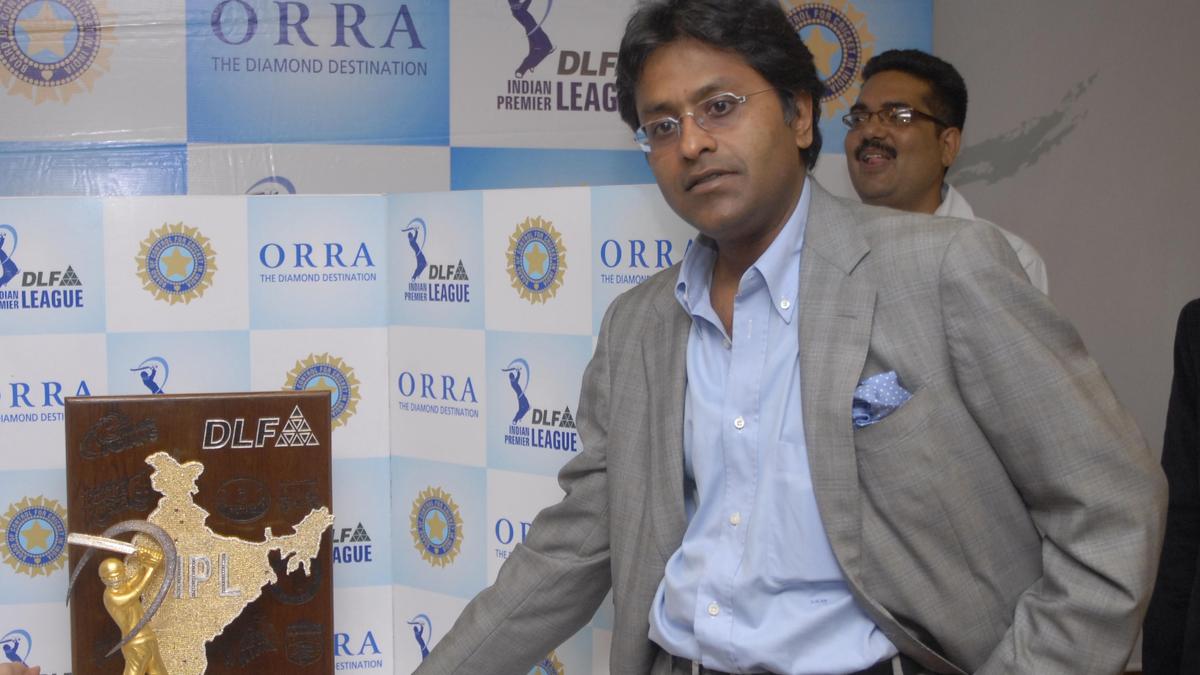
The Indian Premier League, a multi-million-dollar, football-style, franchise-based domestic competition conceived and executed by Lalit Modi, has propelled cricket into the fast lane. | Photo Credit: The Hindu Photo Library

The Indian Premier League, a multi-million-dollar, football-style, franchise-based domestic competition conceived and executed by Lalit Modi, has propelled cricket into the fast lane. | Photo Credit: The Hindu Photo Library
There is a tendency now to treat the Indian Premier League (IPL) as if it arrived fully formed, with billion-dollar valuations trailing in its wake.
In Lalit Modi’s telling, it was anything but. It was imagined early, abandoned once, challenged by rivals, dismissed by the market and then, almost improbably, forced into existence.
“The idea to me was always to be the biggest league in the world,” Modi, the first chairman of the IPL, says. But the idea predates the IPL. “When I conceived it in the early ‘90s, it was called the Indian Cricket League. If you check who owns the domain name, it is not Subhash Chandra. It’s Lalit Modi.”
According to Modi, that first version, an eight-team, city-based competition, came close to life in 1995. “It was all set up, approved by the Board of Control for Cricket in India (BCCI). We spent $17 million to $20 million. All the top players were hired. It was an eight-team format: Delhi Panthers, Mohali Stallions, Gwalior Cobras, Calcutta Tigers, Bangalore Bulls, Chennai Tuskers.”
It collapsed just as quickly. “There was a requirement of too many underhand payments, and I decided this is not the way it’s going to work. And we shelved it,” Modi says.
The idea waited. When it returned a decade later, it entered a changed ecosystem and a rivalry.
“When I was launching the IPL, the first person I went to was Subhash Chandra. I said, ‘Would you like to buy the IPL rights?’” Modi says. Chandra declined and built his own league. “He picked up two of my people to develop the Indian Cricket League.”
Modi calls him “a great adversary”, but is clear about the flaw in Chandra’s system of “owning all the teams, all the broadcasting and all the players”. His own model would move the other way.
Yet the larger obstacle was indifference.
“We went to all the broadcasters. Nobody came in. Everybody came back with a no.” Investors were no better. “I’m making presentations to over 1,000 businessmen. Ninety-nine per cent didn’t understand what we were talking about.” Even within the BCCI, “not a single person could understand except for two.”
The problem, he realised, was cultural.
“I needed to attract the audience of the Saas Bahu shows on TV. That’s where the money was. The bulk of the Indian advertising money sat on the eight o’clock time slot,” he says. “I decided to do a paradigm shift. Night cricket. Eight o’clock start. Music, dancing, fun.”
The logic is blunt. “I needed to attract women and children… that is where the money was.”
The product still needed a trigger. And it arrived, unscripted, in 2007.
“You know the story of Yuvraj Singh’s six sixes already,” Modi says. “India winning over Pakistan, huge, huge. We bring them back as heroes. Millions of people come. That helped it.”
The IPL had its first advertisement.
But emotion could not substitute structure. “I explained, the first pillar is the broadcaster. Without broadcasting, we don’t have a pillar,” he says.
Sony’s interest came with a condition: “We will buy it, provided you have the top 100 players.”
“The task became to find the top 100 players,” Modi says. “You need Team India, without doubt. If you don’t have Team India, you have a problem.”
Even as he scrambled for players, the media rights auction brought the league to the brink.
“So, Sony signed the contract as a sub-licensee of World Sports Group. There were only three bidders, ESPN, World Sports Group, and Sony,” he says.
“ESPN’s bid was revenue sharing. ‘If we do well, we’ll give you 50 per cent.’ I threw them out.
“Before I opened the Sony bid, minutes before, they withdrew. It was hand in glove. I’m in front of live media. I don’t know what’s going to come.
“I opened the World Sports Group bid. It’s a billion dollars. It was a mindset number… I needed the headline to be, ‘IPL has the audacity to ask for a billion dollars’. So, we have a billion-dollar cheque guaranteed. We don’t have a broadcaster at that point in time.”
From there, he says he turned to franchise owners.
“4th of January was the opening of the franchisee tenders. The minimum bid price was 50 million paid over 10 years,” Modi says. “If you bid a minimum of 50, I’m going to give you back five. You’re only giving me five; the rest is your ego money.
“You’re going to get ticketing revenue, team sponsorship, food and beverage, and 60 per cent from the central pool.”
He tried to sell belief. “If you believe in me, it’ll be so big, you don’t have to ever look back.”
But few did.
“None of them believed it, Airtel, Tata group, Birla group, ICICI, HDFC. None of them believed it,” Modi says.
So, he made the risk explicit. “If the IPL doesn’t work in year one, I will tear up all these agreements and cancel IPL year two.”
It was not just a league being launched. It was a wager.
“I put my entire career on the line. I put all my goodwill on the line,” he says. “We formed our own team, paid from our own pocket… and with Sharad Pawar, we got it up and running.”
“And fortunately for us, it worked.”
Published on Apr 08, 2026
此内容由惯性聚合(RSS阅读器)自动聚合整理,仅供阅读参考。 原文来自 — 版权归原作者所有。