








For the 30,000 or so people who call themselves residents of Shahabad Mohammadpur, a vestige of Delhi’s aggressive urban land reclamation policies after Independence, the rumble of jet engines and aeroplane wheels on runways are ordinary sounds that serenade the day.
The village is an urban peninsula hemmed in by the barbed wire of the Indira Gandhi International Airport on three sides. In the summers, the heat of the tarmac combines with the carbon emissions; in the monsoons, waterlogging is an unwelcome guest—the barbed wire able to contain neither the heat nor the water. The village, however, finds relevance today for its fourth side, away from the airport. What appears to be a forest forms this border, in stark contrast to the concrete aerodrome, with an abundance of green, chirping birds, and nilgais.
This patch of land, an ecosystem that would come to be known as the Dwarka forest, is separated from the village by a railway line flanked by forest land on the Delhi-Jaipur route. The forest, a site of respite for the villagers and animals of Shahabad Mohammadpur, is now the subject of legal battles between environmentalists and the railway authorities. As per the judgment by the Supreme Court of India in Naveen Solanki v. RLDA on March 20, 2026, what appears to be a forest might not be a forest at all.
Dwarka forest is an area of over 120 acres in southwest Delhi—a self-grown, unplanned natural forest that developed in the shadow of Delhi Airport’s Terminal 3. It is a contiguous mix of dense woodland, grassland, and a seasonal waterbody.
Historically, it constituted an agricultural patch belonging to the nearby villages of Shahabad Mohammadpur and Bhartal, until it was acquired by the Delhi Development Authority in 1986. The land remained unremarkable until 2008, when it was leased to the railways for an Integrated Metropolitan Passenger Terminal project and recorded as barren land. It was subsequently earmarked for multi-use development as part of the larger Bijwasan Railway Station redevelopment in the Delhi Master Plan of 2015 and later in 2021.
As ownership and function changed hands over the decades after its initial acquisition, the land gradually and quietly welcomed nearby flora and fauna that overwhelmed the area and lent it the appearance of a lush forest. The remnants of the village that once occupied the land surface through old wells hidden beneath thick undergrowth.
Estimates by the Delhi Forest Department in 2025 recorded about 20,000 trees of 33 varieties, while independent surveys by Land Conflict Watch put the figure at up to 25,000 trees. Of these, 15 species are native to the Indian subcontinent, including ecologically significant trees such as babool and khejri. The area supports about 65 bird species, among which 15 are migratory, owing to its location along the Central Asian Flyway. Other fauna include herds of nilgais and a rich diversity of butterflies, dragonflies, beetles, and other insects.
What is remarkable about the forest is its emergence amidst intense human intervention. Landscapes such as these are referred to as novel ecosystems—systems that arise through both intentional and unintentional human influences. They are recognised as persistent, evolving in response to local and contemporary climatic conditions, often in contrast to formally restored sites. Although such forests may appear “accidental” in relation to planning and administrative intent, they are entirely natural in ecological terms.
In one of the landmark judgments in the T.N. Godavarman Thirumulpad v. Union of India case, the Supreme Court clarified that the term “forest” must be understood by its dictionary meaning—that is, any area where vegetation forms a dominant presence, irrespective of land ownership. The court further established that the definition of a forest extends beyond areas formally recorded as forests in government records to include deemed forests, such as private forests, community lands, and other areas with forest-like characteristics. As per a 1997 affidavit, the Delhi government stated that areas larger than 2.5 acres with a density of at least 100 trees per acre would qualify as deemed forests.
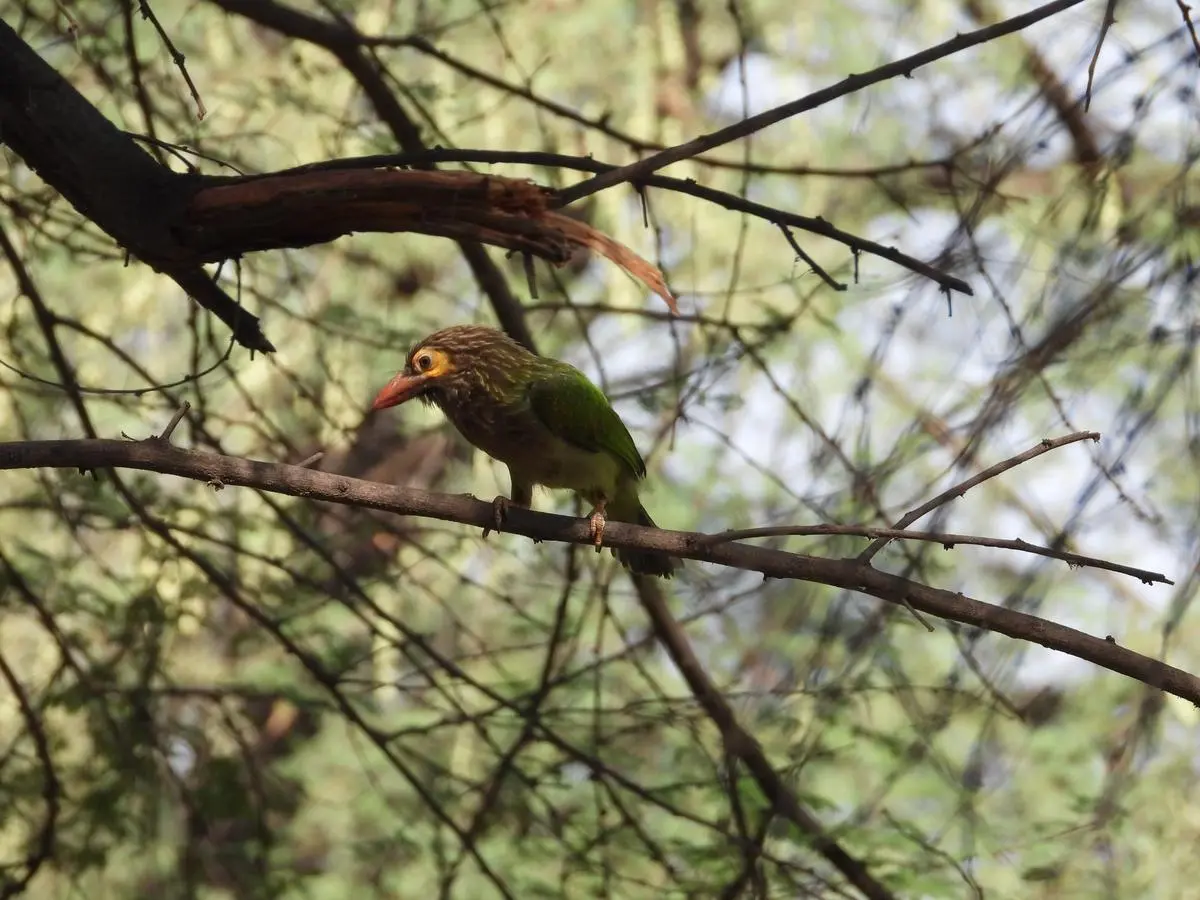
A brown-headed barbet (Psilopogon zeylanicus) spotted at Dwarka forest. The area supports about 65 bird species, among which 15 are migratory, owing to its location along the Central Asian Flyway. | Photo Credit: Green Peace
The distinction between a “forest” and a “deemed forest” is not ecological but administrative. In the dictionary sense, both are forests; the latter simply awaits formal notification and legal recognition.
In subsequent environmental jurisprudence, however, the Supreme Court has emphasised the need to evaluate past land use, present ecological conditions, and potential future use when determining the legal status of forest land. In the absence of formal recognition as a forest, Dwarka forest’s present ecological identity remains legally vulnerable.
The search for protection
On January 12, 2022, Naveen Solanki, a local activist and resident of Shahabad Mohammadpur, noticed construction activity in the forest area. He lodged a complaint with the Delhi Forest Department, which upon inspection found that about a thousand trees had been damaged, and imposed a fine of about Rs.6 crore on the Rail Land Development Authority (RLDA). “Several trees were buried under soil and construction waste, to the point it reached their canopies. The trees had to be excavated from under the soil,” Solanki said.
Following this, the RLDA allegedly stepped up tree felling and construction activity. In May 2023, the RLDA leased the land for 99 years to Bagmane Developers Pvt. Ltd (BDPL), a Bengaluru-based company, for mixed-use development. R.M. Asif, a lawyer, filed an application contesting the RLDA’s proposal with the National Green Tribunal (NGT), claiming “deemed forest” status for the land. The tribunal rejected the application, citing the Forest Conservation (Amendment) Act, 2023’s exclusion of “deemed forests” from protection.
Solanki, and Ajay Joshi, an animal rights activist, appealed the NGT order in the Supreme Court, arguing that Dwarka forest qualified as a forest under broader definitions from previous judgments. An independent survey found that the tree density in the area exceeded 100 trees per acre in sample plots. This prompted the Supreme Court to grant an interim stay order on any construction activity in the area.
Despite this, Solanki alleged that construction waste dumping persisted. “I used to patrol the site regularly, and would notice that the dumping issue was still prevalent. I negotiated with the people who would do it, even alerted the police, but no action was taken,” he said. “They even tried to offer me money to turn a blind eye. There are designated dumping sites in Najafgarh, but they continue dumping construction and development waste here to save costs.”
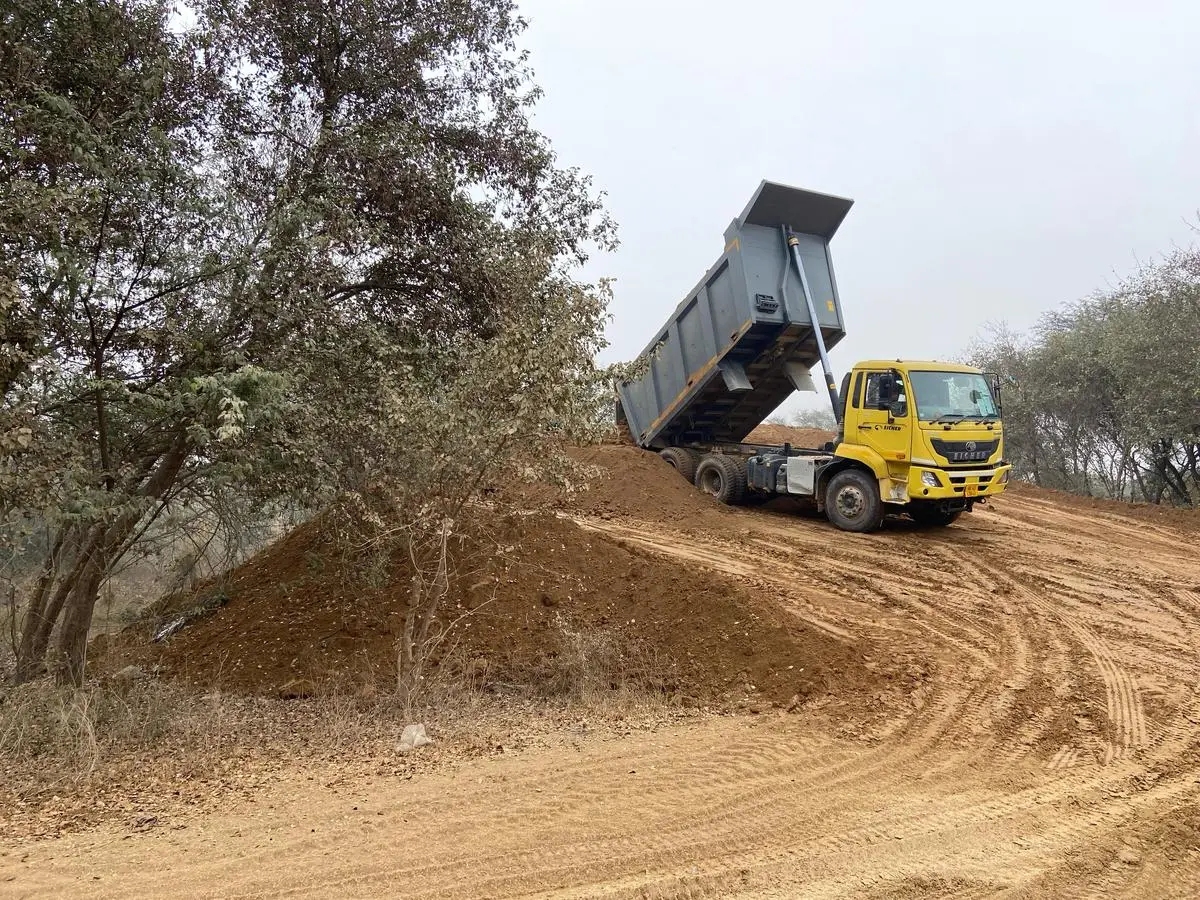
The stay order did little to halt construction and dumping activities at the forest. | Photo Credit: Naveen Solanki
Solanki also said he was the victim of an incident in which he tried to stop tractors from dumping construction waste, and the tractors charged at him and ran over his foot. He alleged complicity of the police with the assailants, saying no FIR has been lodged despite photographic evidence of the tractors and the perpetrators. Despite the threats to his safety, Solanki has persisted in his efforts to save the forest.
The judgment
On March 20, 2026, in its judgment in Naveen Solanki and Another v. Rail Land Development Authority and Others, the Supreme Court dismissed the appeal filed by Solanki and Joshi against the NGT ruling, effectively granting the RLDA clearance for the felling of over 1,200 trees in the Dwarka forest. The bench comprising Justices Augustine George Masih and Dipankar Datta established the primacy of the Master Plan in the relevant environmental jurisdiction, ruling that subsequent growth of vegetation, even dense tree cover as in the case of the Dwarka forest, cannot override a previously drafted Master Plan.
Advocate Ankur Sood, who represented the petitioners, pointed to the significant time-lag between notification of a Master Plan and the commencement of construction or development. “The citizen doesn’t go around checking patches of land under the Master Plan,” Sood said. “We only come to know about deforestation when trees are actually being felled. There is a big time difference between when the Master Plan is enforced and when construction starts.” He warned about the precedent this judgment sets.
In its affidavit before the NGT, the RLDA stated that the land was part of the Master Plan of Delhi, 2021, and that when it was handed over by the DDA in 2008, it was “a completely barren land with no tree(s) nor any significant vegetation.” It argued that the growth of “some shrubs and trees” over time did not make it forest land, and that the land was not recorded as forest in any municipal revenue record. The RLDA also pointed to a clause in the Request for Proposal requiring successful bidders to obtain all forest and tree clearances as per law.
Bagmane Developers, through senior counsel, made a similar case, citing Google Earth photographs from 2009 to argue that no greenery existed when the land was transferred to the railways. It also submitted that an application had been filed before the Delhi Forest Department for the removal and transplantation of trees, and that 20 per cent of the project area would be retained as green cover. The Ministry of Law and Justice, the developer noted, had opined that commercial development on railway land fell within the definition of “railway” under the Railways Act and required no Environment Ministry clearance.
The court ruled that the relevant date for determining the land’s character is the date the Master Plan came into force. Subsequent natural growth of vegetation, no matter how dense, cannot override a pre-existing planned land use, a ruling that threatens protection for urban forests that arise spontaneously. Sood argued that environmental protection should take precedence over statutory planning documents. “These small patches are of great value to the city, and environmental protection is the need of the hour,” he said.
“Based on the contours of the judgment, other safeguards have been granted that are not necessarily under the Forest Act,” said Sood. The judgment stipulated that 20 per cent of the total built area must remain green, and the developer is to undertake all necessary measures for tree clearances, including a transplantation initiative. “This 20 per cent can be spread out across the project in any form, even artificial grass, and cannot be compared to a forest,” said Solanki. “Transplantation is also a myth. Most of the trees transplanted during the Dwarka Expressway construction have died,” he alleged.
Official data from the Delhi Forest Department show survival rates as low as 33 per cent in transplantation projects between 2019 and 2021, with only one of 22 projects meeting the mandated 80 per cent threshold. Of the total trees transplanted for the Dwarka Expressway Project in one stretch, only 27 per cent survived. In the Central Vista redevelopment, 43 per cent of transplanted trees perished.
The judgment pertains only to about 30 acres of the total land, which has been leased to BDPL. About 95 acres that remain unallotted are stayed under the NGT. “In light of the judgment, we will try to work out the best outcome to the NGT case,” said Sood. Solanki, however, worries that the NGT order might be influenced by the Supreme Court order. “If the tribunal wanted to save the forest, they could have passed a judgment way earlier,” he said.
Upon repeated attempts to reach the RLDA and Bagmane Developers, the officials did not comment on the matter.
Invasive or adaptable?
Of the 33 tree species documented in the Dwarka forest, only 15 are classified as native. The majority are classified as “invasive species,” a point the Supreme Court picked up in its judgment, saying, “The subject land consists of 70 per cent trees of such invasive species which are not beneficial for maintaining ecological balance rather disrupting the native biodiversity.”
Environmentalists and scientists argue for a different perspective on these tree species, such as Neltuma juliflora (formerly Prosopis juliflora), colloquially known as vilayati kikar. It was introduced to Delhi by the British and now spans more than 60 per cent of the city’s green cover, according to environmentalist Pradip Krishen. “The affidavit that was filed does not distinguish between the nature of species. Other forests in the city consist of just the same trees as the Dwarka forest,” said Sood. Solanki argued that the “invasive” label has been selectively invoked to legitimise the removal of green spaces for development.
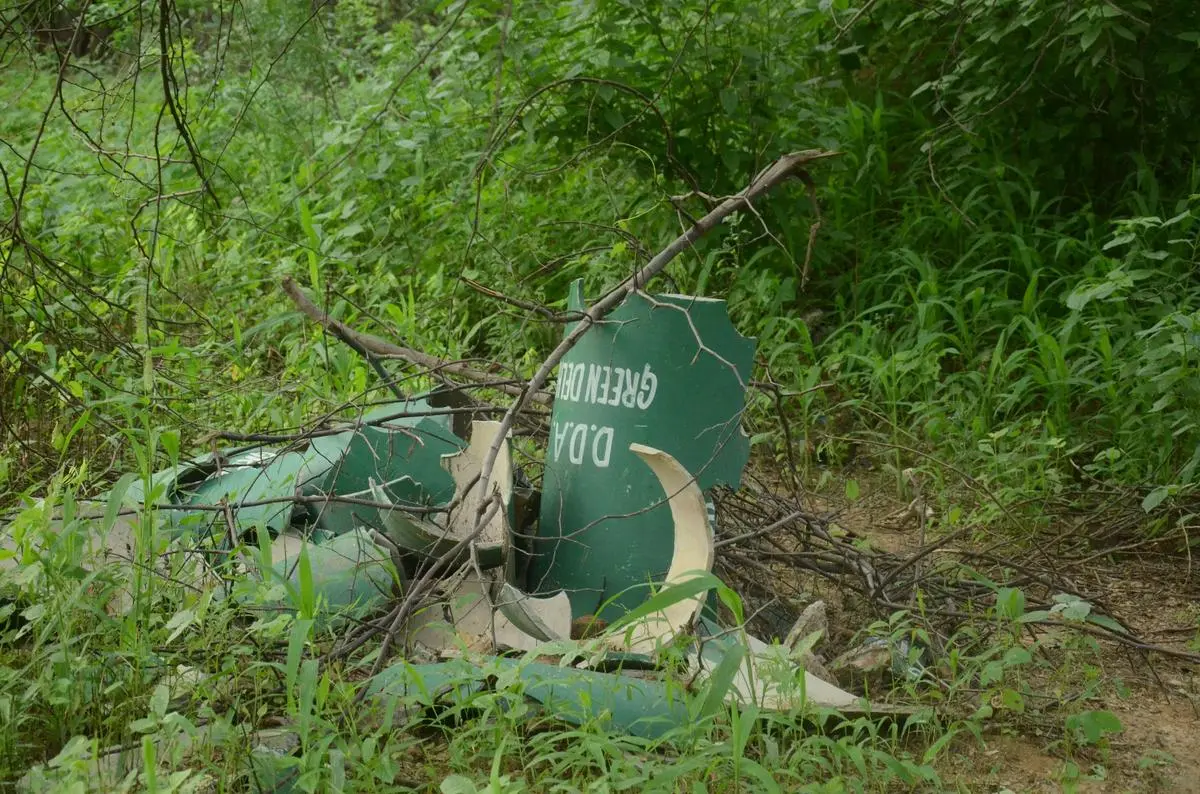
Waste dumped inside the forest. | Photo Credit: Nirjesh Gautam
A 2017 study published in Tropical Ecology challenges the assumption that vilayati kikar causes a decline in native plant biodiversity. Similarly, research published in Plants, a peer-reviewed journal, suggests that invasive species often form new assemblages, reshaping species associations rather than simply displacing native flora. A senior forest official clarified that the complete removal of vilayati kikar is no longer under consideration, given its significant contribution to Delhi’s green cover and carbon sequestration.
The Delhi Forest Department has acknowledged the significance of such long-established species, noting in its official observations: “Prosopis trees and shrubs have become naturalised constituents of many natural and cultivated ecosystems; their total eradication is not only ecologically risky but technically and economically impossible.”
Equally concerning is the limited recognition of the presence of nearly 60 nilgais in the area. The nilgai is a protected species under Schedule III of the Wildlife Protection Act, 1972. “The decision has already triggered construction activities in core areas where nilgai rest, and it appears that they are under stress… Soon there will be reports of roadkill,” cautioned Solanki.
This case rests on the Forest Conservation (Amendment) Act, 2023, which narrowed the scope of protections by limiting the parent Act’s application to lands officially recorded as forests. The judgment reinforces a static understanding of what constitutes a forest, privileging “naturally evolved indigenous ecosystems”. If applied rigidly, this could render ecologically functional areas such as the Delhi Ridge legally vulnerable—not because they lack ecological value but because they do not conform to an idealised notion of “native” nature. In the Delhi Ridge, vilayati kikar’s dominance can reach as high as 94—96 per cent, as noted by Pradip Krishen.
In response to a query in the Rajya Sabha, between 2021 and 2025, about 293 acres of forest land was diverted for non-forest use in Delhi, according to the Ministry of Environment, Forest and Climate Change. Novel ecosystems such as Dwarka forest deliver a range of ecological services, including water filtration, soil erosion control, carbon sequestration, and soil formation—services of particular value to a city with a notorious record on pollution.
For the residents of Shahabad Mohammadpur, the airport on three sides and a construction site on the fourth will complete the encirclement.
Harishankar Manoj is a freelance journalist based in Delhi. Nirjesh Gautam is an independent researcher and writer based in Greater Noida, and an active participant of the Save Dwarka Forest campaign. Himanshi Aggarwal is a freelance journalist and documentary filmmaker based in Delhi.
Also Read | A green light that experts say ignores the evidence
Also Read | Your reusable cup won’t save us