


Asha Bhosle lived for 92 years. The first Indian talkie, Alam Ara, was released in 1931— two years before she was born. She recorded her first song in 1943 at the age of ten, “Chala Chala Nav Bala” for the Marathi film, Majha Bal. By the 1950s, Indian film music had entered a golden phase, with composers blending classical raga-based melodies with Western influences, creating a richer and more popular sound. Asha Bhosle’s journey not only paralleled this transformation but came to embody it. Her career intersected with, and in many ways reflected, the lives and legacies of generations of composers, musicians, and lyricists. Through her voice, one can trace the arc of the Indian film song itself—its birth, its evolution, and its enduring reinvention across decades. Her life spanning nearly the entire evolution of Indian film music itself.
The story of Asha Bhosle is not for the faint-hearted; in many ways, the same could be said of both Dinanath Mangeshkar’s daughters, Lata Mangeshkar and Asha alike. After the early loss of their father, both sisters were thrust into adulthood, compelled to shoulder the burden of sustaining their family at an age when most are still sheltered by it.
While Lata remained steadfastly devoted to her family and her music, Asha’s path was more turbulent and adventurous. She left home to marry a man much older than herself, only to find the marriage collapse, leaving her to fend for herself and her three children. In the recording studios, she faced repeated rejection—her voice, many felt, bore too close a resemblance to Lata’s in tone and expression.
“My musical talent was all that I had,” she would later recall—and she made it count. Through sheer hard work and persistence, Asha carved out a space where none seemed available. She reshaped her voice, giving it a distinct character of its own. Listening closely to Western music, she absorbed its boldness and rhythmic vitality, blending it with the inherent sweetness of her singing to create a style that was entirely her own. Over time, she became indispensable to the film industry – altering its very soundscape.
Asha was, in effect, negotiating several battles at once: the collapse of marriage, the severity of an unforgiving industry, and the quiet but constant comparison with her own sister, Lata, the undisputed diva of film music. In a Doordarshan interview, the stoic and pragmatic Asha had remarked: “Have you ever seen my sister or I go to the press about not getting enough opportunities? This is showbusiness, you stay relevant or leave. There’s no room for mourning.”
When Asha Bhosle received the coveted Dinanath Mangeshkar Award, Lata Mangeshkar bore witness to her journey, placing on record a tribute to Asha’s extraordinary rise—won through sheer perseverance and relentless effort. From an aspiring musician who faced rejections, Asha grew to a place where she had multiple songs in the same film competing for top popularity. It was no longer Asha versus another singer—it was, more often than not, Asha versus herself on the charts.
Finding a voice
In a career that spanned eight decades and over 12,000 songs across languages, what does one remember, and what can one possibly forget? For the devoted listener of Indian film music, one can only stand in awe of the sheer versatility of a musician like Asha Bhosle—a voice that could slip effortlessly into the skin of every song it inhabited.
Her career took a decisive turn with songs that embraced a bold, unabashed sensuousness. The emotional and tonal range her voice could summon in such compositions had few parallels in the Hindi film industry. She did not merely accept the challenge—she redefined it, reshaping the very grammar of what came to be known as the “oomph” song.
Also Read | SPB: The heartbeat of generations
In “Aaj Ki Raat Koi Hai Re Baba,” there is a teasing play of anticipation—her voice lingers, stretches, and withholds, creating a mood that is as much suggestion as it is sound. In “Karle Pyar,” one hears an unselfconscious urgency, a rhythmic abandon that mirrors the shifting urban sensibilities of its time. And in “Hungama Ho Gaya,” her voice turns almost mischievous—playful, irreverent, and brimming with a theatrical energy that blurs the line between song and performance.
These songs endure not merely for their popularity, but for what they signal: the emergence of a new feminine voice—playful, assertive, and self-aware—articulating desire without coyness or apology. In giving sound to this sensibility, Asha did more than sing—she expanded the expressive possibilities of the Hindi film song itself.

Lata Mangeshkar and Asha Bhosle at the Pandit Hridaynath Mangeshkar Awards in Mumbai in 2013. | Photo Credit: AFP
When recording the iconic “Aaja Aaja Main Hoon Pyar Tera” from Teesri Manzil, composer R. D. Burman pushed Asha Bhosle into unfamiliar territory, asking her to render it in a Western rock-and-roll style. The demand initially unsettled her; the idiom was new, its energy relentless. She hesitated. Yet, after three days of intense rehearsals, something shifted—she not only found her footing within the form but made it entirely her own. The song would go on to become synonymous with her, a defining moment in her artistic evolution.
A companion piece in this vein is “Piya Tu Ab To Aaja,” where her voice embraces an even greater theatricality—breath, pause, and pulse becoming as significant as melody itself. There is a raw energy to her singing here, as though the voice were not merely carrying the tune but generating movement. The transition from melody to physicality—from singing to performance—is seamless, even breathtaking.
Much of this seamless movement from melody to physicality was no accident, it can be traced to her meticulous attention to the visual dimension of song. Watching Helen during rehearsals, Asha absorbed the nuances of performance—the rhythm of breath, the flicker of expression, the arc of gesture. What she gleaned, she translated into sound. The result was not simply playback singing, but a vocal embodiment of performance itself—an artistry in which the boundaries between voice, body, and spectacle dissolved. In giving voice to such songs, Asha did more than expand her own repertoire—she transformed the expressive possibilities of the Hindi film song, making it at once more sensuous, more performative, and more alive.
Yet, this widely celebrated facet of Asha Bhosle’s career tells only part of the story. Equally compelling is her work in Marathi bhavgeet, where her voice reveals an altogether different aesthetic—one of finesse, restraint, and melodic purity. Stripped of overt theatricality, these songs demand an inwardness, a quiet control that rests entirely on musical nuance.
Many of these compositions were crafted by her brother, Hridaynath Mangeshkar, an exacting and visionary composer whose work is known for its complexity. His compositions often traverse wide octaves and shift tonal centres with disarming fluidity, posing challenges not merely of range but of musical intelligence. In meeting these demands, Asha’s transitions appear seamless, almost effortless—yet beneath that ease lies rigorous riyaz, an internalized discipline that gives her voice both agility and poise.
In songs like “Jivalaga Rahile Re Door Ghar Maze,” based on the haunting contours of Raag Puriya Dhanashree, her voice lingers with a quiet ache, each phrase unfolding with meditative precision. In “Chandanyat Phirtana” and “Chandane Shimpit Jashi,” there is an ethereal luminosity—her singing at once delicate and deeply anchored in sur. And in Sudhir Phadke’s “Jivalaga Kadhi Re,” a composition that weaves together shades of Yaman, Kedar, Basant, Sohni, and Miya Malhar, she negotiates shifting melodic landscapes with remarkable assurance, never allowing technicality to overshadow emotional clarity.
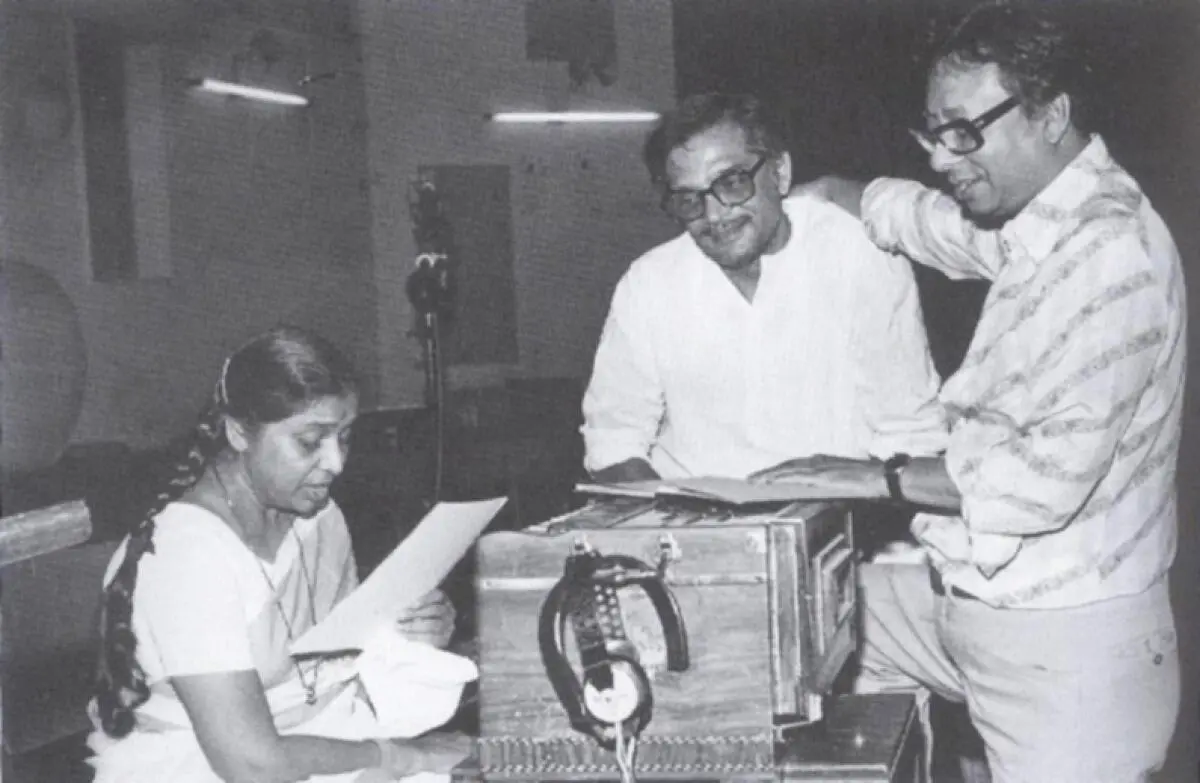
Music composer R.D. Burman (right) pushed Asha Bhosle into new territory, asking her to sing in a Western rock-and-roll style. | Photo Credit: The Hindu Archives
Asha often maintained that her formal classical training was brief. Yet, in these renderings, one encounters a musician whose command over classical idioms could challenge even the rigorously trained—her artistry residing not in display, but in the effortless absorption and expression of form.
To speak of Asha Bhosle as merely versatile is to understate the breadth of her artistry; she was, in a profound sense, a master of form. Nowhere is this more evident than in her engagement with the ghazal.
Her collaboration with the unparalleled ghazal maestro Ghulam Ali in the 1980s, the album Meraj-e-Ghazal, unsettled long-held assumptions about the genre. Ghulam Ali’s singing—marked by intricate melodic turns and an almost miraculous fluidity—had long seemed inimitable. Yet, in this meeting of voices, Asha did not recede; she rose to meet that complexity with astonishing ease, matching nuance for nuance, phrase for phrase.
Among the many jewels in that collection, “Gaye Dinon Ka Suragh Lekar” stands out as a quiet revelation. Each listening uncovers new subtleties—her voice tracing delicate, almost intangible contours, lingering on phrases with a sensitivity that suggests both restraint and deep emotional interiority. There is no excess here, no overt display—only the assurance of a master craftsman who knows precisely how much to reveal and how much to withhold.
A similar refinement marks her work in cinema, particularly in films like Umrao Jaan and Ijazat. In “Katra Katra Milti Hai” and “Khaali Haath Shaam Aayi Hai” from Ijazat, her voice becomes a vehicle for the narrative itself, registering shifts in emotional landscape with remarkable subtlety. The songs do not merely accompany the story—they inhabit it, capturing, in their quiet progression, the fragility of memory, longing, and loss.
Also Read | Zakir Hussain (1951-2024): Recollections of the tabla maestro—musical and personal
In these ghazals, one encounters yet another dimension of Asha Bhosle—far removed from the exuberance of her popular songs—where her voice, pared down to its essence, becomes an instrument of introspection, capable of articulating the most delicate shades of human experience.
It is within this inward turn that one must also place her renditions of the bhajan—an equally compelling, if less frequently acknowledged, facet of her artistry. In pieces such as “Tan To Mandir” and “Ek Mantra Japate Raho,” her voice sheds all ornamentation, embracing a quiet devotional clarity. The emphasis here is not on virtuosity, but on surrender—each note offered with a simplicity that is at once disarming and profound.
Particularly evocative is the Meera bhajan “Bala Main Bairagan Hongi,” composed by her sisters Meena Khadikar and Usha Mangeshkar. In rendering it, Asha enters a space of spiritual yearning, her voice carrying both detachment and longing in equal measure. It reveals, once again, her remarkable ability to inhabit not just genres, but states of being.
Carrying the song into new territory
How does one capture a journey that spans nearly a century—one that, in its sweep, holds within it the very history of Hindi film music—through a handful of songs and scattered stories? In the life of Asha Bhosle resides not just the arc of an individual artist, but also the larger story of the Mangeshkar family—a lineage that shaped, refined, and elevated Indian film music to a level of sophistication it may have not otherwise attained easily.
With her passing, it feels as though a century of musical memory has fallen silent. And yet, silence is never complete. For in the vast and varied body of her work—songs that continue to echo across time—her voice endures, telling and retelling the story of an art form, of an era, and of a life lived entirely through music.
Deepa Ganesh teaches at RV University, Bengaluru.