





This Diwali, a film that has been described as “the most authentic, sacred, and visually stunning adaptation of our history, our truth, and our culture” is likely to arrive in Indian cinemas. The words in quotes belong to Namit Malhotra, producer of Nitesh Tiwari’s Ramayana, a two-part epic shot for IMAX screens. Part One, releasing in November 2026, stars Ranbir Kapoor as Ram, Yash as Ravana, Sai Pallavi as Sita, and Sunny Deol as Hanuman. Part Two follows at Diwali 2027.
The budget for the two-part franchise has been confirmed at over Rs.4,000 crore (approximately $500 million), making it the most expensive Indian film ever produced. Hans Zimmer and A.R. Rahman are scoring the film together. The VFX teams have been in post-production for nearly 600 days. Who puts up that kind of money for a myth? And why now, arriving as it does in the third Diwali after the consecration of the Ram temple at Ayodhya—built on the rubble of a demolished mosque, the Babri Masjid—in a political moment when the ruling BJP has made the figure of Ram into something approaching a state religion?
These are not questions the film’s promoters are being asked. They are, however, questions that anyone thinking seriously about Indian cinema, Indian politics, and Indian public life should be pondering. The money is not incidental. A production at this scale does not emerge from the market alone; it requires the alignment of financial capital, cultural prestige, and political will. What we are witnessing is not merely a big Bollywood film. It is a civilisational project sold as entertainment, one whose sheer scale is intended to definitively answer the question of who owns the Ramayana and, therefore, who gets to define what India is.
A.K. Ramanujan’s 1987 essay “Three Hundred Ramayanas” has a radically simple observation: there is no single Ramayana; there never was. Ramanujan documented an extraordinary plurality of tellings—in Sanskrit, Tamil, Jain, Buddhist, Thai, Indonesian, and Malay, among others—each reshaping the story according to the social and philosophical commitments of its tellers. In some versions, Sita is Ravana’s daughter; in others, Ravana is a grieving father, a scholar of unparalleled learning, a figure deserving of sympathy rather than annihilation. In certain Jain tellings, Rama cannot kill anyone at all—he is bound by the principle of ahimsa; it is Lakshmana who strikes down Ravana, and Rama must offer penance for what his brother has done in his name.
Ramanujan argued that these were not deviations from an original. The tradition itself is constituted by its multiplicity. The Ramayana is not a tree with a single trunk; it is a forest, dense and entangled, where the very idea of an origin becomes suspect.
Three counter-traditions deserve more than a passing mention here, because each is a direct refutation of the reading that Hindu nationalism has sought to impose on the epic. The Tamil and Dravidian reading, associated most forcefully with Periyar E.V. Ramasamy, treats the Ramayana as a document of Brahmanical conquest. In Periyar’s reading, Ravana—dark-skinned, southern, and powerful—is the true hero: the king of a prosperous civilisation destroyed by the northern Aryan armies of Rama. Sita’s abduction is a pretext; the real story is territorial domination. This is an interpretive tradition from which the Dravidian political movement built a mass politics in Tamil Nadu. It is also, unsurprisingly, the tradition that Hindutva has most aggressively targeted because it dismisses the foundational claim that the Ramayana belongs to a unified “Hindu India”.
The Dalit reading enters through a different entrance: the story of Shambuka. In the Valmiki Ramayana, Shambuka is a Shudra ascetic killed by Rama for performing tapasya—a spiritual practice the text presents as the exclusive right of the twice-born. His death is presented as an act of dharmic order. For Dalit intellectuals and activists, this episode is the Ramayana’s confession. B.R. Ambedkar wrote about the Shambuka episode with characteristic directness: the same Rama who is worshipped by hundreds of millions murdered a man for the act of prayer.
Then there is the tradition documented by scholars of Adivasi and syncretic religious practice—a world in which the boundaries between Hindu, Buddhist, Jain, and indigenous spiritual life are porous and challenge the classifications that Hindutva demands. In Bhil communities, reverence for Muslim saints exists alongside Hindu devotion. Ravana is worshipped in parts of Madhya Pradesh and Rajasthan. Mandodari, his wife, has temples in her honour. These traditions do not seek permission from the Brahmanical order to exist. They exist as evidence that the story has always belonged to many people.
Ramanujan’s key intervention was to insist that this plurality is not a problem to be resolved. It is the tradition. The relationship between tellings is one of creative engagement, not hierarchical fidelity, and there is no first telling from which all others derive. There are only tellings, proliferating across languages and centuries, each one a mirror reflecting the world of its makers.

Scholar and linguist A.K. Ramanujan. Drawing on debates around A.K. Ramanujan’s ‘Three Hundred Ramayanas’, this article examines how cinema, politics, and mythology intersect in India’s evolving public sphere. | Photo Credit: T.A. Hafeez
This argument became a flashpoint in 2011, when the Delhi University Academic Council removed Ramanujan’s essay from its BA history syllabus, following sustained pressure from the Akhil Bharatiya Vidyarthi Parishad, the student wing of the RSS. What Hindutva requires is not mythology per se but a monopoly over mythological meaning. If there are three hundred Ramayanas, then no single political formation can claim to speak for Rama. And if no one can claim to speak for Rama, the entire edifice of Hindu nationalist identity—which depends on equating Hindu culture with one particular reading of Hindu scripture—begins to tremble.
The Rs.4,000-crore film arriving this Diwali is, among other things, a financial answer to Ramanujan, as it is an attempt to produce a telling so spectacular, so total, and so state-aligned in its prestige that it forecloses the question of which Ramayana we are watching.
The political economy of sacred spectacle
Hindu nationalist cinema is not new; what is new is its scale, its synchronisation with the state, and the money behind it. The films that preceded Tiwari’s—from The Kashmir Files to Adipurush—each did their work in their own way. The Kashmir Files deployed documentary aesthetics to construct a narrative of Hindu victimhood that elided decades of military occupation and human rights abuses. Adipurush stripped the Ramayana of its philosophical complexity and produced a spectacle in which the epic’s moral ambiguity was replaced by a simple clash between visually coded Hindus and demonised others. Both found enthusiastic support from State governments and BJP-aligned media.
What has not been adequately examined is the structural question: what enables this alignment? Who is the money, and what does the money want?
Ramayana is being produced by Prime Focus Studios and DNEG, both subsidiaries of Namit Malhotra’s conglomerate, a company with significant interests in VFX and post-production infrastructure across India, the UK, and North America. The scale of the investment is predicated on a calculation that a film positioned as the definitive mythological spectacle will perform as a cultural event, generating theatrical revenues, merchandise, downstream licensing, and the soft-power capital that accrues to whoever produces the authorised version of a civilisation’s founding story.
The Modi government has invested significantly in cultural infrastructure: the Ayodhya temple, the rebranding of cities and institutions, and support for films that advance a Hindu nationalist imaginary. The Central Board of Film Certification (CBFC), a government-controlled body, has operated as a gatekeeper that fast-tracks ideologically sympathetic productions while subjecting critical or counter-cultural work to delays, demands for cuts, or bureaucratic inertia. Tiwari’s Ramayana will encounter no such obstacles. It will arrive in IMAX multiplexes with full state approval, preceded by the kind of promotional saturation that only happens when cultural and financial power move in the same direction.
The timing is also important. The Ayodhya temple was consecrated in January 2024. The Modi government secured its third term in June 2024. Ramayana arrives this Diwali, in the third year of the new temple’s existence, as the symbolic consolidation of what began as a political project and has since been normalised as a cultural one. Cinema here is being consciously deployed to produce it.
The counter-tellings
There is, by contrast, another film about the same mythology, made from an entirely different political position. Dev Patel’s Monkey Man was scheduled for release in India in April 2024. It has still not been seen here—not in cinemas, not on OTT.

Poster of Dev Patel’s Monkey Man (2024). | Photo Credit: Wikipedia
The CBFC’s Examining Committee never processed the certification, despite a five-day deadline under the Cinematograph (Certification) Rules that passed in May 2024. When an RTI application was filed seeking clarity, the CBFC replied that “there is no larger public interest that warrants the disclosure of such information”. Netflix, which originally acquired the film for $30 million during production, had dropped it before theatrical release because its political content, reportedly, unnerved the streamer.
The film eventually found a theatrical run internationally through Jordan Peele’s Monkeypaw Productions and Universal Pictures, but Indian audiences cannot legally watch it anywhere. The contrast is worth dwelling on. The CBFC that cannot find time to process a film critical of Hindu nationalism will have no difficulty fast-tracking the most expensive mythological spectacle in Indian cinema history.
Patel’s film is, at its core, a counter-telling. Its protagonist, known only as Kid, is not a Brahmin prince or a divine incarnation; he is an Adivasi orphan, dark-skinned and brutalised, who earns a living in underground fighting rings while wearing a gorilla mask: a degraded echo of the divine monkey. His enemy is not a demon king but a spiritual guru who presides over a nexus of religious authority, police violence, and land theft. The demons, in Patel’s telling, wear saffron.
Monkey Man incorporates actual protest footage and depicts communal violence with a documentary rawness. It is a film that, in any functioning democracy with a constitutionally guaranteed freedom of expression, would have been available to audiences. That it was not itself an argument about the state of Indian democracy.
The appropriation of Hanuman by Hindu nationalist movements is well documented. From car stickers depicting a muscle-bound, saffron-clad Hanuman to the use of “Jai Shri Ram” as a war cry during communal violence, the monkey god has been transformed from a figure of humble devotion into a mascot for majoritarian aggression. This is a relatively recent phenomenon. For centuries, the Hanuman of popular devotion—particularly in north India—was a god of the poor and the powerless. His divinity expressed itself through loyalty and service.
The transformation tells us something important: the content of religious symbolism is not fixed. It is contested. What Hanuman means at any given moment is a political question. Patel’s intervention is to take this saffronised Hanuman and attempt to return him to the dispossessed. Kid’s relationship to the monkey god is one of wounded identification: Hanuman as the child who was punished by the gods for reaching too high, Hanuman as the orphan who found purpose in solidarity with those robbed of their homes.
But Monkey Man’s political gesture is not without its complications. Two critics—Siddhant Adlakha in Time and Torsa Ghosal in the Los Angeles Review of Books—have made arguments that deserve engagement rather than dismissal. Both contend, from different angles, that the film does not finally escape the logic it is trying to critique.
Ghosal’s argument is the more structurally rigorous. She contends that the film recruits the Ramayana’s emotional grammar of righteous rage without detaching it from the hypermasculine angst that characterises its usage in Hindutva propaganda. The villain is assigned the iconography of Ravana. The hero is authorised by the mythology of Hanuman. The affective economy is identical to that of the films it purports to oppose: Manichaean, personalised, and resolved through spectacular violence. What changes is who is wearing the mask of the demon. What does not change is the structure that requires a demon at all.
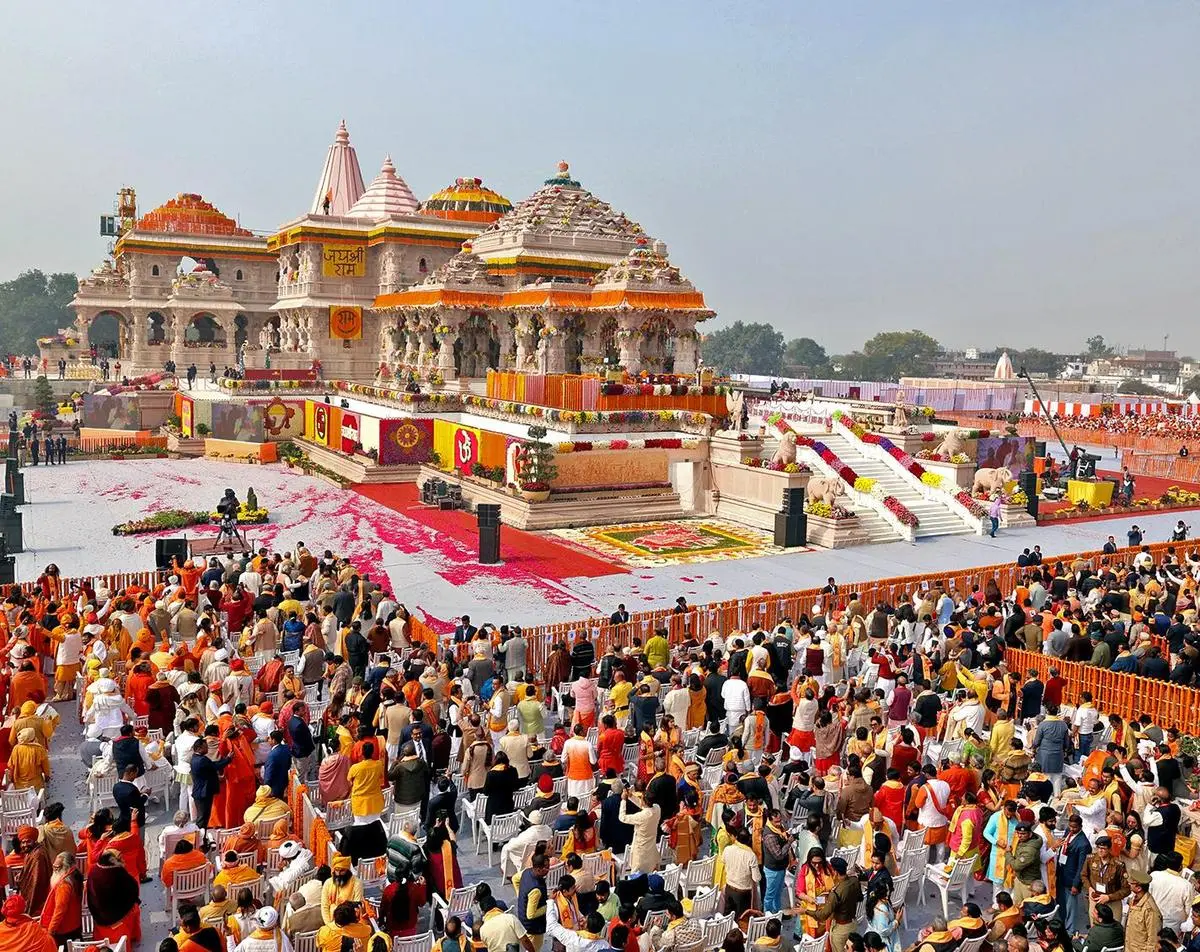
Gathering at the Ram Janmabhoomi Temple on the occasion of the “Pran Pratishtha” ceremony in Ayodhya on January 22, 2024. | Photo Credit: ANI
This critique has force. Revenge as a narrative structure is not politically neutral. Political outfits understand this instinctively. Hindutva is a demon-producing machine: illegal immigrants, Muslims, Kashmiris, and Dalits who assert their rights. There is always a new Ravana to supply the template. A counter-cinema that simply reassigns the role of the demon has not escaped this logic.
And yet, the critique might be understating what is genuinely disruptive about Patel’s film. The trans community at the centre of the film’s third act is not a representational gesture. It is a theological argument. By placing trans—simultaneously revered in certain devotional traditions and subjected to extraordinary violence in everyday life—at the moral and spiritual heart of the Hanuman narrative, Patel is drawing on a heterodox tradition that predates and exceeds the Brahmanical order. The film’s spirituality is queer in every sense: porous, syncretic, and refusing the binaries of gender, caste, and religion that Hindutva depends on maintaining.
Monkey Man does not offer a fully worked-out counter-politics. What it offers is something more modest but still significant: a disruption of the grammar through which the mythology has been captured. It shows that the story can be told differently, that Hanuman can bless the dispossessed instead of blessing their dispossessors. Whether a Hollywood action film is the right vehicle for that argument is a legitimate question. What is not legitimate is the state’s decision to ensure that Indian audiences never got to ask it.
The Adivasi dispossession depicted in Monkey Man is a compressed representation of processes exhaustively documented across central and eastern India. The absorption of indigenous communities into the Hindu fold proceeds through a sophisticated apparatus of cultural organisations, conversion drives dressed as homecoming ceremonies, and the systematic replacement of indigenous festivals with Hindu ones. In Jharkhand, Chhattisgarh, and the forests nominally protected by the Forest Rights Act of 2006, the same guru-politician-police nexus that Patel depicts operates with relative impunity.
For obvious reasons, the Shambuka episode will not appear in Nitesh Tiwari’s Ramayana. Neither will a Dravidian Ravana. Neither will the Jain Rama, nor the Rama of the syncretic folk traditions of the Deccan. What will appear is the Rama that Namit Malhotra described as “our history, our truth, and our culture”—a formulation that effaces, in eleven words, centuries of heterodox traditions.
One should be careful here. It is entirely possible to produce a Ramayana adaptation that is visually spectacular, emotionally powerful, and ideologically responsible. The epic is not inherently Hindutva property. Though not actually about the Ramayana, Mani Ratnam’s Raavan (2010) captured the essence of its core dynamics, proving that a sympathetic take on a Ravana figure could win over audiences in Tamil Nadu. The theatrical Ramayana traditions of Kerala and the shadow puppet traditions of Andhra have produced counter-readings for generations, without State support and without Rs.4,000 crore.
The question is not whether the story should be told. The question is which story will be told, with what resources, and on whose authority.
When a production of this scale arrives with the implicit blessing of the State, the certification board, and the cultural machinery of the ruling party, it is not simply entering the marketplace of ideas. It is attempting to end it. The aim is to produce a Ramayana so overwhelming in its spectacle, so complete in its prestige, and so saturated in its market presence that the question of other tellings simply ceases to be asked.
That’s why the battle over who gets to tell the Ramayana becomes a political one, fought over the meaning of India itself. When the Hindu right claims Hanuman as its own, it is claiming the right to define what India is and who belongs within it. When a counter-telling places Hanuman in the hands of an Adivasi orphan, surrounded by trans people and allied with the communities that Hindu nationalism most aggressively targets, it is, instead of desecrating a tradition, returning the tradition to its own plurality.
Ankush Pal is a sociologist trained at the London School of Economics, researching urban spatiality, caste epistemology, and social movements.
Also Read | Dhurandhar’s humiliation kink
Also Read | Ten years of Sairat and the unfinished story of the Dalit hero