




惯性聚合 高效追踪和阅读你感兴趣的博客、新闻、科技资讯
阅读原文 在惯性聚合中打开

推荐订阅源

WordPress大学
WordPress大学
O
OpenAI News
钛媒体:引领未来商业与生活新知
钛媒体:引领未来商业与生活新知
博客园 - 三生石上(FineUI控件)
Webroot Blog
Webroot Blog
GbyAI
GbyAI
S
SegmentFault 最新的问题
Cyberwarzone
Cyberwarzone
Exploit-DB.com RSS Feed
J
Java Code Geeks
Google DeepMind News
cs.CV updates on arXiv.org
博客园 - 【当耐特】
S
Secure Thoughts
酷 壳 – CoolShell
酷 壳 – CoolShell
AWS News Blog
AWS News Blog
Engineering at Meta
Engineering at Meta
S
Security Affairs
H
Help Net Security
Microsoft Security Blog
D
DataBreaches.Net
云风的 BLOG
云风的 BLOG
Hugging Face - Blog
Hugging Face - Blog
Google DeepMind News
Spread Privacy
Spread Privacy
T
Threatpost
Forbes - Security
Forbes - Security
C
Cisco Blogs
Scott Helme
Scott Helme
Attack and Defense Labs
Simon Willison's Weblog
腾讯CDC
The Last Watchdog
The Last Watchdog
Cloudbric
Cloudbric
Last Week in AI
Last Week in AI
Recorded Future
Recorded Future
小众软件
小众软件
V
Vulnerabilities – Threatpost
美团技术团队
人人都是产品经理
人人都是产品经理
有赞技术团队
有赞技术团队
Apple Machine Learning Research
Hacker News - Newest:
Hacker News - Newest: "LLM"
I
Intezer
月光博客
月光博客
C
Cyber Attacks, Cyber Crime and Cyber Security
博客园 - 司徒正美
C
Cybersecurity and Infrastructure Security Agency CISA
Martin Fowler
Martin Fowler
博客园 - 聂微东

India’s National Fortnightly Magazine

SIR West Bengal Voter Exclusion Case 2026 TN Assembly Polls 2026: Senthil Balaji and SP Velumani Clash for Western Belt Supremacy Women’s Reservation Act Amendments Raise Delimitation Fears Healthcare’s Breaking Point India’s Elderly Boom: Care Gaps and Policy Failures AI chatbots fill mental health gaps in India, but risks grow Substandard Drugs in India: The Hidden Public Health Threat India Healthcare Costs Crisis: Who Pays the Price? ASHAs hold India’s fragile health system together but are woefully underpaid Partha Chatterjee’s For a Just Republic and the Limits of the People-Nation India’s Missing Middle: Trapped Between Health Insurance and Care Hungary Election 2026: Orbán Defeated, Magyar Wins Big Shailaja Paik on Dalit Women, Caste, and the Politics of Erasure in India Free Speech Crackdown in India: Is Dissent Under Threat? Ambedkar Jayanti and the New Publicness of Protest Politics Implementing Women’s Reservation: Why a Hybrid 651-Seat Lok Sabha Model Outperforms Mass Expansion Ambedkar and Free Speech: Who Controls Dissent in 2026? How a Maharashtra Village Turned Tea with Dalits into a Statewide Equality Mission Women’s Reservation, Delimitation Bills Spark Secrecy Row Reforming Tamil Nadu's Local Governance: Why MLAs Aren't Fixers in 2026 Sewage, Neglect, and Governance Failure Mark India's Water Crisis West Bengal voter list controversy explained | Why names are being deleted Pattukkottai Kalyanasundaram: Tamil Cinema and Left Politics Delhi’s PM-UDAY Reset: Regularising Unauthorised Colonies on an “as is” Basis Will Vijay’s TVK disrupt DMK and AIADMK? | Tamil Nadu election 2026 Constitutional Morality vs Social Morality in India 2026 Amit Shah’s Anti-Conversion Promise Opens a New Faultline in Punjab Politics Why Indian Shias Protest for Iran: History of Solidarity (2026) West Bengal Voter List Row 2026: “Votercide” Debate The Hidden Ecosystem Inside our Homes Asha Bhosle’s Death Marks the End of an Era in Indian Playback Music Women’s Health in India: Inequality by Design How Algorithms Turn Feminism into a Marketable Aesthetic An Unanswered People: Adivasi Poetry’s Fight for Language and Land Rereading Kari in the Age of Identity Debates Absolute Jafar: Nostalgia and restlessness in frames Anita Nair’s Why I Killed My Husband Review: Powerful Themes, Uneven Storytelling Why the FCRA Amendment Bill 2026 Has Triggered a Political Storm Iran’s Staying Power Redraws the US-Israel War Calculus Snake Metaphors in Indian Politics 2026: Venomous Rhetoric From Grief to Politics: Porkodi Armstrong and the Battle for Dalit Power in North Chennai West Bengal election 2026: Will Babri Masjid split the Muslim vote? West Bengal Communal Politics and the 2026 Election Battle Raghav Chadha-AAP Rift Explained: Rise to Fallout (2026) Why India Is Not Energy-Secure Amid Global Oil Shocks Mulla Shah Mosque: Jahanara Begum's forgotten legacy Strait of Hormuz Ceasefire: Pause, Not Peace Dharavi’s Kumbharwada Potters fear Adani-led Redevelopment will Destroy their Livelihoods How India’s Poor Lose Years Waiting in Queues (2026) India IT Rules 2026: Threat to Free Speech? Iran War Ceasefire Signals a Shift Toward Multipolar Deterrence US Foreign Policy: Empire, Coups, and Control (2026) CBFC Ban on Gaza Film Raises New Alarm Over Censorship Queer Dalit identity and the limits of visibility 2026 Assembly Polls: Congress vs BJP Power Test Israel's Relentless Bombing Creates Displacement Crisis in Lebanon Iran War Ceasefire Marks End of US Dominance Era Imported Inflation in India: Navigating Gulf Crisis Kerala Assembly Election 2026: LDF Anti-Incumbency vs UDF Momentum Petronet LNG: A Public Company Built to Escape Public Accountability Gujarat Local Polls: AAP Rise Deepens Congress Crisis Who Defines You? | The Frontline Newsletter SIR controversy deepens fear of Muslim disenfranchisement in Bengal Kerala Election 2026: LDF, UDF, and the BJP “B Team” Charge Delhi’s LPG Crisis Exposes How Migrants Are Locked Out At 100, Krishnammal Jagannathan’s Life Marks a Legacy of Dalit Land Rights and Resistance Who will win Kerala Assembly Election 2026? LDF or UDF? Assam Polls: Cash Transfers Mask Stagnant Incomes and Job Distress Jaishankar and India's Diplomacy Crisis West Bengal SIR 2026: Voters Treated as Suspects Sathankulam Verdict: How a Rare Death Penalty Challenges India’s Custodial Torture Crisis How three 2026 bills redefine identity, marriage, and freedom in India After Nitish Kumar, Bihar BJP faces its biggest test: caste coalition without a ‘Mr Clean’ Nuclear Deterrence in South Asia: Fragile Stability Actor Vijay and Politics: An Emerging Landscape Dharavi’s Idli-Vada Economy Faces Disruption Under Redevelopment Child Marriage Annulment in India: Khushbu’s Fight (2026) India’s Role in Palestine: Why West Asia Peace Needs Action 2026 Rethinking Iran beyond Western narratives N Rangasamy’s 2026 Puducherry Poll Strategy and Power Play Khalid Jawed on Urdu’s Future and Cultural Loss (2026) Kashmir Encounter Killing Sparks AFSPA Debate 2026 Birds and grief in Hamnet and H is for Hawk GST Federalism Crisis 2026: How States Lost Fiscal Power US-Iran War 2026: Petrodollar Stakes Behind Hormuz Clash White Savior Complex in Arab Regimes Drives Ukraine Deals Not Self Reliance UPA Corruption Narrative vs Court Verdicts 2026 Mathur Sathya Case Exposes Patriarchy in Progressive Politics Personality Cult in Indian Politics 2026: Why Leaders Remain Untouchable India Needs a New Economic Model Beyond Neoliberalism Why J&K MLAs Are Fighting the Lieutenant Governor Over Security Pawar Family Rivalries Stall NCP Factions Merger in Maharashtra DMK manifesto 2026: Key promises, alliances, & welfare politics State Assembly Elections 2026: How Voter Dynamics Are Shaping India Iran-Israel War: Hegel’s Recognition Theory Explains the Escalation Coal, Capital, and Compliance: Fairmine Under NGT Lens Hindu Rashtra Debate: 2026 State Elections Test Secular India Tamil Nadu Election 2026: How Gender and Gen Z Voters are Reshaping the Dravidian Power Struggle Gujarat's proposed marriage registration amendment 2026 polices choice Will NEET Break More Students Than It Makes Doctors?
How Bengal’s Landslide Pattern Helped BJP Secure a Massive Mandate
Sanjay Kumar,Vibha Attri ,Arindam Kabir · 2026-05-15 · via India’s National Fortnightly Magazine
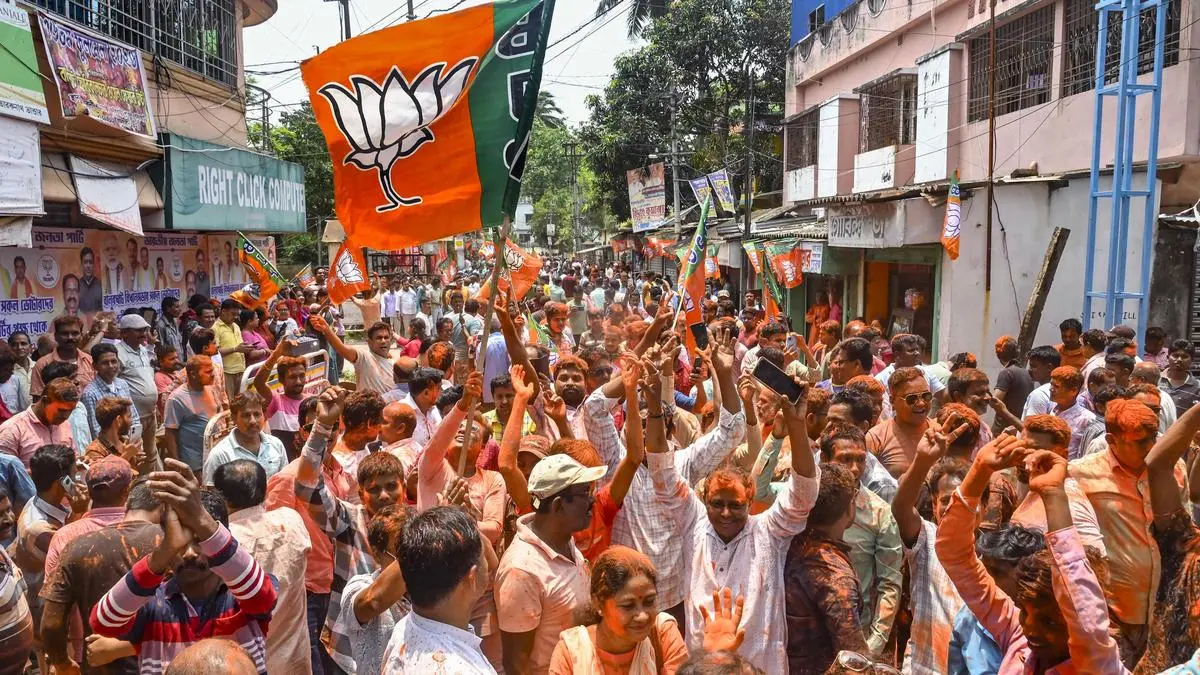
BJP workers celebrate as the party takes the lead on the West Bengal Assembly election result day, in Dakshin Dinajpur district on May 4, 2026.

BJP workers celebrate as the party takes the lead on the West Bengal Assembly election result day, in Dakshin Dinajpur district on May 4, 2026. | Photo Credit: PTI

The BJP’s landslide victory in West Bengal has surprised many. While a section did believe that the party would win, what seems to have surprised several others is the extent of the victory—207 seats with a 45.8 per cent vote share. The landslide victory, however, should not be a surprise. Since the 1972 Assembly election, Bengal has had a history of giving landslide victories to the winning party, barring a few exceptions.

The winning party has always won by a substantial margin both in terms of seats and vote share. If we look at Assembly election data since 1972, we see that the proportion of seats won by the ruling party has mostly been above 50 per cent, barring the 2001 election when the Communist Party of India (Marxist), or CPI(M), won 49 per cent of the seats.

The 1972 election, which was held for 280 seats, saw the highest percentage of seats won by the Congress at 77 per cent (Table 1). Since then, the victory sweep was in the 50-60 per cent range until the 2016 Assembly election. Since 2016, the percentage of seats won has been in the 70 per cent range, with 72 per cent in 2016 and 73 per cent in 2021, both won by the All India Trinamool Congress. Now, we have the BJP with 70 per cent seats in the 2026 Assembly election. The pattern points to a long-standing tendency in Bengal’s politics towards decisive electoral mandates.

How did the BJP manage to secure such a massive victory and nearly match the previous government in terms of the proportion of seats won? There has been talk about the deletion of names from the voters list after the Special Intensive Revision (SIR) having played a role in the BJP’s big win. Others believe that a strong anti-incumbency attributed to the Trinamool’s mis-governance as one of the main reasons. Some others believe that the poor law and order situation was a reason behind the Trinamool losing women’s votes.

A glimpse at how political parties campaigned makes it clear that the parties picked up various issues to mobile voters towards their fold, but the big narrative on which the Trinamool contested was the issue of “Bengali identity”, while the BJP pitched the election on “development and parivartan (change)”. Data from Pollsmap, an independent polling, survey and research firm, suggest that the issue of development caught the attention of voters much more than the issue of Bengali identity.

Evidence suggests that for nearly 50 per cent of the people, development was the bigger issue compared to identity. Only around 15 per cent identified Bengali identity as a main issue, while about a quarter said both issues mattered equally (Table 2). For much of the campaign, Trinamool leader Mamata Banerjee portrayed the election as a fight to safeguard Bengal’s cultural identity and culture from the “outsider” BJP. However, this narrative did not resonate strongly enough. The evidence suggests that development was instead the important factor, with 53 per cent of respondents indicating that development of Bengal was their prime concern.

Voters from the poorer and lower economic classes were found slightly more likely to say that protecting Bengali identity resonated (Table 3). In contrast, the issue of development found support across all sections of society, with the strongest support from voters belonging to the more affluent classes.

Education levels also shaped preferences on this issue. Less educated voters were more likely to consider Bengali identity as more important than development (Table 4). While nearly three in 10 non-literate voters said that protecting Bengali identity mattered more, the figure sharply declined with higher levels of education, falling to around 12 per cent among college-educated voters. In contrast, support for development over Bengali identity showed a reverse trend, becoming more important as education levels increased.

Across age, gender and locality, development was consistently preferred by voters, with high levels of agreement across groups. In contrast, there were no significant differences in the importance assigned to Bengali identity across these categories. Bengali identity has long been projected by the Trinamool as central to Bengal’s politics, but this time, voters appeared to place greater importance on development and governance.

Sanjay Kumar is an election analyst and psephologist.

Vibha Attri and Arindam Kabir are researchers with Lokniti-CSDS.

The views expressed by the authors are their individual views and do not reflect the views of any institution.

Also Read | Bengal’s violent transition into a new political era

Also Read | A closer look at Bengal’s tribal mandate