






Selvaraj Velayutham, associate professor in Sociology at Macquarie University, Australia, specialises in race and ethnic relations, multiculturalism, migrant lives, and the “sociology of everyday life”. A scholar deeply engaged with Tamil studies and cinema, he is the editor of the book Tamil Cinema: The Cultural Politics of India’s Other Film Industry. In an email interview with Frontline, Prof. Velayutham shared his thoughts on a range of issues, including the historical roots of Tamil cinema, its evolution over the years, the phenomenon of superstar-politicians, and actor Vijay’s political plunge.
Edited excerpts:
In the introduction to your book on Tamil cinema, you argue that the Tamil film industry has grown to be the “most domineering influence” in the cultural and political life of the State. Why does cinema in Tamil Nadu possess this power to shape reality whereas in other States it remains primarily a form of entertainment?
This is a well-established argument in the works of scholars like Robert Hardgrave, Theodore Baskaran, M.S.S. Pandian, and Sara Dickey. I was merely reiterating it. For the most part of the silent and early talkies era, Tamil cinema was largely based around mythologies. During the Second World War, Independence movements looked to cinema as a way of reaching the masses. Soon after, DMK [Dravida Munnetra Kazhagam] stalwarts Arignar Anna and Karunanidhi understood the power of cinema as a medium of mass political communication and began espousing social justice issues, anti-casteism and Dravidian ideology. I don’t think any other State took advantage of this opportunity. Theodore Baskaran writes that Gandhi and the Congress party were suspicious of cinema and, therefore, didn’t see it as a vehicle to transmit political ideology. On the back of the DMK’s defeat of the Congress, we saw MGR [M.G. Ramachandran] and Jayalalithaa using cinema as a platform for their political career.
You’ve written about how the use of the Tamil language in film generates a “symbolic, embodied, and affective connection to ‘Tamilness’’’. How does this emotional bond with the language and identity provide a “political infrastructure” that actors can later exploit?
This trope is evident in the screenwriting of Arignar Anna and Karunanidhi and it is also central to the Tamil stage oratory tradition (very astutely argued by Sumathi Ramaswamy in her book Passions of the Tongue: Language Devotion in Tamil India, 1891-1970). The politics of Tamil identity is deeply rooted in its literary, poetic, and cultural history and this foundation remains strong in Tamil Nadu. However, the explicit assertion of Tamil identity in cinema has declined compared to its historical role as a platform for linguistic and cultural politics. This is largely due to the Censor Board’s [now Central Board of Film Certification] requirements and the rise of post-regional blockbuster films that tried to reach out to a broader pan-India audience. Nevertheless, some film stars have been able to leverage “Tamilness” for their exploits.
In particular, over the last two decades, actor Vijay has consistently (as have Rajinikanth and Kamal Haasan) taken on roles that position him as a defender of justice, especially in films dealing with corruption (Sarkar, Mersal), corporate or state exploitation (Kaththi), social inequality and education (Master), and vigilante-style justice or mass uprising narratives (Theri, Bigil). These films often construct him as a morally upright, people’s champion, sometimes explicitly aligned with Tamil identity or pride, especially through dialogue, symbolism, and political undertones. This [link with Tamil] is less evident in Rajini’s or Kamal’s films.
While there was a “symbiotic relationship” between the Dravidian parties and the film industry, do you believe the “mobilization phase” that worked for the DMK and the All India Anna Dravida Munnetra Kazhagam (AIADMK)—using films as propaganda tools—is still viable in the age of social media and fragmented audiences?
It seems to me that the phase of overt political messaging in Tamil cinema is well and truly over. Tamil cinema was always rooted in entertainment, but script writers, producers and directors successfully mobilised it to propagate DMK and AIADMK ideologies. As we moved into the 2000s, mainstream Tamil cinema has largely focussed on entertainment.
A notable exception is the emergence of Tamil Dalit cinema. Filmmakers like Pa Ranjith, Mari Selvaraj, and Vetrimaaran have played a major role in bringing caste realities into mainstream Tamil cinema, often blending storytelling with social critique. Their films frequently centre around marginalised communities (especially Dalit lives and experiences), expose caste oppression/violence and use cinema as a form of political or educational intervention and not just entertainment. For example, Pariyerum Permumal (Mari Selvaraj) explores caste discrimination in education and everyday life, Asuran (Vetrimaaran) deals with caste violence, land rights, and resistance, and Kaala (Pa Ranjith) tackles caste, class, and urban marginality.
Despite the rise of social media and increasingly fragmented audience attention, Tamil cinema consumption remains robust, although it has shifted across theatrical and digital platforms, with star-driven films continuing to draw significant viewership.
We should also factor in the role of the rasigar and narpani mandrams [fan and charity associations] which have emerged as powerful platforms linking cinema and politics, influencing both fan culture and political discourse.
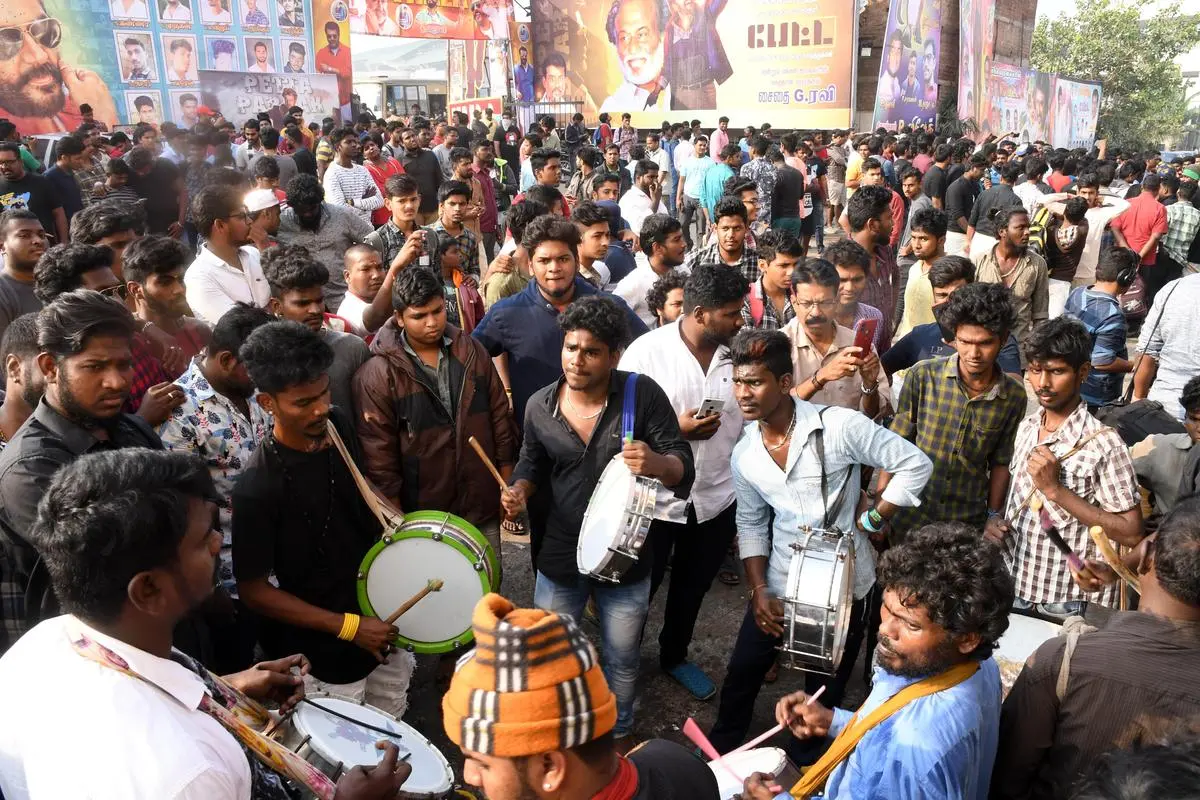
Fans celebrate the release of Rajinikanth-starrer Petta and Ajith-starrer Viswasam at Rohini Theatre, in Chennai on January 10, 2019. | Photo Credit: R. Ravindran
Sara Dickey’s chapter in your book analyses MGR as a “nurturing hero”. Is this archetype of the “nurturer” or “provider” still the primary requirement for a Tamil actor entering politics, or has the expectation shifted towards a more “administrative” or “managerial” hero?
Both elements are equally important for any Tamil actor aspiring to enter politics. Having said that, MGR’s films focussed on the struggles of ordinary and subaltern lives rather than directly attempting to reform social structures or institutions. However, with the rise of the Indian middle class, audiences increasingly expect the hero to challenge bureaucratic and systemic injustices while still remaining a caring and compassionate individual.
Given your background in the “sociology of everyday life”, how do you explain actor Vijay’s specific popularity? Is it rooted in the “fixed and unchanging” gender identities and “Tamil masculinity” that you describe in your research, or does he represent a new, more modern social category?
Vijay’s mass appeal has been reinforced by commercial blockbusters over the last decade. Importantly, he has one of the most organised fan networks in Tamil cinema, which actively engages in charity drives and social media promotion. The combination of his blockbuster films and organised fan network has catapulted him to the political stage. However, in a highly fragmented electoral landscape, his political ideologies lack distinctiveness, making significant electoral success uncertain. It is also important to note that his carefully constructed image as a progressive/feminist male need not necessarily translate into female support, as his fan base remains predominantly male.
You have researched extensively on how the Tamil diaspora uses cinema as a “cultural resource”. Do you see support for Vijay from this base and will that give him a sort of “external” legitimacy?
Tamil cinema has not historically reached diasporic audiences to the same extent as Bollywood. For instance, Tamil-language releases on OTT platforms began only in the early 2010s, whereas Bollywood content had an established global presence since the 1990s. Also, the Tamil diaspora is smaller in size compared to the Hindi-speaking diaspora, which has limited the international reach of Tamil films. As a result, there has been no significant instance of Tamil actors or filmmakers actively seeking to cultivate support outside India or gaining external recognition.
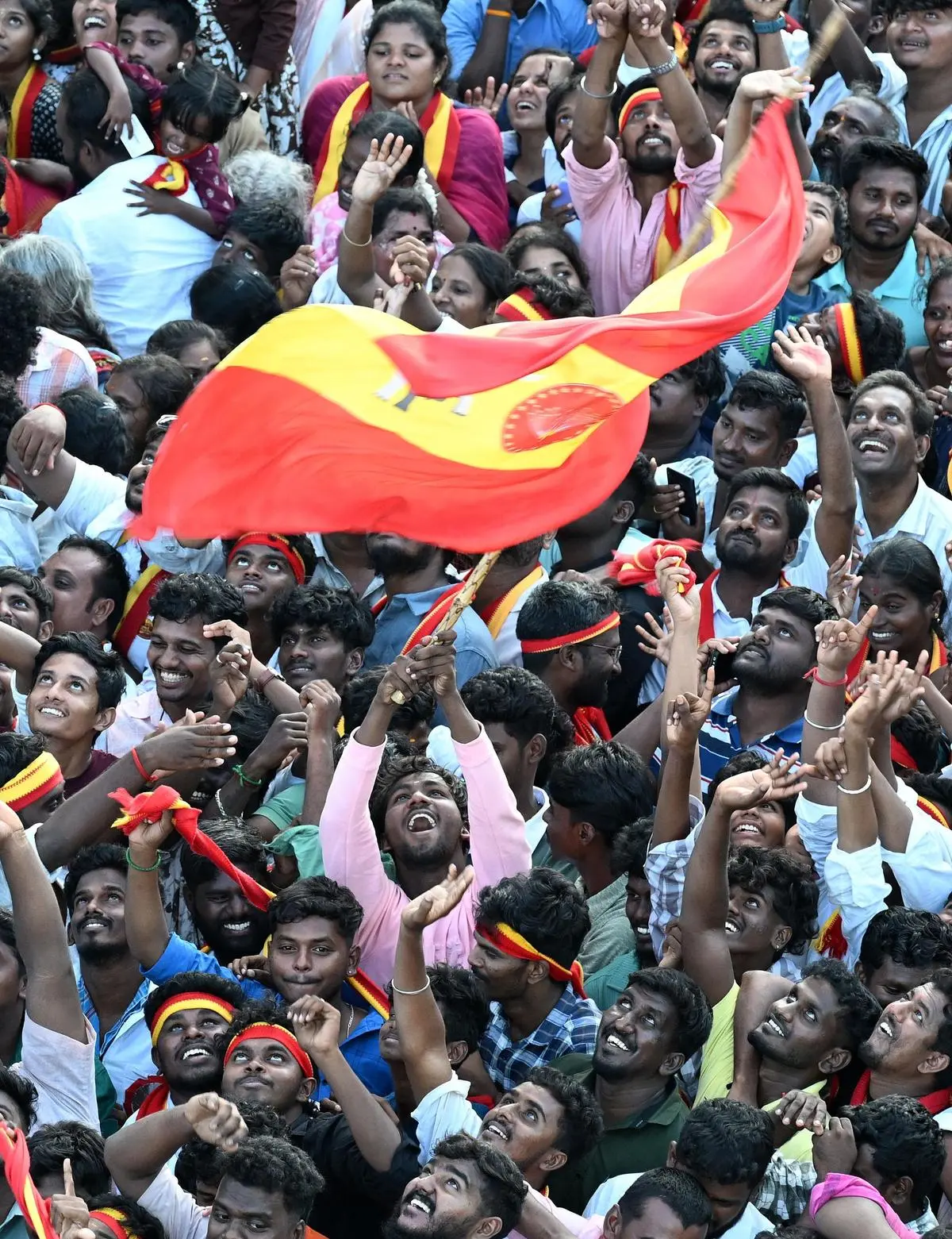
Supporters of actor Vijay at a Tamilaga Vettri Kazhagam (TVK) rally in Karur on September 27, 2025, where a stampede resulted in over 40 deaths and several injuries. | Photo Credit: M. Moorthy
How would you compare the diasporic response to Rajinikanth’s political foray—especially among NRIs in the US and UK—with the reception to Vijay’s entry? Do you see a shift in the nature or intensity of that support?
Yes! First, there is a generational difference. The Tamil diaspora, especially in the US/UK, was largely shaped by migration waves between the 1980s and 2000s. They are deeply tied to theatrical cinema. Rajini’s peak overlapped with this period, so he became a shared cultural symbol and a nostalgic figure tied to “home”. By contrast, Vijay’s rise coincides with a digitally native diaspora whose relationship is less singular and less emotionally consolidated.
Second, Rajini with his punchlines and unique onscreen style created a mythic aura around him, which made his political entry feel like a moral intervention. Vijay’s persona, on the other hand, is more grounded and down to earth. While this may make him more political in content he is less of a mythic figure.
Third, Rajni’s fandom is older and more entrenched in diaspora institutions. For many NRIs, supporting Rajini was symbolic, identity-driven, and low risk. It was not tied to detailed policy expectations. Vijay has a younger, more domestically rooted fan base. Today’s younger Tamil diaspora is politically segmented and critical. It is less likely to rally en masse without a clear ideological positioning, and thus far Vijay’s political signals are suggestive but not fully articulated.
Given the current social milieu, do you see Vijay as a genuine experiment that could disrupt established parties or is he simply the latest iteration of a well-worn cinematic-political tradition?
It is fair to say that Tamil cinema and the careful crafting of Vijay’s on-screen persona over the past decade have served him well in consolidating his popularity. However, as seen in the case of Kamal Haasan, despite enjoying immense fan support, he has had limited success in translating cinematic fame into political victory. In Rajinikanth’s case, he announced a political foray but did not follow through. In other words, while the cinema-to-politics trajectory may produce new political aspirants, it does not guarantee electoral success in the way it did for earlier figures such as Karunanidhi, MGR, Jayalalithaa, or Vijayakanth. The trajectories of these earlier actors demonstrate that while mass appeal can provide a platform, it is political acumen, organisational backing, and timing that remain decisive factors in achieving sustained political power.
Also Read | Beyond the Dravidian binary
Also Read | Can Vijay succeed where Kamal, Vijayakanth failed?