







A “Communist-free India” has, for the moment, become a reality. For the first time in nearly five decades, communist parties are out of office in every State in India. That this has happened in the centenary year of the CPI lends it unmistakable historical gravitas. Equally striking is the symbolism: Kerala, the first State to elect a communist government nearly seven decades ago, has now become the last to lower the red flag. Ironically, this decisive setback for a movement born in Pinarayi village in 1939 has come more than eight decades later, under the watch of its most famous son, Pinarayi Vijayan.
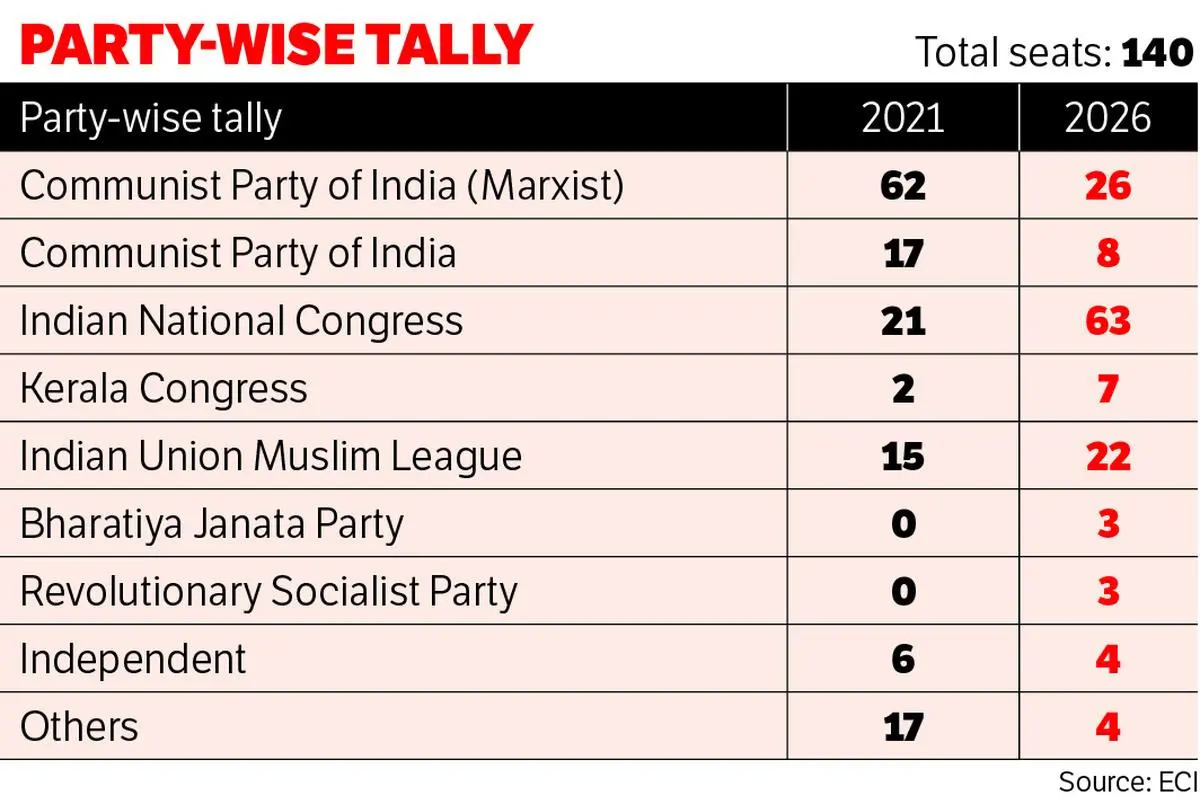
For the Left Democratic Movement (LDF), the verdict marks its worst-ever defeat: with the coalition reduced to just 35 seats in a 140-member Assembly, even below its previous nadir of 40 seats in the 2001 Assembly election. What makes the rout starker is the collapse in the LDF’s traditional northern bastions. In 2001, the three Malabar districts had largely held firm, delivering 16 of 28 seats to the Left. This time, even that firewall crumbled.
The scale of this debacle is accentuated by the fact that it follows the LDF’s unprecedented consecutive victory in 2021 under Vijayan, when it bagged 99 seats. The LDF’s vote share has dipped below 40 per cent for the first time in four decades. The final vote share data confirm a decisive shift, with 46.36 per cent for the United Democratic Front (UDF), 37.54 per cent for the LDF, and 14.13 per cent for the National Democratic Alliance (NDA)—a near inversion of the 2021 numbers.
Conversely, this is the UDF’s most emphatic victory and among its best in Kerala’s electoral history. With 102 seats, it surpasses its previous high of 99 in 2001 and approaches the scale of the Congress–CPI alliance’s landslide of 1977 post-Emergency. The Congress alone, with 63 seats, has delivered one of its strongest performances.
The UDF’s second pillar, the Indian Union Muslim League (IUML), once again demonstrated its electoral solidity, winning 22 of the 26 seats it contested. Its general secretary, P.K. Kunhalikutty, set a new State record with an 85,327-vote margin in Malappuram. The party also registered a symbolic breakthrough with the victory of Fathima Thahlia (35), its first woman MLA, who defeated LDF convenor T.P. Ramakrishnan in Perambra, a long-standing Left stronghold.
Meanwhile, even seasoned observers were unprepared for Vijayan’s personal vulnerability. As counting progressed on a sweltering May afternoon in Dharmadam, one of the CPI(M)’s most impregnable citadels, the Chief Minister briefly trailed a relatively unknown Youth Congress candidate. Although Vijayan eventually won, his margin shrank dramatically from over 50,000 in 2021 to under 20,000.
Across the State, several CPI(M) leaders fell in constituencies they had held for decades. Thirteen Ministers were defeated, as were prominent leaders such as K.K. Shailaja, once celebrated widely as the “Corona-slayer” for her pandemic management and widely regarded as a potential successor to Vijayan.
The broader political context is crucial. Kerala had remained the last significant electoral bastion of the Left in India over the past two decades. One reason was the rise of the BJP, which has disrupted the State’s bipolar contest since the mid-2000s and split the anti-Left vote. Initially, this fragmentation worked to the LDF’s advantage. Priveleged-caste voters drifted towards the BJP, but in recent years, segments of the CPI(M)’s own base, especially among the Ezhava OBC community, have also shown signs of moving towards Hindutva politics. The CPI(M)’s attempts to counter this through religious outreach and tactical alignments appear to have alienated minorities even as the party failed to consolidate Hindu support fully. The current vote patterns are likely to confirm this churn.
The NDA, though still a distant third, has achieved a breakthrough of its own by winning three seats, its best-ever performance in the State. The BJP reclaimed Nemom through Rajeev Chandrasekhar, its new State chief and politician-entrepreneur, and added Kazhakkoottam and Chathannur. However, the continued slide in the saffron vote share from the nearly 20 per cent mark it achieved in the 2024 Lok Sabha election should be a cause for concern.
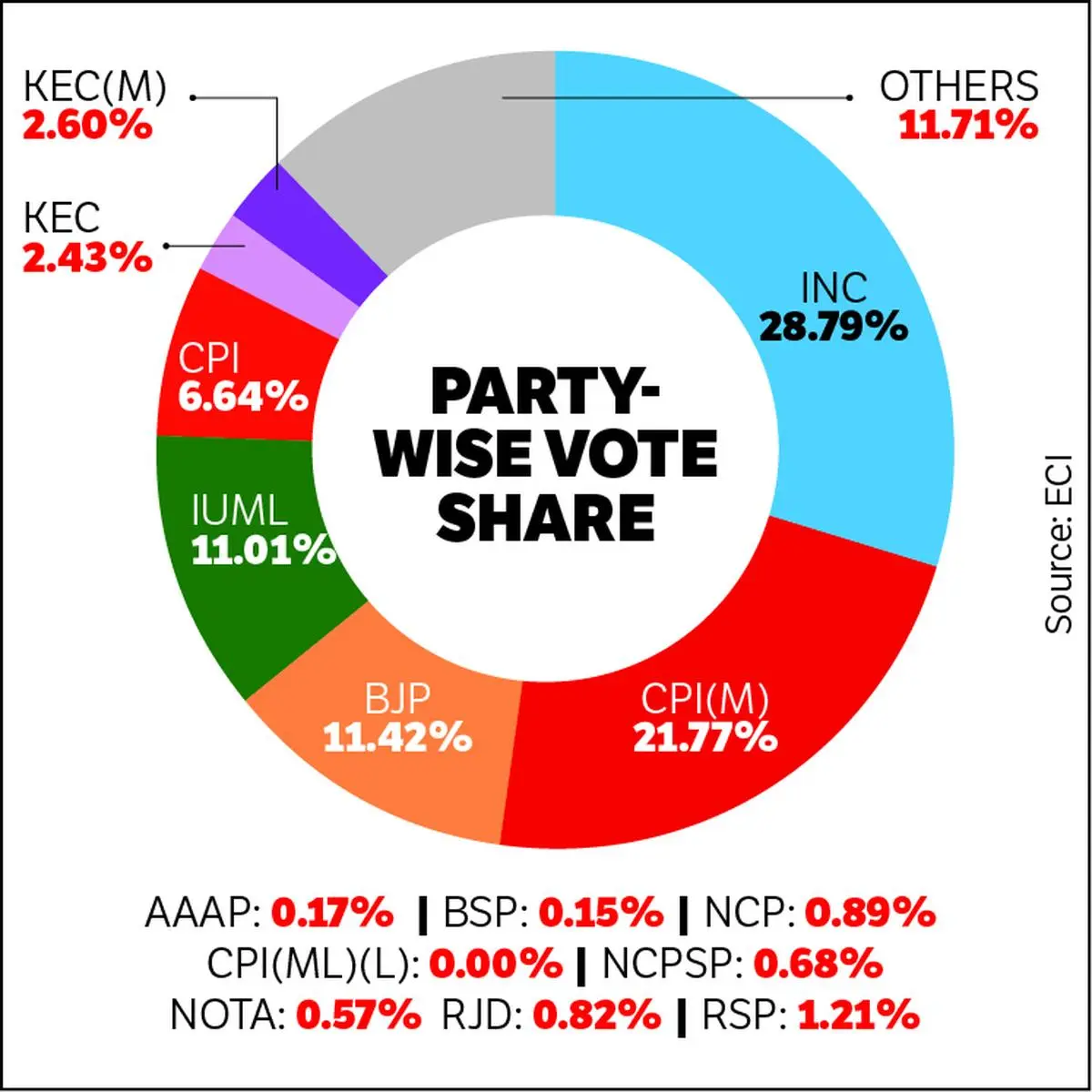
What explains this sweeping UDF victory? It would be reductive to attribute it solely to minority consolidation. The evidence suggests a broader cross-sectional verdict: an unmistakable wave of anti-incumbency sentiment, particularly against the CPI(M). While it is simplistic to reduce such outcomes to individual leadership, political processes often crystallise around a figure. In this case, Vijayan has come to embody both the achievements and the failures of the regime. “Autumn of the Patriarch”, screamed a newspaper following the debacle.
To Vijayan’s credit, the LDF governments navigated unprecedented crises—from natural disasters to a hostile Centre—while strengthening public education, healthcare, and welfare systems. Unlike the Left Front under Buddhadeb Bhattacharjee in West Bengal, Kerala’s Left did not rely solely on neoliberal policy shifts. Moreover, allegations of large-scale corruption remained relatively muted.
Yet, popular perception is not driven by development metrics alone. Political culture matters in a democracy. The administration’s arrogance, its intolerance of dissent, and a coercive police force eroded its credibility. Vijayan’s own public remarks—often brusque and dismissive—came to symbolise this disconnect.
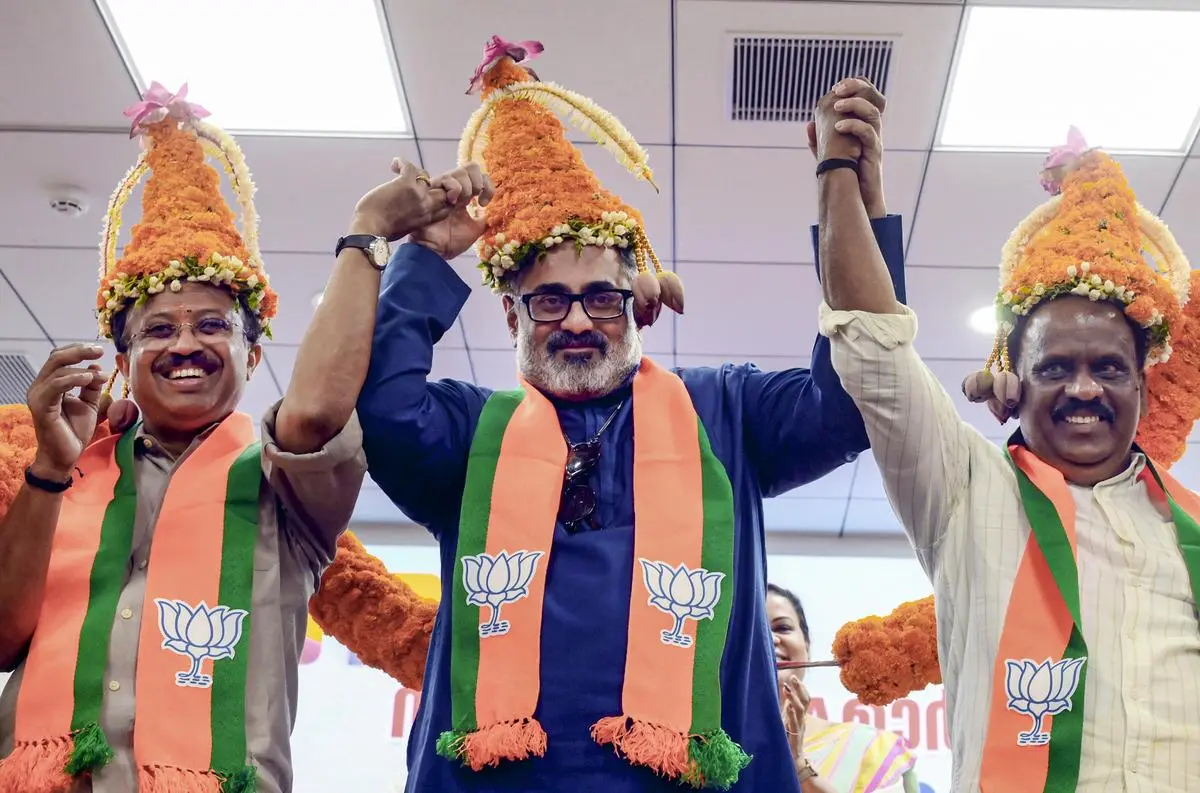
BJP candidates V. Muraleedharan, Rajeev Chandrasekhar, and B.B. Gopakumar celebrate at the party headquarters in Thiruvananthapuram, on May 5. | Photo Credit: PTI
Does this signal a Bengal-like collapse of the Left? Not necessarily. Kerala’s social and political fabric is distinct. However, the possibility of sharper communal polarisation—minorities consolidating behind the Congress and sections of Hindus gravitating towards the BJP—cannot be dismissed in the long run, as is evident in Bengal, where the Trinamool Congress and the BJP hold on to the two religious poles.
For the CPI(M), revival hinges on structural correction. Foremost is the restoration of internal democracy, which has visibly weakened under Vijayan, who commanded the party as its iron-fisted State secretary for a record 17 years before serving as Chief Minister for the next 10 years. No political movement can endure without space for dissent. The role played by dissidents—and even sections of traditional Left voters—in this defeat suggests a conscious internal correction by the support base itself.
Vijayan’s stature as the defender of the last Left bastion gave him unrivalled authority within the party, including in the Polit Bureau. But such centralisation often hollows out institutions. History offers enough cautionary tales about “supreme leaders”. The CPI(M), once known for its collective leadership, now faces a vacuum created by prolonged over-centralisation. Addressing this requires not cosmetic adjustments but a generational shift. At 81, and with evident health concerns, Vijayan’s continued centrality reflects the party’s deeper leadership crisis: the “there is no alternative” (TINA) syndrome that has become its biggest impediment.
However, Vijayan leaves behind a complex and layered legacy. He is far more than the unsmiling “dark lord” or the megalomaniac who, according to his critics—they are legion—brought about the destruction of his own movement. Such caricatures flatten a far more complex political figure. His tenure embodied both the possibilities and the limits of a centralised leadership within a cadre-based party.
He was not only Kerala’s longest-serving Chief Minister but also the only communist leader in the State to secure two consecutive terms in office. Like Bhattacharjee, he will be remembered for decisively pushing the State towards a growth model increasingly driven by private capital.
The present debacle also invites comparison between the trajectories of the two comrades. Both attempted to reconcile Left politics with market realities, and both, in different ways, paid its political costs. Both fought a viscerally hostile media.
At a more personal level, Vijayan’s journey mirrors that of V.S. Achuthanandan before him. Born into a toddy-tapper family from a backward Thiyya caste, Vijayan rose from conditions of economic and social marginality and physical violence to occupy the highest office in a movement that claimed to represent precisely such classes, but which, for long stretches, was led by those from relatively privileged social backgrounds. This upward trajectory—both symbolic and real—remains one of the enduring markers of Vijayan’s political life, even as the contradictions of his tenure continue to invite scrutiny.
The UDF sweep
The immediate future, however, belongs to the UDF—and the question of leadership. Despite pre-result factionalism within the Congress, the scale of the victory strengthens Vadassery Damodaran Satheesan’s claim over his two older contenders: K.C. Venugopal, the All India Congress Committee general secretary and Rahul Gandhi’s trusted confidant, and Ramesh Chennithala, the former Kerala Pradesh Congress Committee (KPCC) chief.
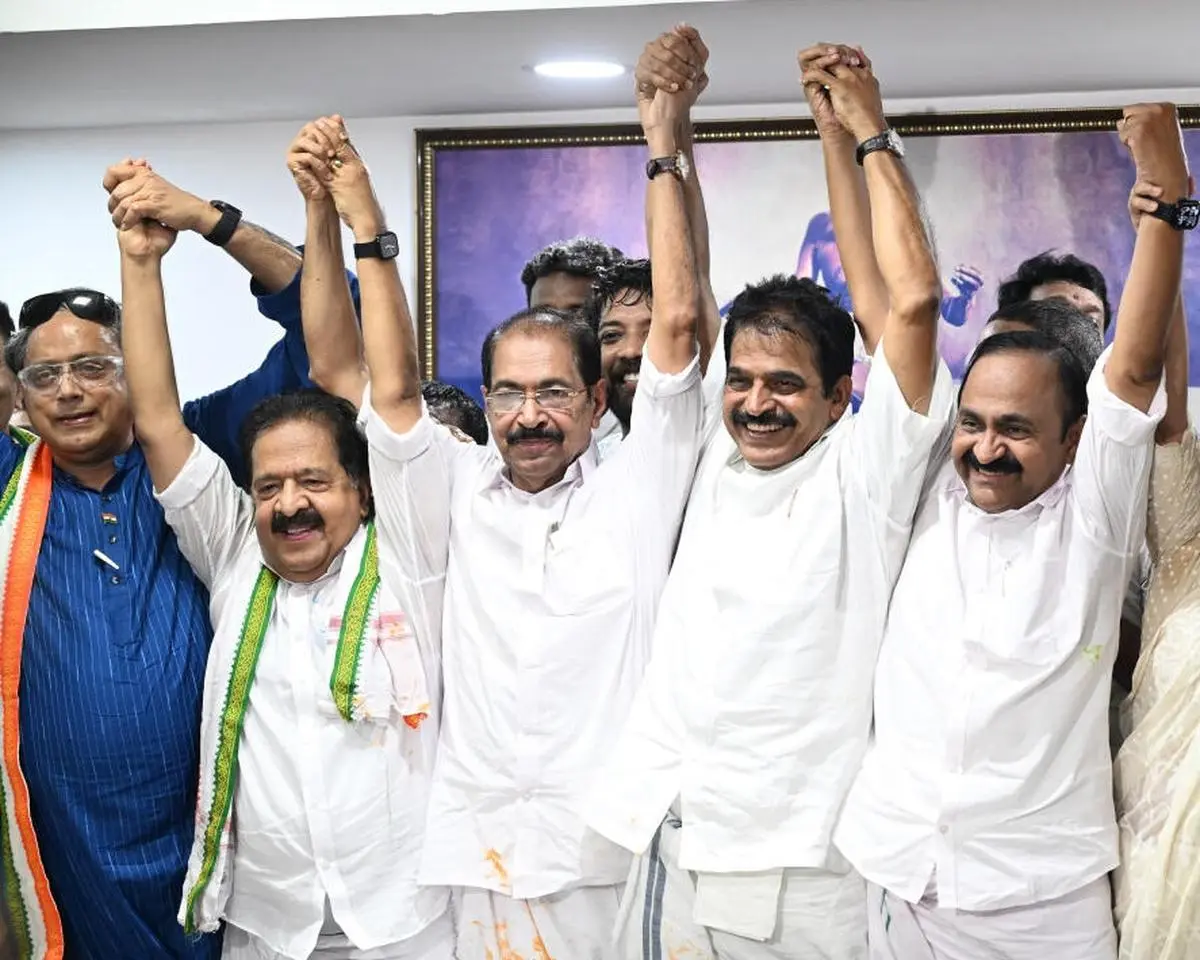
Congress leaders Shashi Tharoor, Ramesh Chennithala, Sunny Joseph, K.C. Venugopal and V.D. Satheesan celebrate the UDF’s victory at Indira Bhavan in Thiruvananthapuram on May 4. | Photo Credit: NIRMAL HARINDRAN
A six-time legislator and former advocate from Ernakulam, Satheesan (62), led the opposition’s campaign with consistent aggression and clarity. His pre-election assertion—that he would retire from politics if the UDF failed to cross 100 seats—was dismissed as overreach by even UDF leaders until it turned prophetic.
As the KPCC turns a generational page after the passing or retirement of its old titans, Satheesan is increasingly seen as their natural legatee, despite never having held ministerial office. He combines, in varying measure, the political tact of K. Karunakaran and Oommen Chandy with the idealism of A.K. Antony.
Satheesan has shown a keen strategic sense, most notably in securing the crucial backing of the Muslim League in his onward journey towards the Chief Minister’s chair. His reputation as a man of principles was reinforced when he took an unambiguous stand against sexual misconduct within the party, refusing to kowtow to entrenched caste or communal interests.
Unlike many of his contemporaries in the Congress, Satheesan also stands out for his intellectual inclinations: he is widely regarded as a voracious reader, a trait that subtly shapes both his politics and public persona.
This emphatic mandate gives both Satheesan and the Congress unusual leverage, not only over internal rivals but also in managing allies and resisting pressures from entrenched caste and communal lobbies. Whether that space will be used for governance reform or squandered in familiar factional contests will shape Kerala’s next political cycle.
M.G. Radhakrishnan, a senior journalist based in Thiruvananthapuram, has worked with various print and electronic media organisations.
Also Read | It’s a do-or-die election battle for the Left in Kerala: M.G. Radhakrishnan
Also Read | Finally, Kerala brings good news for Congress