







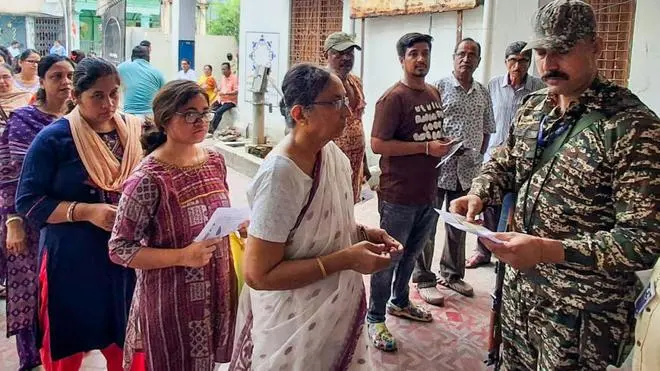
The Supreme Court has, in a patronising manner, lauded the people of West Bengal for the record voter turnout in the first phase of the 2026 Assembly election. The Chief Justice said that, as a citizen, the high voter turnout made him proud. In his view, the people must participate in the electoral process; if people realise the power of their vote within a democracy and follow the rule of law, they will shun violence. This participation is framed as a testament to their faith in the democratic system.
Justice Joymalya Bagchi, sitting alongside the Chief Justice on the bench, noted another positive aspect of the election: the absence of violence. Then, offering proof of his Bengali roots, he recited a proverb: “Raja raja-ye juddho hoy, ulukhagrar pran jay” (When kings go to war, the ulukhagra grass is trampled). The ulukhagra is a mere plant, crushed underfoot during the battles of monarchs. The proverb means the powerful fight the wars, while the poor are caught in the middle and killed. Justice Bagchi views this election as a war between “kings” in which the hapless, passive voter is crushed like that blade of grass.
This is how our judges perceive electoral competition in a democracy. They view voters as inert grass to be trampled under the feet of clashing elephants. Our eminent judges believe they have been granted the right and the responsibility to protect these “helpless” voters. According to their logic, this citizenry can neither think for itself nor make its own decisions.
In the first phase of the 2026 West Bengal Assembly election, about 92 per cent of the electorate cast their ballots. This figure has astonished our justices.
It would have been more honest if, rather than lecturing the people of Bengal on the right to vote and its significance, our courts had reflected on their own role in preventing eligible voters from exercising their franchise. After all, it was these very justices who, while refusing to grant interim relief to deleted voters, indicated that missing one election was not a matter of great consequence. Was this not the view of the same justices who are today congratulating the people of Bengal for understanding the value of their franchise?
Twenty-seven lakh voters of Bengal had approached these very judges with the plea that they were alive, they were citizens of India, and yet their names had been purged from the electoral rolls. They sought a court directive to the Election Commission to restore their names. At that time, the court said that the question of allowing them to vote did not arise while their appeals were pending. Verifying these petitions would take time, the judges argued, and it was possible the names might not be added in time for this round. But what great calamity would that cause?
It is deeply ironic that while they were praising the people of Bengal for voting, they were simultaneously refusing to hear the petitions of 65 Bengalis who pleaded for their names to be restored to the rolls. These were no ordinary citizens; they were polling officers—individuals deputed by the Election Commission itself for election duty. There can be no greater irony than the fact that those responsible for conducting the vote found their own names missing from the voter list. Yet this did not disturb our judges. They directed the petitioners to approach an appellate tribunal, suggesting that if they could prove their case was “urgent,” they might be heard. They added that since time was short, the names might not be added this time, but the “real thing” was getting the name on the list eventually.
A voter stands before the court with folded hands: they have voted in every election, yet this time the Election Commission has struck off their name, citing a “logical discrepancy” in their claim. Justice Bagchi himself expressed surprise at this “logical discrepancy” test, noting that it had not been applied in any other State. He pointed out that the Election Commission had deviated from its own stance in the Bihar SIR, where voters mapped to the 2002 electoral roll were not required to upload documents.
Yet the court did not order the Election Commission to restore the names removed through this route. The judges insisted that the appellate tribunals would investigate each claim. That would take time. The elections would be over by then. But our lordships remained unconcerned that this delay would mean these individuals could not vote this time. The franchise of the people of Bengal is being snatched away through an absurd logic. The court understands this; it finds the logic of the Election Commission flawed; yet it shows no urgency in restoring the people’s right to vote.
Why Bengal is ‘political’
If both judges possessed the ability and inclination to speak the truth, they would say they are deeply amazed that for the people of Bengal, nothing is more important than voting. They abandon all work and endure the crush of trains to reach their villages and homes. Why, after all, is “politics” a matter of life and death for them?
The justices ought to have asked whether abandoning work for a fortnight or a month to cast a single vote adversely affects the national economy. Is economic progress more vital, or is politics? They should have asked why the people of Bengal are so “political.”
When the disenfranchised voters of West Bengal approached the court to get their voting rights restored, the bench was irritated. It was perturbed that everyone in Bengal speaks in a “political language.” The Chief Justice had also said that West Bengal was the most politically polarised State in the country.
To speak in a political language is a sign of an active democratic consciousness. This should be cause for celebration, yet our judges were worried by Bengal’s intense political sensibility. Political polarisation also signifies that people are serious about their political choices. This is not the negative trait our judges think it to be.
Upon hearing the news of the 92 per cent turnout, the judges ought to engage in serious self-reflection. They should publicly repent for having, in tandem with the Election Commission, suspended the franchise of 27 lakh Bengali voters. The court owes an apology to these millions for failing to be as vigilant about democratic rights as these voters themselves are, and for failing to protect voters from the cruelty of the Election Commission.
The 92 per cent turnout in West Bengal is a mirror in which the true face of the Supreme Court is reflected. That would not be a pleasant sight for our lordships.
Apoorvanand teaches Hindi at Delhi University and writes literary and cultural criticism.
Also Read | Mamata versus Suvendu in Bhabanipur
Also Read | SIR: BJP’s hope, Mamata’s worry