





The question of whether one preferred a song by Mohammed Rafi or Kishore Kumar was among the most frequently articulated in the Hindi film music discourse of the latter half of the twentieth century. Running parallel—arguably with greater cultural charge—was another: whether one favoured Lata Mangeshkar or Asha Bhosle. Such preferences were not merely expressions of individual taste; rather, they functioned as markers of distinct social grammars. The polarity they implied may be read as symptomatic of the internal tensions within an evolving postcolonial society.
While Lata Mangeshkar’s playback voice came to be associated with characters embodying normative ideals of femininity—often portrayed as restrained, dutiful, and aligned with prevailing social codes—R. D. Burman composed for Asha Bhosle in ways that frequently unsettled these sensibilities. The songs they produced together introduced tonalities and themes that could appear transgressive to audiences habituated to Lata Mangeshkar’s repertoire. In a suggestive, if somewhat schematic, formulation, one might position these contrasting musical sensibilities along a spectrum between a Gandhian moral austerity and a Nehruvian openness to modernity.
In this sense, the collaborations of R. D. Burman, Kishore Kumar, and Asha Bhosle may be understood as articulating the sonic textures of an India in transition. Yet this emergent audience did not altogether reject Mohammed Rafi or Lata Mangeshkar; rather, its modern sensibility was marked by a capacious inclusiveness that expanded, and in doing so enriched, the aesthetic horizons of its aficionados. A comparable parallel may be discerned within Hindustani classical music, particularly in the manner in which Ravi Shankar, the romantic Nehru on sitar, extended, and in certain respects departed from, the path delineated by his Ustad, Baba Allauddin Khan, often remembered for his austere, almost monastic discipline.
With the passing of Asha Bhosle at the age of 92, a defining voice of an important era in Hindi film music has fallen silent, marking, in many ways, not only the end of a significant cultural chapter but also inviting a reconsideration of the interpretive possibilities that her voice brought to playback singing. In this context, it is noteworthy that K.J. Yesudas, S. Janaki, and P. Susheela remain among the living exponents of a comparable era in south Indian film music, though they are no longer active in film playback singing.
Paying tribute to Asha Bhosle, K.J. Yesudas observed that “Asha’s strength lay in her ability to render classical, folk, and Western idioms with equal ease and calibre; her deep training and understanding of Hindustani classical music lent a distinctive richness to her singing.” This essay seeks to situate Asha Bhosle’s playback career in relation to diverse traditions of female vocality within global musical cultures.
Playback and the question of interpretation
Playback singers in Indian cinema perform compositions written, composed, and arranged by others, their artistry unfolding within a largely pre-structured musical framework. A broadly analogous situation may be observed in the case of soprano singers within Western classical music, where vocal performance is similarly shaped by pre-composed scores. The parallel, however, is not exact: whereas the soprano operates within a codified tradition of notation and performance practice, the playback singer’s interpretive space is mediated by the specific demands of cinema, including narrative context, voice-body disjunction, and recording technologies.
A soprano, conventionally defined as the highest female vocal range within Western classical music and related traditions, is typically characterised by clarity, brightness, and a ringing tonal quality, alongside the capacity for agility in executing rapid and intricate passages. In performance, sopranos are frequently entrusted with the expression of affective states such as joy, innocence, and love, while also accommodating moments of heightened dramatic intensity. Crucially, however, their interpretive creativity operates within a highly codified framework, wherein the musical material remains, in essence, pre-composed and pre-scripted. In this respect, a suggestive parallel may be drawn with playback singers in Indian cinema, whose vocal performances, though often perceived as spontaneous and expressive, are similarly shaped by pre-existing compositional and narrative structures, even as they negotiate their own spaces of nuance and individuality within them.
An examination of how creativity is articulated in the soprano tradition may, in turn, illuminate the distinctive nature of Asha Bhosle’s artistry.
Asha Bhosle is widely recognised for her exceptional vocal range, frequently operating within the higher soprano register, with a span extending over more than two-and-a-half octaves, often cited between E3 and C6. This expansive range enabled her, particularly in her prime, to negotiate high pitches that posed challenges for many of her contemporaries, including sustained upper-register notes. However, her biographer Raju Bharatan recounts an episode involving the composer C. Ramachandra, who, widely regarded as being favourably inclined towards Lata Mangeshkar, reportedly urged Asha Bhosle to exceed her natural pitch range in a later segment of “Tuu Chuppi Hai Kahaan” from Navrang (1959, directed by V. Shantaram), ostensibly to underscore the exceptional upper-register capabilities associated with her sister. Vocal analysis would suggest that a range spanning E3 to C6 situates the voice broadly within the soprano spectrum, though not at its extreme upper limits.
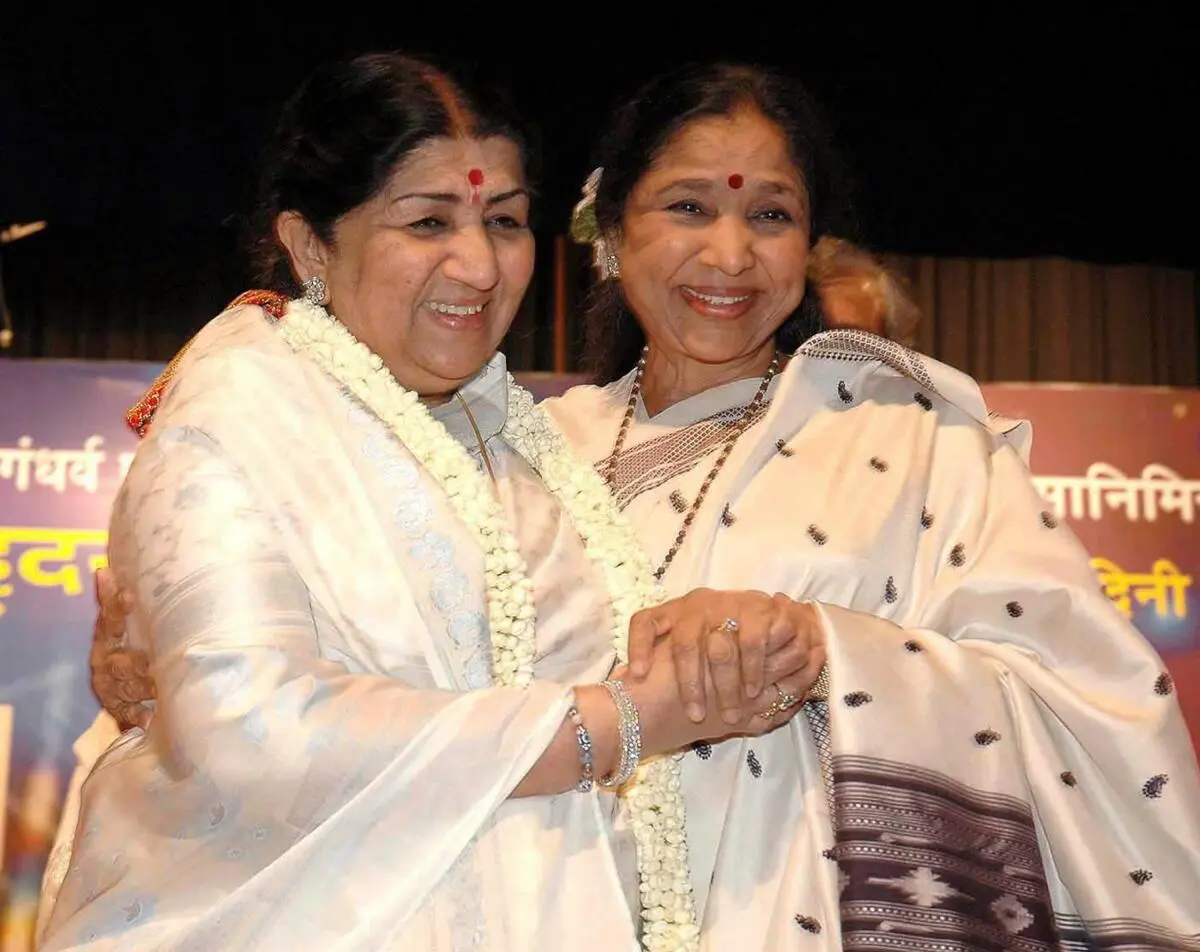
The emergence of Asha Bhosle and Lata Mangeshkar marked a shift in the aesthetics of female playback singing in Hindi cinema. | Photo Credit: PTI
Asha Bhosle’s facility with different scales, often determined by composers to align with male vocal registers, allowed her to adapt to demanding tonal frameworks. Yet this technical command did not confine her to a singular expressive mode. Rather, it facilitated a remarkable mobility across contrasting musical idioms: from the playful exuberance of cabaret-style numbers such as “O Mere Sona Re” to the introspective depth of ghazals like those in Umrao Jaan or “Dil Cheez Kya Hai”. This dimension of her artistry will be examined in greater detail in a subsequent section.
What distinguishes her vocality, however, is not merely range but the nuanced control with which it is deployed. Marked by sharp inflections and a responsiveness to rhythmic and stylistic variation, her singing accommodates a wide spectrum of moods and genres, including jazz, popular, and semi-classical forms. This versatility, coupled with her ability to move seamlessly between high-intensity passages and lower-register expressivity, constitutes a central element of her vast recorded output.
Voice, modernity, and musical transition
The emergence of Asha Bhosle alongside Lata Mangeshkar may thus be understood as marking a significant shift in the aesthetics of female playback singing in Hindi cinema. In contrast to the earlier soundscape shaped by voices such as Suraiya and Shamshad Begum, their arrival redefined expectations of pitch, tonal clarity, and vocal agility, inaugurating a new paradigm in the sonic imagination of film music.
What the soprano contributes, in effect, is a distinctive layer of interpretation to an already composed work. Thus, while Maria Callas (1923–1977) was renowned for the intensity of her dramatic interpretation, Renée Fleming (b. 1959) is often associated with a more lyrical and mellifluous expressivity.
Such differences are readily discernible in the contrasting ways in which Asha Bhosle and her celebrated sister Lata Mangeshkar interpreted song compositions, revealing two distinct modes of negotiating the relationship between compositional structure and vocal individuality. However, just as the soprano performs within a pre-composed structure while bringing creativity through interpretation, expression, and vocal individuality, Asha Bhosle introduced a richly layered brilliance into her rendering of composed material.
A clearer understanding of this distinction may be gained by differentiating between composition and creation. In playback singing, the music director determines the melody, sets lyrics penned by poets and songwriters to music, and defines the overall structure, while the singer’s role is to perform and interpret this pre-composed material. A broadly analogous situation may be observed in the soprano tradition within Western classical music, where the composer—say, Ludwig van Beethoven—specifies the notes, text, and dynamics, leaving the soprano to realise them in performance.
In both cases, therefore, creation does not lie in originating the composition, but in the interpretive act that animates it. In this sense, the relationship between composers such as Vincenzo Bellini, Gaetano Donizetti, and Giuseppe Verdi and a soprano like Maria Callas may be seen as broadly analogous to that between composers such as O.P. Nayyar, S.D. Burman, and R.D. Burman and Asha Bhosle, in both cases foregrounding the singer’s role as an interpreter of pre-composed musical worlds.
It is within this interpretive space that distinctive vocal identities emerge. In the case of Lata Mangeshkar, the voice is often associated with qualities of purity and tonal refinement; Asha Bhosle’s singing, by contrast, may be characterised by versatility and a certain playfulness of expression; Mohammed Rafi exemplifies a mode of delivery marked by emotional range and technical finesse; while Kishore Kumar is frequently noted for a more natural, expressive, and conversational idiom. These distinctions, while necessarily schematic, point to the varied ways in which singers negotiate the relationship between compositional structure and vocal individuality.
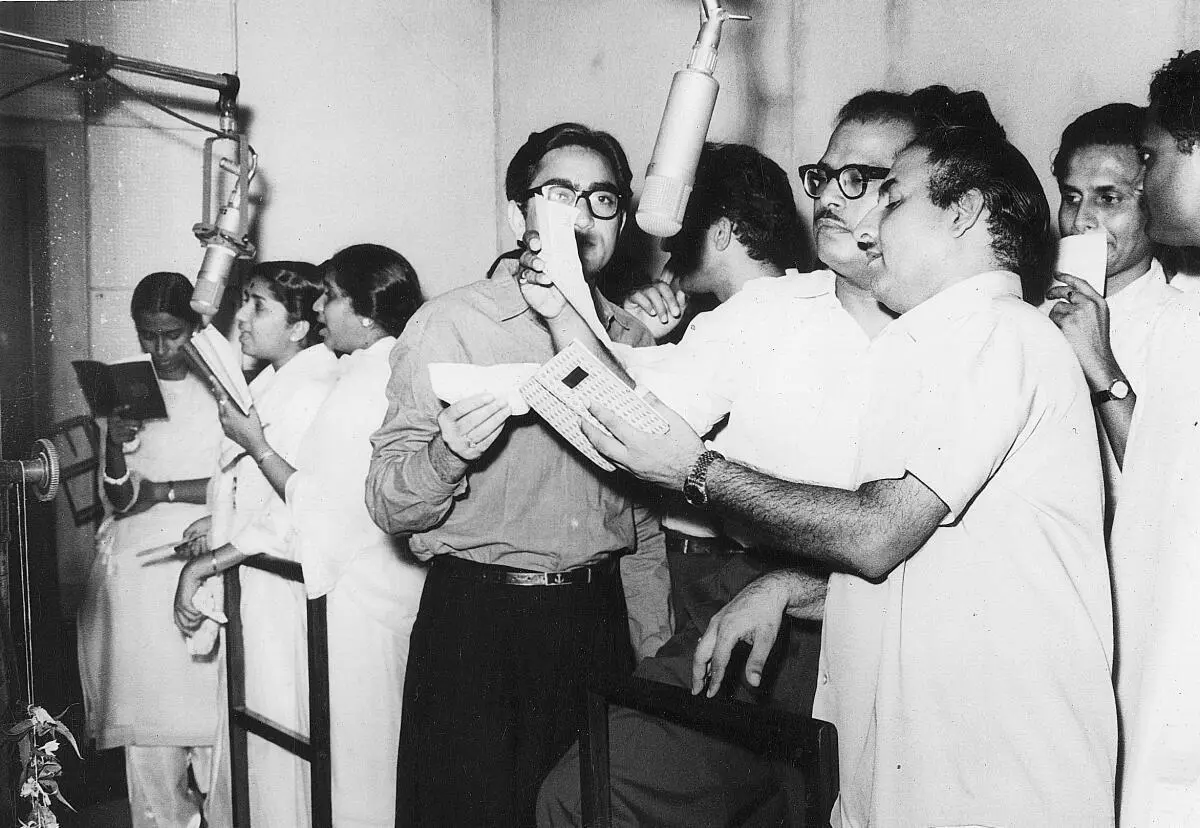
Playback singers Lata Mangeshkar, Asha Bhosle, Manna Dey, and Mohammed Rafi rehearse for a marathon qawwali sequence in Intezar. | Photo Credit: The Hindu Archives
The range and diversity of Asha Bhosle’s musical repertoire were remarkable. While her collaborations with R.D. Burman in the 1960s marked a departure from the stylistic terrain associated with Lata Mangeshkar, particularly through the rendering of rhythmically vibrant and emotionally charged compositions, Asha Bhosle’s oeuvre extended far beyond this idiom. She engaged with a wide spectrum of musical forms, including folk traditions, raga-based semi-classical compositions, and the ghazal, bringing to each a distinctive interpretive originality.
Asha Bhosle’s musical career may be understood in terms of a sustained resistance to stylistic fixity, as her repertoire consistently exceeds the kinds of vocal and expressive stereotypes that have often shaped playback singing. Her musical world was expansive and continually evolving, encompassing a wide range of stylistic influences. She has often recalled that her earliest musical training lay in singing bhajans associated with her father, Deenanath Mangeshkar, an experience that grounded her voice in the idioms of devotional and classical music from an early age. Asha Bhosle began her musical journey at an early age, recording her first song for the Marathi film Majha Bal in 1943, when she was just ten years old.
The release of Teesri Manzil (1966) marked a significant moment in the evolution of Hindi film music, contributing to a reconfiguration of its sonic and aesthetic sensibilities, particularly for a younger, urban audience. Composed by a then 27-year-old R.D. Burman, the film’s soundtrack introduced a new rhythmic and tonal vocabulary that departed from established conventions. Within this framework, the voice of Asha Bhosle assumed a central role, articulating the energy and expressive possibilities of this emergent musical idiom. The song “Aaja Aaja Main Hoon Pyar Tera” may be seen as emblematic of this sensibility, one that resonated not only with urban youth but also with listeners in small-town and rural India, for whom it offered an aural entry into the rhythms and imaginaries of an aspirational urban modernity. The vocal idioms associated with Lata Mangeshkar and Suraiya, while deeply influential within earlier aesthetic frameworks, proved less suited to articulating this emergent sonic imagination; it is within this space that Asha Bhosle’s voice assumes particular significance.
At the same time, a more nuanced lineage may be discerned in her musical sensibility. Elements of the emotive depth and stylistic restraint associated with Begum Akhtar find a subtle yet discernible resonance in her rendering of ghazal-oriented compositions. This affinity is evocatively articulated by Muzaffar Ali, director of Umrao Jaan (1981), who observed that she “moved beyond craft” to become “the voice of a civilisation shaped by tehzeeb, restraint, and unspoken ache”, creating through her singing a sense of place and cultural memory that cinema had long struggled to evoke.
Over the course of a career spanning more than seven decades, Asha Bhosle recorded over 12,000 songs, traversing an extraordinary range of musical forms and cinematic contexts. Her voice continued to resonate across generations, as evidenced by her collaboration with A.R. Rahman in the film Lagaan (2001), where “Radha Kaise Na Jale” reintroduced her to a new millennium of listeners.
With her passing, an era in Indian playback singing draws to a close; yet, as A.R. Rahman observed, she “lives forever through her voice and aura—what an artiste!” In this sense, her artistry exceeds the temporal limits of performance, continuing to inhabit the interpretive spaces she so remarkably expanded.
S. Gopalakrishnan, writer, columnist, and broadcaster, is founder and host of the Dilli Dali podcast.
Also Read | Asha Bhosle (1933-2026): Reinvention was her only constant
Also Read | From passion to piety