
惯性聚合 高效追踪和阅读你感兴趣的博客、新闻、科技资讯
阅读原文 在惯性聚合中打开

推荐订阅源

L
LINUX DO - 最新话题
cs.CV updates on arXiv.org
PCI Perspectives
PCI Perspectives
cs.AI updates on arXiv.org
K
KPMG report finds enterprise disconnect between AI and its ROI | CIO
H
Heimdal Security Blog
S
Security @ Cisco Blogs
N
News | PayPal Newsroom
J
Java Code Geeks
罗磊的独立博客
Security Archives - TechRepublic
N
News and Events Feed by Topic
V
V2EX
WordPress大学
WordPress大学
Google Online Security Blog
N
News and Events Feed by Topic
www.infosecurity-magazine.com
月光博客
月光博客
AI
AI
小众软件
小众软件
The GitHub Blog
The GitHub Blog
MongoDB | Blog
MongoDB | Blog
A
Arctic Wolf
CTFtime.org: upcoming CTF events
美团技术团队
Threat Intelligence Blog | Flashpoint
Exploit-DB.com RSS Feed
Hacker News - Newest:
Hacker News - Newest: "LLM"
T
Tailwind CSS Blog
S
Schneier on Security
博客园 - 三生石上(FineUI控件)
F
Full Disclosure
B
Blog RSS Feed
Forbes - Security
Forbes - Security
S
SegmentFault 最新的问题
钛媒体:引领未来商业与生活新知
钛媒体:引领未来商业与生活新知
人人都是产品经理
人人都是产品经理
云风的 BLOG
云风的 BLOG
Jina AI
Jina AI
Cisco Talos Blog
Cisco Talos Blog
U
Unit 42
Project Zero
Project Zero
H
Hacker News: Front Page
Y
Y Combinator Blog
Application and Cybersecurity Blog
The Cloudflare Blog
大猫的无限游戏
大猫的无限游戏
S
Secure Thoughts
The Hacker News
The Hacker News
Microsoft Azure Blog

India’s National Fortnightly Magazine

SIR West Bengal Voter Exclusion Case 2026 TN Assembly Polls 2026: Senthil Balaji and SP Velumani Clash for Western Belt Supremacy Women’s Reservation Act Amendments Raise Delimitation Fears Healthcare’s Breaking Point India’s Elderly Boom: Care Gaps and Policy Failures AI chatbots fill mental health gaps in India, but risks grow Substandard Drugs in India: The Hidden Public Health Threat India Healthcare Costs Crisis: Who Pays the Price? ASHAs hold India’s fragile health system together but are woefully underpaid Partha Chatterjee’s For a Just Republic and the Limits of the People-Nation India’s Missing Middle: Trapped Between Health Insurance and Care Hungary Election 2026: Orbán Defeated, Magyar Wins Big Shailaja Paik on Dalit Women, Caste, and the Politics of Erasure in India Free Speech Crackdown in India: Is Dissent Under Threat? Ambedkar Jayanti and the New Publicness of Protest Politics Implementing Women’s Reservation: Why a Hybrid 651-Seat Lok Sabha Model Outperforms Mass Expansion Ambedkar and Free Speech: Who Controls Dissent in 2026? How a Maharashtra Village Turned Tea with Dalits into a Statewide Equality Mission Women’s Reservation, Delimitation Bills Spark Secrecy Row Reforming Tamil Nadu's Local Governance: Why MLAs Aren't Fixers in 2026 Sewage, Neglect, and Governance Failure Mark India's Water Crisis West Bengal voter list controversy explained | Why names are being deleted Pattukkottai Kalyanasundaram: Tamil Cinema and Left Politics Delhi’s PM-UDAY Reset: Regularising Unauthorised Colonies on an “as is” Basis Will Vijay’s TVK disrupt DMK and AIADMK? | Tamil Nadu election 2026 Constitutional Morality vs Social Morality in India 2026 Amit Shah’s Anti-Conversion Promise Opens a New Faultline in Punjab Politics Why Indian Shias Protest for Iran: History of Solidarity (2026) West Bengal Voter List Row 2026: “Votercide” Debate The Hidden Ecosystem Inside our Homes Asha Bhosle’s Death Marks the End of an Era in Indian Playback Music Women’s Health in India: Inequality by Design How Algorithms Turn Feminism into a Marketable Aesthetic An Unanswered People: Adivasi Poetry’s Fight for Language and Land Rereading Kari in the Age of Identity Debates Absolute Jafar: Nostalgia and restlessness in frames Anita Nair’s Why I Killed My Husband Review: Powerful Themes, Uneven Storytelling Why the FCRA Amendment Bill 2026 Has Triggered a Political Storm Iran’s Staying Power Redraws the US-Israel War Calculus Snake Metaphors in Indian Politics 2026: Venomous Rhetoric From Grief to Politics: Porkodi Armstrong and the Battle for Dalit Power in North Chennai West Bengal election 2026: Will Babri Masjid split the Muslim vote? West Bengal Communal Politics and the 2026 Election Battle Raghav Chadha-AAP Rift Explained: Rise to Fallout (2026) Why India Is Not Energy-Secure Amid Global Oil Shocks Mulla Shah Mosque: Jahanara Begum's forgotten legacy Strait of Hormuz Ceasefire: Pause, Not Peace Dharavi’s Kumbharwada Potters fear Adani-led Redevelopment will Destroy their Livelihoods How India’s Poor Lose Years Waiting in Queues (2026) India IT Rules 2026: Threat to Free Speech? Iran War Ceasefire Signals a Shift Toward Multipolar Deterrence US Foreign Policy: Empire, Coups, and Control (2026) CBFC Ban on Gaza Film Raises New Alarm Over Censorship Queer Dalit identity and the limits of visibility 2026 Assembly Polls: Congress vs BJP Power Test Israel's Relentless Bombing Creates Displacement Crisis in Lebanon Iran War Ceasefire Marks End of US Dominance Era Imported Inflation in India: Navigating Gulf Crisis Kerala Assembly Election 2026: LDF Anti-Incumbency vs UDF Momentum Petronet LNG: A Public Company Built to Escape Public Accountability Gujarat Local Polls: AAP Rise Deepens Congress Crisis Who Defines You? | The Frontline Newsletter SIR controversy deepens fear of Muslim disenfranchisement in Bengal Kerala Election 2026: LDF, UDF, and the BJP “B Team” Charge Delhi’s LPG Crisis Exposes How Migrants Are Locked Out At 100, Krishnammal Jagannathan’s Life Marks a Legacy of Dalit Land Rights and Resistance Who will win Kerala Assembly Election 2026? LDF or UDF? Assam Polls: Cash Transfers Mask Stagnant Incomes and Job Distress Jaishankar and India's Diplomacy Crisis West Bengal SIR 2026: Voters Treated as Suspects Sathankulam Verdict: How a Rare Death Penalty Challenges India’s Custodial Torture Crisis How three 2026 bills redefine identity, marriage, and freedom in India After Nitish Kumar, Bihar BJP faces its biggest test: caste coalition without a ‘Mr Clean’ Nuclear Deterrence in South Asia: Fragile Stability Actor Vijay and Politics: An Emerging Landscape Dharavi’s Idli-Vada Economy Faces Disruption Under Redevelopment Child Marriage Annulment in India: Khushbu’s Fight (2026) India’s Role in Palestine: Why West Asia Peace Needs Action 2026 Rethinking Iran beyond Western narratives N Rangasamy’s 2026 Puducherry Poll Strategy and Power Play Khalid Jawed on Urdu’s Future and Cultural Loss (2026) Kashmir Encounter Killing Sparks AFSPA Debate 2026 Birds and grief in Hamnet and H is for Hawk GST Federalism Crisis 2026: How States Lost Fiscal Power US-Iran War 2026: Petrodollar Stakes Behind Hormuz Clash White Savior Complex in Arab Regimes Drives Ukraine Deals Not Self Reliance UPA Corruption Narrative vs Court Verdicts 2026 Mathur Sathya Case Exposes Patriarchy in Progressive Politics Personality Cult in Indian Politics 2026: Why Leaders Remain Untouchable India Needs a New Economic Model Beyond Neoliberalism Why J&K MLAs Are Fighting the Lieutenant Governor Over Security Pawar Family Rivalries Stall NCP Factions Merger in Maharashtra DMK manifesto 2026: Key promises, alliances, & welfare politics State Assembly Elections 2026: How Voter Dynamics Are Shaping India Iran-Israel War: Hegel’s Recognition Theory Explains the Escalation Coal, Capital, and Compliance: Fairmine Under NGT Lens Hindu Rashtra Debate: 2026 State Elections Test Secular India Tamil Nadu Election 2026: How Gender and Gen Z Voters are Reshaping the Dravidian Power Struggle Gujarat's proposed marriage registration amendment 2026 polices choice Will NEET Break More Students Than It Makes Doctors?
Women’s Reservation Bill 2026: Modi’s Delimitation Trap Exposed
2026-04-20 · via India’s National Fortnightly Magazine
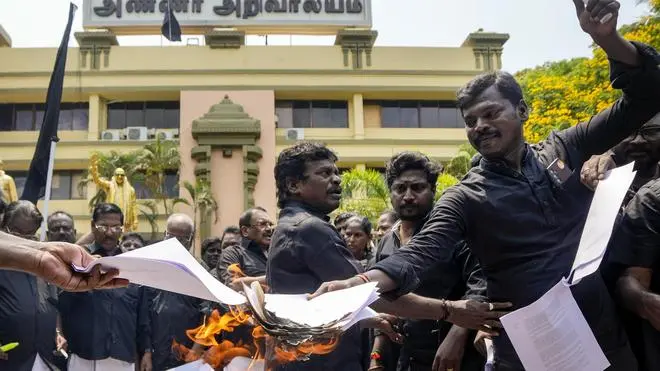
DMK workers burn copies of the proposed delimitation Bill during a protest at the party office, in Chennai, on April 16, 2026.

DMK workers burn copies of the proposed delimitation Bill during a protest at the party office, in Chennai, on April 16, 2026. | Photo Credit: R. SENTHILKUMAR/PTI

April 17, 2026, will be recorded as one of the most consequential dates in the history of Indian democracy. On this day, the opposition parties demonstrated a collective awareness of the threat to the democratic structure that had been absent in 2019—when the Citizenship Amendment Bill was passed or when Article 370 was abrogated. This time, they stood together and defeated the government’s attempt to alter the structure and composition of Parliament.

This defeat was essential for the survival of Indian democracy. This is not only a defaet for the government, it should be seen as a victory for the opposition. It has restored confidence in the opposition. Among the public, too, there is a growing curiosity about the opposition’s perspective. Citizens observed and listened to the parliamentary debates this time with heightened attention. They are looking beyond the “mainstream” media to understand where and how the government deploys deception. The public, it appears, is unlikely to accept the government’s claim that it was merely bringing in a law for women’s representation and had been blocked by a “misogynistic” opposition.

The public today is more receptive to the opposition’s counterargument: if the government is so concerned about the representation of women in legislatures, why has it not yet implemented the Women’s Reservation Act that was passed unanimously by Parliament in September 2023? Why did it not notify the Act until April 16, 2026—the very eve of the vote on the Constitution Amendment Bill? Can women’s reservation not be applied within the existing strength of 543 members? Why is an expansion of the House necessary to grant 33 per cent reservation to women?

Commentators like Siddharth Varadarajan have rightly observed that the government’s true intent was not to increase women’s representation but to preserve male dominance in the legislatures. Opposition parties have also correctly alleged that the real motive, concealed behind the rhetoric of women’s empowerment, is a redistribution of parliamentary seats that would most severely disadvantage the non-Hindi-speaking States, cementing the hegemony of the Hindi heartland.

The government’s hollow defence

The government’s defence is pathetically flimsy. It claims that had the opposition agreed, it would have added a clause to increase seat numbers by 50 per cent across the board. If this was indeed so, why was it not part of the text of the Bill itself, as opposition parties pointed out?

The government, rather amusingly, is aggrieved that the opposition is so “uncivilised” that it refuses to trust even the Prime Minister’s assurance. It is not as if the government has shown it can be trusted; and governments and courts function on the written word, not on faith or verbal assurances.

Priyanka Gandhi is right to assert that this Prime Minister and his government cannot be taken at their word. A government that systematically erodes every constitutional process cannot demand trust. Narendra Modi and his Ministers are incapable of speaking the truth. Even supporters of the government concede that it has shown itself to be a master of falsehood and deceit—they take pride in the fact that its lies have consistently been accepted as truth. They call it being “shrewd”.

Why does the public accept these lies? Largely because the media broadcasts them as established fact. Even now, the media went to town claiming that the opposition had “toppled” the Women’s Reservation Bill. This is a lie. The truth is that the opposition defeated a government attempt to alter the structure and fabric of Parliament and State Legislatures under the pretext of women’s reservation. If that is not the case, why was the delimitation of constituencies linked to women’s reservation? The objective was not to expand space for women but to use them as a pretext to redraw India’s electoral map. The conspiracy to marginalise and render ineffective the representation of States in the south and the northeast is not difficult to discern. We have already seen how the delimitation process in Assam and Jammu & Kashmir was used to politically disempower Muslims. Why is delimitation necessary simply to give women their due?

This is the simplest question the media should be asking, but it remains silent. Instead, it stirs up a storm of government propaganda to blind people to what is actually being done. A tribe of analysts is now busily interpreting the entire episode as another “masterstroke” by Narendra Modi. This lot claims the government knew the Bill would fail but introduced it anyway to paint the opposition as anti-woman. Now, they say, the opposition must disprove this.

This logic is hollow. The government is not so prescient as to have known beforehand that it would fail to fracture the opposition this time. It tried. But the collective injustice of the large-scale deletion of voters’ names during the SIR process in Bihar, Bengal, and elsewhere had already sharpened the opposition’s vigilance. They have recognised that this government uses every available device to ensure its permanence. It is this democratic alertness that kept the opposition steadfast in its refusal to take the government’s bait.

Having lost in Parliament, the government has now taken to the streets—as if it were itself the opposition—to campaign for women’s reservation. A Bill that was already passed in 2023! To conceal the sting of a decisive defeat, it has resorted to old tactics, but they are only spreading the realisation that Narendra Modi—who projects himself as invincible—can indeed be defeated.

The Prime Minister used the sanctity of an address to the nation on Doordarshan to attack the opposition for the Bill’s failure. Modi specifically targeted the Congress, the Trinamool, and the DMK—all three parties with a stake in the upcoming Tamil Nadu and Bengal elections. This government is known for its petty and unethical politics, but such an address on the eve of elections is unacceptable. The Election Commission should have issued a notice and barred Modi from campaigning. But we know that the Election Commission now functions as a wing of the BJP, whose purpose is to convert the BJP’s electoral defeats into victories.

It will be interesting to see how many newspapers and television channels criticise this unethical act by the Prime Minister. It will reveal who in this country actually cares for the survival of democracy.

Whether the media or anyone else cares for democracy or not, we the people must. Just as the workers of Noida and Panipat or the Adivasis of Odisha are fighting to protect their rights, we must all unite with the opposition to safeguard our democratic freedoms. This could be the moment of democracy’s homecoming, or we could lose it forever through our own negligence. The choice is ours.

Apoorvanand teaches Hindi at Delhi University and writes literary and cultural criticism.

Also Read | Timing and intent of women’s reservation Bill suspect: John Brittas

Also Read | The only answer is to decentralise: Nilakantan R.S.