











The first-ever malaria treatment for newborns and infants pre-qualified
April 25 was World Malaria Day, and just ahead of that, the WHO announced the pre-qualification of the first treatment developed specifically for newborns and infants weighing between 2 and 5 kilograms. Pre-qualification implies that the medicine meets international standards of quality, safety, and efficacy and will help to expand access to quality-assured treatment for one of the most underserved patient groups.
The new pre-qualified treatment is based on the antimalarial formulation artemether-lumefantrine. Until now, these youngest vulnerable patients have been treated with formulations intended for older children, which increases the risk of dosing errors, side effects, and toxicity. The WHO pre-qualification will enable public sector procurement, contributing to closing a long-standing treatment gap for some 30 million babies born each year in the malaria-endemic areas of Africa, said the WHO release.
The WHO has also pre-qualified three new rapid diagnostic tests (RDTs) designed to address emerging diagnostic challenges for malaria. The most common malaria RDTs for the P. falciparum (pf) parasite work by detecting the protein known as HRP2. But reported studies and surveys in 46 countries seem to indicate that some strains of the malaria parasite have lost the gene that makes this protein, so they become “invisible” to HRP2-based RDTs, leading to false negatives. In countries in the Horn of Africa, up to 80 per cent of cases went undiagnosed, leading to delayed treatment, severe illness, and even death.
The new tests address this issue by targeting a different parasite protein (pf-LDH) that the malaria parasite cannot easily shed. They provide a reliable, quality-assured alternative where HRP2-based tests are failing. The WHO now recommends that countries switch to these alternative RDTs when more than 5 per cent of cases are missed due to pf-HRP2 deletions.
According to the World malaria report 2025, there were an estimated 282 million cases and 6,10,000 deaths in 2024, which is an increase from 2023. Twenty-five countries are now rolling out malaria vaccines. While 47 countries have been certified malaria-free and 37 countries reported fewer than 1,000 cases in 2024, progress at the global level is stalling. Gains made are at risk due to multiple challenges, including drug resistance, insecticide resistance, diagnostic failure, and severe reductions in international development assistance, the WHO stated.
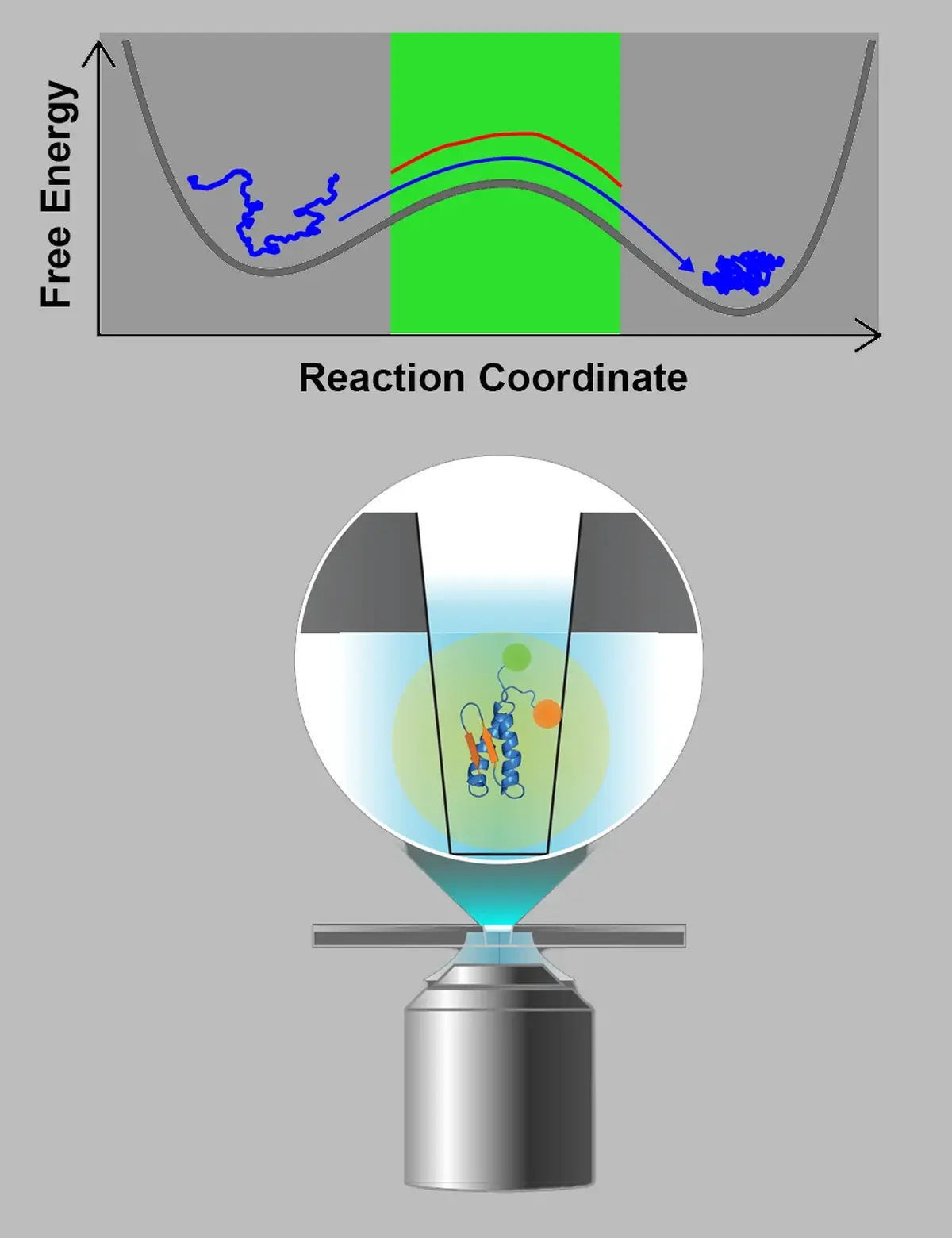
This set-up employed by the biophysicist Hoi Sung Chung’s team is based on measuring individual proteins—tagged with fluorescent markers (green and orange circles)—that diffuse into a nanoscale water-filled “pit”. The pit acts as a waveguide that only allows light to propagate towards an objective lens, boosting the efficiency of photon detection. | Photo Credit: Chi-Jui Feng et al., Physical Review Letters (2026)
How fast do proteins fold?
Protein’s functions are closely linked to their complex 3D structures. A protein’s sequence or size does not seem to be related to the time it takes to fold into its 3D shape. And proteins seem to fold more efficiently than other biomolecules, such as DNA, even though proteins are much more complex. The first-ever direct measurements of how long it takes for an individual, ordinary protein to fold have yielded surprising results. The work was published in a recent issue of Physical Review Letters.
Irrespective of its final complicated structure, a protein starts out as a string of amino acids, “like a long spaghetti noodle” that can fold in any number of ways, as the biophysicist Hoi Sung Chung of the National Institute of Diabetes and Digestive and Kidney Diseases, Maryland, US, and a co-author of the paper, put it. Understanding the details of the folding process is important because improperly or incompletely folded proteins can lead to dysfunction, disease, or toxicity.
Identical protein molecules will all reach their ultimate final 3D structures at different times, after each makes many unsuccessful attempts in the process. Scientists have an idea of how much time the overall process of folding, including those unsuccessful attempts, generally takes. But until now, it was essentially impossible to measure the duration of the act of folding itself: the final sprint called the transition-path time.
Protein folding can be modelled using a one-dimensional free-energy landscape, in which the protein reaches its thermodynamically favourable folded state by crossing a barrier corresponding to a “transition state”. The molecular contacts of the folded state are formed during this transition. The transition period is very short and must be studied in individual molecules. Previous attempts to study this process either involved slowing it artificially or observing unusual proteins that fold at a slow pace.
Chung’s group has now captured the transition period directly by improving the time resolution of a method called single-molecule fluorescence spectroscopy. Using this technique, scientists can assess the dynamics of dye-labelled molecules by measuring their fluorescence.
The researchers attached a red dye molecule to one end of a string of amino acids and a green one to the other end. The green dye shines on its own. The red dye is activated only when it receives energy from the green dye. Before the amino acid string folds, the fluorescence from the green dye is visible. When the string starts folding, the two dye molecules are brought closer together, allowing energy to transfer from the green molecule to the red molecule, which then begins to shine. But this light was still too faint for the scientists to detect. So, they used a light-directing device patterned with nanoscale wells that amplify the signal from the dyes.
The team applied this technique to eight proteins whose overall folding times range from 0.1 to 1,000 milliseconds. Despite the four orders of magnitude spread, the final transition-path times clustered within a much narrower range of 0.7–4 microsec.

A schematic showing parasite exiting an infected host cell. | Photo Credit: Yuta Tachibana et al., Nature Communications (2026)
Insight into how parasites exit host cells
Parasites are a major global health problem, underlying many human diseases worldwide, but a lot about them remains unknown. For example, the complex life cycle of Plasmodium falciparum, the parasite responsible for malaria, is not yet fully understood. One of the unknowns about parasites is how they exit infected host cells.
Now, researchers from the University of Osaka (UoO), Japan, have elucidated the exit process by identifying an essential gene, MIC11, responsible for it. To clearly explain this process, the researchers studied the behaviour of Toxoplasma gondii, known to cause toxoplasmosis and neurological symptoms. A report based on the findings is due to be published in Nature Communications.
The parasite life cycle moves through multiple host organisms, starting from the primary, or definitive, host. For T. gondii, the primary hosts are felines, both domestic and wild, as the parasite can sexually reproduce within their intestines, although T. gondii can also infect intermediate hosts, which include almost all warm-blooded mammals, for asexual reproduction.
After infecting host cells and reproducing, the parasite life cycle requires it to egress so that it can move to the next host. Past studies on the genes required for this process, which often involved opening the host cells, have shown conflicting results. Consequently, researchers were unable to reliably identify the mutations that prevented parasites from egressing. To avoid these limitations, the UoO researchers used an in vivo approach to screen for essential genes.
“Our in vivo screen, based on CRISPR [clustered regularly interspaced short palindromic repeats], identified for the first time that the MIC11 gene is essential for host cell membrane permeability and parasite egress,” explained the lead author Yuta Tachibana. Further tests demonstrated that deleting the MIC11 gene rendered the parasites unable to rupture the host cell membrane. Incapacitating parasites this way thus is a major disruption of the parasite life cycle.
“We also found evidence that MIC11 interacts with PLP1, providing further evidence of MIC11’s crucial role,” said the co-author Masahiro Yamamoto. “PLP1 is another parasite protein that was already known to be essential for egress.” This advance in the understanding of how parasites exit host cells after infection provides a new target for therapeutic intervention in parasitic diseases such as toxoplasmosis and malaria.

Even when your gaze is focussed at a single point, your eyes are constantly moving. | Photo Credit: PeopleImages/Getty Images
Subtle, constant eye movements help us see clearly
Even when your gaze is focussed on a single point, your eyes are constantly moving. A model-based study by a British-American research team, comprising mathematicians and psychologists, has shown that these minute motions—known as fixational eye movements (FEMs)—impact how the brain processes visual information. The work was published in the journal Physical Review Research.
The brain’s visual system is optimised to detect change. When you stare at an object, part of what you see becomes blurred as the retina adapts to the incoming light signals and stops relaying information to the brain. The new model shows that FEMs override this adaptation by refreshing the image and overcoming the retina’s tendency to stop signalling, the release from the American Physical Society explained. The researchers also identified several factors that influence how much visual information the retina can take in at one time and found that excessively fast eye movements negatively impact how much visual information can be captured.
Also Read | Unfolding of protein ‘filmed’
Also Read | The battle against malaria on World Malaria Day and beyond