



惯性聚合 高效追踪和阅读你感兴趣的博客、新闻、科技资讯
阅读原文 在惯性聚合中打开

推荐订阅源

博客园_首页
The GitHub Blog
The GitHub Blog
美团技术团队
Know Your Adversary
Know Your Adversary
CTFtime.org: upcoming CTF events
The Register - Security
Stack Overflow Blog
Stack Overflow Blog
Attack and Defense Labs
G
Google Developers Blog
I
InfoQ
博客园 - 司徒正美
T
Troy Hunt's Blog
Google DeepMind News
J
Java Code Geeks
MongoDB | Blog
MongoDB | Blog
博客园 - 聂微东
A
About on SuperTechFans
云风的 BLOG
云风的 BLOG
S
Security Affairs
M
MIT News - Artificial intelligence
Simon Willison's Weblog
K
KPMG report finds enterprise disconnect between AI and its ROI | CIO
T
Tailwind CSS Blog
量子位
Vercel News
Vercel News
月光博客
月光博客
V
Vulnerabilities – Threatpost
N
News and Events Feed by Topic
Hugging Face - Blog
Hugging Face - Blog
酷 壳 – CoolShell
酷 壳 – CoolShell
L
LangChain Blog
D
Darknet – Hacking Tools, Hacker News & Cyber Security
L
LINUX DO - 最新话题
F
Full Disclosure
The Hacker News
The Hacker News
Hacker News: Ask HN
Hacker News: Ask HN
T
Tor Project blog
A
Arctic Wolf
Application and Cybersecurity Blog
Forbes - Security
Forbes - Security
IT之家
IT之家
Apple Machine Learning Research
B
Blog
Exploit-DB.com RSS Feed
Y
Y Combinator Blog
GbyAI
GbyAI
B
Blog RSS Feed
V
Visual Studio Blog
T
The Blog of Author Tim Ferriss
F
Fortinet All Blogs

India’s National Fortnightly Magazine

SIR West Bengal Voter Exclusion Case 2026 TN Assembly Polls 2026: Senthil Balaji and SP Velumani Clash for Western Belt Supremacy Women’s Reservation Act Amendments Raise Delimitation Fears Healthcare’s Breaking Point India’s Elderly Boom: Care Gaps and Policy Failures AI chatbots fill mental health gaps in India, but risks grow Substandard Drugs in India: The Hidden Public Health Threat India Healthcare Costs Crisis: Who Pays the Price? ASHAs hold India’s fragile health system together but are woefully underpaid Partha Chatterjee’s For a Just Republic and the Limits of the People-Nation India’s Missing Middle: Trapped Between Health Insurance and Care Hungary Election 2026: Orbán Defeated, Magyar Wins Big Shailaja Paik on Dalit Women, Caste, and the Politics of Erasure in India Free Speech Crackdown in India: Is Dissent Under Threat? Ambedkar Jayanti and the New Publicness of Protest Politics Implementing Women’s Reservation: Why a Hybrid 651-Seat Lok Sabha Model Outperforms Mass Expansion Ambedkar and Free Speech: Who Controls Dissent in 2026? How a Maharashtra Village Turned Tea with Dalits into a Statewide Equality Mission Women’s Reservation, Delimitation Bills Spark Secrecy Row Reforming Tamil Nadu's Local Governance: Why MLAs Aren't Fixers in 2026 Sewage, Neglect, and Governance Failure Mark India's Water Crisis West Bengal voter list controversy explained | Why names are being deleted Pattukkottai Kalyanasundaram: Tamil Cinema and Left Politics Delhi’s PM-UDAY Reset: Regularising Unauthorised Colonies on an “as is” Basis Will Vijay’s TVK disrupt DMK and AIADMK? | Tamil Nadu election 2026 Constitutional Morality vs Social Morality in India 2026 Amit Shah’s Anti-Conversion Promise Opens a New Faultline in Punjab Politics Why Indian Shias Protest for Iran: History of Solidarity (2026) West Bengal Voter List Row 2026: “Votercide” Debate The Hidden Ecosystem Inside our Homes Asha Bhosle’s Death Marks the End of an Era in Indian Playback Music Women’s Health in India: Inequality by Design How Algorithms Turn Feminism into a Marketable Aesthetic An Unanswered People: Adivasi Poetry’s Fight for Language and Land Rereading Kari in the Age of Identity Debates Absolute Jafar: Nostalgia and restlessness in frames Anita Nair’s Why I Killed My Husband Review: Powerful Themes, Uneven Storytelling Why the FCRA Amendment Bill 2026 Has Triggered a Political Storm Iran’s Staying Power Redraws the US-Israel War Calculus Snake Metaphors in Indian Politics 2026: Venomous Rhetoric From Grief to Politics: Porkodi Armstrong and the Battle for Dalit Power in North Chennai West Bengal election 2026: Will Babri Masjid split the Muslim vote? West Bengal Communal Politics and the 2026 Election Battle Raghav Chadha-AAP Rift Explained: Rise to Fallout (2026) Why India Is Not Energy-Secure Amid Global Oil Shocks Mulla Shah Mosque: Jahanara Begum's forgotten legacy Strait of Hormuz Ceasefire: Pause, Not Peace Dharavi’s Kumbharwada Potters fear Adani-led Redevelopment will Destroy their Livelihoods How India’s Poor Lose Years Waiting in Queues (2026) India IT Rules 2026: Threat to Free Speech? Iran War Ceasefire Signals a Shift Toward Multipolar Deterrence US Foreign Policy: Empire, Coups, and Control (2026) CBFC Ban on Gaza Film Raises New Alarm Over Censorship Queer Dalit identity and the limits of visibility 2026 Assembly Polls: Congress vs BJP Power Test Israel's Relentless Bombing Creates Displacement Crisis in Lebanon Iran War Ceasefire Marks End of US Dominance Era Imported Inflation in India: Navigating Gulf Crisis Kerala Assembly Election 2026: LDF Anti-Incumbency vs UDF Momentum Petronet LNG: A Public Company Built to Escape Public Accountability Gujarat Local Polls: AAP Rise Deepens Congress Crisis Who Defines You? | The Frontline Newsletter SIR controversy deepens fear of Muslim disenfranchisement in Bengal Kerala Election 2026: LDF, UDF, and the BJP “B Team” Charge Delhi’s LPG Crisis Exposes How Migrants Are Locked Out At 100, Krishnammal Jagannathan’s Life Marks a Legacy of Dalit Land Rights and Resistance Who will win Kerala Assembly Election 2026? LDF or UDF? Assam Polls: Cash Transfers Mask Stagnant Incomes and Job Distress Jaishankar and India's Diplomacy Crisis West Bengal SIR 2026: Voters Treated as Suspects Sathankulam Verdict: How a Rare Death Penalty Challenges India’s Custodial Torture Crisis How three 2026 bills redefine identity, marriage, and freedom in India After Nitish Kumar, Bihar BJP faces its biggest test: caste coalition without a ‘Mr Clean’ Nuclear Deterrence in South Asia: Fragile Stability Actor Vijay and Politics: An Emerging Landscape Dharavi’s Idli-Vada Economy Faces Disruption Under Redevelopment Child Marriage Annulment in India: Khushbu’s Fight (2026) India’s Role in Palestine: Why West Asia Peace Needs Action 2026 Rethinking Iran beyond Western narratives N Rangasamy’s 2026 Puducherry Poll Strategy and Power Play Khalid Jawed on Urdu’s Future and Cultural Loss (2026) Kashmir Encounter Killing Sparks AFSPA Debate 2026 Birds and grief in Hamnet and H is for Hawk GST Federalism Crisis 2026: How States Lost Fiscal Power US-Iran War 2026: Petrodollar Stakes Behind Hormuz Clash White Savior Complex in Arab Regimes Drives Ukraine Deals Not Self Reliance UPA Corruption Narrative vs Court Verdicts 2026 Mathur Sathya Case Exposes Patriarchy in Progressive Politics Personality Cult in Indian Politics 2026: Why Leaders Remain Untouchable India Needs a New Economic Model Beyond Neoliberalism Why J&K MLAs Are Fighting the Lieutenant Governor Over Security Pawar Family Rivalries Stall NCP Factions Merger in Maharashtra DMK manifesto 2026: Key promises, alliances, & welfare politics State Assembly Elections 2026: How Voter Dynamics Are Shaping India Iran-Israel War: Hegel’s Recognition Theory Explains the Escalation Coal, Capital, and Compliance: Fairmine Under NGT Lens Hindu Rashtra Debate: 2026 State Elections Test Secular India Tamil Nadu Election 2026: How Gender and Gen Z Voters are Reshaping the Dravidian Power Struggle Gujarat's proposed marriage registration amendment 2026 polices choice Will NEET Break More Students Than It Makes Doctors?
How the 2026 Elections Changed India’s Democratic Debate
Aditya Sinha · 2026-05-07 · via India’s National Fortnightly Magazine
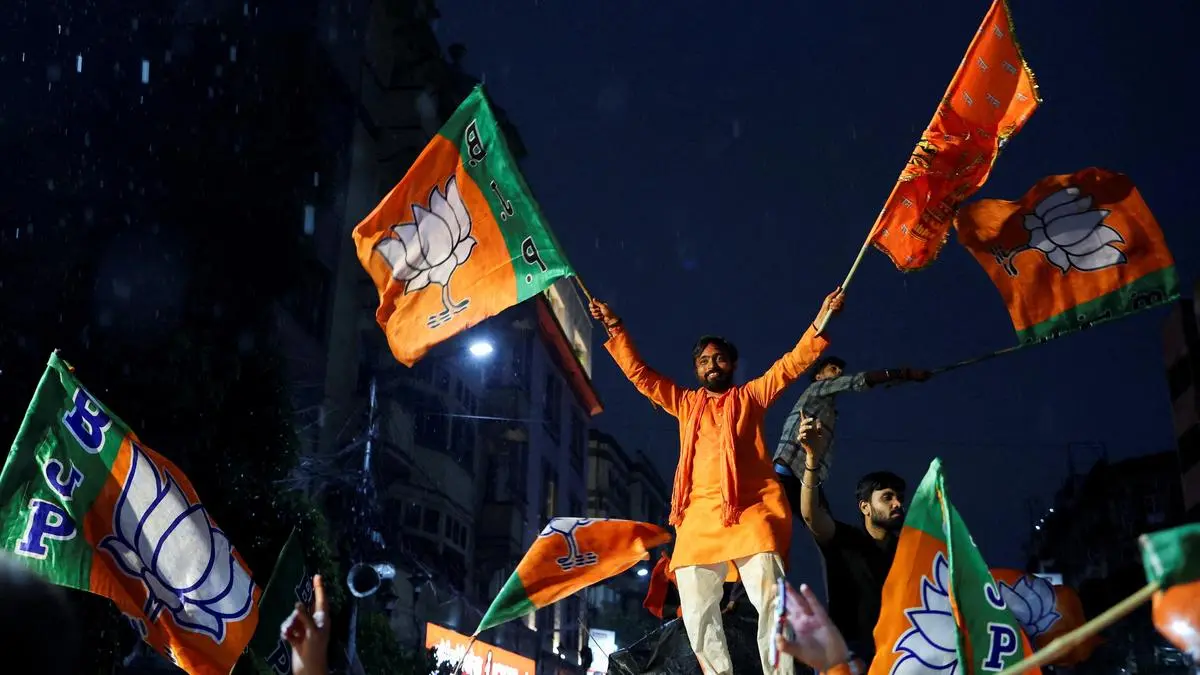
BJP supporters celebrate their party’s lead in the West Bengal Assembly election outside the party’s regional office in Kolkata on May 4, 2026.

BJP supporters celebrate their party’s lead in the West Bengal Assembly election outside the party’s regional office in Kolkata on May 4, 2026. | Photo Credit: Reuters

Democracy in India is dead. This sobering conclusion was made clear with the election results on May 4, which were not unexpected. Given the massive deletions of voters in West Bengal, several of whom were shown in fact to be citizens of standing (newspapers, etc., can’t give anecdotes of all 27 lakh voters; the electronic media is just the regime’s soundtrack), it was no surprise that in constituency after constituency, the margin of victory was less than the number of voters deleted. We have known for several years that our judiciary, which enabled the vote-theft, is both rotten and shameless.

The regime’s supporters claim that all names deleted were of infiltrators, an expectedly lazy claim by those who have for decades been clamouring for strongman rule. “India needs a dictator" has been a common middle-class mutter since I was a boy in the 1970s. This talk of infiltration is a bogie. The same people who echo talk about Bangladeshis as termites are the same people who can’t live without Bengali cooks, cleaners, or garbage collectors.

In Assam, my wife was subdued by the result. She had the impression that Chief Minister “Himanta (Biswa Sarma) had gotten too big for his boots” and had annoyed a lot of voters. Apparently, the only ones annoyed were the ones deleted by the Special Intensive Revision (SIR) of electoral lists, or worse, by the 2019 exercise of the National Register of Citizens (NRC). The rest of Assam bought into the CM’s loud and vulgar demonisation of “Miya” Muslims. What hogwash. Ever since I first visited Assam in 1988, I have been seeing headlines warning of “demographic threat” to Assam. Thirty-eight years later, the same headlines appear, though Assam seems intact.

I am not a Tamil, and despite having lived four years in Chennai in the late 2000s, I cannot say much about the youthful-faced Vijay, whose party knocked both established parties off their feet. All I have heard is that he is not even a good actor. Some friends claim that all he is interested in is “the chair” and keeping an actress as his consort (emulating earlier CMs). They predict that he will fail quickly. All that this suggests to me is that the regime will make use of him.

Ironically, the regime’s supporters are celebrating around the country at having finally won Bengal, on the same day that the alliance that India’s Great Leader pledged public allegiance to, lost. Yes, the US-Israel-UAE axis (of which India became an unofficial member in February) has lost the Iran war. US Secretary of State Marco Rubio announced on Tuesday that the combat operations of "Epic Fury” had “concluded”, while his boss President Donald Trump announced that “Project Freedom”, meant to escort ships through the Strait of Hormuz, was “paused”. This is as close as the Americans will come to admitting defeat.

This is yet another example of India’s regime’s failure at policy, governance, and diplomacy. That we upended a perfectly able foreign policy and then ended up on the losing side and isolated on the global stage is an act of incompetence that Indian history may never record again. All because of the Great Leader and his parent organisation’s stubborn anti-Muslim agenda, expanded to the world stage as some civilisational war against Muslims: a “demographic threat” on a global level.

Electoral capture

The only competence that this regime has shown has been its capture of the exercise of electoral democracy. The State election results only confirmed a trend that has come to characterise elections after 2024, when the regime was reduced to 240 seats, requiring the support of other parties to garner a majority and form the government: a naked and ruthless display of electoral theft. Haryana, Maharashtra, Bihar; one was only waiting for the result from the last opposition bastion of West Bengal.

Now it is clear. In India, democracy is dead. Not only for digging up the pitch that is the level playing field provided by elections (“one person, one vote”), but for the capture of institutions like the judiciary for predetermined outcomes. Of course, even the one-person-one-vote idea is being taken apart to the extent of creating a federal-state imbalance, with the aim of delimitation that the government recently tried to sneak in with the Trojan horse of a superfluous women’s representation bill. A new Parliament, with 50 per cent more seats, will ensure that India is dominated by the regime’s home State, UP. With Vijay now in the saddle in Tamil Nadu, one wonders if he too will be a Trojan horse for the regime’s agenda.

What can the opposition do? One can hardly take comfort in the way that the Congress leadership patted itself on the back with a win in Kerala, where the BJP is not a substantial political force—yet. Also discomfiting is the manner in which some Congress members have begun proclaiming that the entire opposition must line up behind the Congress if the regime is to be dislodged. They point to Hungary’s recent election where the formerly fragmented opposition rallied behind Peter Magyar’s Tisza Party, won in a landslide and ousted Viktor Orbán, who had been in power for 16 years. Yes, an opposition unity must begin ASAP, but it must be earnest—not the default grouping that the Congress thinks is its God-given right to lead.

One can’t see that unity happening soon. So, unless there is a global economic recession (as many in the West are predicting and which Trump is trying desperately to avoid) and the voters decide to throw the regime out, we are stuck. The smug Indian voter will embrace a non-democratic polity, while the marginalised and dispossessed will see it as business as usual.

The Indian voter only cares about showing the Muslims their place and realising Akhand Bharat. He does not care about democracy. He only wants to see his Great Leader cosplay a King. The king does not believe in democracy, only in his own righteousness. Therefore: RIP, democracy.

Aditya Sinha is a writer living on the outskirts of Delhi.

Also Read | Pahalgam’s ghosts

Also Read | All for a failed war plan