




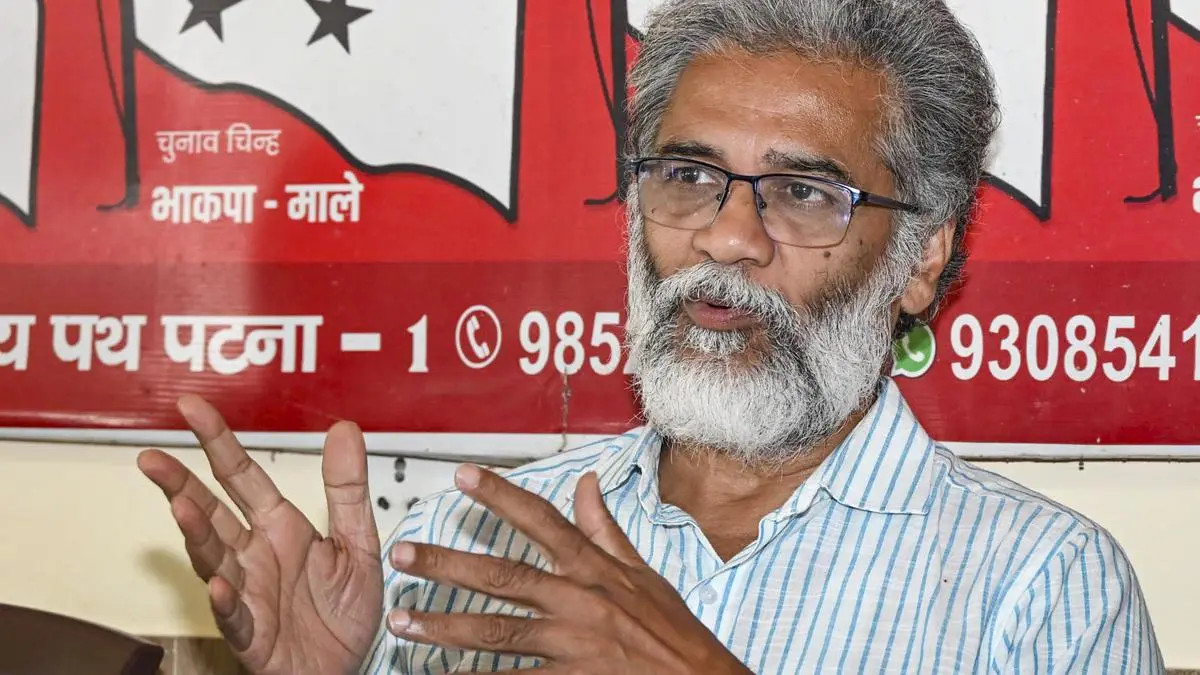
The defeat of the Left Democratic Front (LDF) after two successive terms in power in Kerala has rendered the Left parties without a government anywhere in India for the first time in many decades. In an interview with Frontline, Dipankar Bhattacharya, general Secretary, Communist Party of India (Marxist-Leninist) Liberation, spoke about the outcome of the recent Assembly elections, the implications of the Left’s decline, the rise of the Right and the need for a Left revival in the interests of a secular, democratic India.
While he was concerned about the decline of the Left, Bhattacharya was equally, if not more, exercised about the larger implications of the overall outcome and the need for the Left to be the face of anti-fascist resistance. He also said that the need for the INDIA bloc as the broadest possible platform of unity, cooperation, and coordination among the entire range of non-BJP forces has only grown after the May 4 results. Excerpts:
What do you make of the overall electoral results, and the Left’s performance in particular? For the first time in decades, the Left leads no government today.
The Left will, of course, have to evaluate its own electoral performance, but it is the overall outcome that must be the greater concern. The BJP’s massive victories in Assam and West Bengal and the defeats suffered by the Dravida Munnetra Kazhagam [DMK] and the Trinamool Congress, the two major regional parties in the anti-BJP camp, tilt the political balance more decisively in favour of the BJP. An emboldened Modi government and the Sangh brigade will now accelerate and intensify their campaign for greater centralisation of power in the hands of the Sangh-BJP establishment and concentration of wealth in fewer corporate hands.
Given the decline of the Left, what are the specific challenges facing progressive forces today?
Of the five election-bound States, it was only in Kerala that the Left was in power. After 10 years in office, the defeat of the LDF was expected, but the scale of the defeat is definitely a matter of concern. In West Bengal, the CPI(M) has refused to learn any lesson and take any corrective measures since the Singur land acquisition phase, and the decline is yet to be arrested. I hope the CPI(M) and other sections of the Left in Kerala will be sincere about introspection and course correction. Ten years ago, the BJP had only three seats and a small vote share in West Bengal; today it is placed on a similar level in Kerala. The progressive forces of Kerala will surely take note and save the State from going the Bengal way.
What are the reasons for the uneven development of the Left across India?
Historically, the Left in India grew as an integral part of India’s anti-colonial freedom movement. The quest for social equality and rational enlightenment, militant peasant struggles against the feudal order, emerging working-class action against capitalist exploitation, and popular revolts against autocratic rulers in princely States gave it added impetus. The stubborn feudal-patriarchal turf of North India has generally been less receptive or more hostile to the growth of the Left ideology. Over the years, it came to be seen as some sort of a settled pattern. But with every settled pattern getting unsettled, there is no reason why the Left cannot grow as a political trend in States where its presence has hitherto remained quite marginal.
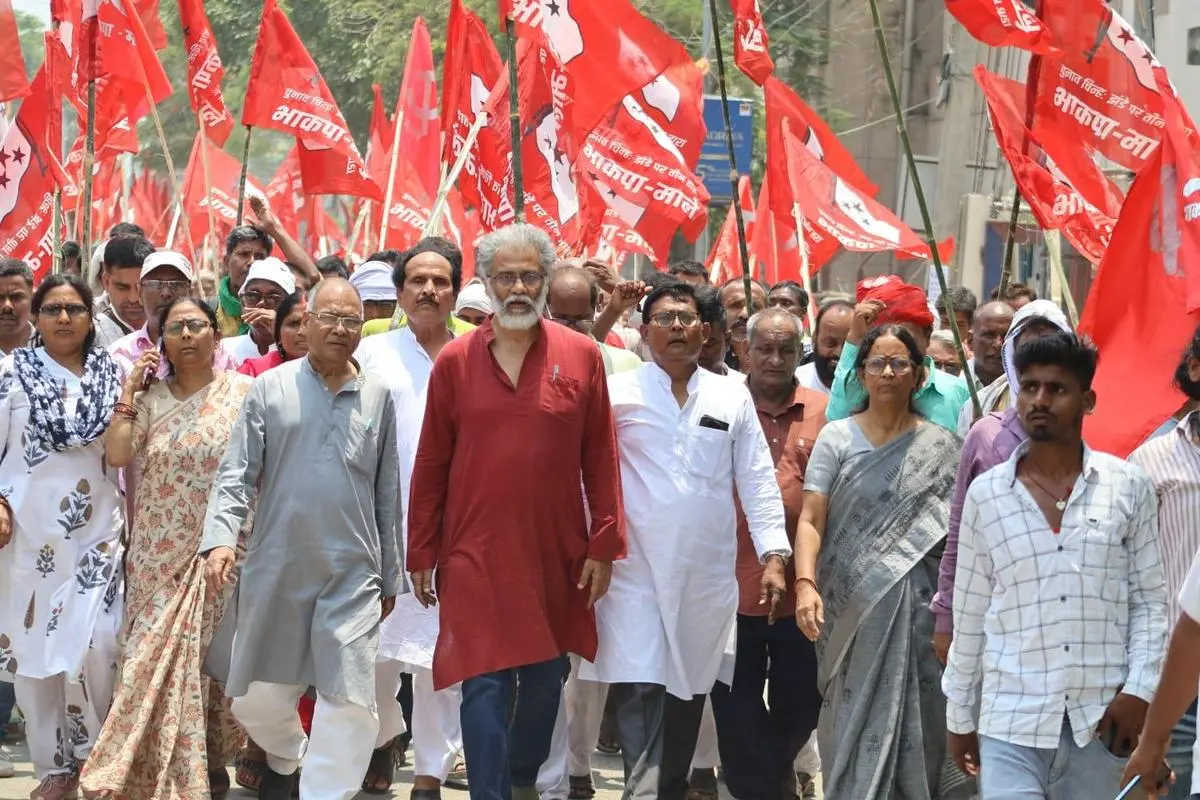
Marching to the venue of the 12th State Conference of the Bihar unit of the CPI(M-L)L, in Darbhanga, on May 16, 2026. | Photo Credit: By special arrangement
How can the Left overcome the disproportionate influence of money and large resources on the electoral system?
The Left can only fight the vicious grip of big money and big media by harnessing the power of the people and potential of an alternative media by making full use of every avenue of mass communication and mass mobilisation. We got the Constitution and parliamentary democracy as integral parts of our freedom package. Now that fascism is threatening to hollow out all our democratic gains and institutions, we need nothing short of a second freedom movement to win more rights for the people and make our democracy more robust, participatory, and egalitarian. The Left has to champion this anti-fascist agenda in terms of both idea and initiative.
The Trinamool Congress made overtures for opposition unity against the BJP. The non-BJP opposition—the Left and the Congress—in West Bengal rejected Mamata Banerjee’s overtures because of their uneasy relationship with the Trinamool. Do you think a unified bloc is possible nationally against the BJP, given that seat-sharing and vote transfer remain contentious issues?
The Trinamool has been and still remains a constituent of the INDIA bloc in the all-India context. It was manifested just the other day in the special Parliament session when the entire opposition voted unitedly against the sinister delimitation Bill. However, in West Bengal where the Trinamool was in power for the last 15 years, there was no unified opposition to the BJP within the State as the Left and the Congress also had to oppose the Trinamool on issues like corruption and various other facets of misrule. There has been no State-level coordination among INDIA bloc constituents in States like Kerala and Punjab either. The equation may undergo some changes in Tamil Nadu too.
While such strains are an inescapable reality in India’s diverse and complex political landscape, relations among various anti-BJP opposition forces are bound to get recalibrated in the course of time in the changed context of West Bengal. Much will depend on how the Trinamool reinvents and reconfigures itself in this new situation.
Some are writing the obituary of the INDIA bloc, especially as its constituents are no longer in government. Would that be a fair assessment?
The INDIA bloc is a product of today’s political circumstances wherein the ruling BJP is bent on turning India into an opposition-free one-party state. The emergence of the INDIA bloc was made possible by powerful struggles on the ground: unrest among students triggered by the institutional murder of Rohith Vemula and the assault on JNU and other universities, the historic mobilisation for equal citizenship against the divisive and discriminatory Citizenship (Amendment) Act and the massive assertion of India’s farmers against the attempted corporate takeover of agriculture, to mention just three examples.
This context has only become more pressing in the wake of the electoral purge and electoral fraud being perpetrated across India, the government’s abject surrender to the US-Israel axis, and the growing economic crisis landing India into what Modi now calls a “decade of disasters”. All ideological streams and political parties constituting the INDIA coalition have to respond to the demands of the situation. The Congress being the biggest party with a wider all-India presence, obviously has to play an anchor’s role in taking this coalition process forward. Any obituary of regional parties or dream of a grand revival of the Congress will be premature. The answer to one-party domination has to come in the shape of a vigorous assertion of India’s multi-party democracy and federal framework on the one hand and a simultaneous reawakening of the anti-imperialist and inclusive secular core of India’s nationalism.
How do you view the rise of the Tamilaga Vettri Kazhagam (TVK) helmed by C. Joseph Vijay, which has effectively marginalised the DMK-led Secular Progressive Alliance, of which the Left was a constituent in Tamil Nadu?
In Tamil Nadu, the phenomenal rise of the TVK has caused a major rupture in the State’s well-established political pattern. The BJP surely smells a great opportunity in this unsettling of settled equations. The Left will have to carefully navigate this juncture to make sure that Tamil Nadu remains one of the strongest bastions of the secular, democratic and federal character of our republic.
It is the BJP’s unprecedentedly sweeping electoral rise in Assam and West Bengal that has the most challenging and disastrous implications for India’s democracy and the Left. Delimitation in Assam and the SIR [Special Intensive Revision] in West Bengal have a lot to do with the scale of the BJP’s victories, as does the utterly partisan role of the Election Commission of India and the militarised environment in which elections were held.
When India’s admittedly weak institutions of democracy are proving to be incapable of resisting the growing consolidation and aggression of fascism, communists and all other shades of anti-fascist forces must rely on the strength of the people and invoke the power of India’s progressive democratic heritage to resist the fascist offensive. Closer integration with the people, greater focus on their everyday struggles for survival and dignity, and broader unity of all fighting forces is the only way forward. The Left, which played a major role in India’s freedom movement and post-colonial quest for expansion of democracy and deepening of people’s rights, will have to revive itself in today’s phase of anti-fascist resistance.
With the Congress disengaging from the DMK-led alliance in Tamil Nadu, there is speculation that the INDIA bloc is on its way to disintegration. Do you agree?
The INDIA [bloc] had emerged as the overarching platform of unity comprising even parties that were ranged against each other in certain States. While West Bengal will now have greater clarity and commonality of purpose, there is a certain strain in the non-BJP camp in Tamil Nadu. But the need for the INDIA bloc as the broadest possible platform of unity, cooperation, and coordination among the entire range of non-BJP forces has only grown after the May 4 results. The Congress is not only the biggest component of the INDIA bloc, it has also been the biggest beneficiary of this coalition. It must therefore continue to play a consistently committed and responsive role.
Also Read | BJP stands for feudal restoration in Bihar: Dipankar
Also Read | SIR probably the biggest possible attack on the Constitution: Dipankar