


Tamil is the only Indian language with a thriving modern literary tradition that has been consistently overlooked by the Jnanpith award. The Jnanpith has historically recognised writers who expanded the possibilities of Indian literature, including K. Shivarama Karanth, M. T. Vasudevan Nair, Ashapurna Devi, and Qurratulain Hyder. Tamil has had no dearth of such figures. However, in over 60 years of its existence, only three awards have been made over to Tamil, and all three have been controversial choices.
The first Jnanpith was conferred in 1975 upon Akilan, a writer who wrote sentimental pulp fiction. In an essay published in the little magazine Pragnai in 1976, the writer Sundara Ramasamy famously condemned the choice, calling it an endorsement of “phonies”. “I have not found, in any Indian language, an artist equal to Pudhumaipithan,” he wrote in the essay titled “Poli mugangal - sandharppam: Jnanapita parisu” (Phoney faces in light of the Jnanpith Award). “If Pudhumaipithan’s short stories and (Akilan’s) Chithira Paavai are both called quality works, what, then, is the standard that is common to these ‘qualities’?”
The next Jnanpith came to Tamil only in 2002, when it was conferred upon D. Jayakanthan. Jayakanthan has always been acknowledged as a significant literary figure in Tamil. But when he won in 2002, it still elicited comments from the intelligentsia about the tendency of uratha pechu (didacticism) in his writing. They considered his decision to write for the popular magazines an unforgivable compromise, a “dilution” of literary standards, identifying writers like Ashokamitran, Ki. Rajanarayanan and Sundara Ramasamy as far more artistic writers—writers, incidentally, who were never recognised by the Jnanpith committee in their lifetimes. This observation is not meant to take away anything from Jayakanthan, but rather to underscore the uncompromising critical standards that have always prevailed in modern Tamil literature.
The third and the most recent Jnanpith was awarded to Vairamuthu, a choice that has elicited immediate and widespread condemnation across the spectrum of Tamil letters, more vociferous than ever before. Two petitions, demanding that the award be revoked, have been signed by a wide swath of Tamil readers and literary personalities and sent to the Bharatiya Jnanpith. The award to Vairamuthu has been characterised both as an insult to Tamil literature and a failure of the Jnanpith as a literary institution.
For those outside Tamil, the vigour and clamour in these reactions could appear bewildering. “What’s going on?” a translator friend asked. Was it jealousy? Literary politics? Writers being belligerent? Many believed that the opposition to the award was on the grounds of the 17 counts of sexual harassment complaints against Vairamuthu lodged with the National Commission for Women and since gone uninvestigated, alleging that he used his power and influence to engage in intimidation and sexually predatory behaviour with women colleagues.
A good part of the answer, however, goes back to literary history. Modern Tamil literature has always been a vigorous, argumentative space. The argumentative tradition in Tamil literature goes back to its classical age, when poets were fastidious that any prizes the kings bestowed should be in accordance with the merit of the poet. Varisai thavariya parisil (prizes inconsistent with achievement), were considered a mark of great insult upon all good poets and the poetic tradition itself. But the argumentative vigour can also be attributed to the influence of modern Western literature in the early 20th century, when Tamil literary figures like Pudhumaipithan, Ka. Naa. Subramaniam and Si. Su. Chellappa were influenced by figures like Ezra Pound, T.S. Eliot, F.R. Leavis and, later, Harold Bloom.
Modern Tamil’s little magazine movement
Modern Tamil literature was, from the beginning, a little magazine movement. Set against the dominant currents—of popular magazines on the one hand and Marxist and Dravidian ideological writing on the other—a third kind of writing, shaped by world modernism and New Criticism, emerged as a cultural undercurrent. Written in little magazines like Ezhuthu, Pragnai, Ka-cha-ta-tha-pa-ra and Salangai and read by a small, but dedicated circle of readers, this movement did more to push the boundaries of modern Tamil prose, narrative form, thought and moral imagination than either the populist or the ideological school. It reinvented Tamil for the modern age.
The little magazine movement, also called the Ezhuthu tradition after its flagship journal, nurtured major Tamil writers, poets, and critics including Pudhumaipithan, Mouni, Ku.Pa. Rajagopal, Ku. Azhagirisamy, Na. Pichamurthy, Ashokamitran, G. Nagarajan, R. Chudamani, Sundara Ramasamy, Ki. Rajanarayanan, Ambai, Indira Parthasarathy, Nanjil Nadan, Vannadasan, Vannanilavan, Gnanakoothan, Pramil, Abi, Atmanam, Devadachan, and Devadevan. Then, from the late 1980s to the early 2000s, influenced by magical realism, post-structuralism, and new historicism, writers such as S. Ramakrishnan, Charu Nivedita, Joe d’Cruz, Ba. Venkatesan, Yuvan Chandrasekar, and Jeyamohan emerged, alongside poets like Sukumaran, Vikramadithyan, and Manushyaputhiran.
Parallel to this, in the 1990s and early 2000s, women and Dalit writers (and others from similar backgrounds identifying simply as “creative writers”) produced largely naturalistic, dialect-rich work rooted in folk traditions and rural landscapes. Notable names include Imayam, Uma Maheshwari, Kanmani Gunasekaran, Perumal Murugan, Bama, Cho. Dharman, Chandra, M. Gopalakrishnan, Keeranur Jakir Raja, and Su. Venugopal. Feminist poets such as Kutti Revathi and Malathi Maithri pursued iconoclastic feminist aesthetics outside the Ezhuthu frame.
Since the late 2000s, modern Tamil fiction has entered a “questing” phase, re-engaging classical and folk traditions in a search for meaning. A new generation of women writers has emerged, working within the tradition but pushing the boundaries of its aesthetics in novel ways. Poetry continues to innovate; recent poets of note include Perundevi, Isai, Gandarathithan, Kumaraguruparan, Veyyil, Samraj, Sabarinathan, Mathar, J. Rosalyn, and Anandkumar. This is a modest survey of just Indian Tamil fiction and poetry. Diaspora writing, and the vast body of contemporary Tamil non-fiction, in particular its Dalit writing, are equally significant. Much of this work appears in Ezhuthu-inspired little magazines, which have now moved online: Solvanam, Vallinam, Vanam, Akazh, Neeli, Kurugu, Kanali, Olaichuvadi, Mayir, and Kavithaigal are among the prominent ones. Kalachuvadu and Uyirmmai are mainstream examples that also appear in print.
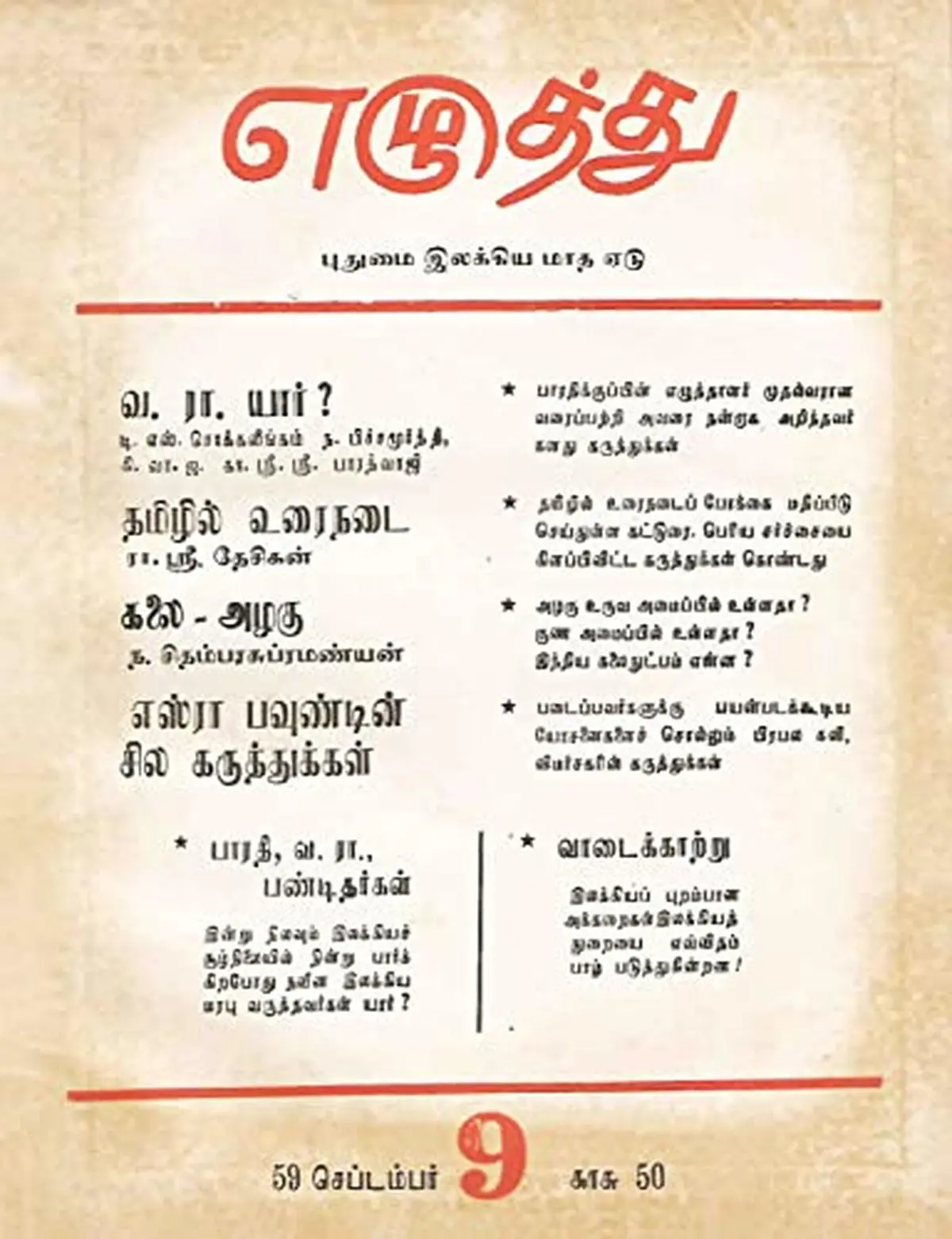
An issue of Ezhuthu dated September 9, 1959.
One of the greatest legacies of the Ezhuthu-school little magazine movement in Tamil is the body of fastidious readers it has nurtured across four generations, who have been immersed in the tradition and inherited an exacting literary taste. Tamil readers are the hidden treasure of the Tamil literary world. They do not just read, they sift through the massive body of work that appears every year for literature that pushes the boundaries of form, expression, and vision, updating the canon with each new and exciting book they read. Their main critical tool is comparative reading. It is on the basis of their broad reading of modern Tamil and of Indian and world literature that they judge which writers are original and which ones derivative.
“Vairamuthu is a simple versifier. He breaks commonplace ideas into lines and creates statements that he calls poetry”—this is a common refrain that can be heard across the Tamil reading public. If readers judge his poetry to be “simple”, “derivative”, or even “phony”, it is because they compare him with poets like Pramil, Devadevan, Abi, and Vikramadithyan, whose poetry bears the inheritance of Tamil, Indian, and European poetic traditions. In comparison, Vairamuthu fares very poorly. “His poetry has no subtext, no original imagery, no fresh ways of using language,” remarked a Tamil reader who requested not to be named.“He writes in a strident, didactic tone, as if he’s on a soapbox all the time.”
It is a common belief that Vairamuthu emerged from the Vanambadi (skylark) tradition of Tamil poetry. The Vanambaditradition was influenced by poets like Pablo Neruda and was characterised by its adoption of free verse along with Left-leaning politics and romanticism. Represented by poets like Puviyarasu and Mu. Mehta, the Vanambadi school believed that poetry was for the people and the poets often declaimed from public platforms.
However, Vairamuthu’s verses have none of the hallmarks of the Vanambadi tradition either. His poetry is not Left-leaning. It does not enter into conversation with the masses. Nor is it romantic. It is considered derivative verse of the most ordinary grade. “Vairamuthu’s free verse has no grounding in any tradition. It is phony,” said writer Jeyamohan. “It was influenced by the commonplace rhetorical style of Dravidian-movement public speakers like Vetrikondan and Theepori Arumugam and licentious portions of Tamil folk songs.”
‘Crafted, superficial, pretentious’ writing
Readers are turned off when they see that the writing is phoney—that it is trying to be something it is not. Indeed, “fake” was a word that was thrown around a lot in the past week. Tamil readers do not consider Vairamuthu an ideological writer, despite his well-known proximity to political parties across the spectrum. “There is no real political consciousness in his writing,” remarked a reader. “Compare him to writers like Imayam, Ponneelan, or even Melanmai Ponnusamy. His ideology is fake.” In a Facebook post, writer C. Saravanakarthikeyan, who claims to have read 30 of Vairamuthu’s works in his youth, acknowledges Vairamuthu’s contributions as a film lyricist, but characterises his fiction as “crafted, superficial, pretentious”. Writer Suresh Pradeep notes on his website that Vairamuthuobserves what is trending in modern literature, and apes that in fiction that sounds literary but has no real depth.
The scenes of rural life he has depicted in novels like Karuvaachi Kaviyam (The Epic of Karuvaachi)or Kallikattu Itihasam (The Saga of the Cactus Land)are pale copies of what writers like Nanjil Naadan, Poomani, Ki. Rajanarayanan, Su. Venugopal or Kanmani Gunasekaran have done with far greater finesse and depth. Nilaakkal Dhoora Dhooramaaga (Moons, far, faraway), a memoir by writer Bharata Devi about her childhood spent in the bleak karisal black-soil land, is a truer testimony to the Tamil woman’s rural life than anything Vairamuthu has ever written. Indeed, for the Tamil world, it is almost comical that with the rich variety of modern Tamil literature to choose from, the Jnanpith committee decided to endorse someone like Vairamuthu.
When such controversies erupt, responses from Anglophone readers often border on disbelief. “Why haven’t we heard of these other names before,” they wonder. The answer is that the selective translation and publication of Tamil literature in English has largely been along lines where considerations other than merit are paramount. Often, writers deemed politically important are translated into English. Identity politics is a saleable commodity in a neoliberal world, so one cannot blame publishers for wanting to capitalise on it.
It is fine to front voices who work outside the literary tradition or indeed the various shades of voices within it—diversity in literature is an excellent thing. But if readers outside Tamil are not introduced to its mainline literary tradition but must judge the entirety of it by the yardstick of someone like Vairamuthu, then that is hardly desirable or fair. Indeed, the best of modern Tamil poetry has not made it into English yet.
Like literature everywhere, the best of Tamil literature is judged on whether it deals with a certain truth, whether it enquires into the human condition, has insights into life, a vision for humanity. Yes, tastes may vary across readers. Many Tamil women readers, for example, hail Jayakanthan as a visionary of unimpeachable integrity who stood for them; the occasional didacticism of his prose does not bother them; for them his artistry lies elsewhere. But readers are always clear about who is original and what is the truth in the writing. This is the reason behind the vociferous reactions to Vairamuthu getting the Jnanpith.
“Vairamuthu’s political influence is no secret, he doesn’t keep it a secret either,” wrote the editors of Akazh, a prominent Tamil little magazine, after the Jnanpith was awarded. Writers like Vannanilavan have gone on record to describe their first-hand experience with Vairamuthu’s lust for awards. That Vairamuthu secured this award through his political influence and persistent, relentless networking is well known in Tamil literary circles.
It is this context that the accusations of sexual harassment and predatory behaviour by 17 different women against Vairamuthu show up in new light. It appears the same psychology operates behind using power to prey on women and using influence to grab awards. And it looks like the Jnanpith is either unaware of the real Tamil literary scene, or endorses these dubious values. But the Tamil reader is unequivocal: neither the common woman, nor the reader, nor Saraswati herself can be strong-armed into submission.
At this juncture, modern Tamil literature finds itself at a crossroads: one where it finds its own tradition larger than the national awards that are supposed to recognise it. It now falls on Tamil itself to recognise the best in Tamil writing, to evolve ways to expand its readership, and to discover ways to take its literature to the world.
Suchitra is a writer, translator, and co-founder of the literary initiative Mozhi.
Also Read | Remembering Pudumaippithan
Also Read | 'There is no language in the world which is pristine and pure'