








“Farewell Karachi,” the film critic Bhawana Somaaya writes, “is an ode to my family and an ode to a city that my parents called their motherland.” While her book is subtitled “A Partition Memoir” and is certainly an ode to her family, the Karachi and Partition segments, though figuring prominently in the beginning, become less central fairly quickly. Yet the title is not entirely a misnomer for you could argue, as Somaaya seems to suggest, that the reverberations of Partition inform the whole story and that those who undergo such an experience can never be free of it.
Somaaya was born long after the family were forced to uproot themselves from Karachi, but the collective trauma communicated itself to her and became part of her life too. “Partition involves a sense of displacement, even if you haven’t experienced it,” she writes, explaining how it engenders a sense of “recurrent insecurity”. To borrow from the title of a Kiran Desai novel, this inheritance of loss comes through in Somaaya’s detailed, quotidian evocation of her family’s life in pre-Partition Karachi: a world that she learnt about from her parents and older siblings, yet one that clearly figured prominently in family lore. Their large, multigenerational joint family, which hailed from the Lohana community, inhabited a sprawling house in Karachi and could trace their roots in Sindh back five generations and a hundred years.
In Somaaya’s telling, the family was presided over by her grandfather and lived and ate together. The men went to work (they oversaw sawmills and owned a construction business), while the chores were amicably shared between the wives. The pace of life was calm and predictable. In the hot Karachi summers, everyone slept out on the terrace. There were family picnics to Manora Island, storytelling sessions by grandmothers and aunts, and joyous celebrations of festivals. Partition ended this idyllic existence.
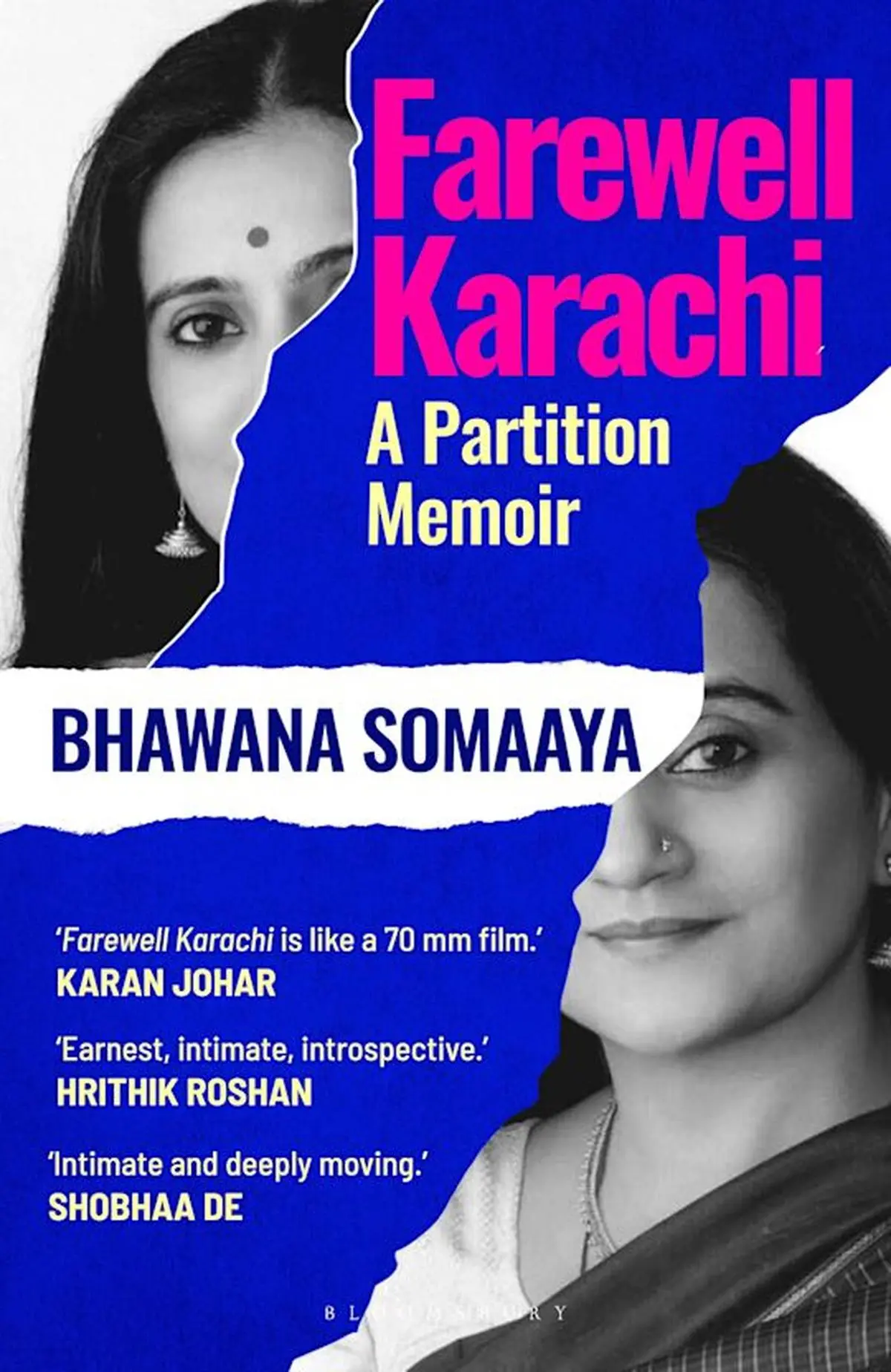
In Farewell Karachi, the drama of Partition segues into the story of the family’s post-Partition existence and what it actually meant on a day-to-day basis to go from complete security to total uncertainty. | Photo Credit: By special arrangement
Farewell Karachi: A Partition Memoir
By Bhawana Somaaya
Bloomsbury India
Pages:188
Price: Rs. 450
Like so many others, the Somaayas thought it would pass: “Karachi had no history of violence,” they reasoned. But after August 1947, it was now another country, and when the riots began, the decision was taken to leave. On September 22, 1948, the family managed to board a packed, chaotic steamer that would take them to the port town of Mandvi in Kutch, India. The family first settled in Burj, before shifting to Bombay, where Somaaya’s father’s office—he worked for Burmah Shell—was located.
The initial months in Burj were hard. Her father returned to Karachi to secure his transfer orders from Burmah Shell and sell the family home. He received only a pittance for the property, leading him to observe sadly that their once-trusted friends had turned into “vultures”. Meanwhile, his delayed return meant the family in India had to resort to selling Somaaya’s mother’s jewellery to make ends meet.
These are all familiar Partition stories: the brutal uprooting, the betrayals, the terrible journeys, and the uncertainty that did not end in India. Instead, there was endless struggle and an intense, unremitting sadness for the world that was lost. Farewell Karachi gives these well-trodden tropes a granular reality.
Of course, we also know that it all worked out, not just for the Somaayas but for multitudes of others. Their father’s job took them to Bombay, where they moved houses frequently in what was an unfamiliar and alien city. Eventually, it became their home: they bought their own flat, put down strong roots, survived, and thrived.
Somaaya has six sisters and two brothers; the youngest by a long margin, she has written this book as a hymn to large family life. Her father worked long hours to provide for the family, their mother nurtured them, her sisters were married off, and her brothers were educated. It is a familiar tale, but told with warmth and authenticity, even if Somaaya remains reticent about the tensions, disagreements, and power struggles of family life.
There are many delightful period details, though: her brother Mahendra standing in front of a mirror, for instance, carefully fixing his Dev Anand “puff” to his satisfaction; listening to Chhaya Geet on the radio and watching Phool Khilen Hain Gulshan Gulshan on TV; reading her parents’ local library books—brightly coloured paperbacks with smudgy print of Perry Mason, Pearl S. Buck, Daphne du Maurier, and Somerset Maugham. Mahendra sent them gifts from Germany, which are a peephole into India during the licence-permit raj: voile fabric, crockery, cutlery, cameras, spectacle frames, knives; the bigger items that were sent through sea mail included camp cots, refrigerators, dinner sets, and washing machines!
Somaaya tells us little about her personal life other than the known facts of her being a successful film critic, the editor of Screen magazine, and the author of biographies of Amitabh Bachchan and Hema Malini. She does drop some tantalising glimpses of 1960s and 1970s Bollywood: “I was well acquainted with movie culture. I could sniff a struggler from his swagger, categorise a star by his brand of sunglasses, ice buckets, cigarettes, umbrellas and hand mirrors.” Alas, she does not tell us more.
This is an involving read: the drama of Partition segues into the story of the family’s post-Partition existence and what it actually meant on a day-to-day basis to go from complete security to total uncertainty and the grinding effort and iron determination it took to rebuild an acceptable life.
Ranjana Sengupta is an editor and the author of Delhi Metropolitan: The Making of an Unlikely City.
Also Read | Writing Partition: A violent birth
Also Read | Of love, loss, and redemption