


If you have been watching routine discussions about the ongoing global bloodbaths, it is likely that you have grown weary of words like “escalation”, “humanitarian zone”, “pre-emptive strikes”, and suchlike. Emptied of all empathy and moral disgust, the calculus of war drones on with its pathetic vocabulary, leaving some fundamental questions wilfully unanswered.
What is it, really, that takes nations to war (and genocide)? What is it about the historical architecture of nation states that makes them so reminiscent of religious passions? Why is it that states are increasingly removed from the needs of ordinary people? Rana Dasgupta’s timely new book, After Nations: The Making and Unmaking of a World Order, comes as a gripping and thought-provoking response to these fundamental questions.
The book traverses a staggering range of ideas that are as insightful as they are scrupulously researched. Dasgupta is deceivingly modest when he writes in the introduction that he is not a professional researcher but that he “presses existing knowledge to new ends and configurations”. The book combines economic, legal, political, and intellectual history to produce a novel synthesis of scholarly insights; its multidisciplinary sweep is a breath of fresh air.
Colonial histories (and horrors) are constantly brought into focus. Did you know that Patrice Lumumba, the Congolese leader assassinated in 1961, had his corpse hacked to pieces by a Belgian police officer? This officer proceeds to take Lumumba’s teeth as a souvenir to be passed on as some kind of family heirloom. We learn about Elbridge Colby, a captain in the US Army, who wrote a war manifesto in 1925 that proclaims how “to a fanatical savage, a bomb dropped out of the sky on the sacred temple of his omnipotent God is… an indication of the relentless energy and superior skill of the well-equipped civilised foe…”.
British colonialism wrought extraordinary cruelty on subjugated peoples, but Dasgupta also reminds us that during the 18th century “the same system was vampiric towards its own citizens”. It forced men and women to sell themselves en masse into labour and prostitution since all but propertied men were summarily excluded from the political system.
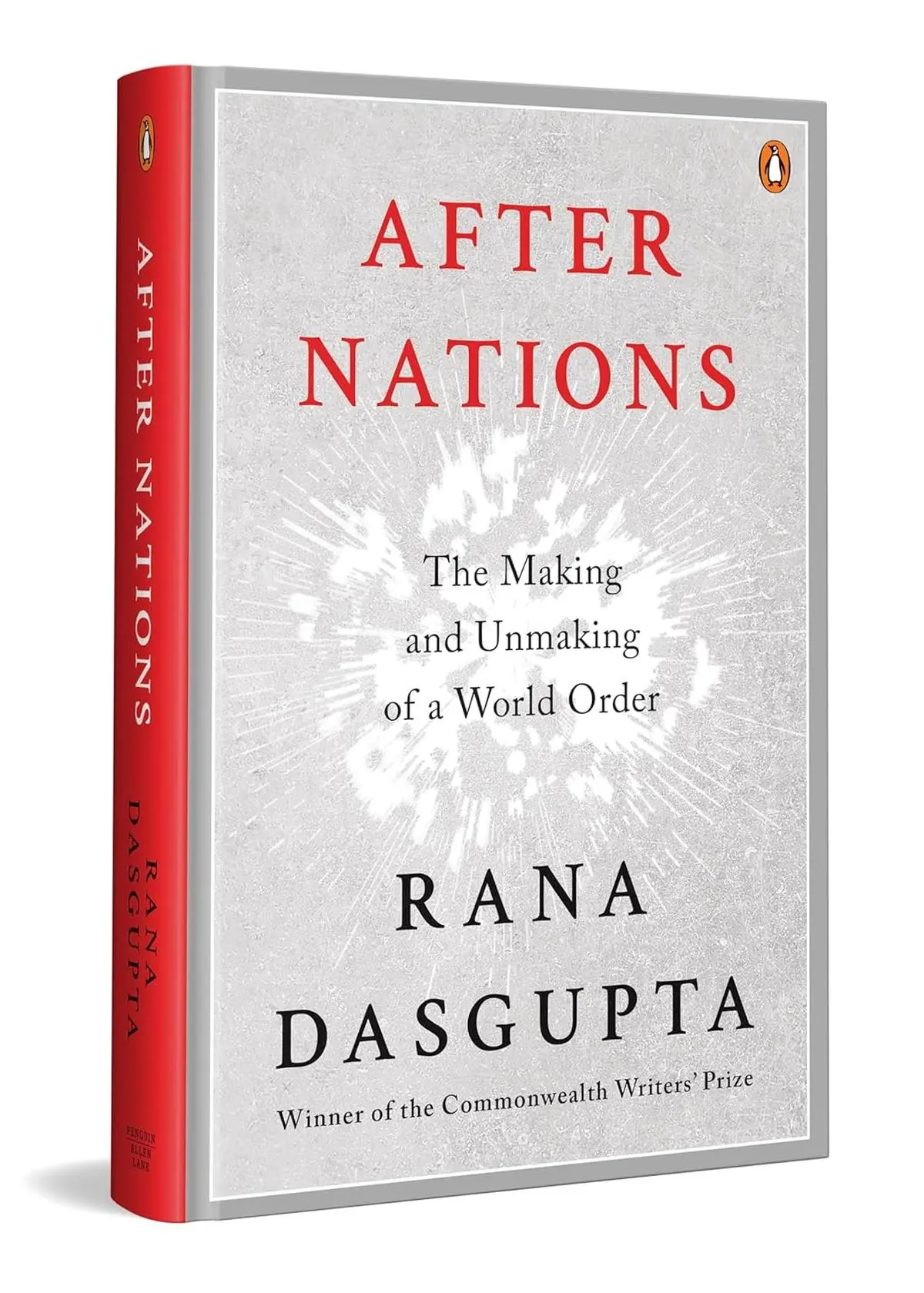
After Nations
The Making and Unmaking of a World Order
By Rana Dasgupta
Allen Lane
Pages: 496
Price: Rs.999
Dasgupta’s survey of political theory is never doctrinaire, and the book urges us to understand the historical underpinnings of our present predicaments. These histories are never fully remote from us, for their ghosts are still floating around. For instance, a key argument in the book details how European liberalism and nationalism were mostly designed to solve disputes within Christianity.
He also showcases how inextricable from mysticism and obscurantism the Enlightenment really was. Pair this with the following scathing commentary on the present moment: “Duped by their own language of secularism, liberals often fail to understand that their commitments are every bit as religious as their opponents—and that their contempt for ‘uncouth’ theologies often looks like nothing more than priestly sanctimony.”
A great deal of attention is paid to the imperial trajectories of Europe, America, and China, but the book is equally concerned with understanding the ramifications of the last 50 years of neoliberalism: “In the late 1970s, there began a set of processes which restored the autonomy of financial capital, reset the purpose of politics, and generated a number of formidable new competitors to the nation-state…. Nearly five decades later, the nation-state is unable even in theory to manage reality as it once did.”
Neoliberalism and the nation state
While the years following the Second World War had produced a broad welfarist consensus that brought about a measure of prosperity to the West, this would soon devolve into monopoly and grotesque inequality. Globalisation eroded the conditions in which the religions of the modern state could flourish so that by the time we arrive at the heavily privatised states of the 21st century, “time no longer seemed to bring human betterment, and the old gospel of ‘progress’ appeared to be little more than elite self-justification”.
Hand in hand with this economic turn was a theological shift, a common theme across centuries. Part of the book’s genius is how well it captures these connections. Dasgupta points out that the age of neoliberalism is coterminous with the emergence of equally impressive religious irruptions: the Islamist coup in Iran; Saudi Arabia and the US’ sponsorship of the jehad in Afghanistan; the spread of Pentecostal Christianity in Latin America, Asia, and Africa in the 1980s; the founding of Islamist welfare parties in Turkïye; the rise of Hindutva and the RSS in India post-Emergency.
If, as Dasgupta puts it, “theocracy is rising everywhere from liberalism’s fall”, where do we begin searching for universalism? He locates the answer in planetary ecology, in the rejection of national monocultures, writing that “we need to recover our lapsed theological intelligence, and to revive inter-religious conversations of the kind that were common in the great empires of the past but are rare today”.
At the end of all its excursions into the history of the nation state, After Nations arrives at what is perhaps the most haunting theme of our times: AI. Dasgupta harbours a cautious (and unconvincing) optimism for AI, and this is perhaps the weakest link in the book. The stakes are high: “The most important political question of our time, indeed, is probably that of government by machines; if political philosophers do not do the work of designing such government for the benefit of human beings and the planet, private corporations will design it for profit.”
Surprisingly, Dasgupta does not dwell much on the dystopian possibilities of AI-led warfare, despite their very real deployment in the genocide and destruction happening right now. This, in spite of his sweeping assertion that “AI will also take over much of the work currently performed by media organisations, universities, and think-tanks”.
He instead argues that AI could help “transcend the combative nature of much democratic conversation”, by finding patterns of agreement in people and fostering consensus-building. There is also the romanticised hope that AI could help extend democracy beyond humans to non-human agents: migratory birds, endangered animals, rivers. New forms of digital citizenship that promote migrants’ rights and freedoms, coupled with new forms of digital monies that break away from the tyranny of national currencies, are futures that Dasgupta envisions for a brighter world.
I was recently introduced to an online game called Worldle, where one must guess the country from its geographical borders. It is a fine way to dwell on the absurdity of nation states (as well as one’s ignorance): The Gambia looks like an intestine; Kosovo and Montenegro are almost doppelgangers. The aching hopes and desires of entire peoples corralled into the destinies of around 200 bizarre-looking states, ranked in an unforgiving hierarchy of currencies and passports.
What might a game like this look 100 years from now? If, as Dasgupta puts it, the “nation state is a constantly changing commercial engine, whose interests coincide only sometimes with those of human beings”, we must only hope that other forms of political creativity emerge that may champion humanity, ecology, and above all, life.
Srikar Raghavan is the author of Rama Bhima Soma: Cultural Investigations into Modern Karnataka.
Also Read | The lie of Modi-land
Also Read | Rama Bhima Soma pushes the boundaries of Kannada cultural discourse