










Solapur has more sugar mills than any other district in Maharashtra—42 of them, drawing cane from across its plains. The Shri Shankar Cooperative Sugar Mill in Malshiras tehsil is among the oldest. In most years, its crushing season runs through March and into mid-April.
This year, the machines stopped on February 5.
Total cane crushed: 2.55 lakh metric tonnes. The season ended six weeks early. For three consecutive years, Solapur’s mills have wrapped up in the first week of February. Each early closure leaves a trail of unpaid bills—transport contractors, cane cutters, farmers—that management committees must clear with money they do not have.
What is happening at Shri Shankar is happening across Maharashtra. The State’s sugar industry, built over decades as a cooperative model of rural development, is now carrying Rs.8,315 crore in unpaid dues. Industry leaders warn that without urgent intervention from both the State government and the Centre, the consequences will reach millions who depend on the crop.
Maharashtra’s 210 sugar mills—cooperative and private—crushed approximately 1,035 lakh metric tonnes (LMT) of sugarcane in the 2025–26 season, producing an estimated 95 to 98 LMT of sugar. Historically India’s largest sugar-producing State, Maharashtra reasserted that position in 2025–26 with output touching 99 LMT, after Uttar Pradesh briefly overtook it in 2024–25.
Nearly 50 lakh farmers depend directly on sugarcane cultivation. One million cane cutters are tied to the crop. In 2024–25, the farmers’ sugarcane bill was Rs.28,000 crore; labourers received Rs.10,000 crore. The annual wage bill across all 210 mills is Rs.4,500 crore. The State government draws around Rs.8,000 crore in direct revenue from the industry. Industry sources put the sector’s annual turnover at Rs.55,000 to Rs.60,000 crore.
The structural problem is a single, widening disproportion. The Fair and Remunerative Price (FRP) for sugarcane—the minimum mills must pay farmers—has risen from Rs.2,750 per tonne in 2018–19 to Rs.3,550 per tonne in 2025–26, an increase of 26 per cent in seven years. The Minimum Selling Price (MSP) for sugar, the floor below which mills cannot sell, has not moved. It remains at Rs.31 per kg, where the Union government fixed it in February 2019.
According to an audit by the Sugar Commissionerate of Maharashtra, the cost of producing one quintal of sugar now stands at Rs.4,029. Mills are realising on average only Rs.3,700 per quintal—a shortfall of Rs.300 to Rs.500 per quintal. The industry’s aggregate losses from this gap alone are estimated at Rs.3,300 crore for the season.
“We have requested both the Central and State governments to increase the sugar MSP to at least Rs.41 per kg. Only then will mills be able to cover production costs,” said Harshvardhan Patil, President of the National Federation of Cooperative Sugar Factories, speaking to Frontline.
For a mill to be financially viable, it must operate for at least 150 days in a season. None managed that in 2025–26. Excessive humidity and overcast weather triggered premature maturity in sugarcane, depressing yields. Total cane crushed was roughly 100 LMT below projections, and sugar recovery averaged 9.42 per cent.
The politics around MSP
The Union government’s reluctance to revise the sugar MSP is widely discussed within the industry as a political calculation. A higher MSP flows through to retail prices, which affects urban consumers—the BJP’s core constituency. “For ten years, the Modi government has prioritised middle-class voters over farmers. Linking everything to electoral politics is strangling agriculture. The sugar industry had the resilience to absorb pressure—now that too is crumbling,” said Vijay Chormare, a senior journalist based in Kolhapur.
Other States have moved independently. Karnataka has announced a subsidy of Rs.50 per tonne; Punjab, Rs.685 per tonne. The Sugar Federation has asked the Maharashtra government for Rs.500 per tonne.
“We have held multiple meetings with all stakeholders. Chief Minister Devendra Fadnavis has briefed Prime Minister Narendra Modi and Union Cooperative Minister Amit Shah on the situation. We will announce decisions soon,” Maharashtra Cooperative Minister Babasaheb Patil told Frontline.
On March 24, 2026, Fadnavis convened a meeting in Mumbai at which he reportedly assured mill leaders he would personally press the Union government to raise the sugar MSP to Rs.41 per kg. No decision had been announced at the time of writing.
The unpaid dues reflect how far the gap has widened. According to the Sugar Commissionerate’s report of February 15, 2026, of the total FRP of Rs.20,902 crore owed to farmers, Rs.4,300 crore remains unpaid. Of Rs.8,480 crore owed to cane cutters and transporters, Rs.2,000 crore is outstanding. Workers’ salary arrears stand at Rs.550 crore; dues to traders, Rs.1,750 crore. The total pending bill across all 210 mills: Rs.8,315 crore.
To bridge the cash shortfall, mills have resorted to advance payments from traders at a 3 per cent monthly interest rate. Banks lend against FRP obligations, but at Rs. 2,390 per quintal, their loans fall short of the actual FRP requirement. “The State government should facilitate loans of Rs.5,500 crore to mills under an Interest Subvention Scheme at 7 per cent interest to clear pending bills,” said Dilip Walse Patil, NCP (Ajit Pawar) MLA and a senior figure in the sugar sector, speaking to Frontline.
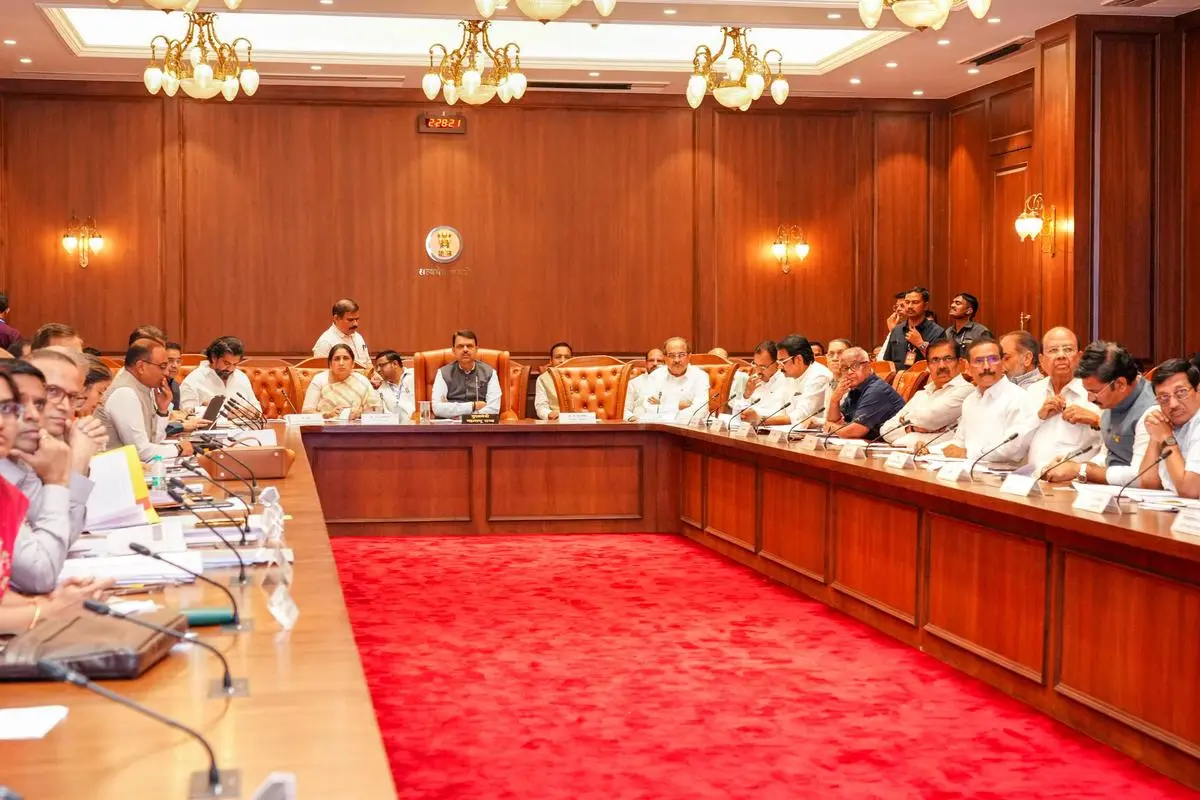
Chief Minister Fadnavis chaired meeting about sugar industry on March 24 in Mumbai. Sugar mills in Maharashtra have expanded ethanol infrastructure, but procurement orders from oil marketing companies cover only a fraction of installed capacity. | Photo Credit: By Special Arrangement
When the Union government introduced its Biofuel Policy in 2018 and promoted ethanol production as a revenue stream, the sugar industry invested heavily. According to Sugar Commissionerate data, 119 mills built ethanol infrastructure with a combined capacity of 323 crore litres.
Oil Marketing Companies (OMCs) under the Union government have placed orders for only 116 crore litres—36 per cent of the State’s installed capacity. The remaining infrastructure services debt without generating revenue. The rate for ethanol produced from sugar syrup has remained at Rs.65.61 per litre and from B-heavy molasses at Rs.60.73 per litre, both unchanged as FRP costs climbed.
“Increasing the ethanol quota for sugar mills would help the Union government stabilise petrol prices and benefit sugarcane farmers,” said Hemant Patil, Member of the Legislative Council from the Eknath Shinde-led Shiv Sena and owner of private sugar mills, speaking to Frontline.
Industry representatives have also been in talks with Union Transport Minister Nitin Gadkari on ethanol allocation. Gadkari, a vocal advocate of ethanol and with direct ties to Maharashtra’s cooperative movement, is familiar with the industry’s position.
Co-generation—the sale of surplus power to the grid—offers a further revenue stream, at rates between Rs.4.50 and Rs.4.99 per unit. Industry bodies want those rates raised. A separate problem compounds matters: the State power corporation levies a 5 per cent penalty on mills if farmers linked to them fail to clear electricity bills, even though the State government runs a free power scheme for farmers. No mill can recover dues that the government has effectively waived, yet the penalties continue.
The contradiction requires a policy decision: either end the power subsidy or exempt mills from penalties for arrears that the government created. Sources in the power department told Frontline that the State is in discussions with the power department and is considering settling Rs.308 crore owed by the Maharashtra Electricity Regulatory Commission (MERC) to mills as one option.
Political control of the sugar belt
Maharashtra’s sugar cooperatives were, for decades, the political territory of the Congress and the Nationalist Congress Party (NCP). Every significant mill was linked to a regional leader from one of the two parties. Access to State support—loan guarantees, policy decisions—flowed through that channel.
Since the BJP came to power in 2014, that arrangement has been systematically reworked. The approach has been to draw Congress and NCP leaders into the ruling coalition or restrict those who decline to switch. The mechanism runs through bank guarantees. Sugar mills need continuous bank financing to operate. Banks lend against State government guarantees. If a guarantee is withheld, the mill cannot raise capital, farmer payments fall behind, and the leadership’s local credibility collapses.
By most accounts, roughly 90 per cent of the State’s sugar mill leadership has aligned with the BJP or Ajit Pawar’s NCP faction, both part of the ruling Mahayuti alliance.
At the Centre, the Union government created a Cooperative Ministry in 2021 with Home Minister Amit Shah at its head. Murlidhar Mohol, Lok Sabha MP from Pune, was appointed Minister of State in the same ministry. The move was read within the industry as a bid to extend BJP influence into the cooperative sector.
“Policy decisions on sugar industry issues are routinely delayed. Discretionary power rests with the Minister. We hear constantly about which mill got a bank guarantee and which did not—and why. It is how the BJP is spreading itself into every corner of the sugar belt,” said Hanmant Mohite, a senior journalist from Sangli.
Maharashtra’s cooperative sugar movement built more than an industry. It seeded milk dairies, technical colleges, and rural financial institutions. Generations of farmers moved out of poverty through enterprises the sugar economy made possible.
Whether the governments in Mumbai and Delhi act in time—or whether short-term electoral calculation continues to override structural reform—will determine the fate of an industry that sustains tens of millions across rural Maharashtra.
Also Read | Maharashtra hunger games: Contentious coda to report takes over debate on farmer suicides
Also Read | Onion crisis: Maharashtra farmers are paying the price for a misguided attempt to control inflation