


The Iran war is widely regarded as having opened the door for the global economy to transition to a new order. Politicians, experts, and civil society groups, particularly in the US and western Europe, are now debating and collaborating to prepare recipes for the “cookshops of the future” that could take them, and the rest of the world, into a post-neoliberal horizon.
From “state planning” to “cooperatives”, everything is on the table for this new democratic future, where citizens might reclaim control from Wall Street, monopoly capital, and their collaborators. Much like some foreign policy experts who have raised questions about India’s current foreign policy vis-a-vis the US and Israel—which is working to India’s detriment—I pose here a similar question, not only to the government but to all those who seek to transcend a present that is ridden with socio-economic inequality.
A little over a month before the war began, on January 28, the Indian National Congress released a report titled “The Real State of the Economy”. In many ways, the report echoes Congress leader Rahul Gandhi’s election speeches during the 2024 Lok Sabha campaign, particularly in its critique of monopoly capitalism in India. However, since it does not explicitly articulate an alternative, one can only infer that it seeks to revive the vision of the Congress-led United Progressive Alliance (UPA) governments from 2004 to 2014, which emphasised a welfare state grounded in universal access to education, healthcare, and housing.
Continuing along this timeline, a week later, on February 2, the Spanish government, recently celebrated for its stance on Israel, its critique of US aggression on Iran, and its ability to manage the energy crisis resulting from the war, released a report titled “Democracy at Work”. Prepared by an expert group of social scientists and economists from across the world, the report was officially presented by Vice President and Minister of Labour Yolanda Diaz and Secretary of State for Employment Joaquin Perez Rey. It explores how the Spanish economy might be democratised beyond a model in which the state merely guarantees basic welfare provisions that remain politically contingent and vulnerable to rollback when progressive governments lose power.
A comparison of these two reports reveals the extent to which, across the political spectrum in India, including within dominant expert circles, there is a striking lack of imaginative capacity to articulate a genuinely transformative future. Such a future would not only wrest control from usurious financial interests but also challenge forms of production oriented towards accumulation for its own sake, where continuous profit generation becomes an end in itself. This dynamic is driven by competition that compels firms either to outcompete rivals or to rely on political patronage.
The issue is not merely the dominance of a few large corporations like the Adani Group or Reliance Industries, or venture capitalists, which the opposition in Parliament and some members of civil society critique, but the structure as a whole, one in which speculation, greed, and the profit imperative dominate all aspects of life. In the process, these dynamics reproduce exploitative labour regimes within firms and factories, normalising the subordination of workers to the imperatives of capital.
Imagining a new future
There are two primary reasons why civil society and the opposition in India should take the Spanish government’s report very seriously. First, the report takes the idea of “democracy” and roots it not in the electoral domain but in workplaces, since the economy impinges on almost everything that makes up modern lives.
The report imagines a future built around two pillars. One is voice, where workplace decisions are delegated to workers more than to the niche board of shareholders, and the other is ownership, where workers are able to collectively own shares in the firms.
In other words, just bringing in money as capital should not guarantee voting rights in a firm’s policies. It makes a case for the corporation to be reconstituted, where one can reimagine the worker as a “labour investor”, since it is, after all, labour that produces capital.
Second, the report finds that such a model is articulated, among other places, in India. It is the Anand Milk Union Ltd (Amul) cooperative. In principle, the report acknowledges the Amul mission as an enterprise based on the collective ownership of dairy farmers who share profit. In this model, elections are held every two-and-a-half years to ensure the continuous representation of farmers’ voices in decision-making processes. Although it is a matter of debate to what extent democracy really prevails in that model and to what extent it does not act under the imperative of capital, for the committee it nevertheless stands as a successful example to be generalised as an alternative to capitalism.
This report comes at a time that it describes as an era of “polycrisis”. The term has gained traction, particularly through the writings of Adam Tooze, a historian at Columbia University who has written extensively on the global economy, especially on the period that followed the 2008 financial crisis and the economic crises in the aftermath of the 2020 COVID pandemic.
While the term has been hotly debated, particularly over whether the crises it refers to, such as climate change, inflation, geopolitical conflict, and unemployment driven by artificial intelligence, are discrete, or are linked through their common emergence from the imperative of capital circulation, it has nevertheless acquired analytical value, as this report demonstrates.
The other major development emerging at this conjuncture, particularly as climate change has become something the west is beginning to reckon with, is the renewed role of the state. Many observers, including Tooze himself, have taken note of the contemporary Chinese state for its capacity to transition to what has been described as an “electrostate”. This refers to its willingness and ability to move away from fossil fuels toward batteries, electric vehicles, and large-scale grid infrastructure powered by renewable energy.
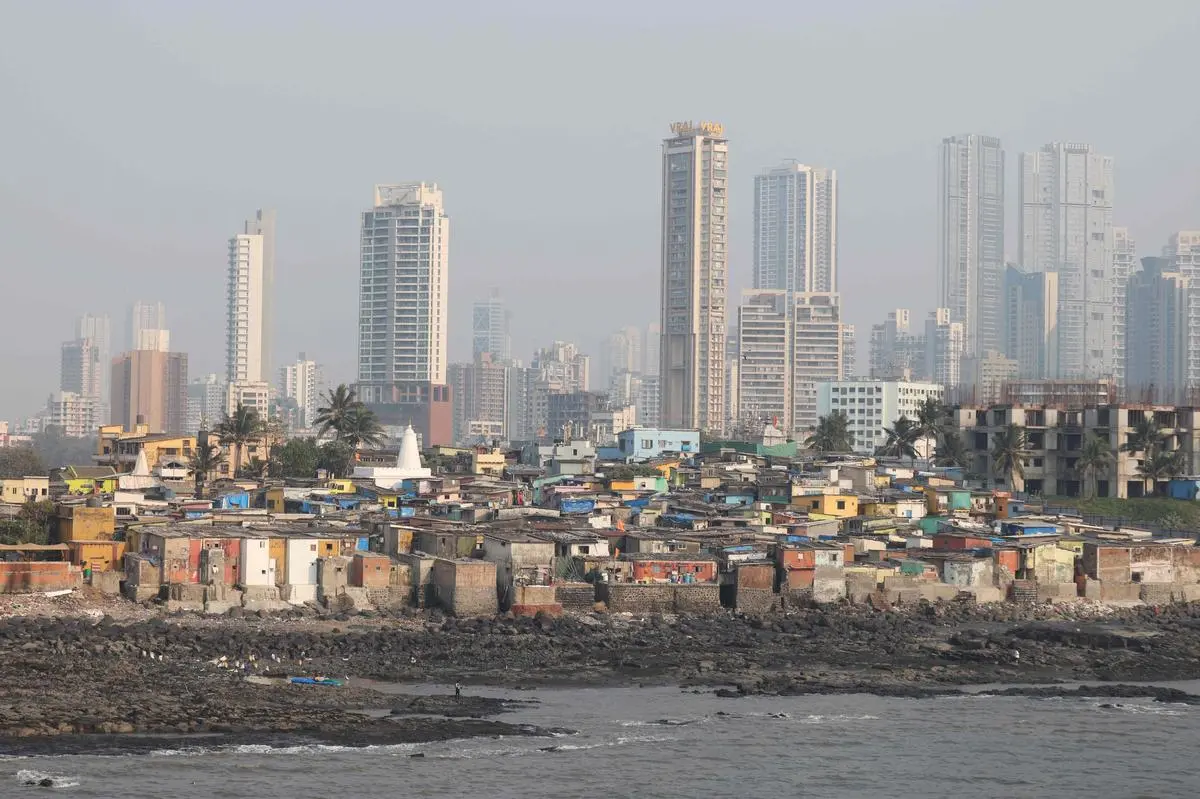
Slum houses and skyscrapers rise along the Arabian Sea coast, in Mumbai, on February 16, 2026. | Photo Credit: LUDOVIC MARIN/AFP
In the US, similar questions about state-led transformation have emerged from different political directions. Grassroots movements such as the Sunrise Movement, along with political figures such as Saikat Chakrabarti and Alexandria Ocasio-Cortez, have advanced proposals like the “Green New Deal”. Despite differences among these actors, their efforts converge on the idea that large-scale state coordination and capacity are indispensable for addressing the climate crisis and creating new avenues through which working people can secure their lives in the cleaner future, supposedly free from fossil fuels, that is to come.
What about India?
These debates around the state again bring us back to the question of what imagining a new future from India looks like. Can India at all think beyond the predicaments it currently faces? India, in the wake of Independence, saw the urgency of building a strong state that could create the capacity for the country to transition to a postcolonial future. It created a state planning model partly inspired by the Soviet economic planning model, and partly by the New Deal of the Franklin D. Roosevelt era, both of which had convergences because of the shared context of the Great Depression of the 1930s and the need for industrialisation to be carried out in a more equitable manner.
While many in the Indian intelligentsia and in the political arena may look at planning as a thing of the past, especially since the Planning Commission was unceremoniously dumped, the role of the state in creating and transitioning to a green future has found renewed interest.
Can India shy away from at least participating in these debates about what can be done, given that it is one of the countries that has seen massive impacts from climate change? This is evident in erratic monsoons, rising heat, landslides in the Himalaya, flooding, and the loss of land along coastlines to the ocean, as in the Sundarbans.
Radical solutions needed
From where we stand today, amid a world-changing war that has led many to wonder whether life as we know it will come to a standstill, it is clear that the future belongs to those who are able to imagine radical solutions.
This is especially true at a time when American companies are rapidly developing artificial intelligence (AI) models. These models, primarily designed for displacement through increased productivity, are likely to create unemployment among the white-collar working class. They will also affect those with land, such as the farming community, as AI servers will have to be built by displacing such communities. Not to mention the amount of energy AI servers will require and the amount of water they will use at a time of global climate crisis.
Interestingly, and perhaps inevitably, it is from the fiercely capitalist West, and particularly from the model that is being imagined in Spain, that a possible answer is emerging. That there is a way, through the state and through “cooperative” ownership, to move away from capital’s imperatives.
While this may not bring an immediate end to capitalism itself, it can certainly pave the way towards a kind of economy where people can stand and fight for a world in which work does not consume human lives and where there is no artificial division between the head and the hand, as is seen today, where one section labours and another reaps the profits and makes the decisions without having to labour.
It is only such an economic system that can guarantee true democracy, and its achievement could only be possible if India’s political class shows the intelligence and initiative to seize the interregnum that this crisis has opened up.
Soumyadeep Guha is a PhD candidate in History at Binghamton University, New York.
Also Read | Is India’s economy now stuck in the West Asian quagmire?
Also Read | Between the numbers and the street