



惯性聚合 高效追踪和阅读你感兴趣的博客、新闻、科技资讯
阅读原文 在惯性聚合中打开

推荐订阅源

WordPress大学
WordPress大学
Spread Privacy
Spread Privacy
T
The Exploit Database - CXSecurity.com
Simon Willison's Weblog
P
Privacy & Cybersecurity Law Blog
L
LINUX DO - 热门话题
T
Threat Research - Cisco Blogs
T
Tenable Blog
TaoSecurity Blog
TaoSecurity Blog
Security Archives - TechRepublic
AI
AI
P
Proofpoint News Feed
A
About on SuperTechFans
P
Privacy International News Feed
月光博客
月光博客
雷峰网
雷峰网
S
Secure Thoughts
博客园 - 叶小钗
博客园 - 聂微东
cs.CL updates on arXiv.org
Project Zero
Project Zero
The Cloudflare Blog
SecWiki News
SecWiki News
The Hacker News
The Hacker News
V
Vulnerabilities – Threatpost
罗磊的独立博客
A
Arctic Wolf
阮一峰的网络日志
阮一峰的网络日志
Know Your Adversary
Know Your Adversary
酷 壳 – CoolShell
酷 壳 – CoolShell
OSCHINA 社区最新新闻
OSCHINA 社区最新新闻
T
Troy Hunt's Blog
The Last Watchdog
The Last Watchdog
Schneier on Security
小众软件
小众软件
有赞技术团队
有赞技术团队
博客园 - 司徒正美
T
Tailwind CSS Blog
量子位
C
Cybersecurity and Infrastructure Security Agency CISA
让小产品的独立变现更简单 - ezindie.com
Hugging Face - Blog
Hugging Face - Blog
人人都是产品经理
人人都是产品经理
奇客Solidot–传递最新科技情报
奇客Solidot–传递最新科技情报
S
Security @ Cisco Blogs
大猫的无限游戏
大猫的无限游戏
S
SegmentFault 最新的问题
Apple Machine Learning Research
宝玉的分享
宝玉的分享
L
Lohrmann on Cybersecurity

India’s National Fortnightly Magazine

SIR West Bengal Voter Exclusion Case 2026 TN Assembly Polls 2026: Senthil Balaji and SP Velumani Clash for Western Belt Supremacy Women’s Reservation Act Amendments Raise Delimitation Fears Healthcare’s Breaking Point India’s Elderly Boom: Care Gaps and Policy Failures AI chatbots fill mental health gaps in India, but risks grow Substandard Drugs in India: The Hidden Public Health Threat India Healthcare Costs Crisis: Who Pays the Price? ASHAs hold India’s fragile health system together but are woefully underpaid Partha Chatterjee’s For a Just Republic and the Limits of the People-Nation India’s Missing Middle: Trapped Between Health Insurance and Care Hungary Election 2026: Orbán Defeated, Magyar Wins Big Shailaja Paik on Dalit Women, Caste, and the Politics of Erasure in India Free Speech Crackdown in India: Is Dissent Under Threat? Ambedkar Jayanti and the New Publicness of Protest Politics Implementing Women’s Reservation: Why a Hybrid 651-Seat Lok Sabha Model Outperforms Mass Expansion Ambedkar and Free Speech: Who Controls Dissent in 2026? How a Maharashtra Village Turned Tea with Dalits into a Statewide Equality Mission Women’s Reservation, Delimitation Bills Spark Secrecy Row Reforming Tamil Nadu's Local Governance: Why MLAs Aren't Fixers in 2026 Sewage, Neglect, and Governance Failure Mark India's Water Crisis West Bengal voter list controversy explained | Why names are being deleted Pattukkottai Kalyanasundaram: Tamil Cinema and Left Politics Delhi’s PM-UDAY Reset: Regularising Unauthorised Colonies on an “as is” Basis Will Vijay’s TVK disrupt DMK and AIADMK? | Tamil Nadu election 2026 Constitutional Morality vs Social Morality in India 2026 Amit Shah’s Anti-Conversion Promise Opens a New Faultline in Punjab Politics Why Indian Shias Protest for Iran: History of Solidarity (2026) West Bengal Voter List Row 2026: “Votercide” Debate The Hidden Ecosystem Inside our Homes Asha Bhosle’s Death Marks the End of an Era in Indian Playback Music Women’s Health in India: Inequality by Design How Algorithms Turn Feminism into a Marketable Aesthetic An Unanswered People: Adivasi Poetry’s Fight for Language and Land Rereading Kari in the Age of Identity Debates Absolute Jafar: Nostalgia and restlessness in frames Anita Nair’s Why I Killed My Husband Review: Powerful Themes, Uneven Storytelling Why the FCRA Amendment Bill 2026 Has Triggered a Political Storm Iran’s Staying Power Redraws the US-Israel War Calculus Snake Metaphors in Indian Politics 2026: Venomous Rhetoric From Grief to Politics: Porkodi Armstrong and the Battle for Dalit Power in North Chennai West Bengal election 2026: Will Babri Masjid split the Muslim vote? West Bengal Communal Politics and the 2026 Election Battle Raghav Chadha-AAP Rift Explained: Rise to Fallout (2026) Why India Is Not Energy-Secure Amid Global Oil Shocks Mulla Shah Mosque: Jahanara Begum's forgotten legacy Strait of Hormuz Ceasefire: Pause, Not Peace Dharavi’s Kumbharwada Potters fear Adani-led Redevelopment will Destroy their Livelihoods How India’s Poor Lose Years Waiting in Queues (2026) India IT Rules 2026: Threat to Free Speech? Iran War Ceasefire Signals a Shift Toward Multipolar Deterrence US Foreign Policy: Empire, Coups, and Control (2026) CBFC Ban on Gaza Film Raises New Alarm Over Censorship Queer Dalit identity and the limits of visibility 2026 Assembly Polls: Congress vs BJP Power Test Israel's Relentless Bombing Creates Displacement Crisis in Lebanon Iran War Ceasefire Marks End of US Dominance Era Imported Inflation in India: Navigating Gulf Crisis Kerala Assembly Election 2026: LDF Anti-Incumbency vs UDF Momentum Petronet LNG: A Public Company Built to Escape Public Accountability Gujarat Local Polls: AAP Rise Deepens Congress Crisis Who Defines You? | The Frontline Newsletter SIR controversy deepens fear of Muslim disenfranchisement in Bengal Kerala Election 2026: LDF, UDF, and the BJP “B Team” Charge Delhi’s LPG Crisis Exposes How Migrants Are Locked Out At 100, Krishnammal Jagannathan’s Life Marks a Legacy of Dalit Land Rights and Resistance Who will win Kerala Assembly Election 2026? LDF or UDF? Assam Polls: Cash Transfers Mask Stagnant Incomes and Job Distress Jaishankar and India's Diplomacy Crisis West Bengal SIR 2026: Voters Treated as Suspects Sathankulam Verdict: How a Rare Death Penalty Challenges India’s Custodial Torture Crisis How three 2026 bills redefine identity, marriage, and freedom in India After Nitish Kumar, Bihar BJP faces its biggest test: caste coalition without a ‘Mr Clean’ Nuclear Deterrence in South Asia: Fragile Stability Actor Vijay and Politics: An Emerging Landscape Dharavi’s Idli-Vada Economy Faces Disruption Under Redevelopment Child Marriage Annulment in India: Khushbu’s Fight (2026) India’s Role in Palestine: Why West Asia Peace Needs Action 2026 Rethinking Iran beyond Western narratives N Rangasamy’s 2026 Puducherry Poll Strategy and Power Play Khalid Jawed on Urdu’s Future and Cultural Loss (2026) Kashmir Encounter Killing Sparks AFSPA Debate 2026 Birds and grief in Hamnet and H is for Hawk GST Federalism Crisis 2026: How States Lost Fiscal Power US-Iran War 2026: Petrodollar Stakes Behind Hormuz Clash White Savior Complex in Arab Regimes Drives Ukraine Deals Not Self Reliance UPA Corruption Narrative vs Court Verdicts 2026 Mathur Sathya Case Exposes Patriarchy in Progressive Politics Personality Cult in Indian Politics 2026: Why Leaders Remain Untouchable India Needs a New Economic Model Beyond Neoliberalism Why J&K MLAs Are Fighting the Lieutenant Governor Over Security Pawar Family Rivalries Stall NCP Factions Merger in Maharashtra DMK manifesto 2026: Key promises, alliances, & welfare politics State Assembly Elections 2026: How Voter Dynamics Are Shaping India Iran-Israel War: Hegel’s Recognition Theory Explains the Escalation Coal, Capital, and Compliance: Fairmine Under NGT Lens Hindu Rashtra Debate: 2026 State Elections Test Secular India Tamil Nadu Election 2026: How Gender and Gen Z Voters are Reshaping the Dravidian Power Struggle Gujarat's proposed marriage registration amendment 2026 polices choice Will NEET Break More Students Than It Makes Doctors?
NEET-UG 2026 Row Gives INDIA Bloc New Rallying Point
Anand Mishra · 2026-05-24 · via India’s National Fortnightly Magazine

After bruising defeats in the May 2026 Assembly elections—losing Tamil Nadu to the newcomer Tamilaga Vetri Kazhagam (TVK), West Bengal to the BJP, and Assam to the BJP-led NDA for a third consecutive term, while the Congress wrested Kerala from the Left Democratic Front—opposition parties have found common ground in the alleged irregularities of the NEET-UG 2026 examination, holding nationwide protests to corner the ruling BJP at the Centre. The National Testing Agency (NTA) cancelled the May 3 examination on May 12, and the government referred the matter to the Central Bureau of Investigation; a re-test is scheduled for June 21.

On May 21, after a Congress protest march towards the BJP headquarters in Delhi, Leader of the opposition Rahul Gandhi reiterated his demand for the Union Education Minister’s resignation. “We won’t stop until Dharmendra Pradhan resigns and a strong, secure system is put in place to stop paper leaks in the country,” he said in a post on X.

While Rahul Gandhi said the opposition would continue its campaign on examination reform and accountability, his party colleague, AICC general secretary in-charge for Karnataka Randeep Surjewala, addressing a similar protest at Freedom Park in Bengaluru the same day, alleged that the NTA under the Modi government had become a “National Tamasha Agency.” “What expectations can we have from those who can’t keep the NEET exam NEAT and CLEAN?” he said. Karnataka Chief Minister Siddaramaiah and several State Ministers joined the demonstration, where some protesters wore T-shirts with the slogan “PM is compromised.”

More than wordplay, Surjewala sought to blame the BJP for multiple examination frauds and paper leaks in a Congress-ruled State that goes to the polls in 2028. “For the last 12 years, the Modi government has handed over India’s education system to an education mafia and paper leak mafia,” he said. Listing major scandals, he added that under the Modi government, the list of education scams grows daily, and that paper leaks were no longer administrative lapses but the “new normal.”

In BJP-ruled Jaipur, the Congress’s large protest marked the first since its 2023 Assembly loss. Led by State chief Govind Singh Dotasra and Leader of the opposition Tikaram Jully, party workers faced water cannons and police batons as young men and women in mock doctors’ aprons stained with red paint shouted slogans.

That the issue had brought the opposition together was evident in the flags of the Left parties and regional outfits fluttering alongside the Congress’s at the venue—a fortnight after the Congress had wrested Kerala from the Left in a closely fought election.

The Congress’s student wing, the National Students’ Union of India (NSUI), led nationwide protests in several State headquarters in response to the NEET paper leak. Its National President, Vinod Jakhar, who took charge in February 2026, gave the government a 10-day ultimatum to deliver justice to NEET students, dissolve the NTA, and demand the Education Minister’s resignation. Jakhar alleged that Rajasthan was a major centre of the leak network and claimed political protection for those involved.

A unifying cause, contested terrain

The NEET protest gave a previously divided opposition a unified and powerful moral voice, refocusing the political narrative for the youth.

In Jaipur, the protest concluded with a candlelight vigil. The same day, in West Bengal’s Uttar Dinajpur and Kolkata, the Youth Congress, the All India Democratic Students’ Organisation (AIDSO), and the Trinamool Congress (TMC) held parallel protests, demanding a Supreme Court-monitored investigation. TMC protesters marched to the State’s Education Department, and Rajya Sabha MP Sagarika Ghose led the call for accountability, denouncing the failures of the Central government.

In NDA-ruled Patna, where frequent paper leaks made headlines, Rashtriya Janata Dal (RJD) leader Tejashwi Yadav seized the NEET protest moment. He argued that the NEET-UG leak was not an isolated incident, stressing that an “organised mafia operated under political patronage.”
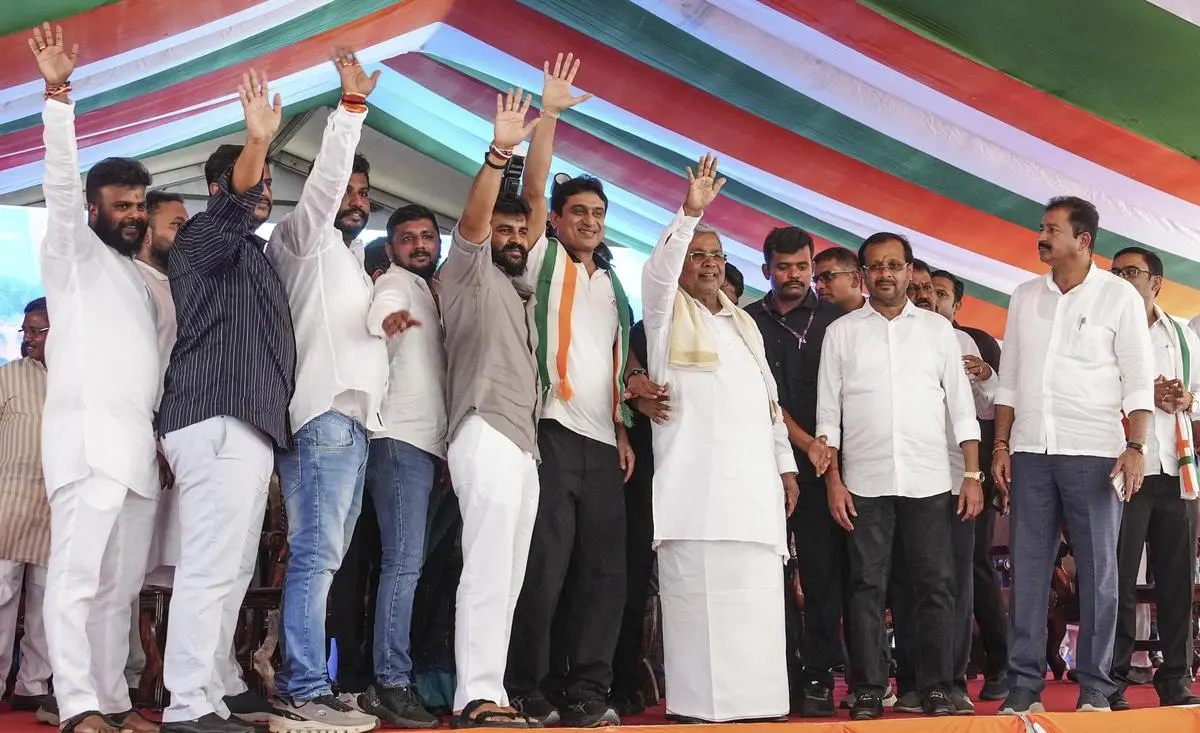
Karnataka Chief Minister Siddaramaiah with IYC National President Uday Bhanu Chib, State Youth Congress president H.S. Manjunatha, and others during a protest over alleged irregularities in the NEET-UG medical entrance exam, at Freedom Park in Bengaluru on May 21, 2026.

Karnataka Chief Minister Siddaramaiah with IYC National President Uday Bhanu Chib, State Youth Congress president H.S. Manjunatha, and others during a protest over alleged irregularities in the NEET-UG medical entrance exam, at Freedom Park in Bengaluru on May 21, 2026. | Photo Credit: PTI

Citing data on past examination leaks, he also took a jibe at Prime Minister Narendra Modi’s Pariksha Pe Charcha programme, saying that while the Centre talks about a discussion on examinations, it ends up giving the youth lathis when they ask for accountability.

RJD MP Manoj Kumar Jha said the Centre’s promise of an error-free re-test only confirmed that the system was never working. He argued that true reform should begin with dismantling the NTA and decentralising the process.

In Tamil Nadu, the DMK chose to seize the occasion to target the Modi government over the “centralised testing” model. More than 500 people took part in a State-wide protest organised by the Dravidar Kazhagam (DK) on May 16, with the DMK extending open support.

On May 12, after the cancellation of the examination, DMK spokesperson Saravanan Annadurai said it was “a vindication of what the DMK has always stood for”—for abolishing NEET and making admissions on the basis of Class XII marks. “The NTA is a repository of RSS functionaries. That’s the biggest problem. The question paper has leaked from a BJP-ruled State. And this is probably the 4th or 5th time the question paper has leaked,” he posted on X.

In Uttar Pradesh, which votes next year, the Samajwadi Party’s youth wing protested the NEET cancellation alongside demands on unemployment, fuel prices, and inflation. Their aim goes beyond the examination issue to target the Adityanath government. At a Parliamentary Standing Committee meeting on education, opposition members from the Congress, the Aam Aadmi Party (AAP), the Samajwadi Party, and the Communist Party of India (Marxist) formed a united front, calling on NTA officials to take moral responsibility for the paper leak.

Cosmetic unity, real fault lines

Rahul Gandhi’s restraint in West Bengal reflects the Congress’s awareness that, with fewer than 100 Lok Sabha seats in 2024, it cannot challenge the BJP alone and must ally with regional parties for 2029. While the NEET protests signal potential opposition unity, the Monsoon Session of Parliament in July will test that resolve, given the changes in State politics within the INDIA coalition.

The Congress now partners with the TVK in Tamil Nadu, dropping its former ally, the DMK. The Left has lost Kerala to the Congress, raising questions about future ties among the Congress, the Left, and the DMK in opposition unity.

Perhaps aware of the need for the larger opposition unity framework, DMK President M.K. Stalin’s message to his cadres on social media on May 22 was: “Every party has the right to determine its political decision. Therefore, as your leader, my loving appeal to you, DMK comrades, is that at this time, you should not speak harsh words that would hurt anyone.”

While the NEET-UG paper leak has created a cosmetic unity of the opposition for the time being, care will have to be taken by all in the INDIA coalition to ensure it does not crack soon—and that will require a lot of give and take from both sides: the main opposition Congress, and regional parties, who have now reduced strength.

Also Read | The opposition has let India down

Also Read | NEET: A test in turmoil