
惯性聚合 高效追踪和阅读你感兴趣的博客、新闻、科技资讯
阅读原文 在惯性聚合中打开

推荐订阅源

月光博客
月光博客
freeCodeCamp Programming Tutorials: Python, JavaScript, Git & More
N
Netflix TechBlog - Medium
大猫的无限游戏
大猫的无限游戏
爱范儿
爱范儿
Martin Fowler
Martin Fowler
OSCHINA 社区最新新闻
OSCHINA 社区最新新闻
The Register - Security
IT之家
IT之家
博客园_首页
Microsoft Security Blog
钛媒体:引领未来商业与生活新知
钛媒体:引领未来商业与生活新知
博客园 - 三生石上(FineUI控件)
I
InfoQ
CTFtime.org: upcoming CTF events
Jina AI
Jina AI
Apple Machine Learning Research
M
MIT News - Artificial intelligence
博客园 - Franky
C
Check Point Blog
T
The Blog of Author Tim Ferriss
V
Visual Studio Blog
Cyber Security Advisories - MS-ISAC
T
Tailwind CSS Blog
Recent Announcements
云风的 BLOG
云风的 BLOG
美团技术团队
The Cloudflare Blog
Y
Y Combinator Blog
H
Hackread – Cybersecurity News, Data Breaches, AI and More
MyScale Blog
MyScale Blog
The GitHub Blog
The GitHub Blog
D
DataBreaches.Net
Google DeepMind News
V
V2EX
aimingoo的专栏
aimingoo的专栏
GbyAI
GbyAI
G
Google Developers Blog
S
SegmentFault 最新的问题
Hugging Face - Blog
Hugging Face - Blog
奇客Solidot–传递最新科技情报
奇客Solidot–传递最新科技情报
U
Unit 42
罗磊的独立博客
量子位
MongoDB | Blog
MongoDB | Blog
Last Week in AI
Last Week in AI
Stack Overflow Blog
Stack Overflow Blog
小众软件
小众软件
D
Docker
人人都是产品经理
人人都是产品经理

India’s National Fortnightly Magazine

SIR West Bengal Voter Exclusion Case 2026 TN Assembly Polls 2026: Senthil Balaji and SP Velumani Clash for Western Belt Supremacy Women’s Reservation Act Amendments Raise Delimitation Fears Healthcare’s Breaking Point India’s Elderly Boom: Care Gaps and Policy Failures AI chatbots fill mental health gaps in India, but risks grow Substandard Drugs in India: The Hidden Public Health Threat India Healthcare Costs Crisis: Who Pays the Price? ASHAs hold India’s fragile health system together but are woefully underpaid Partha Chatterjee’s For a Just Republic and the Limits of the People-Nation India’s Missing Middle: Trapped Between Health Insurance and Care Hungary Election 2026: Orbán Defeated, Magyar Wins Big Shailaja Paik on Dalit Women, Caste, and the Politics of Erasure in India Free Speech Crackdown in India: Is Dissent Under Threat? Ambedkar Jayanti and the New Publicness of Protest Politics Implementing Women’s Reservation: Why a Hybrid 651-Seat Lok Sabha Model Outperforms Mass Expansion Ambedkar and Free Speech: Who Controls Dissent in 2026? How a Maharashtra Village Turned Tea with Dalits into a Statewide Equality Mission Women’s Reservation, Delimitation Bills Spark Secrecy Row Reforming Tamil Nadu's Local Governance: Why MLAs Aren't Fixers in 2026 Sewage, Neglect, and Governance Failure Mark India's Water Crisis West Bengal voter list controversy explained | Why names are being deleted Pattukkottai Kalyanasundaram: Tamil Cinema and Left Politics Delhi’s PM-UDAY Reset: Regularising Unauthorised Colonies on an “as is” Basis Will Vijay’s TVK disrupt DMK and AIADMK? | Tamil Nadu election 2026 Constitutional Morality vs Social Morality in India 2026 Amit Shah’s Anti-Conversion Promise Opens a New Faultline in Punjab Politics Why Indian Shias Protest for Iran: History of Solidarity (2026) West Bengal Voter List Row 2026: “Votercide” Debate The Hidden Ecosystem Inside our Homes Asha Bhosle’s Death Marks the End of an Era in Indian Playback Music Women’s Health in India: Inequality by Design How Algorithms Turn Feminism into a Marketable Aesthetic An Unanswered People: Adivasi Poetry’s Fight for Language and Land Rereading Kari in the Age of Identity Debates Absolute Jafar: Nostalgia and restlessness in frames Anita Nair’s Why I Killed My Husband Review: Powerful Themes, Uneven Storytelling Why the FCRA Amendment Bill 2026 Has Triggered a Political Storm Iran’s Staying Power Redraws the US-Israel War Calculus Snake Metaphors in Indian Politics 2026: Venomous Rhetoric From Grief to Politics: Porkodi Armstrong and the Battle for Dalit Power in North Chennai West Bengal election 2026: Will Babri Masjid split the Muslim vote? West Bengal Communal Politics and the 2026 Election Battle Raghav Chadha-AAP Rift Explained: Rise to Fallout (2026) Why India Is Not Energy-Secure Amid Global Oil Shocks Mulla Shah Mosque: Jahanara Begum's forgotten legacy Strait of Hormuz Ceasefire: Pause, Not Peace Dharavi’s Kumbharwada Potters fear Adani-led Redevelopment will Destroy their Livelihoods How India’s Poor Lose Years Waiting in Queues (2026) India IT Rules 2026: Threat to Free Speech? Iran War Ceasefire Signals a Shift Toward Multipolar Deterrence US Foreign Policy: Empire, Coups, and Control (2026) CBFC Ban on Gaza Film Raises New Alarm Over Censorship Queer Dalit identity and the limits of visibility 2026 Assembly Polls: Congress vs BJP Power Test Israel's Relentless Bombing Creates Displacement Crisis in Lebanon Iran War Ceasefire Marks End of US Dominance Era Imported Inflation in India: Navigating Gulf Crisis Kerala Assembly Election 2026: LDF Anti-Incumbency vs UDF Momentum Petronet LNG: A Public Company Built to Escape Public Accountability Gujarat Local Polls: AAP Rise Deepens Congress Crisis Who Defines You? | The Frontline Newsletter SIR controversy deepens fear of Muslim disenfranchisement in Bengal Kerala Election 2026: LDF, UDF, and the BJP “B Team” Charge Delhi’s LPG Crisis Exposes How Migrants Are Locked Out At 100, Krishnammal Jagannathan’s Life Marks a Legacy of Dalit Land Rights and Resistance Who will win Kerala Assembly Election 2026? LDF or UDF? Assam Polls: Cash Transfers Mask Stagnant Incomes and Job Distress Jaishankar and India's Diplomacy Crisis West Bengal SIR 2026: Voters Treated as Suspects Sathankulam Verdict: How a Rare Death Penalty Challenges India’s Custodial Torture Crisis How three 2026 bills redefine identity, marriage, and freedom in India After Nitish Kumar, Bihar BJP faces its biggest test: caste coalition without a ‘Mr Clean’ Nuclear Deterrence in South Asia: Fragile Stability Actor Vijay and Politics: An Emerging Landscape Dharavi’s Idli-Vada Economy Faces Disruption Under Redevelopment Child Marriage Annulment in India: Khushbu’s Fight (2026) India’s Role in Palestine: Why West Asia Peace Needs Action 2026 Rethinking Iran beyond Western narratives N Rangasamy’s 2026 Puducherry Poll Strategy and Power Play Khalid Jawed on Urdu’s Future and Cultural Loss (2026) Kashmir Encounter Killing Sparks AFSPA Debate 2026 Birds and grief in Hamnet and H is for Hawk GST Federalism Crisis 2026: How States Lost Fiscal Power US-Iran War 2026: Petrodollar Stakes Behind Hormuz Clash White Savior Complex in Arab Regimes Drives Ukraine Deals Not Self Reliance UPA Corruption Narrative vs Court Verdicts 2026 Mathur Sathya Case Exposes Patriarchy in Progressive Politics Personality Cult in Indian Politics 2026: Why Leaders Remain Untouchable India Needs a New Economic Model Beyond Neoliberalism Why J&K MLAs Are Fighting the Lieutenant Governor Over Security Pawar Family Rivalries Stall NCP Factions Merger in Maharashtra DMK manifesto 2026: Key promises, alliances, & welfare politics State Assembly Elections 2026: How Voter Dynamics Are Shaping India Iran-Israel War: Hegel’s Recognition Theory Explains the Escalation Coal, Capital, and Compliance: Fairmine Under NGT Lens Hindu Rashtra Debate: 2026 State Elections Test Secular India Tamil Nadu Election 2026: How Gender and Gen Z Voters are Reshaping the Dravidian Power Struggle Gujarat's proposed marriage registration amendment 2026 polices choice Will NEET Break More Students Than It Makes Doctors?
David Attenborough at 100: The Voice That Changed Nature TV
2026-05-09 · via India’s National Fortnightly Magazine

If one adjective could describe renowned British broadcaster, naturalist, and author Sir David Attenborough, it would be “indefatigable.” Though having physically slowed down with age, the now 100-year-old presenter’s passion for the natural world—and his enthusiasm in sharing it with viewers—has not waned.

He holds the Guinness World Record for “the longest career as a television presenter and naturalist.” From his on‑screen debut in “Animal Disguises” in 1953 to the recent Netflix documentary “A Gorilla Story: Told by David Attenborough,” his broadcasting life has spanned more than 70 years.

A history of making history

He has accumulated a wide range of distinctions over the years—from 32 honorary degrees to two knighthoods—and even set a social media record in 2020 when his new Instagram account drew more than one million followers in 4 hours and 44 minutes. When BBC’s “Blue Planet II” premiered in 2017, demand in China was so intense that local media reported temporary internet slowdowns as viewers rushed to stream it.

Attenborough was first knighted by the late Queen Elizabeth II in 1985. In June 2022, he was knighted a second time by then Prince Charles for his nature documentaries and advocacy, becoming a Knight Grand Cross of the Order of St Michael and St George.

In April that same year, he received the United Nations’ highest environmental honour, namely the UN Champions of the Earth Lifetime Achievement Award. Together with Pope Francis and the World Health Organization, he was also one of the nominees for the 2022 Nobel Peace Prize.

He is also the only person to have earned the UK’s BAFTA awards across every major era of television technology—from black‑and‑white to colour, HD, 3D and, 4K. In his native UK, he is often referred to as a “national treasure”—a term that does not sit well with him.

Early fascination with fossils

David Frederick Attenborough was born on May 8, 1926 in England, the second of three boys. His sibling, Richard, was the renowned actor and director who famously played John Hammond in the 1993 film “Jurassic Park” and its 1997 sequel, and directed the Oscar-winning film “Gandhi” in 1982.

His fascination with fossils stems from childhood. In a 2019 interview with German magazine Der Spiegel, he said he considered it a form of “magic” to come across the remains of an ancient creature that “hasn’t seen the sunlight for 150 million years.” He often rode his bicycle long distances to nearby quarries, hoping to uncover more specimens.

In 1936, he attended a lecture by famed British writer and conservationist, Archibald Belaney, also known as Grey Owl, which left a strong impression on him and deepened his interest in the natural world.

Big teeth and Monty Python

After graduating from Cambridge University in 1947 with a degree in Natural Sciences, Attenborough spent two years of national service in the British navy. In 1950, he applied to work for BBC’s radio service, but was asked if he would like to try the broadcaster’s new trainee program instead.

His bosses, however, had their doubts about his presentability on TV, Attenborough told the Daily Mail in 2010. “I discovered 40 years later that they had said of me as a trainee: He could be a perfectly pleasant chap, might be a perfectly good producer, but he shouldn’t be used again as an interviewer on camera because his teeth are too big.”
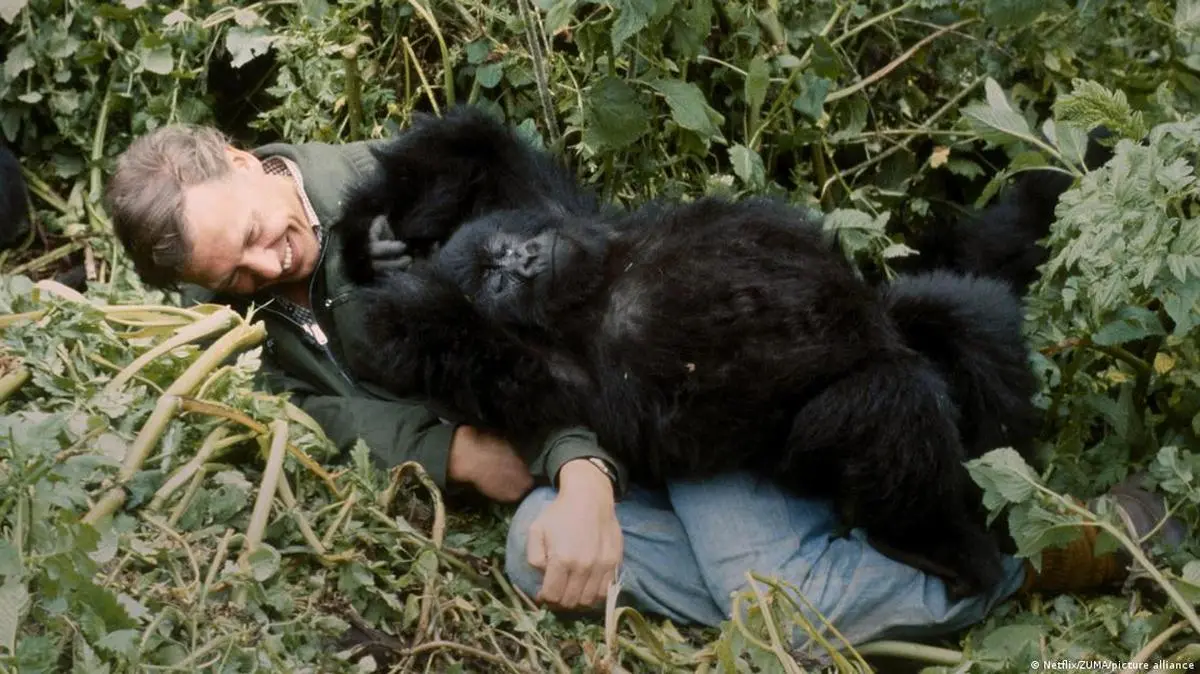
Getting cozy with Pablo the gorilla in 1979.

Getting cozy with Pablo the gorilla in 1979. | Photo Credit: Netflix/picture alliance

In the end, Attenborough became an on-camera presenter when he was asked to stand in for a host who’d fallen ill. Over time, he moved into senior roles at the BBC and eventually became controller of BBC Two, where he played a key role in bringing colour broadcasting to European audiences. He also approved “Monty Python’s Flying Circus” in 1969, the comedy troupe’s first ever major production series.

Mother nature’s ‘semi-whispering’ champion

However, he eschewed a management career at the BBC, choosing instead to marry his love of nature with broadcasting. He narrated every episode in the long-running “BBC Wildlife on One” (1977-2005).

He was also narrator for other high-profile BBC wildlife documentaries like “The Blue Planet” and “Planet Earth,” having a “patented semi-whisper way of narrating,” as noted by NPR radio once.

His 1979 series “Life on Earth” broke new ground by filming species in their natural environments across multiple continents. And it featured a legendary, unscripted scene when a three-year-old mountain gorilla called Pablo came and lay across him. His close encounter with the gorillas prompted him to utter, also unscripted: “There is more meaning and mutual understanding in exchanging a glance with a gorilla than any other animal I know.”

Over forty species bear his name

Audiences have also been entertained by the creatures that have shared screen time with him, sometimes even upstaging the naturalist. During the filming of “Paradise Birds,” a cheeky bird-of-paradise forced several retakes after it repeatedly interrupted the amused presenter with its calls and fancy moves.

Over 40 species of flora and fauna—both living and extinct—have been named after him. This includes a prehistoric marine reptile called the Attenborosaurus, and a Madagascan dragonfly called Attenborough’s pintail.

There is one animal that petrifies him though. “I really, really hate rats. I’ve handled deadly spiders, snakes, and scorpions without batting an eyelid. But if I see a rat I’ll be the first to run,” he told Entertainment Daily in 2021.

Never losing hope

David Attenborough has also drawn on his long career and public profile to advocate for climate action and environmental protection, often speaking at major international gatherings. Yet, it is his balanced choice of words—urgent yet not dire—that resonates with viewers.

“We can now destroy or we can cherish, the choice is ours,” he said in the 2009 mini-series, “Planet Earth.”

In 2022, he received the UN’s Champion of the Earth Lifetime Achievement Award. In a congratulatory article for online news outlet Tortoise, author Simon Barnes wrote: “If the world is, indeed, to be saved, then Attenborough will have had more to do with its salvation than anyone else who ever lived.”

Pragmatic about mortality

In 2020, Attenborough told Anderson Cooper on 60 Minutes that he wasn’t afraid of death, “I’d just like it to be a quick process, thanks very much.”

Saying that he was more afraid of “becoming helpless and gaga,” he had expressed his surprise and gratitude for relatively good health that enables him to still work and remain active at his advanced age. Something fans would readily agree with.

Thus, it comes as no surpise that documentaries have been slated to commemorate his 100 years on Earth, including a live celebratory event at the Royal Albert Hall, featuring the BBC Concert Orchestra and special guests who will honour the naturalist and his illustrious career.

Also Read | How an ancient giant turtle got its name from a Stephen King character

Also Read | Giving our oceans a fighting chance against the climate crisis