






The results of the 2026 West Bengal Assembly election indicate a structural shift in India’s eastern politics with consequences that extend directly into Bangladesh. The BJP has won 206 seats in a 294-member Assembly, while the All India Trinamool Congress has been reduced to a diminished opposition with just 81 seats. The thing that appears domestically as a political reversal simultaneously registers in Dhaka as a foreign-policy development.
West Bengal’s election has always carried an external dimension, but the stakes are sharper this time because Bangladesh itself has entered a new phase. Under a new government led by Tarique Rahman’s Bangladesh Nationalist Party (BNP), relations with India are being recalibrated. New Delhi, which once preferred the Awami League, has adjusted pragmatically.
Yet that diplomatic reset now collides with electoral dynamics in Bengal, where the BJP’s campaign has again fused questions of identity, migration, and border security. In Bengal, the “Bangladesh issue” is rarely separate from domestic politics; it is often the same political instrument viewed from two sides of a border.
The result reshapes a State that for long acted as a buffer against the BJP’s core ideological programme. That buffer now weakens. More importantly, it redraws the strategic landscape along one of South Asia’s most sensitive frontiers: the India–Bangladesh border, which is a dense corridor of trade, transit, kinship, and memory.
Kolkata functions as Bangladesh’s principal gateway to India, while border districts on both sides remain economically and socially intertwined. Political shifts in Bengal, therefore, transmit quickly into Bangladesh in ways that developments in most other Indian States do not.
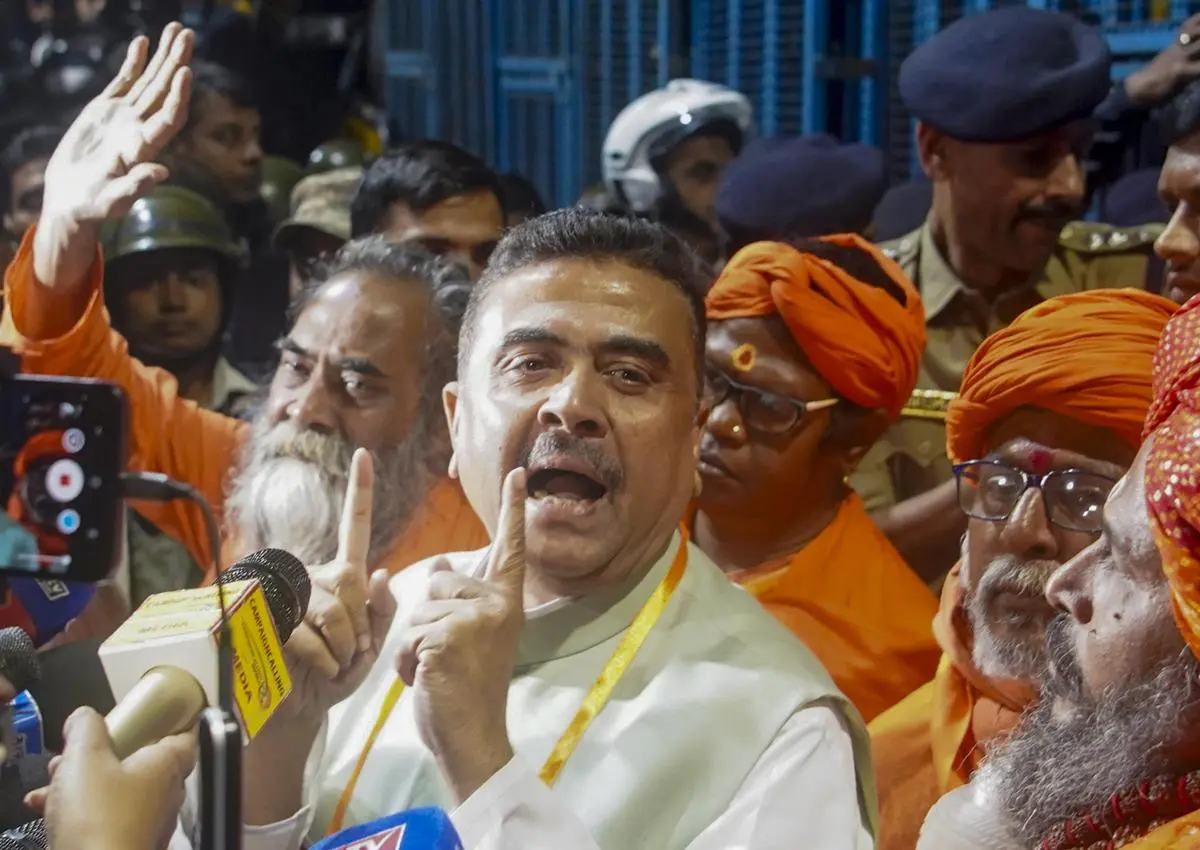
BJP’s Suvendu Adhikari at a protest in Kolkata on December 26, 2025. The party’s leaders have spoken of identifying and expelling “Bangladeshi Muslims”, framing the issue in both administrative and communal terms. | Photo Credit: PTI
The significance of a decisive mandate lies in administrative possibility. Electoral dominance provides the bandwidth to implement policies that were previously contested or deferred. Among these, citizenship verification—tested at scale in Assam—becomes newly actionable in Bengal.
A government combining legislative control with an expanded vote share can present such measures as administrative correction rather than ideological assertion, even when their effects are uneven.
The Assam precedent
Assam offers a measurable precedent. The National Register of Citizens excluded roughly 1.9 million people in 2019, around 6 per cent of the State’s population. Exclusion closely tracked poverty, illiteracy, and lack of access to documentation. Individuals were required to produce proof of ancestry predating 1971, a threshold many could not meet because of gaps in historical records rather than recent migration. The outcome was the creation of a large category of “doubtful citizens”, subject to appeals, tribunals, and, in some cases, detention.
Transposing that model to West Bengal produces larger numbers but similar mechanics. With a population exceeding 90 million, even a modest exclusion rate of 3 per cent would implicate close to three million people. This is not a political estimate but a statistical one. In large populations with incomplete archival systems, small percentage errors generate large absolute consequences. The administrative question is not whether discrepancies will occur, but how they will be managed once identified.
The infrastructure for such management already exists in embryonic form. Assam has built detention facilities and a network of Foreigners’ Tribunals, lowering the marginal cost of replication elsewhere. Once the legal and physical architecture for classification and confinement is established, expansion becomes a matter of scale rather than design.
What changes in Bengal is not the model but the constraint. Alignment between State and Central priorities becomes more likely, enabling incremental steps—stricter voter list verification, tighter documentation requirements for welfare access, and increased scrutiny in border districts—that collectively approximate a verification regime.
For Bangladesh, the implications are immediate. The border, stretching over 4,000 km, is already among the most intensively managed regions of the world. Yet, reports of informal “push-ins” from Assam and parts of Bengal have periodically surfaced. These are not formal deportations, which require bilateral agreement and verification of nationality, but ad hoc practices that shift the burden of identification onto the receiving side. A more assertive verification regime in Bengal would likely increase such pressures, whether through formal channels or informal ones.
Political signalling reinforces this trajectory. BJP leaders such as Suvendu Adhikari (who is likely to become the next Chief Minister) have spoken of identifying and expelling “Bangladeshi Muslims”, framing the issue in both administrative and communal terms. Campaign rhetoric does not automatically become policy, but it shapes expectations within the governing coalition and among its supporters.
In a context where millions may be subject to documentation checks, the distinction between identifying non-citizens and targeting specific communities can blur in practice.
Diplomatic strain and the humanitarian dimension
Dhaka’s position is structurally constrained. Bangladesh has for long argued that large-scale illegal migration into India is overstated and it has resisted accepting deportees without clear proof of citizenship. An increase in individuals pushed towards the border—formally or informally—would strain diplomatic channels and border management systems. It would also introduce a humanitarian dimension, as those caught in verification processes may find themselves unable to establish legal belonging on either side.
This intersects with Bangladesh’s own political recalibration. A BNP-led government must balance engagement with India against domestic opinion that is more nationalist and less deferential than in previous years. If India’s Central government seeks stable ties while politics in Bengal frames Bangladesh as a demographic or security threat, the contradiction will become difficult to manage. Public rhetoric in Bengal is heard in Bangladesh not as administrative language but as social and political signalling.
The economic effects will follow a predictable pattern. Individuals with uncertain legal status face barriers to formal employment, pushing them into informal labour markets with lower wages and weaker protections. Evidence from Assam shows that those entangled in verification processes often incur legal costs exceeding annual incomes, financed through debt or asset sales.
In Bengal, with its larger population and extensive informal sector, the aggregate impact would be greater. Any cross-border displacement—formal or informal—would add pressure to Bangladesh’s border districts, where resources are already limited.
Yet, the political economy of verification remains favourable to those implementing it. It creates a visible distinction between “verified” and “unverified” populations, reinforcing a sense of security among the majority while imposing compliance costs on a minority. Assam suggests such systems can operate without immediate instability, as disputes are channelled into legal processes rather than mass mobilisation. Visible conflict is reduced even as administrative load increases.
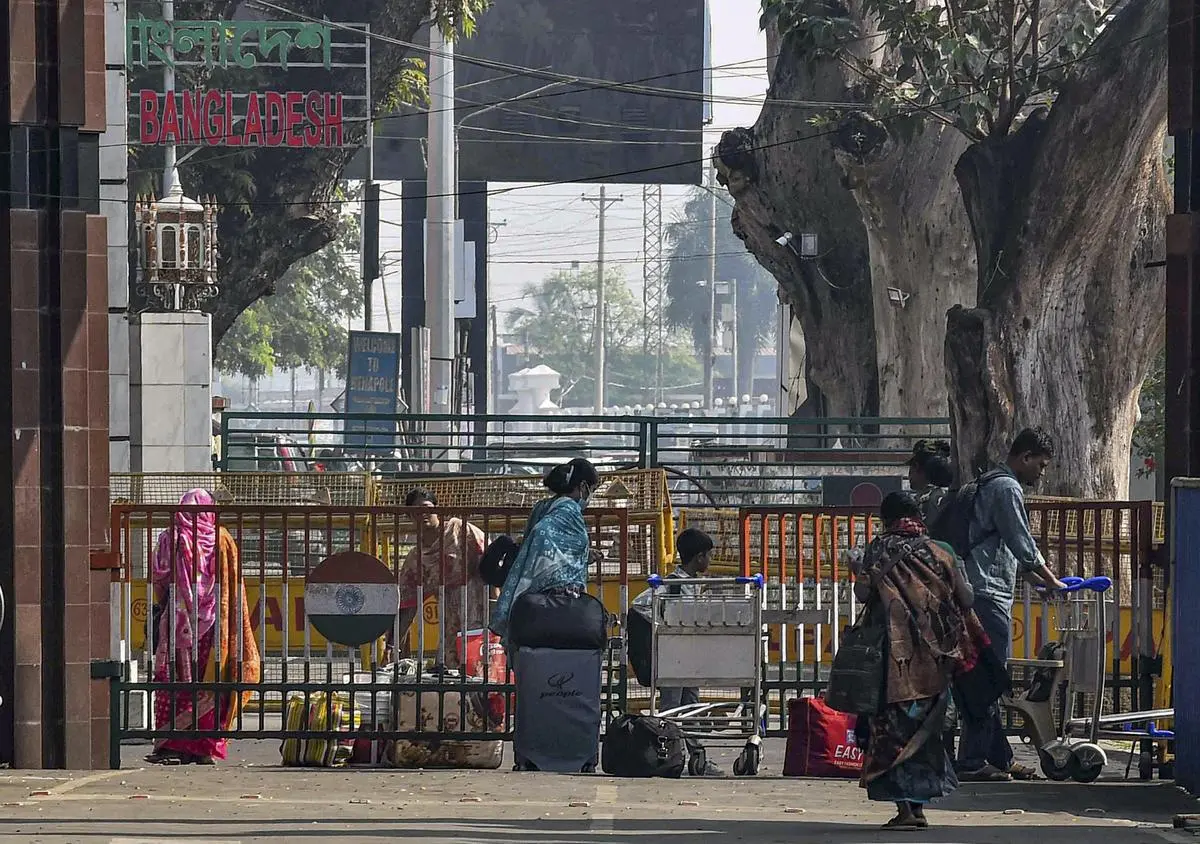
People at the India-Bangladesh border, at Petrapole, in North 24 Parganas district on November 13, 2025. | Photo Credit: PTI
Capacity, however, is a constraint that does not disappear with political will. Large-scale verification requires consistent documentation standards, trained personnel, and functioning adjudication systems. Errors—false exclusions, inconsistent tribunal decisions, mismatched records—are inevitable. Even low error rates generate substantial caseloads when applied to millions.
Assam’s backlog, with many cases unresolved years after publication of the NRC, illustrates the risks of prolonged uncertainty. Replicating such a system in a larger State will amplify those challenges.
Internationally, this approach places India among a small group of states attempting retrospective citizenship validation at scale. Most countries prioritise prospective controls, regulating entry rather than reclassifying existing populations. The reason is practical: retrospective exercises are administratively expensive and politically sensitive, producing diffuse economic costs alongside concentrated human consequences. When combined with cross-border implications, as in Bengal, they also carry diplomatic risk.
Language is evolving accordingly. Terms such as “detention camp” are moving from abstraction into administrative vocabulary, reflecting a broader normalisation of confinement as a procedural outcome. When detention is framed as routine governance rather than exceptional punishment, expansion becomes easier to justify.
For Bangladesh, the election result is not about choosing a preferred outcome but about managing consequences. A BJP-led Bengal may align more closely with New Delhi, potentially easing certain forms of coordination and connectivity. But it is also likely to intensify rhetoric and policy attention on migration and citizenship, raising political costs for cooperation in Dhaka.
A Trinamool-led Bengal would have preserved a buffer against such pressures but continued to complicate issues like the Teesta water-sharing agreement, where State-level resistance has blocked progress.
No outcome is uncomplicated. What the 2026 result does is expand the range of policies that can now be pursued in Bengal and compress the space for ambiguity along the border. With legislative authority, organisational capacity, and a supportive voter base, the BJP can move towards a more assertive definition of citizenship. Given Bengal’s scale, even small administrative margins will translate into large human numbers.
For Bangladesh, situated immediately across that border, those numbers translate into pressure—on diplomacy, on local economies, and on the fragile equilibrium that has for long governed one of South Asia’s most interconnected frontiers.
Faisal Mahmud is a Dhaka-based journalist.
Also Read | This Bengal election sees weaponisation of ethnicities: Surajit Mukhopadhyay
Also Read | Will Didi prevail over Delhi?