






This year marks the 60th anniversary of the making of one of the greatest debut films in the annals of world cinema: Closely Watched Trains by the Czech master Jiri Menzel (1938-2020). If there is such a thing as light-hearted seriousness, arguably no one excelled at it more than Menzel, one of the legendary makers of New Czech Cinema, which took the world by storm in the 1960s to 1980s. It was our privilege to see many of his films repeatedly, thanks to the active film club movement.
Closely Watched Trains (35mm, b/w, 92mins, 1966), about a pubescent youth with real/imaginary sexual and emotional difficulties, was Menzel’s first full-length fictional feature and did his cinematic career the kind of wonders that dreams are made of. It won him an international audience and several important prizes, including the Grand Prix at Mannheim (a small but serious festival that also discovered Menzel’s fellow countryman, Jan Nemec, of Diamonds of the Night fame) and an Oscar for the best foreign language film. Almost two decades later, in 1985, Menzel narrowly missed a second Oscar for his hilarious pastoral elegy My Sweet Little Village, but this was more than made up for by its enormous commercial success in erstwhile Czechoslovakia.
Director, scriptwriter and actor, wonderful conversationalist (as one discovered during his brief but fun-filled visit to Calcutta in 1987) and profound citizen of a country that had known long spells of grief punctuated by brief, spontaneous outbursts of self-assertion, Menzel was born in Prague in 1938. He graduated from the Film and TV School of the Academy of Performing Arts in Prague (FAMU), a film school of international eminence, where his diploma film, Our Mr Foerster Died, marked him out as an exceptional pupil.
Leaving film school, he served a period of apprenticeship working with Vera Chytilová, who was also destined to make a name with her fragmented and eccentric style of film-making. When, in 1968, censorship came down heavily on Czech filmmakers who had known a brief period of creative freedom earlier in the decade, experimenting with varied subjects and manners of self-expression, Menzel and Chytilová were among those who stayed on in Czechoslovakia, refusing to join an exodus of fellow artists to the West.
Following the international success of Closely Watched Trains, Menzel made a film adaptation of Vladislav Vančura’s novel, Capricious Summer. He also acted in the film in the major role of the acrobat. His love of acting was to be reflected in the roles he did in many of his subsequent films as well as in some made by others.
In 1969, Menzel made Larks on a String, which first brought him into conflict with the censors. The film was banned and it took two decades for it to be released for public screening. Shown at the 1990 Berlin film festival, Larks on a String shared the Golden Bear with Music Box, directed by the Paris-based Greek film-maker Costa-Gavras. Again, in the “shelved films” category of Czech and Slovak films held in Bratislava in the same year, the best director’s prize was split between Larks on a String and Karel Kachyňa’s The Ear.
Lying low
Menzel’s refusal to see himself in any heroic role was borne by his decision not to go in for a head-on collision with the authorities following the Larks on a String experience. Instead, with quiet dignity, he opted out of film-making for a while; that was his gesture of protest which some of his contemporaries did not fail to notice. He turned to the stage for artistic fulfilment and, of course, for a living. He produced and acted in plays at home (Prague) and abroad (Basel and Bochum). It was not before five years that he returned to film-making.
A Cottage Near the Woods (1976) and Cutting it Short (1980) were used by Menzel to eulogise village life—the extensive green, the clean air, and the close bonds between good neighbours—in his characteristic light-hearted style, hinting at human frailties and celebrating small but significant fulfilments. Menzel’s The End of Old Times (1989) was based on another Vančura novel.

Filmmaker Jiri Menzel. | Photo Credit: Wikimedia Commons
The two writers to whom Menzel was indebted for the narrative content and the philosophical thrust of his films were Bohumil Hrabal and Vančura (shot by the Gestapo in 1942), but especially to the latter who had written extensively on his personal experiences in occupied Czechoslovakia. Hrabal’s highly personal vision of the world was also repeatedly reflected in Menzel’s films which are “a combination of poetry and humour, tragedy and joy” with the focus invariably on the individual; on the performance and the destiny of ordinary human beings.
Closely Watched Trains is a wise and sensitive, yet down-to-earth exploration of Hrabal’s literary text; a work of great simplicity, charm and sadness that has deservedly stood the test of time. Here it is necessary to recount what Menzel and Hrabal had said about the hilarious ways of trainee railwayman, Miloš Hrma, while employed at a small Bohemian railway station during Nazi occupation and his tragic but triumphant end: “Life is cruel and sad and it is superfluous to show that in cinema too. Let us prove our courage by being able to live. The laughter shall not be considered cynical but conciliatory.”
Needless to emphasise, these words carried an added meaning in the context of post-Second World War events and experiences in east and central Europe. If Czechoslovakia, following the end of the Cold War, became two nations suddenly grown suspicious of each other, if people who had been good neighbours for decades turned into strangers and worse, if “separate identities” or “conflicting interests” entered the core of a new divisive jargon, it was because there were few takers, especially in the ranks of the so-called leaders, for the sentiments voiced by people like Menzel.
The same philosophy of patience, combined with the expressed necessity to look beyond one’s immediate history, shines all through My Sweet Little Village. At the same time, the film has an undercurrent of comment, more wistful than angry, at the decline in morals and manners for which the highly-placed are more responsible than the commoner. The story of the powerful urban bureaucrat’s bid to buy over the village home of a country bumpkin, and an orphan to boot, so as to have a second home in clean rural surroundings, is told with a mixture of fun and pathos that is to be seen to be believed.
Told in a deceptively light vein, My Sweet Little Village takes the viewer into the homes, the fields and public places of a modern Czech village that is a marvel and a disaster at one and the same time. Out of this backdrop emerge commonplace characters made uncommon by the director’s gentle emphasis on unique physical and temperamental attributes. The local truck driver and his long-eared, simpleton assistant (the orphan), the two characters on whom the film is largely centred, are as amusing and engaging as the village’s philosophical doctor with a weakness for the bottle and patriotic poetry, or his long-enduring patients who are given the same medicine regardless of their ailments. Fun-loving adolescents and healthy young girls in search of amorous adventures also populate the film, frequently causing funny scandals that set village tongues wagging in delight.
Even the most brazen-faced person in the audience would be compelled to break into roars of laughter watching the truck driver’s assistant blithely going about wrecking things, or the elderly doctor messing up his car as he drives it straight into a wayside tree. Professional, philosopher and patriot, each of sorts and rolled into one, the doctor is then heard mouthing the profoundest of truths about life, its deceptions and delights, all under the influence of alcohol. No one can escape being moved by his recitation of snatches from poems underlining the need to be one’s own master, especially the master of such a beautiful country as Czechoslovakia, and the tragedy of being forced to carry out other people’s dictates, all the while his glazed eyes lovingly taking in the pleasures and beauty of the countryside.
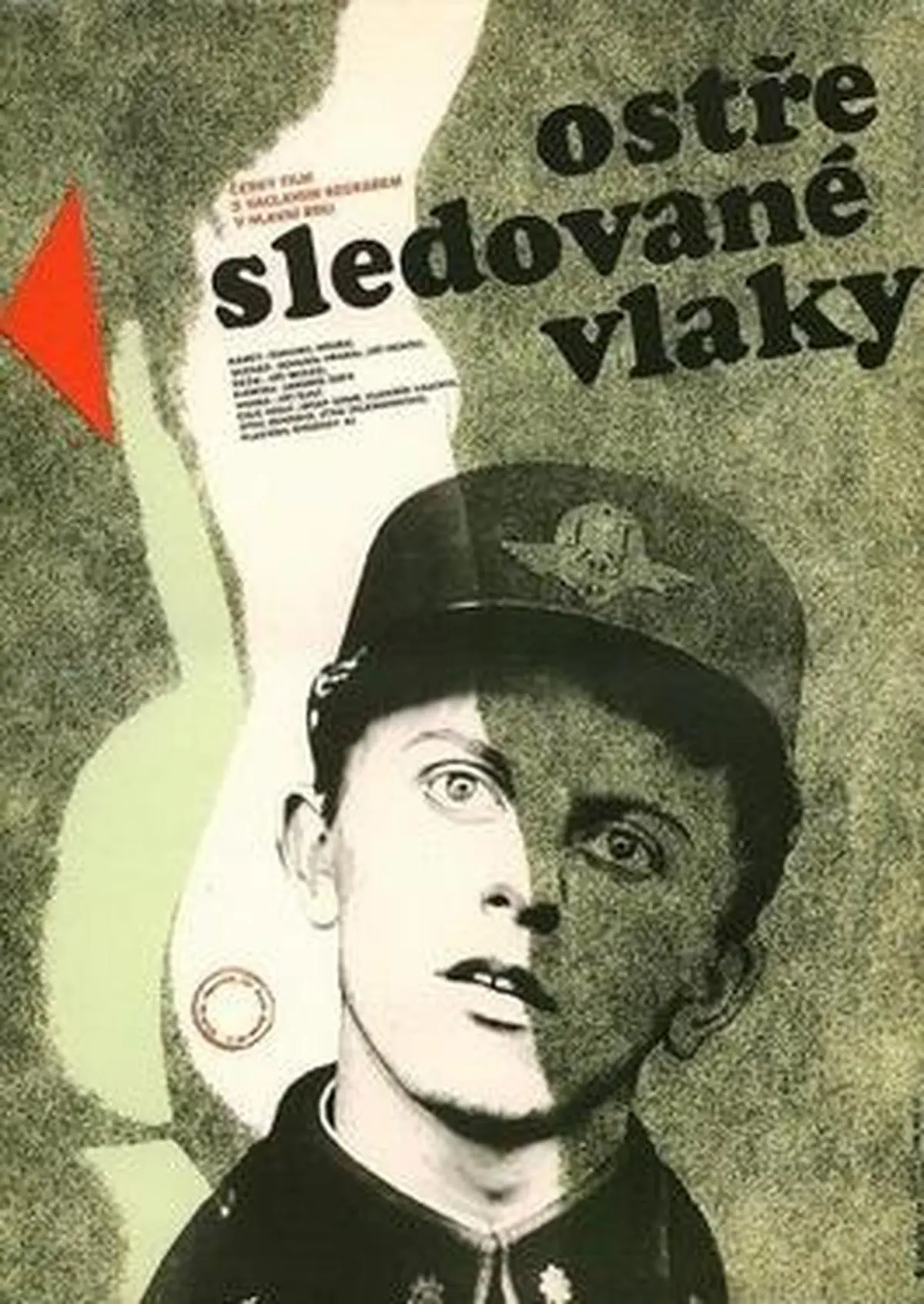
A threatrical release poster of Closely Watched Trains. | Photo Credit: Wikipedia
Here, it needs to be stressed that where others in modern Czech cinema resorted to darker, denser words, gestures and images to make their anger and sadness felt, Menzel settled for a more understanding approach with humourous story-telling as its principal prop.
Die-hards in Czechoslovakia were known to be none-too-happy with Menzel’s humane works of art. Judging things from as they seemed on the surface, a common enough mistake that the narrow-minded and the hidebound make in any society, they argued that conditions were far more severe than what Menzel showed in his films. Amongst other things, it was difficult to convince such detractors that, as the situation stood, repair and reconstruction would have been that much more difficult if artists and intellectuals, too, were to talk of an eye for an eye and a tooth for a tooth.
In that sense, there is no saner voice in contemporary Czech cinema than Menzel. “I have the impression that we should smile at the fifties considering them silly mistakes made in childhood, because mistakes have always been made and it is good to smile at them rather than to do something else.”
Menzel’s films in India
In Calcutta, we have had the good fortune of attending retrospectives of Menzel’s films more than once. Such sessions never failed to bring home to the viewer the wise, sad, funny and seemingly improbable world of Jiri Menzel. The director’s moral attitudes and philosophical concerns, veiled as they often are in strange encounters or in the sexual peccadilloes of hilarious creatures, may seem difficult to comprehend at first glance, but they begin to grow on a perceptive, appreciative audience after a while. Laughter, Menzel seems to be whispering into your ears, is indeed the best medicine. And if you can’t laugh, so much the worse for you!
Thanks to his visits to different Indian cities over a period of several decades to attend retrospectives of his films or to accept lifetime achievement awards, Menzel had become a familiar figure who stood out by his witticisms and his trademark smile wreathed in what looked like childlike naughtiness. When the news of his death reached me, a death which wouldn’t have happened but for COVID-19, I was reminded of a scene in front of the Kairali theatre in Trivandrum, of Menzel playing like a kid with a small sweet girl. When a local film-lover asked the director whether he was thinking of doing a new film, Menzel pointed to the child and chuckled, “She is my latest film!” Everyone around him broke into peals of laughter.
Memories of Menzel, not just his great, comforting films, but also the man who consistently courted humour to make life seem a little less dark, can still see us through our moments of anxiety in a world riven by stress and strife. Watching Menzel, one is reminded of Mark Twain’s words:” Against the assault of laughter, no thing can stand.”
Vidyarthy Chatterjee is a veteran Calcutta-based writer-critic.
Also Read | Indian and Israeli voices unite against CBFC’s ban on The Voice of Hind Rajab
Also Read | ITFoK 2026: The theatre that refused to go silent