



The bane of the Modi government’s foreign policy has now come to haunt its domestic policy. For over a year, India’s diplomacy has been in a tangle because of the Modi government’s poor assessment of US President Donald Trump’s temperament and love for India. That tangle has become knottier with New Delhi’s underestimation of Iran’s capacity to endure the unjust war against it.
Likewise, a faulty assessment of women’s quest for representation was the reason the 131st Constitutional (Amendment) Bill, 2026, failed to pass in the Lok Sabha. The Bill sought to advance reservation for women in an expanded House, where its seats were to be redistributed among States and Union Territories through delimitation based on the 2011 Census.
In contrast to Prime Minister Narendra Modi silently reconciling with the setbacks to his foreign policy, he has tried, through his address to the nation on April 18, to weaponise one of his most significant reversals in the domestic realm. His fierce attack on the opposition was not only a flagrant violation of the model code of conduct, but also an attempt to deploy women as an instrument for conquering West Bengal and Tamil Nadu.
But first, the Modi government’s stratagem to introduce the 131st Constitutional (Amendment) Bill last week. At the nub of it was the government’s assessment that the political parties of the States slated to see their share in the Lok Sabha dip would vote for the Bill out of their fear of incurring the wrath of women, in case reservation wasn’t given to them by 2029. They would, in other words, care less about their States’ clout diminishing in the Lok Sabha than losing the support of women.
This assessment presumes the existence of an extremely large, cohesive constituency of women that is so politically conscious as to prioritise political representation over their own and their family’s material needs. Had this presumption been correct, the P.V. Narasimha Rao government, which introduced 33 percent reservation for women in local bodies in 1992-93, wouldn’t have been voted out of power in 1996.
Women, to invoke Marxist terms, are neither a “class-in-itself” nor a “class-for-itself”. All women don’t share the same economic position, because of which they are unlikely to unite on most policies as these impact differently the various segments of them.
For sure, there exists a growing, relatively cohesive constituency of women in comparison to, say, the 1990s, which is increasingly autonomous of the control of men, including in exercising their franchise. Yet it is also true that this constituency has emerged because of the transactional relations between the state and women. In Bihar, Haryana, Jharkhand, and Maharashtra—the States that have had Assembly elections since May 2024—women in substantial numbers voted for the ruling parties that transferred money to their bank accounts.
Modi and the BJP failed to grasp the fact that cash transfers have a more compelling reality for women than reservation, not least because they lack the wherewithal to fight elections. This misconception had them time the special session of Parliament for passing the 131st Constitutional (Amendment) Bill days before West Bengal and Tamil Nadu were to have their Assembly elections, believing the ruling parties there would support reservation for women rather than risking losing women’s support.
Welfare and representation
Neither the Trinamool Congress nor the Dravida Munnetra Kazhagam chose to bite the bullet, preferring to prioritise India’s federal structure over quota for women. Quite understandable, indeed. Take West Bengal Chief Minister Mamata Banerjee, whose formidable support among women has been built on the economic relief she has provided them. For instance, through the Lakshmir Bhandar scheme, Banerjee has been transferring, since 2021, Rs.1,000 a month to women aged 25-60, upped to Rs.1,500 in the 2026 Budget. There are payouts to girls who continue their education and don’t get married at 18; and also grants to poor families for marrying their daughters.
These schemes will likely have a greater electoral pull than reservation for women, more so as the Trinamool’s record on gender representation is far more impressive than the BJP’s. The former has fielded 55 women candidates in the current Assembly election, 22 more than the BJP. Again, 38 per cent of Trinamool MPs are women, the highest among all parties; 13.7 per cent of MLAs in Bengal are women, the second highest among all State Assemblies.
The DMK’s record on gender representation is lacklustre—only three of its 22 MPs and six of its 133 MLAs are women. Yet the DMK would have cemented its bonds with women through a monthly transfer of Rs.1,000 to them. Women would, in case the party returns to power, receive coupons worth Rs.8,000 to buy home appliances of their choice. In contrast to crores of women benefiting from many such schemes, 33 percent reservation would bring only 77 women MLAs to the Tamil Nadu Assembly.
At least in West Bengal, it’s the BJP that should worry about the wrath of women, for they comprise 61.8 per cent of voters deleted from the State’s electoral rolls, because of the Special Intensive Revision (SIR), according to the Kolkata-based Sabar Institute, which engages in public-interest data analysis. These deletions are popularly perceived to have been deliberate, aimed at shrinking the Trinamool’s social base. The female relatives of these women would be seething against the BJP.
If DMK and Trinamool stumble
Yet, should the Trinamool and the DMK stumble at the hustings, the BJP would cite their vote against the 131st Constitutional (Amendment) Bill as the reason for their defeat. The media, as is its wont, would amplify the BJP’s analysis, effectively shifting the focus away from the massive SIR-induced disenfranchisement as being a significant factor behind their defeats. This is one use the collapse of the 131st Constitutional (Amendment) Bill in the Lok Sabha could have for the BJP.
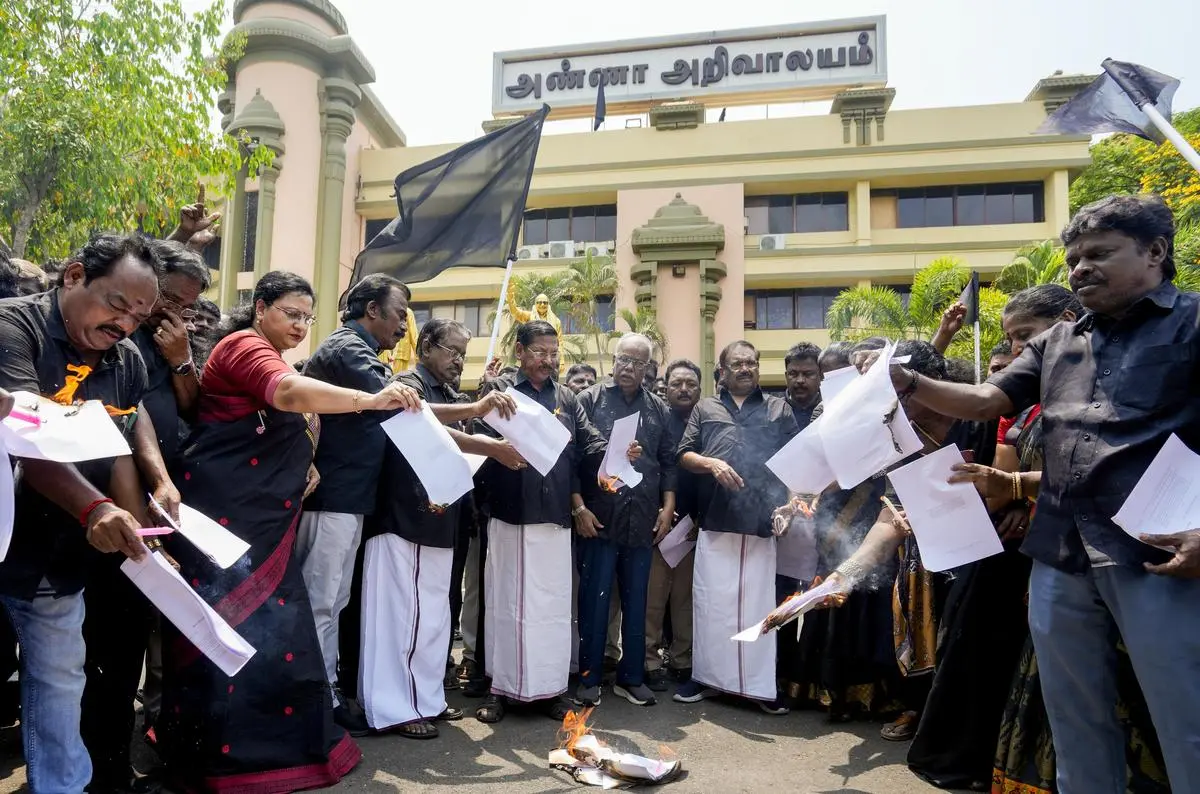
Supporters of the DMK burn copies of the proposed delimitation Bill during a protest at the party office, in Chennai, on April 16, 2026. | Photo Credit: R. SENTHILKUMAR/PTI
Its another use for the BJP would be to build a campaign, as was palpable from Modi’s April 18 speech, to project the opposition parties as villains who banded together to deny women their rights; that he alone among all leaders strives to further the interests of women. This campaign, based on a false narrative, is typically from Modi’s playbook, of depicting himself as a messiah of the weak taking risks to empower them.
For instance, after his policy of demonetisation went horribly wrong, Modi said in Goa on November 13, 2016, “I will not stop doing these things, even if you burn me alive… They may ruin me because their loot of 70 years is in trouble…” In May 2017, about the government’s decision to introduce neem-coated urea, Modi said, “Don’t you think by taking this step… I have ended the business of black marketeers? Don’t you think they will avenge it? I carry my maut [death] in mutthi [fist].”
Just as he engaged in ersatz class war in the past, he will now do so in ersatz gender politics. He may not succeed because the disempowerment of women is due to the overlapping factors of class, caste, and gender, not on account of their poor representation in the legislatures. Women don’t resent or nurse grievances against men to the same degree as the lower classes do against the elite.
In foreign policy, Modi’s and the BJP’s assessment went awry because of their exaggerated belief in India’s importance in the global order and the efficacy of personalised diplomacy. Their estimate of the opposition parties has gone wrong because their hubris, arising from their 12 years of winning spree, has blinded them from seeing that women prefer the parties that ease their burden of living than those who grant reservation. The opposition’s bestowing of ample benefits on women insulated it from the fear the BJP sought to evoke in them.
Ajaz Ashraf is a senior journalist from Delhi and the author of Bhima Koregaon: Challenging Caste.
Also Read | Why Modi’s delimitation exercise makes Stalin see red
Also Read | Census 2027 must capture the lived realities of vulnerable groups, minorities: Poonam Muttreja