


India’s grasslands and rangelands deserve a central place in climate policy. But any carbon-finance pathway must rest on secure rights, pastoral participation, sound methodology, and strong public safeguards.
India’s climate imagination has long been shaped by a forest-first instinct. When carbon is discussed, the mind turns almost automatically to trees, plantations, and canopy cover. Forests are vital, unquestionably so. But they are not the only living systems that matter to climate stability. Across India’s drylands, semi-arid plains, alpine meadows, scrublands, grazing commons, and pastoral corridors lie open ecosystems that sustain livestock economies, biodiversity, and millions of people whose livelihoods depend on mobility, pasture, and seasonal access to land. If these landscapes remain outside climate policy, India’s restoration agenda will remain incomplete. The United Nations declared 2026 the International Year of Rangelands and Pastoralists, with the Food and Agriculture Organization (FAO) leading the observance, to highlight the role of rangelands and pastoralists in food systems, biodiversity, climate adaptation, and mitigation.
That makes this an opportune moment for India to correct a long-standing policy distortion. Grasslands are too often treated as residual spaces: lands waiting to be planted, enclosed, diverted, or improved according to a forest or revenue model. Pastoralism, similarly, is too often treated as a backward livelihood rather than as a sophisticated ecological response to uncertain rainfall and fragile landscapes. Yet healthy rangelands are not empty or wasted.
They are working ecosystems. They support forage, habitat, nutrient cycling, water regulation, and carbon storage, much of it below ground in roots and soils. FAO notes that rangelands cover about half of the Earth’s land surface, hold roughly 30 per cent of global soil organic carbon stocks, and are home to pastoral communities that manage large portions of the world’s land. That global framing has direct relevance for India, where ecological resilience and rural livelihoods are deeply intertwined across dryland and grazing landscapes.
The argument, then, is not difficult to make: India should bring grasslands and rangelands more firmly into climate and restoration policy. In carefully designed circumstances, carbon finance may have a role in doing that. Healthy grasslands can help avoid carbon loss when degradation is prevented, and degraded grasslands can rebuild soil and biomass carbon when restored through ecologically appropriate measures such as native grass recovery, grazing regulation, invasive species control, and improved fire management. In principle, this is exactly the kind of climate response India needs more of: one that can link mitigation, adaptation, land restoration, and livelihood resilience.
But that is only the beginning of the conversation. The harder question is not whether grasslands matter. It is whether carbon finance can enter these landscapes without repeating the failures that have already made voluntary carbon markets deeply controversial. If grassland carbon is to work in India, it cannot be built as a celebratory narrative about a new market frontier. It has to be built as a rights-based, ecologically grounded, and institutionally cautious framework.
Global case studies
The warning signs are already visible in the most prominent global example of rangeland carbon finance: the Northern Kenya Rangelands Carbon Project. Verra first placed the project under review in March 2023 and suspended issuances while the matter was examined. The project was later suspended again amid intensifying scrutiny over governance and consent around associated conservancies.
Reporting on the controversy has highlighted concerns raised by Indigenous pastoralists and rights groups, including allegations that communities had not been properly consulted and that restrictions on grazing mobility worsened vulnerability during drought. Even where project proponents maintain that the technical carbon logic of the project remains defensible, the political lesson is unavoidable. Carbon finance on rangelands can lose legitimacy quickly if land tenure, community consent, and pastoral rights are treated as secondary questions.
India should learn from that case before trying to scale a rangeland carbon market of its own. Carbon stored in grasses and soils may be real. So may the ecological benefits of better grazing, native revegetation, fire management, and restoration of open ecosystems. But carbon markets do not enter empty space.
They enter landscapes with layered histories, multiple claimants, unequal power, and institutions that are often fragile or unresolved. In India, grazing lands are precisely such spaces. Their legal status may involve a mix of customary use, panchayat control, revenue classification, forest administration, and de facto local access. In such conditions, the ownership of a future carbon credit is not merely a technical question to be left for later. It is a prior political and legal question.
This is where pastoralism must move from the margins of the story to the centre of it. For generations, pastoralists have managed variability rather than tried to eliminate it. Mobility, negotiated access, seasonal rotation, and customary grazing rules are not signs of disorder. They are ecological responses to uncertainty. They help manage patchy rainfall, fluctuating biomass, and the spatial unevenness that defines open grazing systems. If carbon finance enters these landscapes with a fixed-boundary, fence-and-control mindset, it risks undermining the social and ecological logic that allows rangelands to function. A project may improve a metric on paper while damaging resilience on the ground.
The Indian legal framework, at least in principle, offers an important starting point for avoiding that mistake. The Forest Rights Act recognises rights of forest-dwelling communities and other traditional forest dwellers over forest resources, and the Ministry of Tribal Affairs has clarified that nomadic and pastoral communities are not automatically excluded merely because they may reside on revenue lands. This is significant because it means that livelihood-linked use, including grazing access, cannot simply be treated as incidental.
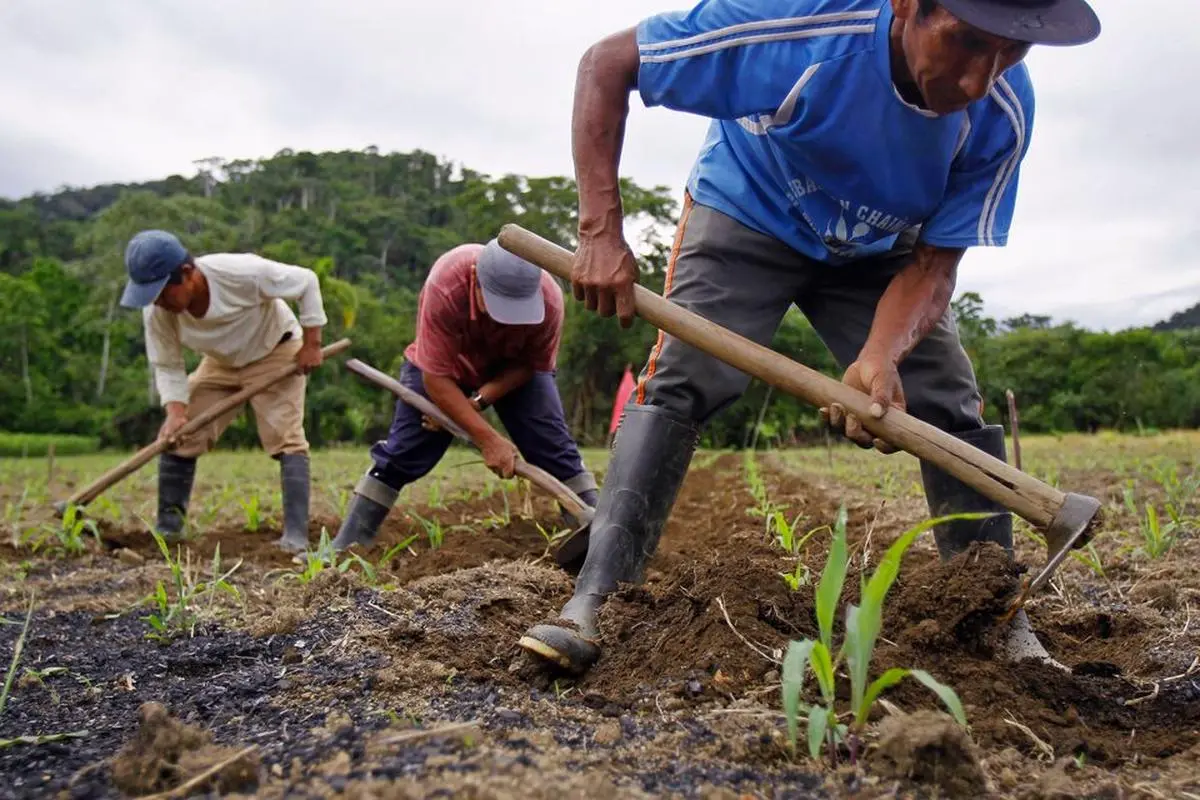
Workers turn soil containing biochar in Peru, which has attracted carbon credits from tech giants such as Microsoft. The UN has declared 2026 the International Year of Rangelands and Pastoralists, highlighting their role in climate resilience and food systems. | Photo Credit: Enrique Castro/REUTERS
But the existence of a law is not the same as secure rights in practice. The application of the Forest Rights Act has been uneven, and pastoral communities often remain under-recognised when compared with more administratively visible forest users. If carbon finance enters grazing landscapes before rights are clarified, the result could easily be credit capture by state agencies, intermediaries, or private project entities rather than genuine community benefit.
Administrative grey zones
In India, this problem is sharpened by the fact that many grazing landscapes fall into an administrative grey zone. Commons may be recorded under revenue categories, governed through customary arrangements, or managed through overlapping local and state institutions without clear recognition of who actually holds decision-making authority. In such circumstances, carbon ownership can quickly become detached from ecological stewardship.
The people who depend on the landscape may not be the ones who control the paperwork, and those who control the paperwork may not be the ones who bear the social and ecological consequences of project rules. That is why the land-rights question is not a side issue to be resolved after the market is designed. It is the foundation on which the legitimacy of any grassland carbon project will rest.
That is why any credible Indian conversation on grassland carbon must begin with a simple proposition: rights before credits. Secure community rights, transparent consent, and institutional clarity must come first. Carbon finance should follow ecological governance, not substitute for it.
The other challenge is scientific credibility. Voluntary carbon markets have already attracted criticism for functioning as reputational cover for polluters, issuing weak or overestimated credits, and relying on methodologies that are too generous in what they count as climate benefit.
Grassland and soil carbon projects face an additional burden because soil carbon change can be slow, spatially variable, and difficult to measure consistently. Baselines matter. Sampling design matters. The timing of rainfall matters. Management history matters. A dry year or a good monsoon can affect measurements in ways that complicate confident accounting. These are not arguments against grassland restoration. They are arguments against treating carbon finance as a simple or self-validating reward for any intervention labelled “restorative”.
This is where a more disciplined Indian pathway could still make a difference. Instead of selling grasslands as the next easy offset opportunity, India should treat them as a demanding but worthwhile restoration domain. If carbon finance is used at all, it should be built on conservative accounting, strong monitoring, and transparent public methods. It should support ecological stewardship, not speculative monetisation. And it should avoid imposing a forest model on open ecosystems. A grassland should not be “improved” by forcing tree cover into a landscape whose climatic and ecological logic is built around grasses, forbs, shrubs, soil carbon, and grazing dynamics.
BEE’s role
The institutional question is equally important. India’s carbon market framework is advancing, but the route through which grasslands could enter it remains underdeveloped. The Bureau of Energy Efficiency’s (BEE) offset mechanism allows voluntary project-based credits, and BEE has issued procedures and invited comments on draft project design documents under that mechanism. Yet the publicly visible examples remain concentrated in other sectors, and no clearly operational grassland or rangeland methodology has yet emerged. Agriculture and forestry appear in broader sectoral thinking, but open ecosystems still sit in a methodological grey zone.
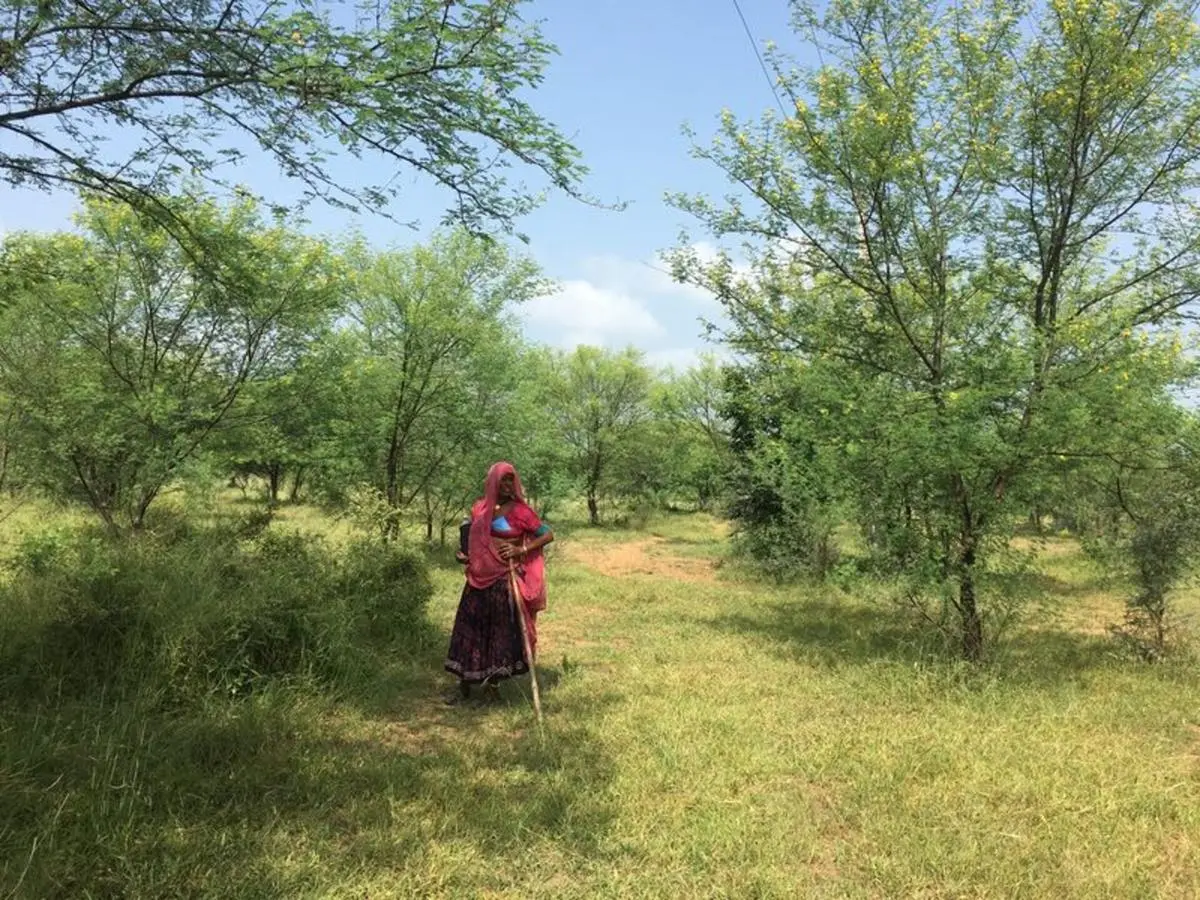
A woman watches over cattle grazing in common lands that the Hastinapur village regained control of in Rajasthan on September 6, 2017. India’s grasslands and rangelands support biodiversity, livestock economies, and major soil carbon storage, but remain marginal in climate policy. | Photo Credit: Rina Chandran/Thomson Reuters Foundation
This matters because policy ambition can move faster than methodological readiness. It is one thing to say that open ecosystems should be recognised within climate strategy; it is another to build a credible carbon framework for them. If India expands the rhetoric of grassland carbon before it develops robust rules for baselines, monitoring, reversals, community consent, and benefit-sharing, it risks creating a market promise that is institutionally hollow. A serious pathway would require not just technical protocols but also public clarity on governance: who approves projects, who owns the credits, who carries liability if restoration gains are reversed, and how pastoral communities are represented in both design and oversight.
That is not a reason to drop the idea. It is a reason to do the preparatory work seriously. Before India starts talking confidently about carbon credits from rangelands, it needs to answer a sequence of grounded questions. What exactly would count as an eligible grassland project? Would credits be based on avoided degradation, restored soil organic carbon, improved vegetation condition, or a bundled landscape metric? How would baseline degradation be defined where grazing intensity varies sharply across seasons and years? How would reversal risk be handled in drought-prone regions? Who would own credits on commons? Who would approve projects? What role would Gram Sabhas play? And how would pastoral users be represented not as symbolic beneficiaries, but as actual decision-makers?
The answers to those questions will determine whether grassland carbon in India becomes credible public policy or just another market slogan.
And yet there is real reason for optimism. Grasslands and pastoral landscapes offer exactly the kind of policy convergence India needs more of. Better management can strengthen fodder security, reduce degradation, improve drought resilience, support biodiversity, and rebuild soil health. In many regions, those gains would be felt long before any carbon revenue arrived. That is an important point. Carbon finance should not be the reason to value grasslands. Grasslands should be valued because they are ecologically indispensable and socially lived landscapes. Carbon finance, where appropriate, should be a supporting instrument, not the moral foundation of the argument.
This distinction matters because it keeps policy anchored in public purpose. If India treats grasslands first as ecosystems and commons, then carbon finance can be designed in service of restoration, livelihoods, and resilience. If India treats them first as carbon assets, then ecology, justice, and governance are likely to be rearranged around revenue logic. That would be a mistake.
So, the policy pathway should be clear. First, recognise open ecosystems properly within climate and restoration policy. Second, clarify rights and tenure in grazing landscapes, especially where pastoral use is longstanding but weakly recorded. Third, develop conservative, transparent, India-specific methodologies for grassland carbon and ecosystem recovery. Fourth, ensure that pastoral institutions and Gram Sabhas are central to project governance. Only then should carbon finance be allowed to scale.
India has spent too long looking upward at carbon in trees while overlooking carbon in soils, grasses, and the open landscapes that support both biodiversity and pastoral life. Correcting that imbalance is necessary. But doing so through carbon finance will require more than enthusiasm. It will require legal clarity, scientific humility, ecological fit, and democratic safeguards.
If India gets that sequence right, grassland restoration could become far more than a niche extension of the carbon market. It could become one of the country’s most promising pathways for linking ecological recovery, rural resilience, and climate action. If it gets the sequence wrong, it risks importing into its commons the same legitimacy crisis that has already unsettled grassland carbon elsewhere.
That is why the task now is not simply to ask whether grasslands can generate credits. It is to ask whether India can build a model of restoration finance that strengthens the landscapes and communities it claims to serve. That is a much harder question. It is also the one worth answering.
Sayanta Ghosh is Associate Fellow, Land Resources, TERI, and J. V. Sharma is Senior Director, Land Resources, TERI.
Disclosure: The authors are affiliated with The Energy and Resources Institute (TERI), a not-for-profit policy research organisation. TERI’s Land Resources Division undertakes research, advisory, and project-related work in the area of carbon markets, including carbon assessment and related technical support.
Also Read | The depot keeps winning in Chhattisgarh. Can the forest fight back?
Also Read | A green light that experts say ignores the evidence