


On April 21, 1526, a Timurid prince from the Ferghana Valley, Zahir-ud-din Muhammad Babur, defeated Ibrahim Lodi at Panipat. The significance of this victory transcends military innovation. The Mughals presided over “one of the largest centralised states of the early modern world”, governing 100 million people by the late 17th century. But scale alone does not explain their historical weight. The quincentenary since the Mughal rule demands we ask: What made Mughal rule transformative rather than merely hegemonic? And why should contemporary Indians acknowledge a debt to all Mughal emperors, including those who presided over decline?
This essay advances five interconnected claims. First, the Mughals created a uniquely cosmopolitan and bureaucratic ruling class, open to Persians, Central Asians, Indian Muslims, Rajputs, and Marathas alike. Second, their patronage actively developed indigenous vernaculars (Braj, Awadhi, Punjabi) alongside Persian. Third, and crucially, the Mughals championed a rationalist educational philosophy that prioritised reason (aql) over rote transmission (manqul). Fourth, their architecture and painting achieved a synthesis so complete that it became north India’s default aesthetic. Fifth, this pluralism was enacted daily in Mughal cities, where diverse communities cohabited, shared boundaries, and conducted business across religious lines. By examining the cumulative contributions of seven rulers, this essay argues that the Mughal legacy is an accretion, each reign adding indispensable layers to India’s modern inheritance.
The most striking Mughal innovation was the composition of its ruling elite. The mansabdari system integrated military and civil administration, drawing on Turanis (Central Asians), Iranis (Persians), Indian Muslims, Rajputs, and others. By 1600, over 20 per cent of the highest-ranking mansabdars were Hindu. This was structural cosmopolitanism.
The contrast with contemporaneous empires is instructive. Safavid Iran enforced Twelver Shi’ism as a state religion, excluding Sunnis and non-Muslims from high office. The Ottoman Empire reserved the highest echelons for a Turkic military slave elite, requiring conversion to Islam. Neither empires integrated non-Muslims into its sovereign class. The Mughals, alone among the three great “gunpowder empires”, produced Hindu generals (like Raja Man Singh), Hindu finance ministers (Raja Todar Mal), Hindu financiers (Jain Oswal banking houses), and even a Hindu chief of artillery. This ruling class, ranked and theoretically open to talent, created a shared political culture across linguistic and religious lines. A Rajput noble, a Persian refugee, and a Kashmiri intellectual could all find advancement under the same imperial umbrella. Contemporary India’s civil service and its ideal of a composite national elite are distant echoes of this Mughal experiment.
Rationalism and education
One of the most intellectually consequential Mughal features was its sustained emphasis on rationalism, reaching its apogee under Akbar. His educational reforms were revolutionary. While recommending the curriculum for imperial households, he explicitly stressed the primacy of aql (intellect, reason) over manqul (received knowledge, tradition, rote learning). This distinction was epistemological: manqul demanded acceptance without interrogation, while aql denoted active, critical reasoning capable of questioning and innovating.
The practical consequences were substantial. Under Mughal patronage, the curriculum expanded to include sciences (astronomy, physics, medicine), arithmetic and mathematics (algebra, geometry, accounting), systematic architecture (ilm-i-mimar), geography, cartography, and logic. This rationalist emphasis distinguished Mughal madrasas (educational institutions equivalent to college and university) from many contemporaneous religious seminaries. Abul Fazl, in the Ain-i-Akbari, explicitly links Akbar’s patronage of rational sciences to the emperor’s conviction that “truth is sought through reason, not inherited authority”.
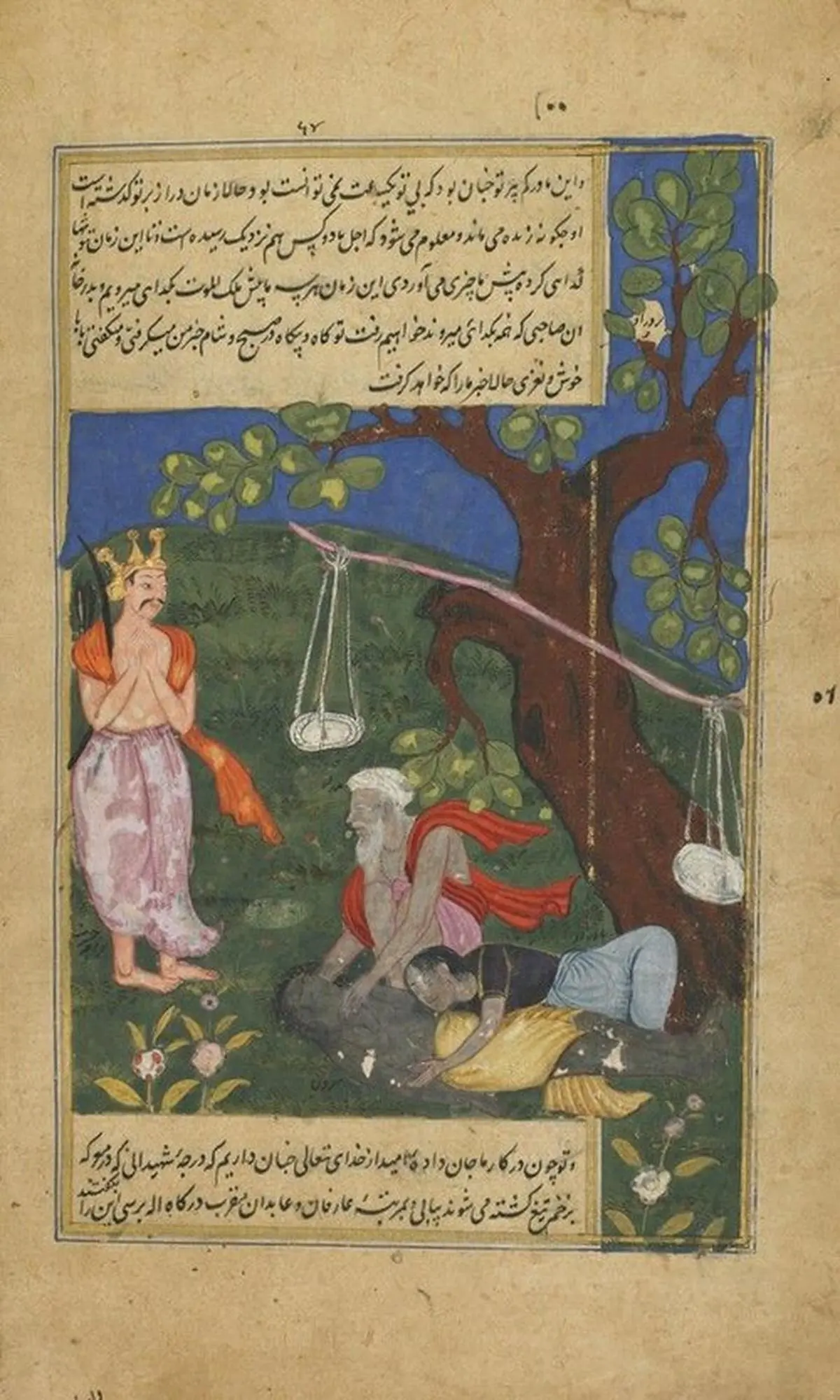
Folio from the Persian translation of Ramayana commissioned by Akbar, featuring the blind hermit and his wife whose son was accidentally killed by King Dasaratha. Attributed to Kala Pahara. | Photo Credit: Wikimedia Commons
The long-term significance for India is profound. This rationalist thread prepared the ground for later engagements with European Enlightenment thought and postcolonial technical education. When contemporary India celebrates its Institutes of Technology and its space program, it inherits an intellectual tradition deliberately cultivated by the Mughals. The emphasis on aql over manqul remains a living resource for those who argue that education should teach students how to think, not what to think.
The Mughals are rightly celebrated for elevating Persian; yet, a more profound contribution was their active patronage of indigenous vernaculars. Braj bhasha flourished under the court poet Abdur Rahim Khan-i-Khanan, who composed dohas rivalling those of Tulsidas. Raja Birbal wrote Braj poetry that remains canonical. Awadhi received imperial attention through the Ramcharitmanas and Malik Muhammad Jayasi’s Padmavat, which blended Sufi metaphor with Awadhi folk idiom. Punjabi flourished under Guru Arjan Dev (executed under Jahangir), who compiled the Adi Granth in Gurmukhi, a project enabled by Mughal stability.
Crucially, this patronage was not passive. Mughal emperors commissioned translations of Sanskrit epics and wrote in vernaculars themselves. Abul Fazl records Akbar using Hindi swear words; Jahangir’s memoirs contain Hindavi phrases; Shah Jahan’s court poet Sundardas composed the Sundar Granth in Braj. The development of Urdu (then Hindavi or Rekhta) as a camp language that became a literary medium owed everything to Mughal military and administrative networks. When contemporary Indians speak Braj in devotional contexts or write in Gurmukhi Punjabi, they inherit a linguistic ecology shaped decisively by Mughal patronage.
Urban cohabitation
This cosmopolitanism was mirrored in the fabric of Mughal cities. The Dutch merchant François Pelsaert, in Remonstrantie (1620s–30s), explicitly asserts that Mughal cities like Agra and Delhi had people of diverse faiths living together in close quarters. He observed that Hindus and Muslims, Jains and Christians, Persians and Rajputs all inhabited the same neighbourhoods without the spatial segregation that characterised contemporary European cities (where Jewish quarters and foreign ghettoes were legally mandated).
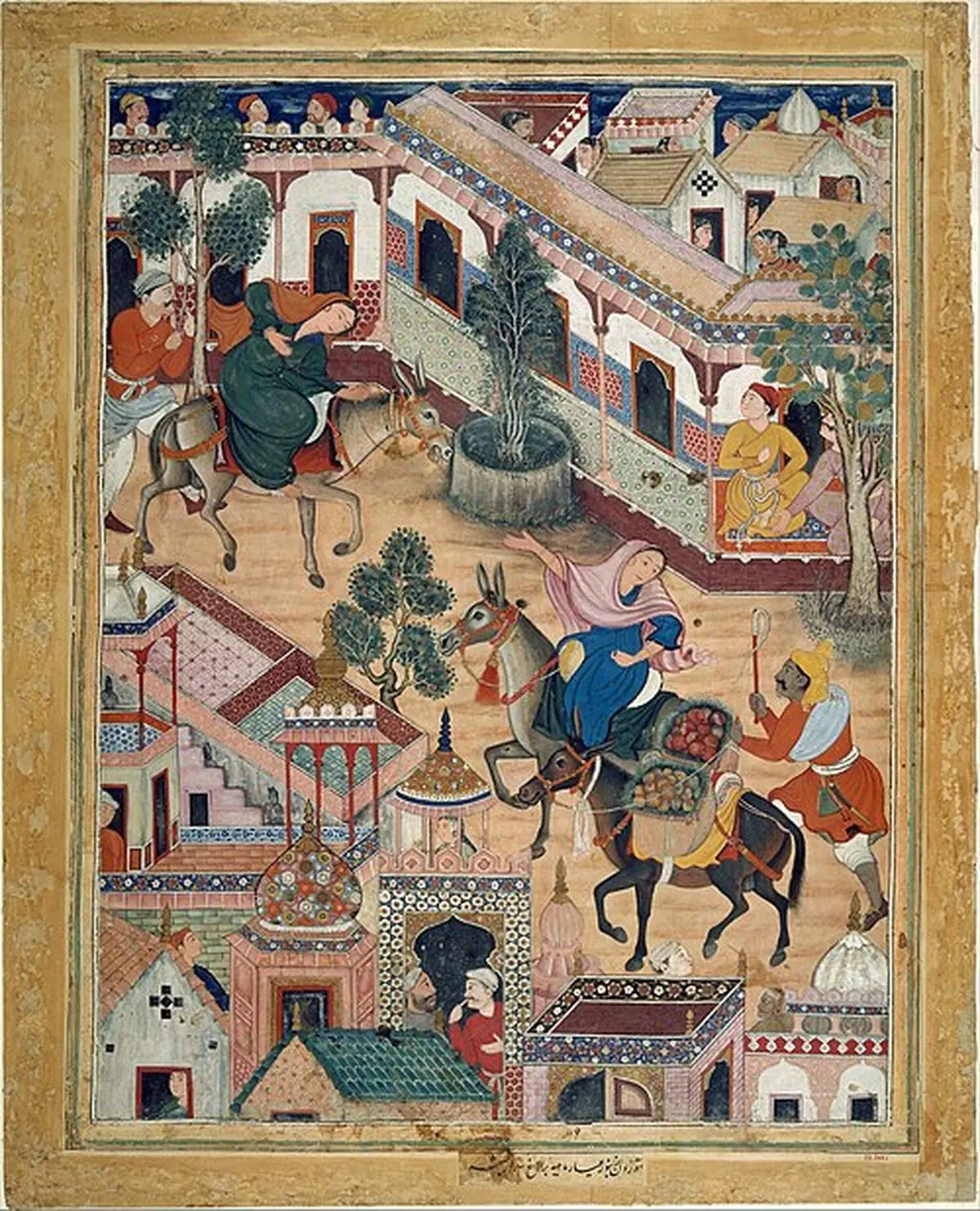
“The Spy Zambur Brings Mahiya to the City of Tawariq”, folio from Hamzanama, circa 1570. Attributed to Kesav Das and Mah Muhammad. Rogers Fund, 1923. Metropolitan Museum of Art. | Photo Credit: Wikimedia Commons
Pelsaert’s observations are corroborated by a substantial corpus of Mughal property documents (Qabala, patta, Ijara) preserved in national and regional archives. These documents reveal a remarkable pattern: Hindus and Muslims, nobles and clerks, Brahmins and Shaikhs routinely lived side by side, sharing boundary walls, courtyards, wells, and drainage systems.
A typical document from late-seventeenth-century Agra records a transaction between a Muslim mansabdar and a Hindu kayastha (record-keeper) for adjacent properties with a shared eastern wall. Another from Shah Jahan’s Delhi shows a Brahmin priest and a Shaikh scholar purchasing adjoining houses with a common rooftop terrace. A third from Aurangzeb’s reign lists tenants in a katra (market-residential complex) including a Jain jeweller, a Muslim cloth merchant, a Hindu goldsmith, and a Christian Armenian trader all sharing a single entrance and common courtyard.
This pattern directly contradicts later colonial and communalist narratives of premodern segregation. The shared boundary wall is a material metaphor for the Mughal urban ideal: proximity without forced conversion, difference without enforced separation. When contemporary Indians live in mixed neighbourhoods or intermarry across religious lines, they inherit an urban ecology shaped by Mughal-era practices of cohabitation.
Architecture and painting
Mughal architecture represents the most visible legacy of this composite culture. The Taj Mahal’s genealogy reveals a profound synthesis: the double dome is Persian; the charbagh garden is adapted to Indian hydrology; the chhatris (pavilions) are Rajput; the pietra dura floral motifs derive from European and Persian models. The rationalist emphasis on geometry, championed in Akbar’s education reforms, found direct expression in the precise proportions of Mughal monuments. The Red Fort’s Diwan-i-Khas bears the inscription: “If there is a paradise on earth, it is this, it is this.” The chaitya window pattern, cusped arches, lotus bulbs, chain-and-bell carvings, and kalasa motifs were drawn from indigenous temple traditions. Even the mosque under the Mughals was transformed into a “templar mosque” with a hierarchical scheme and triple domes, features not encountered elsewhere.
Mughal painting followed the same trajectory. Under Akbar, Persianate naturalism fused with the flat palette of Jain manuscripts, the dynamism of Hindu devotional painting, and the European perspective from Jesuit missionaries. The Hamzanama and Akbarnama depict court scenes with unprecedented detail. What distinguishes Mughal art is its refusal of purity: it is not Persian, not Hindu, not European, but all of these transformed. When contemporary Indians visit the Taj Mahal or admire a miniature, they participate in a visual culture invented by the Mughals through synthesis.
Contributions of individual rulers
Babur (1526–1530) established the template of the cultured conqueror, introducing the Central Asian charbagh and recording Hindustan’s vernacular flora. His son Humayun (1530–1556) preserved the dynasty through catastrophic exile, adopting Persian court rituals and bringing Safavid painters to India. But it was Akbar (1556–1605) who institutionalised Sulh-i-Kul (universal peace), abolished the jizya, patronised Braj and Awadhi, commissioned a Persian translation of the Mahabharata, and reformed education to prioritise aql over manqul, introducing sciences, arithmetic, and architecture into the curriculum.
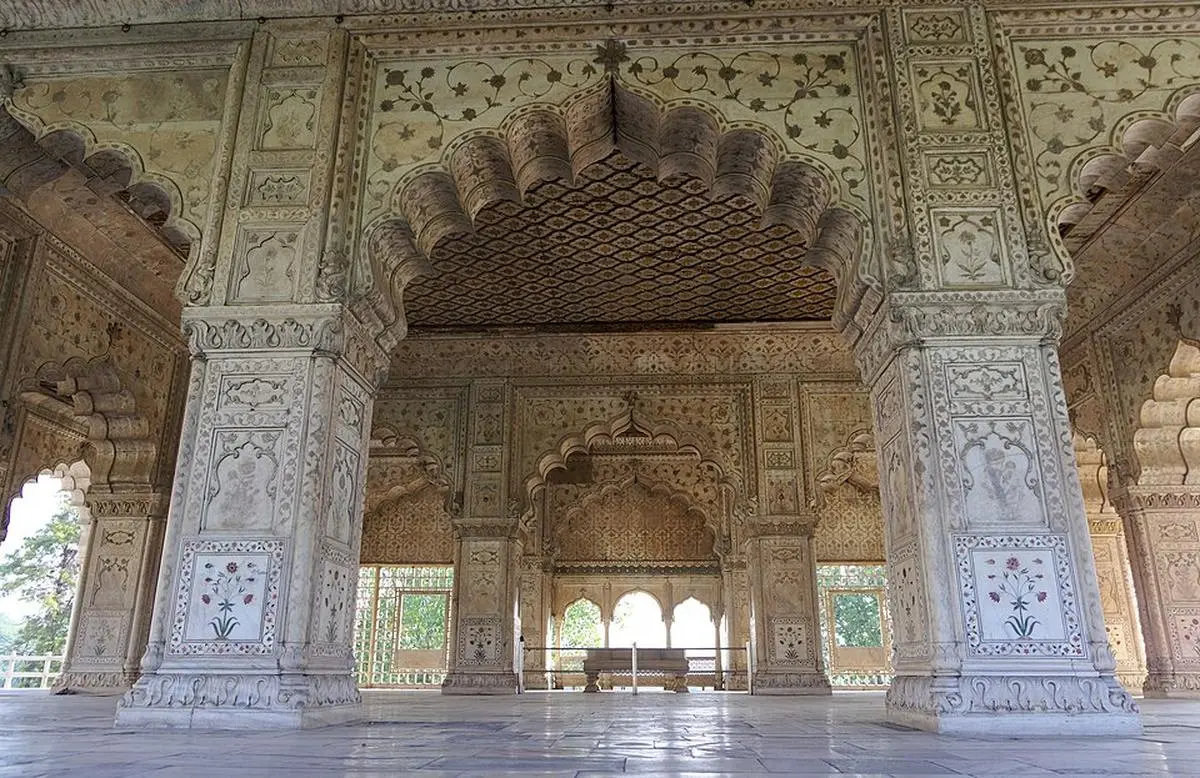
A picture of the Diwan-i-Khas, Red Fort, New Delhi. The rationalist emphasis on geometry, championed in Akbar’s education reforms, found direct expression in the precise proportions of Mughal monuments. | Photo Credit: Jakub Hałun/Wikimedia Commons
Jahangir (1605–1627) deepened access to the law through the chain of justice, elevated miniature painting to its zenith, and recorded Hindavi phrases in his memoirs. Shah Jahan (1628–1658) canonised Mughal architecture with the Taj Mahal and the Red Fort, and patronised Braj poets. The geometric precision of his monuments embodied Akbar’s rationalist curriculum.
Aurangzeb (1658–1707) expanded the empire to its greatest territorial extent, and even as he abandoned Akbari pluralism, property documents from his reign continue to show mixed neighbourhoods, suggesting that official orthodoxy did not fully override everyday coexistence. Finally, Muhammad Shah (1719–1748) presided over the maturation of khayal music and the rise of Urdu poetry through masters like Mir Taqi Mir, proving that cultural brilliance can outlast political power.
As we mark 500 years since Babur’s victory, the Mughals’ significance is neither triumphalist nor nostalgic. It is analytical and civilisational. India today owes the Mughals a cosmopolitan ruling class that rejected ethnic or religious exclusivism, unlike Safavid Iran or Ottoman Turkey. It owes them the development of Braj, Awadhi, and Punjabi as literary languages. It owes them a rationalist educational philosophy that prioritised reason (aql) over rote transmission (manqul), embedding sciences and arithmetic into the curriculum, a tradition that anticipates modern technical education. It owes them a shared composite culture that makes festivals and social practices syncretic.
It owes them an architectural and painterly canon that celebrates synthesis. And it owes them, as Pelsaert and countless property deeds attest, a tradition of urban cohabitation with shared boundary walls, a living resource for pluralistic democracy. To claim that India owes all Mughal emperors is not to excuse Aurangzeb’s bigotry or Muhammad Shah’s negligence. It is to recognise that civilisational legacies are accretions of triumph and failure, wisdom and folly. The quincentenary invites us to hold this complexity without flinching, and to understand that the Mughals, in all their contradictory glory, remain indispensable to any honest account of what India has become.
Syed Ali Nadeem Rezavi is a professor of medieval Indian history at Aligarh Muslim University and the author of a number of publications.
Also Read | India’s journey from grandeur to destitution
Also Read | Phool Walon ki Sair: Another curb, same message