



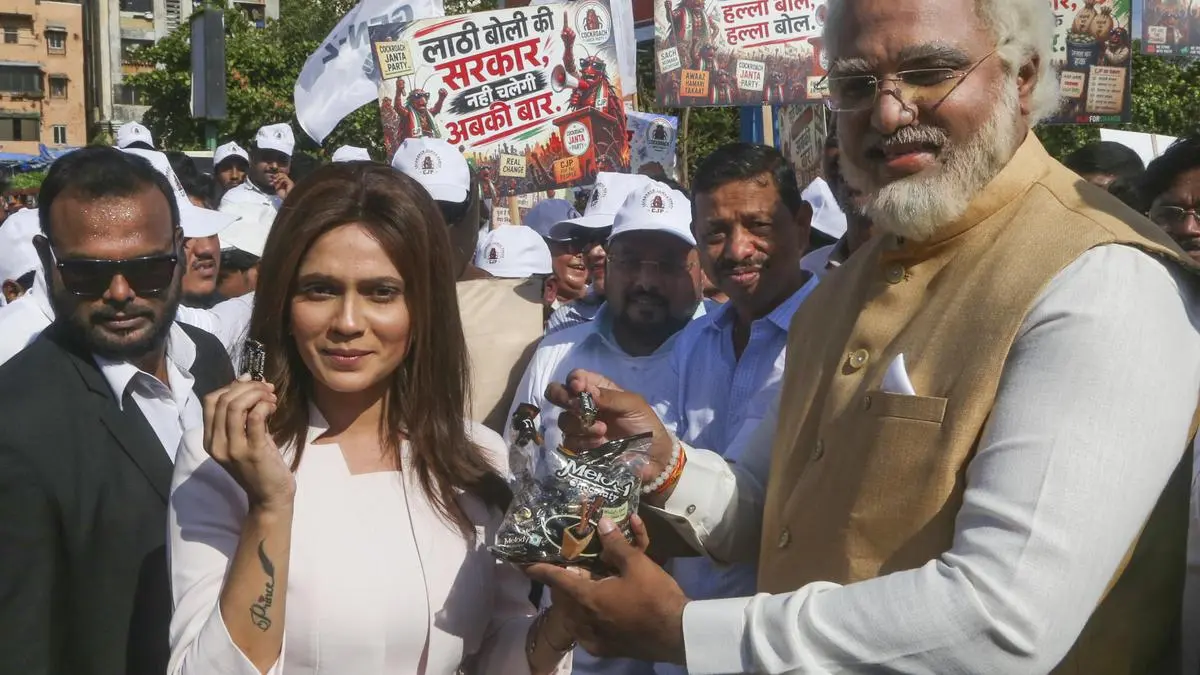
Social reality is best grasped by contrasting phenomena possessing opposite meanings. View through this lens the virality of two moments on social media—the video of Prime Minister Narendra Modi gifting his Italian counterpart Giorgia Meloni a packet of Melody toffees, and the birth and rise of the Cockroach Janata Party, a digital political movement dominated by Gen Z. There can then be glimpsed a conflict between two Indias, not too surprising as the two events are subliminally connected, to begin with, in time and space.
On May 16, Abhijeet Dipke, currently enrolled in Master’s programme in Public Relations at Boston University, latched onto Chief Justice of India Surya Kant’s comparison of the educated unemployed youth with cockroaches, to float the Cockroach Janata Party on social media. The number of followers it acquired soon outstripped that of India’s largest party, the BJP, on Instagram—and crossed the 22 million-mark in a week, prompting a France 24 anchor to breathlessly note that not even soccer superstar Cristiano Ronaldo mustered such numbers in as many days as the CJP did.
Four days later, on May 20, the CJP encountered competition for eyeballs and clicks from the Modi-Meloni-Melody video, which is said to have amassed 100 million views across all social media platforms. The media hailed Modi’s gift of toffees as a masterstroke of diplomacy. It reported that Melody plays upon Melodi, a moniker coined by combining parts of their names—Meloni and Modi—and regurgitated the marketing history of Melody and its iconic tagline— “Melody Itni Chocolaty Kyun Hai?” (Why is Melody so chocolaty?)
True to the corporate culture of exploiting marketing opportunities, Parle Products Private Ltd took out a full-page newspaper advertisement thanking the Prime Minister for gifting its Melody toffee to Meloni. Truly, this is an example of that trite idiom: “You scratch my back and I’ll scratch yours.”
In contrast to the jubilation over Modi’s gift to Meloni, the CJP’s X handle was blocked on May 21, that is, a day after she received Melody and endorsed it as “a very, very good toffee”. This was done on the basis of inputs the Union government claimed to have received from the Intelligence Bureau expressing “national security concerns” posed by the CJP. The blocking, however, could be interpreted as an instance of unfair competition between the Prime Minister and the CJP for dominating social media, or as a BJP attempt to deploy Modi’s popularity to stall the latter’s stupendous rise.
The connection between the CJP and toffee further deepened because Dipke petitioned the Delhi High Court for his party’s X handle to be unblocked. It was symbolic of the cockroach seeking through the judiciary a crack, a sluice, through which it could escape from being squashed by the mighty foot of the government, presided over by the gifter of toffees to Meloni. Dipke wasn’t granted immediate relief. For the CJP’s nearly 23 million followers, the court’s ruling might be seen as a judicial pushback against Dipke’s temerity to satirically mock the CJI.
The above timeline suggests the cockroach and toffee symbolise a conflict between two forces over their perceptions of India’s social reality. Although Parle’s Melody encases just a dash of cocoa solids encased in a layer of caramel, it’s still pitched as chocolate. For centuries, chocolate has seduced people with the promise of providing pleasure through its sweet taste. Its consumption triggers a surge of energy. It’s addictive, and increasingly dubbed the new narcotic. As a cultural artefact, chocolate signifies indulgence and well-being, attraction and affection, and romance in life.
Cockroaches, by contrast, symbolise rot, for they feed upon the waste we create, the reason why entomologists view them as nature’s “cleaning crew”. Yet their site of existence makes them repulsive, in quite the same way as some social groups were declared “untouchables” because of their supposedly polluting occupations. Cockroaches evoke disgust in most and fear in some. They are resilient and persistent, and impossible to eradicate. They are markers of our own failings, for they thrive upon the filth we forget to remove, signifying collapse, decay, and wretchedness.
A performative act
Modi’s gift of Melody toffees to Meloni undeniably had a personal, intimate touch. But it was also performative, with the act of gifting video-recorded and released on social media. He was, from this perspective, seeking to seduce social media users by personifying the multiple meanings of the chocolaty toffee—that there lurks behind his icy demeanour and an obstinately assertive and unforgiving personality a glow of warmth, a certain softness. As his country’s foremost representative, Modi’s gift of the chocolaty toffee typifies a feeling of well-being in India, its coming of age marked by indulging in pleasure and romancing life.
More significantly, the Meloni-Melody video sought to ensure social media users weren’t weaned away from their addiction to Modi’s posts. Although diplomatic minutiae are planned in advance, the performative act of gifting toffees became the virtual equivalent of providing an extra dose of narcotics to induce a higher level of pleasure in social media users so that they remained hooked to him. Its timing, coincidentally or otherwise, overlapped with an explosion of interest in the CJP, implicitly suggesting that the Meloni-Melody video was a Modi counter to the new social media addiction on offer.
Dipke’s CJP, too, personifies the many meanings cockroaches have acquired—that they represent the rot in the socio-political system, its slow collapse, which, in turn, reflects the failure of the gifter of toffee who presides over it; that they are the virtual equivalent, at least as of now, of the system’s “cleaning crew”; that their resilience will have them persist with the endeavour of scavenging.
In the war of perceptions regarding India, cockroaches have spoken truth to the chocolaty toffee. Few can deny that the repeated NEET examination leaks and the goof-up in the evaluation of CBSE class XII test papers are symptomatic of the rot creeping into the system. The wretchedness to which the cockroach is doomed threatens the future of Gen Z, with the paucity of jobs haunting them. Cockroaches have given the lie to the toffee’s symbolic portrayal of India as a land of well-being, pleasure and romance.
Ajaz Ashraf is a senior journalist from Delhi and the author of Bhima Koregaon: Challenging Caste.
Also Read | What’s wrong with Viksit Bharat?
Also Read | Modi’s growth story has run out of fuel