







As a struggling filmmaker, I watch the world with a kind of disciplined distance. I absorb. I observe. I feel deeply—but I withhold any public articulation of what it all might mean about us, about the state of our civilisation, about the love we spend our lives chasing.
As I write this, war rages in Iran. Thousands are dead. Hundreds of them children. A fragile ceasefire is unravelling. Heritage sites lie in rubble. Schools have been struck. Tehran has become, by many accounts, a ghost town. And I find myself thinking not only of the bodies but of the memories being buried with them—the stories, the songs, the cinema, the poetry that an ancient civilisation carried in its living tissue, now under assault.
Some time ago, I watched a video of Sonam Wangchuk speaking after his release from detention. What I saw was not an activist. Not a figure of protest. It was a tired human being, a thousand wounds etched across his face. And yet—dignity. An unbroken composure that did not harden into hate nor dissolve into despair. He spoke gently, as though the very thing he was fighting for—his mountains, his home—still needed that kind of softness to be protected. How does someone move through such strain and not be altered into hatred? I do not know.
Perhaps that is where the unease begins. Not in his suffering, but in ours. In how easily we receive such moments, process them, move on—as though they belong to the ordinary rhythm of things. As though this erosion of the human spirit, this demand that love must endure struggle to justify itself, is somehow normal. His suffering did not turn into hatred. It remained, stubbornly, a form of love. And in that persistence, something about the rest of us—our ease with forgetting, our fluency in indifference, the coldness of the human heart—feels far more unsettling.
Why is it that those who love hardest, feel deepest, think most clearly, remember with unrelenting fidelity—are the ones the world turns against? They are the ones made to suffer. To be broken. Silenced. Jailed. Even erased. As though memory itself were a threat, and love, when it refuses to fade, becomes something the world must discipline. Because a world that can inflict and endure violence often cannot bear the persistence of memory, nor the clarity of those who refuse to forget.
Orhan Pamuk has a deep love affair with his city. Istanbul lives in his prose with the power of visuals—not just recorded but inhabited. He has captured the memories and emotions of himself, his people, his streets in ways no historian ever could. There is something disconcerting about a novelist needing protection. Pamuk was not inciting violence. He was naming it—speaking about histories his country preferred to leave unspoken. And yet, words were enough to endanger him. Even language that preserves the past, when it carries the weight of truth, becomes a threat in a world that depends on forgetting.
A house full of writers
My own experiences have collided with some grim realities of how memory comes to be perceived as dangerous. I grew up in Bhopal, in a house full of thinking, feeling artists and writers. Kamala Prasad—author and national general secretary of the Progressive Writers’ Association—was my father’s mentor and a family friend. The Hindi satirist Harishankar Parsai was among his guiding influences. And alongside them stood the towering presence of Habib Tanvir, who left me with some of my most moving memories.
As a young girl, preparing to leave Bhopal for the Film and Television Institute of India in Pune, Habib Tanvir ji gave me his aashirvaad—his blessing—to go and learn how to tell the stories of my own culture, my own people, my own land. The instant I stepped into his house at Ansal Apartments in Shyamala Hills, I noticed mountains of books strewn across the drawing room. That image has never left me. An iconic artist, growing older, a little frail, surrounded by words and memories pressed into paper—held together by his genius and a remarkable inner strength.
What happened to him felt like an act of brutality. Habib Tanvir is perhaps among the rare playwrights in Indian theatre who devoted his entire life to giving voice to ordinary lives—drawing from the rhythms, stories, and spirit of folk culture. His plays preserved the memories, cultures, and histories of the people of Madhya Pradesh and Chhattisgarh: the tribal communities, the indigenous peoples. And yet, in the 2000s, I witnessed him endure a kind of persecution in his own state, among his own people. All he had sought to do was tell the stories of the places and communities he loved.
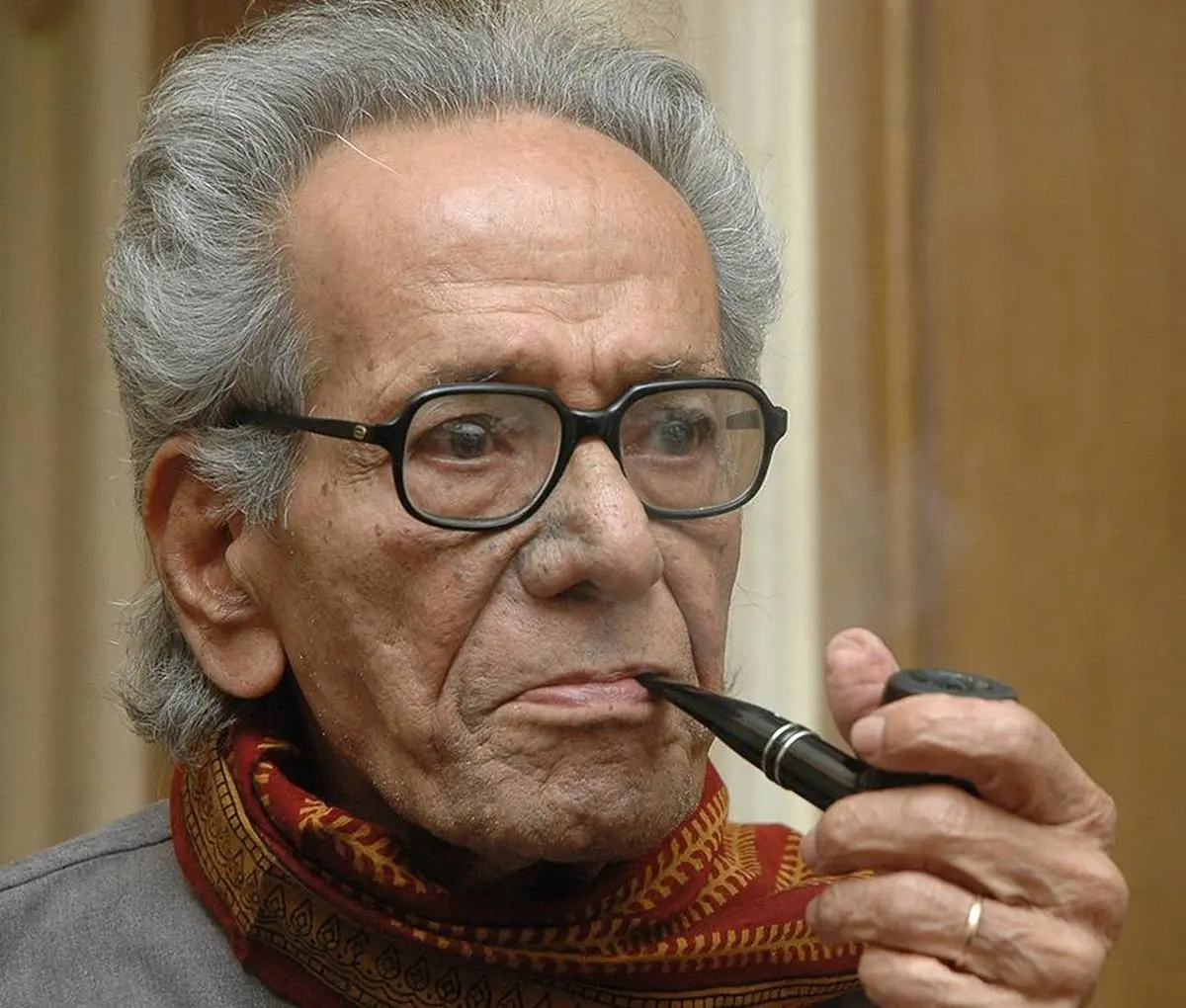
The eminent theatre personality Habib Tanvir, in Hyderabad, on May 1, 2007. | Photo Credit: The Hindu Archives
His play was halted before it could find its voice on stage. Stones were thrown. Chaos took over. What should have been a shared experience turned into isolation. In the end, he performed to an empty theatre—just his wife and a handful of his troupe sitting there, holding space for him. My father, along with his progressive friends, rushed to stand by him. But by the time they arrived, there was nothing left to do. Only to witness, in silence, the cruelty unfolding before them.
After that, he could never stage that play in Madhya Pradesh again. For a playwright, there can be no greater punishment. The only thing an artist lives for is their art. To be cut off from it is a state that resembles a living death.
What compels a society to push an artist to such an edge? How does one come to feel like a stranger in one’s own land? Habib Tanvir withstood forces that sought to silence him. Yet at heart he was a sensitive, loving human being. The ostracism he faced, the slow push to the margins—it must have cut deep.
Today, if one were to ask people in Madhya Pradesh who Habib Tanvir was, I wonder how many would remember. After he was pushed into an unofficial exile, there were efforts to cancel a proposed academy in Bhopal that was to bear his name. His plays disappeared from the stage. There was a deliberate attempt to erase him from public memory—to deny him even a single structure in his name, so that forgetting could complete what exclusion had begun.
And yet he did not disappear. He continues to live in my memory, and in the memories of those who choose to remember.
Cinema as memory
I carried these memories with me to the Film and Television Institute of India. Every evening, at half past six, I sat in the main theatre for the general screening. It was there that I encountered John Abraham through Amma Ariyan. The film is a journey of memory, grief, and collective conscience. It opened my mind in ways I had not known were possible. Until then I had never visited Kerala, never met its people—and yet, in the darkened theatre, as their memories were projected on screen, I found myself inhabiting them as though they were my own. It was at that moment I understood: cinema is perhaps the greatest memory project in the history of human arts. An architecture of memory—constructed yet lived—through which memory moves in flesh and blood, across regions and time, refusing to remain contained within its place of origin.
Cinema, as memory, carries within it a certain danger. I find myself witnessing, with unease, the ways in which the cinemas of India are struggling against brute force. There is a shift that is difficult to ignore—an alteration not just in form but in intention. We seem to have entered an era that recalls the Leni Riefenstahls of the world. Memory itself appears to be under construction. Cinema risks becoming a tool for manufacturing memory rather than bearing witness to it. There is little room left for a voice like John Abraham’s—for a cinema that enables memory to travel freely across borders.
I have always loved Iranian cinema. Majid Majidi’s Children of Heaven was the first Iranian film I watched. It felt less like a film and more like a document of lived experience. A couple of years ago, in Pune, I met a young Iranian woman I was mentoring. I told her how much I admired her country’s cinema. I said that after completing her studies, she must return to telling stories of her own people. Something shifted. Her face dropped. After a pause, she said: no, I do not think so. I would rather forget my country and my people. Move to London or Spain. Live my life. Never make anything about them.
There was something disturbing in that rejection—not born of indifference, but of exhaustion. Of fear. Few cinemas in the world have come as close as Iranian cinema to preserving the memories of its people. And yet, this act of remembering has rarely come without cost. That devotion to truth, that insistence on holding on to memory, has been met again and again with violence and containment.
It is a telling irony that Majid Majidi found an embrace in India, where he made Beyond the Clouds with creative freedom—and that Habib Tanvir found recognition abroad. Artists are often received more gently away from the very places that shaped them.
Memory stays
It is not that the world has turned against memory. What is more unnerving is this: even after leaps in science and technology, even as we build systems of artificial intelligence that can store and simulate vast amounts of human knowledge, we have barely begun to understand love. We remain uncertain about something far more immediate—how to let another human being live, love, and remember in their own way. What happened to Socrates, the silencing of a voice that challenged his time, repeats itself across generations.
It is one of our greatest failures that an artist like Ai Weiwei could be detained for 81 days—not for violence, but for remembering too precisely. For insisting that memory must remain visible. His work does not merely express. It preserves. It records. It refuses disappearance. In giving form to loss, to lives that might otherwise dissolve into statistics, he turns art into a kind of moral archive. His art is not loud. It does not argue. It remembers. And in doing so, it denies the world its most convenient escape: forgetting.
When memory is held with care, when it is carried into public space, it begins to unsettle the very structures that depend on erasure. The punishment is not just of the individual but of what they represent—a refusal to look away and feel nothing.
I might sound cynical. But that day may not be far away when the same impulses that drive wars and concentrate power will shape not just the world we inhabit but the reality we are allowed to remember. We already live within architectures of algorithms that decide what is seen, what is amplified, what disappears. It is not difficult to imagine a future that resembles the controlled world of Severance or the constructed consciousness of Westworld.
And yet, one limit remains: we cannot yet erase memory at will. Perhaps that is why the world continues to rely on more visible forms of erasure—containment, isolation, slow attrition. What happened to Julian Assange was not just punishment. It was an attempt to exhaust memory itself. To confine a body long enough that the mind begins to dim. That clarity becomes fatigue. That truth becomes too heavy to carry.
And that may be the most unnerving truth of all. When memory cannot be erased, it is made to suffer until it begins to fade. And then, like Yayoi Kusama, we retreat into an asylum and keep making art just to hold on to ourselves—not because we are broken, but because the world outside is. Where those who feel and remember are ostracised. And those who do not are left to rule.
I think often of that young Iranian filmmaker in Pune. Her refusal to go home. Today, the country she wanted to forget is being reduced to rubble and statistics. Its schools struck. Its heritage sites destroyed. Its people made into ghosts in their own capital. And I wonder: when the bombs stop, when the ceasefire holds or collapses, what will remain of the memories she was too exhausted to carry? Who will tell the stories she chose not to tell?
Shobhita Thakur is an Indian filmmaker and author, an alumna of FTII Pune, trained in film editing. Her work spans cinema, advertising, and long-form storytelling. Her short film Khilawadi has screened internationally and continues its festival run.
Also Read | Jafar Panahi returns, but not to reconcile with power
Also Read | We don’t need more symbols