





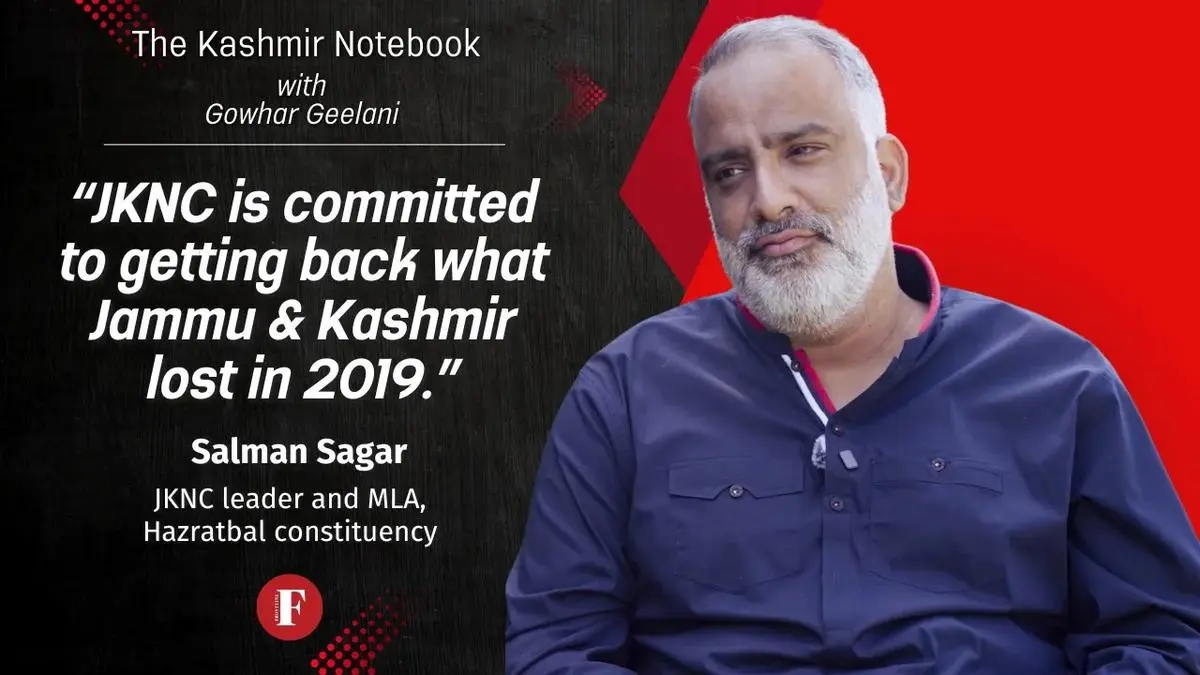
In the latest episode of The Kashmir Notebook, host Gowhar Geelani speaks with Salman Sagar, senior Jammu and Kashmir National Conference leader and MLA from Hazratbal, on the growing political debates shaping Jammu and Kashmir after 2019.
The conversation covers reservation policy controversies, Articles 370 and 35A, restoration of statehood, the National Conference’s manifesto promises, the Lieutenant Governor’s powers, governance challenges, Waqf administration, press freedom, and the future of Kashmir’s political identity. Salman Sagar also responds to criticism from opposition parties, including the PDP and People’s Conference, while defending the Omar Abdullah government’s performance and long-term political roadmap.
Edited excerpts:
We have been meaning to speak with you on various issues, especially because you are part of the ruling government with over 40 MLAs. The first question I would like to ask is about what has happened in West Bengal, Tamil Nadu, and Assam.
There has been something of a political earthquake in West Bengal, with the BJP coming to power with a thumping majority. In Assam, the result was expected, but Tamil Nadu has thrown a surprise by giving its mandate to a film actor, Vijay. Are these developments a concern for you, that something similar could happen in Kashmir in the future?
I think we treat Kashmir differently in electoral politics, and there are a number of reasons for that. Kashmiri voters do not generally follow the trends seen across India. They have always preferred regional parties—most of the time, the National Conference, we are in power today.
The edge in Kashmir will always lean towards regional parties. BJP is trying hard, and in fact, Congress also tried hard to form a government of its own here in previous times, but could not. As far as West Bengal and Assam are concerned, the Assam result was largely expected. In Bengal, the BJP generated such euphoria that they would win, but I would not call it an earthquake. TMC had ruled for 15 years in Bengal, so this is quite a normal outcome.
So you see anti-incumbency as a factor?
We should consider this an anti-incumbency factor. Perhaps some agencies helped BJP gain an edge in certain seats—whether it was the SIR [Special Intensive Revision] or something else. But by and large, I feel it is a normal democratic process in which the BJP got a mandate through anti-incumbency.
They are very organised in that regard. As far as Tamil Nadu is concerned, there has been a trend in the past of film stars entering politics, whether M.G. Ramachandran or Jayalalithaa. This is not something new in Tamil Nadu. By and large, I would view it as a normal democratic process. Governments have come and gone in Tamil Nadu, and voters have always given different parties a chance.
Generally, the DMK.
It was always between the DMK and the AIADMK. Let’s consider it a normal democratic process in which people decide whom to vote for.
In the case of West Bengal, the Communist Party of India (CPI) ruled for a little over three decades with leaders like Jyoti Basu and Buddhadeb Bhattacharya at the helm for 34 years. Voters eventually grew fatigued and threw their weight behind the TMC. So you are saying it is a normal democratic process—governments come and go. Now, let’s focus on Kashmir.
If you speak to young people in universities and colleges in Jammu and Kashmir, one of the main issues they raise is reservations. I would like to remind you of two things mentioned in your manifesto: first, a promise of one lakh jobs for the youth, and second, a review of the reservation policy and rationalising it to address any injustices. What is the status of both?
We are in the process of rationalising the reservation policy. The government has done its part. We were committed to beginning this process, and the Honourable Chief Minister [Omar Abdullah] formed a committee headed by the Health Minister (Sakina Itoo). They have already submitted their report to the Honourable Lieutenant Governor (LG). The ball is now in the LG’s court, and he is expected to act on it.
But we are committed. We know how important it is to address this concern. It affects every household—my children will appear in exams tomorrow, and yours will too. This is not an urban-rural divide; it is a common concern. We are committed to doing justice for open-merit students. Change cannot happen overnight, but we are doing our best. The Chief Minister’s government is working to deliver on the promises made in our election manifesto—and, indeed, beyond it. The manifesto has become a hot topic for journalists and opposition parties alike. They seem more interested in our manifesto than in the good work we are doing.
Also Read | Constitution, democracy, and federalism under attack in Kashmir: Mohammad Yousuf Tarigami
There is a reason people talk about the National Conference’s manifesto, Salman. For many people—at least certain sections of society in Jammu and Kashmir—the National Conference is not merely a political party; it has been a political movement. Consider the history spanning over 90 years, from 1931, when it was the All Jammu and Kashmir Muslim Conference, rechristened as the National Conference in 1939.
That is why certain groups focus closely on what the National Conference promises in its manifesto.
It is entirely fair for your voters to hold the government to those commitments. And now that you have completed nearly 18 months in government, you are no longer new to the system. Let me also remind you of two things. First, your own senior party leader, Agha Ruhullah Mehdi, who is also a Member of Parliament, has been very vocal on the reservation issue.
He even led youth protesters outside Chief Minister Omar Abdullah’s residence. So there are different views on this—not only from the media or civil society, but within your own party.
First and foremost, we must all look at the Honourable Chief Minister’s intentions. I believe he has tried his best. He formed a committee, and it was not easy for him to do so. It was not easy to even withdraw one, two, or three persons from other communities, as you well understand. But he did it. He did it as he promised in the manifesto, and because he saw the aspirations and emotions of young people. The committee has submitted its report.

Salman Sagar says a committee formed by the Omar Abdullah government has submitted its report on reservation rationalisation to the Lieutenant Governor, with further action pending. | Photo Credit: NISSAR AHMAD/The Hindu
And why isn’t that report being made public?
As I said, it is now with the Lieutenant Governor. He has to take a call. There are certain things we are not able to do because of the dual power structure.
You mean the hybrid model of governance?
Call it the hybrid model of governance—there are two power centres, and we have our own limitations. I have great respect for Agha sahib. He is a Member of Parliament, a senior leader, a three-term MLA, and a former Cabinet Minister. He understands how governments function in the present setup and does not need to be told. As long as someone is raising concerns for the betterment of the people, that is welcome.
But if it is merely to create a sensation among the public, then we will leave that to the wisdom of all those who are watching. I have met him a number of times, and we have discussed the reservation issue. He is a people’s man with his own standing; he is also a religious leader. But within the party, we need to maintain a certain discipline. If everyone goes to the media and speaks publicly about internal matters, that is precisely what outside agencies would want.
Let’s turn to another aspect. The political landscape was fundamentally altered in August 2019, and elections were held in 2024—five years later. You were fighting those elections in a new atmosphere, under a new arrangement and the Reorganisation Act.
That was not something you discovered after 18 months in office. Let me quote a verse from your own manifesto: Azm-e- raasikh shouq-e-kamil, sa’aee paiham ki qasam, ye khayal kham hai tera ki manzil door hai, where you say the destination is not far away.
Your manifesto also states that you will strive for the full implementation of the autonomy resolution passed by your party in the J&K Assembly in 2000. You say you will strive to restore Articles 370 and 35A and statehood as they existed before August 5, 2019.
And you say you will endeavour to redraw the J&K Reorganisation Act of 2019. This is not the media speaking—these are your own party’s words. Despite knowing you would be working under a new arrangement, what progress has been made on these fronts?
These are very sensitive issues, and our government and leadership are working on them, behind the scenes. We are working on everything we have committed to, because we will be going back to the people in another three and a half years. I recall the Honourable Chief Minister saying he has a plan in mind should things not go as expected. He doesn’t need to make everything public today—perhaps two or three months down the line, or six months from now, he will announce things when the time is right. He is committed to making things public when necessary. As you noted, this is not merely a political party—it is a movement. We began in 1931 and rid the people of autocracy. We still believe in those principles.
We believe we must work for the people, for their aspirations, for their sentiments. The sentiment is that we must reclaim our powers. Statehood must come first, and after that, we need special protections from the Government of India. Things are not easy now; people must understand that. But our entire leadership is working hard. They are trying to break us in many ways, but we remain committed to what we have promised in our manifesto.
Let’s move to two other important issues. Your manifesto also addresses the unilateral termination of government employees—how they have been removed one by one without due process, with a mere notification sufficing to end someone’s career.
You promise to change this policy of unilateral termination. And as we understand, intellectually speaking, some of these things may not be within your hands, though you knew that before taking office. Beyond that, you also say in your manifesto that you will encourage dialogue between India and Pakistan. New Delhi would, of course, say that it is a foreign policy matter.
So how did such commitments come to be included in your manifesto, when you must have known they fall outside your mandate?
I do not doubt the Honourable Chief Minister’s intentions when it comes to fulfilling his promises. At the same time, we were expecting the Government of India, and particularly the BJP, to be more liberal towards Jammu and Kashmir—not in terms of finances, but in terms of honouring the people’s mandate.
We expected them to consider political concessions, special status, and the aspirations for which people voted. That has not happened as of now. We will continue to fight for that. We are not like our political opponents, who raise these issues merely for media attention—the very people who are themselves responsible for this mess. Name one opposition party, other than the CPI (M), that was not part of the 2014 government alliance with the BJP. They are the ones who should answer for this.
What you are trying to say, I think, is that the PDP [Peoples Democratic Party] was part of the coalition and their allies.
Today, it is the Apni Party, Sajjad Lone’s party. These are the people responsible for what was done in 2019.
We are also seeing a great deal of bickering on social media between the National Conference and the PDP, and between the People’s Conference and the National Conference—a lot of back and forth. But will this blame game resolve anything? Going back to 2014, or further back to 2008-10—will that help? So, but will this resolve the problem by the blame game, that you will go back to 2014, they will go back to 2008-10?
That is for them to decide. They have to reckon with what they did in 2014. We are all going to live with the consequences for a long time to come.
You are saying the damage has been done.
Whatever damage has been done is because of them, and we will be tasting the consequences for a long time, I believe.
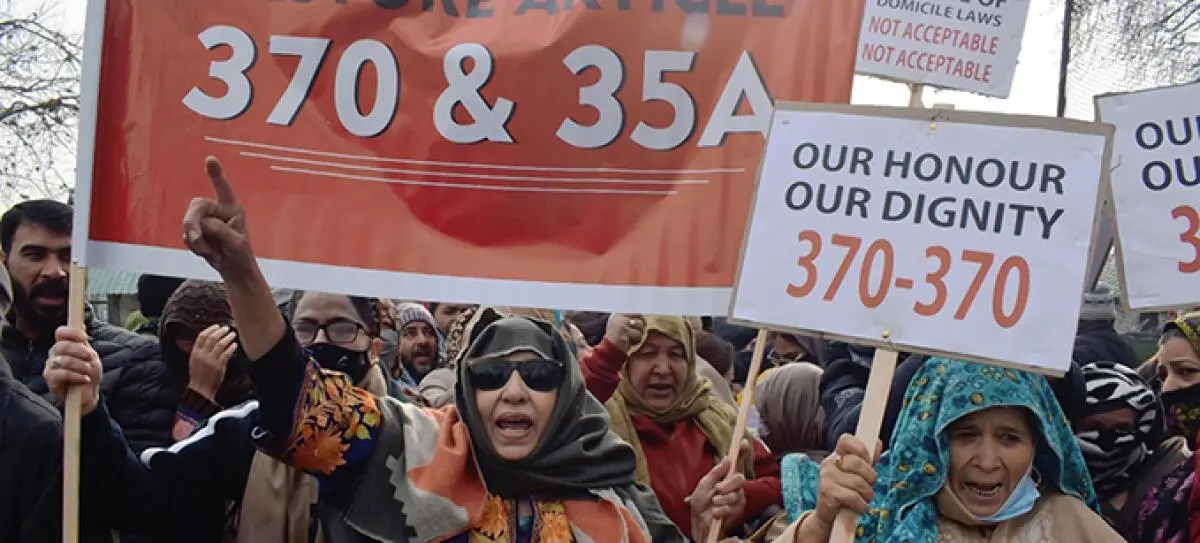
National Conference workers protest against a draft proposal of the Jammu and Kashmir Delimitation commission in Srinagar on January 1, 2022. Sagar says the Omar Abdullah-led government views statehood as the first step before taking up further demands related to Article 370 and special protections for land and jobs. | Photo Credit: NISSAR AHMAD/The Hindu
Do you think the cost of their mistakes—or their alliance—has been enormous?
Enormous—and it has hurt us very badly. They should not politicise this. They should not exploit it for their benefit in opposition to the current government. They have to operate within the very system that their own follies created— the one they built when they allied with the BJP in 2014. They brought the BJP here. And let me tell them through this interview: They will never be forgiven. It will never be forgotten. They should never be exonerated for this.
Now let’s turn to some softer issues. Setting aside the restoration of Articles 370 and 35A for a moment, your manifesto also mentions the autonomy of the Sher-i-Kashmir Institute of Medical Sciences, SKIMS. Is that within your control? You have not been able to restore the gazetted holiday in the name of your own leader, Sheikh Mohammed Abdullah. You have not been able to restore July 13th as Martyrs’ Day. So, how will you restore SKIMS’s autonomy?
No doubt, this is not within our competence at present. That is why the Chief Minister consistently speaks about statehood—we must first be a state. Initially, we are not talking about Article 370, because that will come in a later stage. Once we have statehood, we can engage with the Government of India about further concessions and assurances. And once those are in place—
So are you saying that it has to be an incremental approach?
Once statehood is restored, we will begin talking about Article 370, special status, land rights, and protection of jobs. But all of that is contingent on statehood. Right now, there are departments, universities, and institutions—including SKIMS—that remain under the control of the Lieutenant Governor. We are facing these constraints. I will say again that this is all a consequence of what happened in 2014. But we have to put an end to the blame game ourselves, too. Sagar, I am not quoting any opposition party here—not the PDP, not the People’s Conference, not the Apni Party, not the Communists. I am only quoting from your own manifesto. The question is simply: where is the progress? Eighteen months have passed out of sixty. I understand that certain things are gradual and will take five years. But how would you rate your own progress on a scale of one to 10?
Are you talking about the government on the whole or as an MLA?
On the entire governance, and given the promises that you have made in the manifesto.
I’m sure we’ll be able to do justice with our manifesto, and we will be in a position to go back to the people and seek their mandate again. As for a score, I think this is not the right time, given that it has only been one and a half years.
In that case, you only have three and a half years left.
Three and a half years remain, which is far more than the one and a half we have used. You see the glass as half empty. I believe that, as of now, I would say five out of 10, because it has only been one and a half years. But I am confident we will deliver.
Are you referring to the social welfare schemes—free bus rides, raising marriage assistance fund, and some measures for the economically weaker sections? But let’s come to another issue: restoring the J&K Waqf to its former standing. What progress has been made on that?
Do you really think—
I have not written it; it is in your manifesto.
No, no, we will, we will, we’ll work for that. We are working for that, we are working on that.
Hazratbal is your constituency—
Unfortunately, certain things are not being allowed by the BJP-run Central agencies, which are creating a great many problems for institutions like the Waqf Board and SKIMS.
So it is not only law and order that is under their control—you are saying the Waqf Board too?
With due respect to the current chairperson (Darakhshan Andrabi), the Waqf Board should be within the domain of the locally elected, popular government. That is not the case—it is entirely handled and controlled by the Central Waqf Board. It should not be so. We are working on it. We want a chairperson from our party, or at least someone who truly deserves the position.
There are three key words you have used as pillars in your manifesto: dignity, identity, and development. On development, one could argue you have delivered something—marriage assistance, free bus rides, electricity measures, and support for the economically weaker sections. But on dignity and identity, you have not been able to—
Critics would argue that identity will be restored when special status is granted, when statehood is restored, and when the aspirations of the people are met—that is, when the dignity of the people of Jammu and Kashmir will be restored. As I have said, we are working on it, though not everything can be made public. Some things cannot be announced every day. The time may come sooner than expected when the Honourable Chief Minister will reveal what he has been doing, what he has been discussing with the Government of India. He is working hard. His team is working hard. It may take some more time, but we are following our agenda and our manifesto, both.
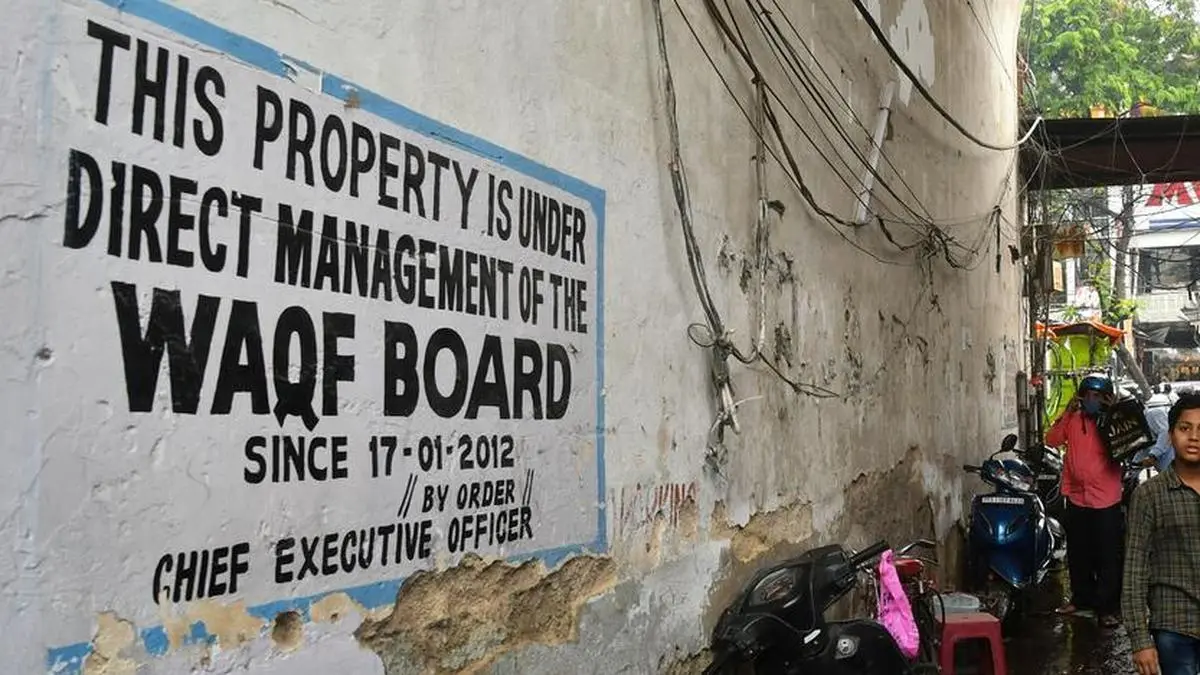
Sagar says the National Conference manifesto includes a commitment related to restoring the Waqf Board’s earlier standing, and he outlines the party’s position on how the institution should be governed. | Photo Credit: The Hindu
Let’s return to the reservation issue. Recently, one of your senior leaders jokingly said that to get the Chief Minister’s attention on the matter, they might have to organise a marathon. The opposition’s argument—and I am not trying to put you on the spot, since this is really a question for the Chief Minister—is that when important issues are at stake, the Chief Minister is seen organising or participating in marathons.
There is nothing wrong with being fitness-conscious, but critics say it comes at the expense of pressing concerns. What would you say to those raising the reservation issue?
They have nothing to offer. The BJP failed to install a Hindu Chief Minister in Jammu, so now they are simply looking for things to say. The PDP and other parties—the ABCD teams, as we called them during the election campaign—need to hide their own failures. They are not a responsible opposition. As for the marathons, everyone has a private space that we should not intrude upon.
Beyond that, the Chief Minister is promoting tourism and fitness simultaneously. If the Lieutenant Governor organises drug-awareness events, no one objects. Yet when the Chief Minister joins a marathon—which in itself is a statement against drug abuse, since a person who runs 10, 20 or 40 kilometres is unlikely to fall into harmful habits—he is criticised. We support the Governor’s initiatives, and the Chief Minister’s should be viewed in the same spirit.
From my understanding, the reason people hold Omar Abdullah to a higher standard than the Lieutenant Governor is that the former has over 40 MLAs behind him—he has an electoral mandate, he won elections. The Lieutenant Governor is an appointee who received no votes. The scrutiny comes from voters’ expectations. Now, Sajjad Lone recently said that Omar Abdullah is a tourist, and that by voting for a tourist, the people got what they deserved. What is your response to that kind of criticism?
For all his remarks about tourists, he could only secure one seat [Handwara] in the Assembly.
So you are saying the result was disproportionate to his stature?
That is what he got. With due respect, Sajjad sahib is a colleague, and I respect him, but he won one seat, and that too by a very slim margin. There has to be dignity in politics—that applies to me, to Sajjad sahib, and to all of us.
Your own colleague Tanvir Sadiq is also an MLA from a constituency near yours— your father, too, is a Member of the Legislative Assembly, from the Khanyar constituency. Tanvir Sadiq recently challenged the PDP, saying they should swear on the holy book that they did not vote for the BJP in the Rajya Sabha voting. There was considerable criticism about invoking religion in a political dispute. And on the International Press Freedom Day, it is worth noting that your manifesto commits to restoring press freedom—yet nothing seems to be happening on that front. The Press Club’s registration has been put in abeyance and is no longer functional, despite Omar Abdullah’s promise to restore it. What are your thoughts on these issues?
An IAS officer has been placed as Director of Information. These officers operate according to their own priorities, and their functioning is directly controlled by the Office of the Lieutenant Governor and the Government of Delhi.
So your hands are tied in these matters?
Salman Sagar: We very much want to talk about press freedom and the freedom of journalists. My colleague Tanvir Sadiq has raised these issues repeatedly—regarding advertisements, regarding press freedom in Jammu and Kashmir. But again, that authority lies with—
Are you saying that someone else is calling the shots in these matters?
Yes, that is true. Someone else is indeed calling the shots.
What would you say to Farooq Abdullah’s recent statement that the National Conference is the only party that can take Kashmir out of its current predicament? How will you assure the people of that?
I second my leader. We have to fight. We cannot abandon the people who gave us their mandate. We have no reason to run away. We have to contest elections again and keep working.
Also Read | Please treat us Kashmiris as equals: Sajad Lone
How confident are you that you will deliver?
It took them more than 75 years to take away what they finally took in 2019. Why are our media and political opponents demanding we undo everything that happened in 2019—as if it can happen overnight? It is not about me being an MLA, or my father being an MLA, or even about Omar sahib being Chief Minister. He can advocate for this cause as a leader, even if he were not in government. Of course, he is a leader who represents a party with nearly 90 years of fighting for the people of Jammu and Kashmir.
A final question: how confident are you that in the next three and a half years you will fulfil the promises in your manifesto, and go back to the people of Jammu and Kashmir— particularly the voters—and say that you have delivered what you committed to?
One encouraging thing is that every who’s who of our society is now focused on our manifesto. That was not the case under any previous regime; no one spoke about manifestos the way they do today. We are committed, and we will fulfil our promises. We have to go back to the people again. And as you said at the outset, this is not merely a political party—it is a movement.
We know that some sections see it as a political movement.
Absolutely. At least you agree to that point. Some sections believe it, because we hold the votes of the people. And we are committed to delivering.
Many also see your party as architect of what has been taken away since the 1960s.
Our opponents will say that until eternity. We do not mind. We are here to serve the people, and we are committed to getting back what was lost. That may take some time.
But in the last 70 years, much seems to have been lost—the post of Sadr-e-Riyasat, the post of Wazir-e-Aazam, the flag, the Constitution, Special Status and Statehood.
Then please keep reminding people who was responsible—who was at the helm of affairs.
There was no People’s Conference in 1963, for example.
There was Congress, no doubt. But who was in Congress? Who were the people when all those titles were taken away? The situation was secure as long as the people of Jammu and Kashmir gave their mandate to the National Conference. The day they handed over their mandate to the PDP, the BJP entered the scene, occupied the corridors of power, and took whatever was left.
Gowhar Geelani is a senior journalist and author of Kashmir: Rage and Reason.
This transcript has been edited for length and clarity.