







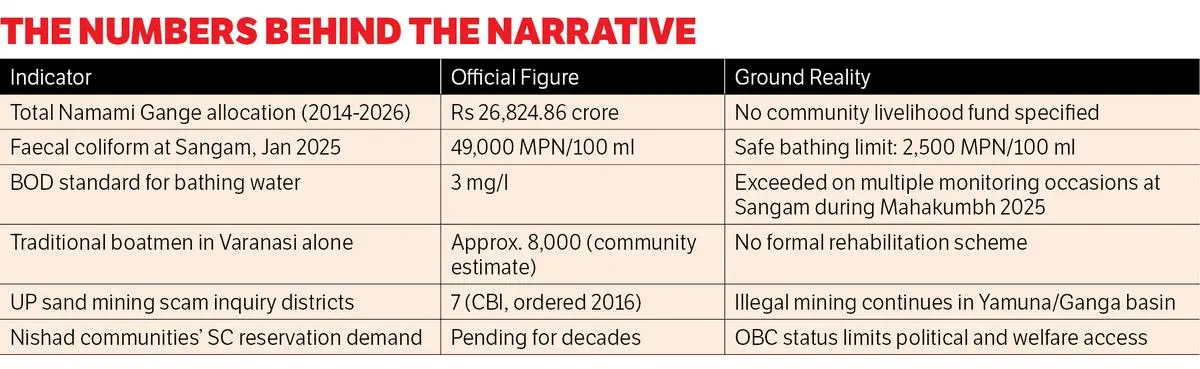
In January 2025, as 660 million pilgrims descended on Prayagraj for the Mahakumbh, the Central Pollution Control Board (CPCB) quietly submitted a report to the National Green Tribunal (NGT) that the government did not advertise. Faecal coliform levels at the Triveni Sangam, where the Ganga, Yamuna, and the mythical Saraswati converge and where millions came to ritually bathe, had reached 49,000 MPN per 100 ml. The safe bathing threshold is 2,500. By February 4, levels near Shastri Bridge registered 11,000.
The CPCB’s own language was unambiguous: water quality “was not conforming with primary water quality criteria for bathing with reference to faecal coliform at all monitored locations on various occasions”. None of this information reached the 25 million pilgrims who bathed on Makar Sankranti alone. The state had chosen spectacle over truth.
This episode compresses the central parable of Namami Gange—a programme vast in ambition, lavish in public relations, and structurally incapable of seeing the people it displaces as anything other than an obstacle to the river it claims to restore.
Since June 2014, the Union government has allocated Rs.26,824.86 crore to the Namami Gange Programme, with a further Rs.3,400 crore budgeted for 2025-26. As of early 2026, 524 projects have been sanctioned and 355 completed. The official ledger records sewage treatment plants, ghat renovations, industrial effluent monitoring, Gangetic dolphin surveys, and afforestation drives. These are real interventions. Dolphin populations have grown. A number of sewage treatment plants are functional. The government rightly notes that the UN recognised Namami Gange as one of the top 10 World Restoration Flagships at COP15 (the UN Biodiversity Conference) in Montreal in December 2022. It tells these stories loudly and often. Faecal coliform readings have genuinely improved at several monitoring stations upstream, including Haridwar and significant stretches of Uttarakhand.
What the ledger does not record is simpler but more consequential: who lost, and what they lost when the state arrived on the riverbank with its contractors and its cameras.
The Nishad, Mallah, Kewat, and Bind communities have lived on the banks of the Ganga and the Yamuna for centuries. In the Ramayana, the Nishad chieftain Guha ferries Rama, Sita, and Lakshmana across the Ganga. The BJP has deployed this mythology with remarkable political fluency, unveiling statues of Nishadraj even as the communities those statues represent grow poorer. The primary occupations of these Other Backward Classes (OBC) communities—fishing, river-farming on kachhaar lands (marshy lowlands on riverbanks), sand transportation, and boating—have faced continuous contraction since the Ganga Action Plan of the 1980s, which imposed restrictions on riverbed cultivation and fishing without offering alternatives. Namami Gange did not reverse this dispossession. It accelerated it.
Riverfront development, which involves the construction of beautified ghats, promenades, and tourist infrastructure, physically displaces the informal settlements that have clustered along these banks for generations. The Uttar Pradesh Tourism Department’s introduction of luxury cruise vessels on the Ganga at Varanasi directly threatens an estimated 8,000 traditional boatmen and an ancillary community of approximately 50,000 Nishad dependants, according to community surveys cited by river rights organisations. The state frames this as modernisation. The community calls it extinction by infrastructure.
Sand, power, capital
Sand sits at the centre of a structural paradox that Namami Gange has never resolved. Successive governments in Uttar Pradesh, including the Adityanath administration, have imposed periodic bans and restrictions on small-scale sand extraction, the traditional livelihood of Nishad sub-castes. As Munna Nishad of Varanasi said, “We are suffering due to the ban, not the mafias.”
The sand mining mafia, politically protected and mechanically equipped, operates at night, in violation of NGT orders, using JCBs on riverbeds in district after district, from Shamli to Kaushambi to the Yamuna tributaries adjoining Prayagraj. The NGT’s own joint committee documented this in 2024. The small-time Nishad operator working with a hand dredger and a country boat gets arrested. The mechanised contractor with the right political connections gets a lease. This is not an enforcement failure. It is enforcement functioning exactly as designed, protecting capital and criminalising subsistence.
The Allahabad High Court ordered CBI inquiry into the Uttar Pradesh sand mining scam laid bare this structure across seven districts. Political agents convert public river resources into private rent, while the communities whose only asset is their proximity to the water face dispossession twice over: first by policy, then by the mafia that operates in the policy’s shadow.
There is a deeper conceptual failure at work here, one that the programme’s planners, drawn overwhelmingly from urban, upper-caste technocratic circles, were perhaps structurally unable to recognise. Namami Gange treats the river as an object of restoration, not as a social system. It measures success in biochemical oxygen demand, dolphin counts, and STP capacity. These are legitimate metrics.

Devotees gathered to take the holy dip at the Triveni Sangam on the occasion of Maha Shivratri and the culmination of Mahakumbh at Prayagraj on February 26, 2025. | Photo Credit: R.V. MOORTHY
But they exclude the communities whose knowledge of the river, its seasonal behaviour, its fish cycles, its sand replenishment patterns, accumulated over generations of intimate dependence, constitutes precisely the kind of ecological intelligence that conservation science now belatedly calls traditional ecological knowledge.
A 2020 joint study by the National Council of Applied Economic Research and the Tata Centre for Development at the University of Chicago found that riverine fisher communities on the Ganga remain socially and economically fragmented, and recommended that the government formally recognise these communities as part of the riverine ecosystem and synchronise their indigenous knowledge with scientific monitoring for better water management. The National Mission for Clean Ganga acknowledged this in principle but ignored it in practice.
What replaced community participation is tourism infrastructure. The Arth Ganga model of river-linked economic development envisions waterway transport, river cruises, and ghat tourism. This is not inherently wrong. But when a luxury cruise vessel displaces the traditional oarsman who has no alternative income, when a beautified promenade erases the kachhaar land that a Nishad family farmed during the dry season, and when a State government offers skilling programmes as a substitute for livelihood protection, the state is not restoring a river. It is gentrifying one.
The colonial precedent is not incidental. The British classified the Mallah as a Criminal Tribe under the Criminal Tribes Act, 1871, citing their mobility along waterways as evidence of criminal propensity. Post-Independence India denotified them, but the structural logic persisted. The river-dependent community remained suspect in the eyes of the regulatory state: their fishing a threat to ecology, their sand-hauling a threat to the river bed, their settlements a threat to the tourist’s view of the ghat. The state’s relationship with the Nishad has always been one of surveillance and displacement, not recognition and inclusion.
Prayagraj
Prayagraj, where the two great rivers converge, offers the clearest view of this contradiction. The Mahakumbh brought an estimated Rs.3 lakh crore in economic activity by official estimates. The occasion led to rebuilding of ghats, widening of roads, installation of pontoon bridges, and deployment of facial recognition systems across the mela grounds.
It did not bring about the rehabilitation of a single Nishad family displaced by the development corridor. It did not cause the creation of a single formal livelihood scheme for the boatmen whose ancestors have ferried pilgrims to the Sangam for centuries. It caused sewage to be pumped into the Yamuna upstream, but there were denials of reports that the Sangam was polluted. It offered the nation a spectacular image of a sacred river reborn, and it silenced, with the precision of a communications strategy, the people whose dispossession made that spectacle possible.
Ankit Mishra is an ICSSR Fellow at Govind Ballabh Pant Social Science Institute, Prayagraj, specialising in political ecology, environmental politics, climate change, public policy and governance.
Also Read | Murky waters
Also Read | The Ganga’s last gasp