




The extensive media coverage of the India AI Impact Summit 2026 discussed only in passing the consequences of automation driven by artificial intelligence for employment. This lacuna has been plugged by writer Nandita Haksar, whose book, How Robots Stole Our Jobs: Struggles of Suzuki Workers in the Age of AI, was published days before the summit was inaugurated on February 19.
In a chilling and heartbreaking account, Haksar provides a foretaste of what the AI age could become for workers aspiring for permanent jobs without being skilled in modern technology. She does this by telling the story of workers who discovered that the security of permanent tenures would not be theirs because their employer, Maruti Suzuki India Ltd, unbeknown to them, had been introducing new technologies—robots far more sophisticated than previously, and AI—into the production process.
The workers found that they had either become redundant for their employer or were, at best, deemed fit for fixed-term employment of one year, renewable to a maximum of three years. With their dream of permanent employment receding, the Maruti Suzuki workers protested. The blowback was swift: they were surveilled and beaten up by the police, with neither the government nor the courts providing them protection.
‘A pent-up anger’
The journey to discovering the impact of new technologies on the workers began on July 18, 2012, when a supervisor abused a worker at the Maruti Suzuki plant at Manesar in Gurgaon, triggering violence fuelled by pent-up anger over oppressive working conditions. One manager was killed, around 75 others were injured, and the plant was set on fire. Claiming it had lost confidence in them, the management dismissed 2,500 workers en masse, of whom 545 were permanent employees.
As many as 148 workers were tried in court: 117 of them were acquitted; 13 leaders of the Maruti Suzuki Workers Union, recognised only in 2011, were sentenced to life imprisonment and another 18 to five years. During the trial, 450 dismissed workers, against whom no criminal charges had been pressed, individually filed cases with the Labour Court for reinstatement or compensation. By 2022, those convicted were out of prison, either on bail granted by the High Court or on the completion of their sentences.
After the union leaders were released from prison, they formed the Sangharsh Committee to pressure Maruti Suzuki into giving back their jobs. Over the next few months, they met Chief Minister Nayab Singh Saini, kept in touch with his Officer on Special Duty, and engaged in tripartite negotiations involving the Sangharsh Committee, the Labour Commissioner, and the Maruti management.
In between, some 200 dismissed workers attended a public meeting of then Deputy Chief Minister Dushyant Chautala, who, in his speech, spoke of Maruti Suzuki establishing a massive factory at Kharkhoda, Sonipat. It would, Chautala said, generate 14,000 jobs. Could the dismissed workers not be accommodated there? They were to soon discover that they would be betrayed at Kharkhoda.
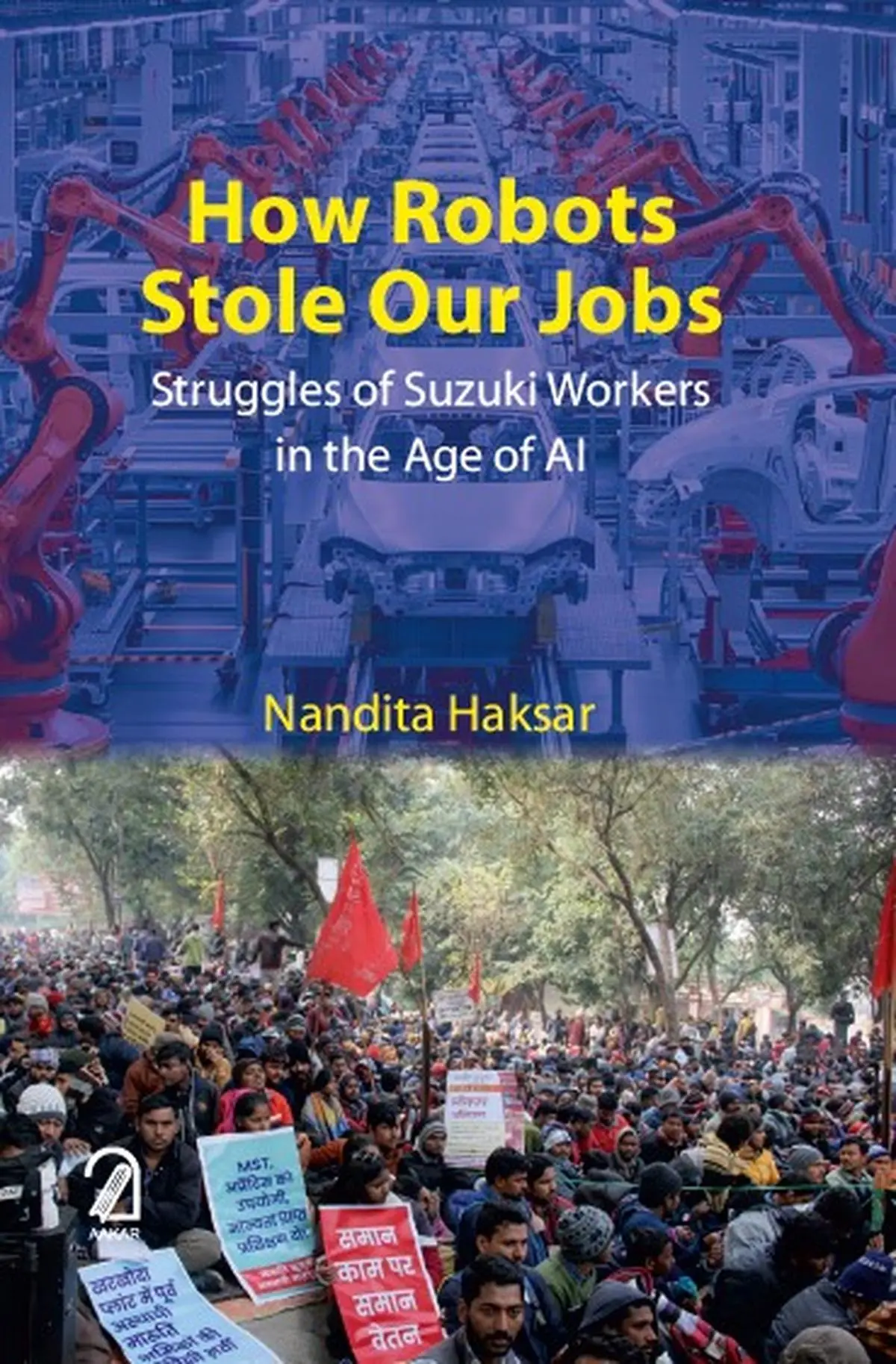
In a chilling and heartbreaking account, Haksar provides a foretaste of what the AI age could become for workers aspiring for permanent jobs without being skilled in modern technology. | Photo Credit: By Special Arrangement
With workers neither reinstated nor monetarily compensated for their arbitrary dismissal, the Sangharsh Committee decided to organise, from September 18, 2024, a dharna outside Maruti’s Manesar plant. As the sit-in extended to several weeks, with the workers cooking and sleeping there, they decided to raise the demands of non-permanent workers at the Manesar plant. These workers were hired as temporary workers and paid salaries far below those of permanent workers even though their work was the same. Maruti Suzuki was, in effect, violating the principle of equal pay for equal work.
A false promise at Kharkhoda
On January 5, 2025, the Sangharsh Committee convened a meeting of non-permanent workers, who turned up in thousands. They narrated their experiences of working at Maruti Suzuki. The story of Jharkhand’s Gautam Pandey was typical: he was hired for seven months and then let go, and the same happened twice again. He decided to apply online for employment at the Kharkhoda plant, which Chautala had portrayed as a beacon of hope for the unemployed.
Pandey found that applicants would only get fixed-term employment. But worse, those who had held temporary tenures at any of the Maruti plants could not apply, nor could those outside the 18–26 age group. Applicants from Himachal Pradesh and Uttarakhand, not Haryana, would be preferred. The labour policy was designed to prevent workers from uniting against the management. Angry, the non-permanent workers constituted themselves into the Maruti Suzuki Asthai Mazdoor Sangh, with the Sangharsh Committee as their adviser.
With worker solidarity growing, the police terminated the dharna outside the Manesar plant on January 31, 2025. The resolve of workers was not dented. They decided to hold a meeting in Sonipat and visit Kharkhoda, keen to understand why a factory as large as Maruti Suzuki’s would offer few permanent jobs, if any.
The meeting was fixed for April 6, 2025. Long before that day, Mahaveer, responsible for coordinating with workers across the country, found his phone had been blocked. His service provider, Jio, told him it had been done on a law-enforcement agency’s instruction. Terror was let loose on April 6: one union member was hung upside down and beaten; others were assaulted. Some were made to do 100 sit-ups and assume the posture of murgha (chicken), which requires a person to crouch on his haunches, pass his arms between the legs, and hold his ears. They were ultimately released after being warned never to enter Kharkhoda again.
Such humiliation, for demanding justice and permanent jobs.
The workers wondered why Maruti Suzuki, a corporate giant, offers only fixed-term employment, now formalised through the four labour codes that the Modi government brought into effect in November 2025. The answer: AI-driven automation.
Haksar backs this conclusion by quoting Rajiv Gandhi—a key member of Maruti Suzuki’s executive committee—from a speech he delivered at a Confederation of Indian Industry summit in November 2024. Gandhi said that to make the Kharkhoda plant productive and cost-effective, it would integrate “advanced technologies such as Industry 4.0, digitisation and artificial intelligence”. He vividly described the use of AI at certain stages of production at Kharkhoda for ensuring “superior quality with reduced human error.”
These are still early days at Kharkhoda, which has yet to begin manufacturing electric vehicles. Since Electric Vehicles do not have an internal combustion engine, they have fewer components to assemble than vehicles run on fossil fuels—the company would therefore need far fewer workers than at present.
The new technology, indeed, underwrites Maruti Suzuki’s labour policy, a point the workers had not fathomed. “But in the course of their struggle,” Haksar writes, “they discovered that the lack of permanent jobs was driven by the adoption of new technologies by profit-seeking corporations.”
The experience of the Maruti Suzuki workers bears out Nobel laureate Geoffrey Hinton, widely regarded as the godfather of AI, who had warned that AI would wipe out millions of jobs. “What’s actually going to happen is rich people are going to use AI to replace workers,” Hinton said. “That’s not AI’s fault, that is the capitalist system.” This is also true of India, where AI is being rolled out without informing workers or upgrading their skills, with the Modi government having legislatively enabled corporates to offer extremely insecure, poorly paid tenures to workers.
Ajaz Ashraf is a senior journalist from Delhi and the author of Bhima Koregaon: Challenging Caste.
Also Read | Dehumanisation, powered by AI
Also Read | The strike and the sermon