







Once again, talks of the merger of the Ajit Pawar and Sharad Pawar factions of the Nationalist Congress Party (NCP) have resurfaced in Maharashtra. This time it is the result of a statement from Sunil Shelke, the Maval (Pune) MLA from the Ajit Pawar faction. Speaking to mediapersons in the last week of March, he said: “If the party is getting bigger under the leadership of Sunetra Pawar, if her leadership is acceptable to all, then the merger of both factions is a matter of joy for us.”
Interestingly, merger talks were reportedly held between both factions a few months ago, but after Ajit Pawar’s sudden death in a plane crash in late January this year, leaders from his faction denied having held any such talks. Now, it is they who have raked up the issue again.
Shelke’s statement is an interesting political move as he has directly placed a condition before the other faction to accept the leadership of Sunetra Pawar, Ajit Pawar’s widow. When Ajit was alive, his wife was only a Rajya Sabha member, but after his death, she quickly became Deputy Chief Minister as well as the national president of NCP (Ajit Pawar).
Frontline was the first to report in detail about the merger talks that had been going on for almost one year when Ajit’s sudden death changed the dynamics.
Family politics
The 2023 split in the NCP is partly attributed to the tussle for power between three members of the Pawar family. Ajit wanted complete control of the party founded by his uncle Sharad Pawar. However, Supriya Sule, Sharad’s daughter, was also a contender for the top post. The third angle of this power triangle was Rohit Pawar, Sharad’s grand-nephew, who became MLA for the first time in 2019. Since then, this ambitious young Pawar has toured the State and tried to establish his brand.
The competition between these three Pawars is held partly responsible for the split, after which Ajit joined the BJP-led government. Nearly three-fourths of the undivided party’s MLAs joined his faction. This was along expected lines because the district satraps, who had always helped maintain Sharad Pawar’s hold on power, aligned with the party that held power.
During the 2024 Lok Sabha election, Sunetra contested against Supriya in Baramati, a family bastion for four decades. Supriya won the election, which shocked Ajit. Also, the Sharad Pawar faction won a total of eight seats, while the Ajit faction could manage only one.
Ajit gains upper hand
However, within four months, Ajit bounced back into the reckoning as the BJP-led Mahayuti alliance returned to power in the State and he was made Deputy Chief Minister and Finance Minister. The Sharad Pawar faction could win only 10 seats in the Assembly election as against the Ajit faction’s 41.
With this, Ajit gained the upper hand in Pawar family politics. Although Ajit Pawar was always seen as a strong and shrewd politician, he was a very emotional person too. He had tremendous respect for Sharad Pawar, who had guided him after Ajit’s father passed away when he was only 18. He was always seen as a natural heir to Sharad Pawar’s political empire. Realisation of this finally dawned on the family and talks of a re-merger started within four months of the Mahayuti returning to power.
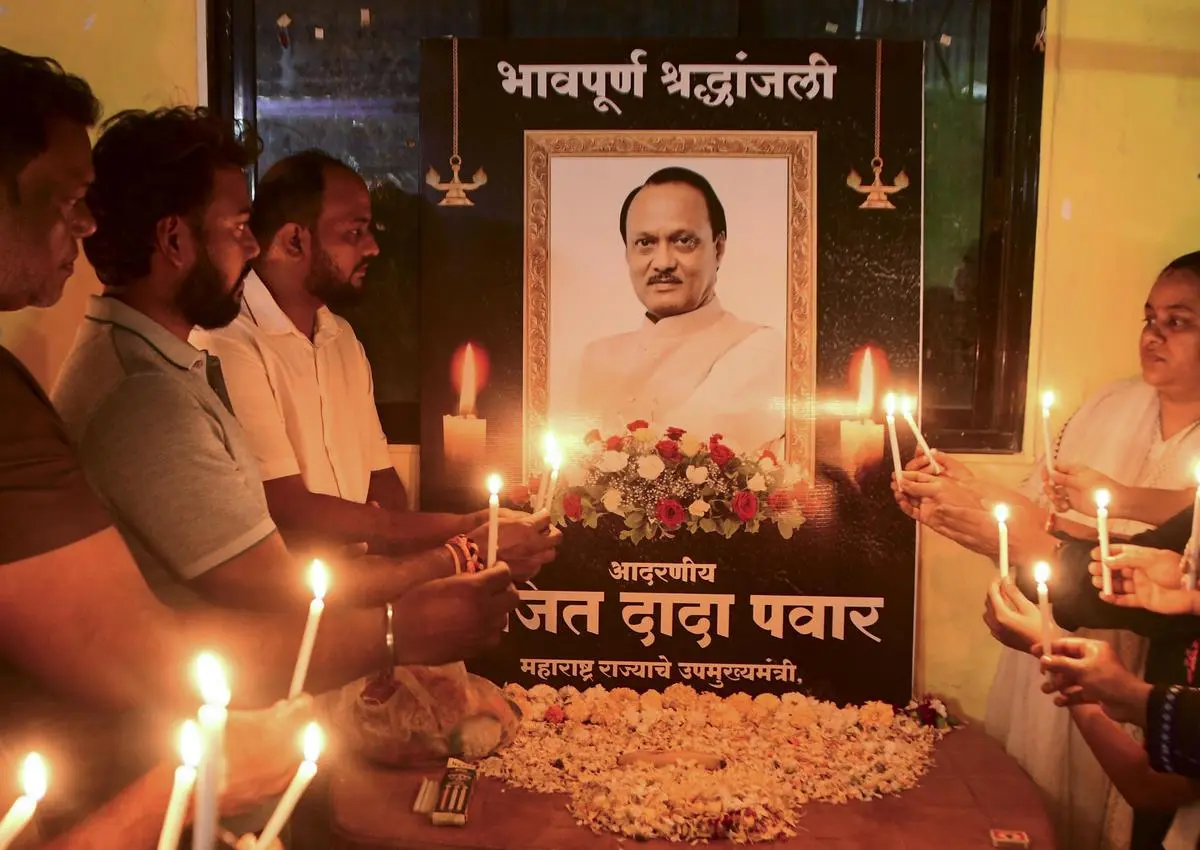
NCP supporters pay tribute to Ajit Pawar, in Mumbai on January 29, 2026. | Photo Credit: PTI
Ajit took the initiative and wanted to complete the merger at the earliest, especially given the deteriorating health of the 85-year-old Sharad Pawar and his mother Ashatai Pawar. Ajit’s leadership was also acceptable to both Supriya and Rohit. Consolidation of power was essential for the Pawar family, and the merger was key to it, especially after the BJP announced it would contest the 2029 Assembly election alone.
Ajit Pawar’s sudden death in a plane crash on January 28 came as a shock to everyone. It was a personal as well as political loss. The Sharad Pawar faction was already contesting the zilla parishad elections in Satara and Pune and in some other districts on Ajit’s symbol. The original plan was to announce the merger immediately after the elections, so with Ajit no more, leaders from the Sharad Pawar faction rushed to give statements about having discussed and finalised merger plans during meetings with Ajit Pawar.
Resentment between factions
Several MLAs from Ajit’s faction resented this, as they saw it as an attempt by the other faction to take control immediately. Most of these MLAs hail from rural areas and their style of politics does not sit well with Supriya; it was Ajit who was their natural leader. Feeling threatened by the possibility of a merger and Supriya taking over the united party, they prevailed upon Sunetra Pawar to move quickly. The swearing-in ceremony was the result.
Sunetra was willing to go along because she understood the delicacy of the situation and she too wanted control of her husband’s party. It has been two months since Ajit Pawar’s death, but Sunetra has yet to say anything about the merger talks.
Ajit Pawar’s sudden death in a chartered plane crash has given rise to several conspiracy theories among the public in Maharashtra. Soon after the incident, Rohit Pawar began raising questions about the company that owned the chartered plane. He also raised questions about the pilot, the aviation authorities, and some key events prior to Ajit’s death. He has succeeded in capturing the public imagination in the past two months, especially because the people want someone to raise questions, and Ajit’s sons Parth and Jay are not pursuing the matter vigorously.
An ambitious third generation
It must be noted that the third generation of the Pawar family is also competing for the spoils of power. Parth is ambitious; he has always wanted to be an MP and contested the Lok Sabha election from Maval constituency in 2019 but lost by a big margin. Rohit contested in the 2019 assembly election, comparably in the a comparably tough seat of Karjat Jamkhed in neighboring Ahilya Nagar district, and won in 2019 defeating a Cabinet Minister. He won again in 2024. Rohit is seen as a young leader who is ready to fight on the streets and take on the mighty BJP publicly.
If the merger had taken place when Ajit was still alive, Rohit would have accepted his leadership. But if a merger happens now, the question of who will lead the party and where Rohit and Parth will figure in a united NCP will remain open. Will the cousins restrain their ambition of becoming independent leaders? Will Rohit accept Parth or vice versa?
Also, in such a case, will Sunil Shelke’s proposal to accept Sunetra Pawar as leader of a united NCP be is acceptable to ambitious young Turks like Rohit Pawar? With the question of leadership likely to become a serious point of contestation between Supriya Sule and Sunetra Pawar on one level and Rohit Pawar and Parth Pawar on another, any merger plans will unlikely be fruitful and desired consolidation of power will still look like a distant goal at this point.
Just as the dynamics within the Pawar family have changed after Ajit Pawar’s death, things have changed in State politics too. Sources informed Frontline that in case the merger had gone through, Sharad Pawar had planned to go to the Rajya Sabha as an independent MP. But when merger talks failed and Sunetra Pawar did not respond to the merger calls from leaders in the Sharad Pawar faction, the Pawar patriarch had no choice but to return to the opposition fold. Supriya Sule met the Congress leadership as well as Uddhav Thackeray to gain their support for Sharad Pawar’s Rajya Sabha bid. With both suspicious whether Supriya’s party would continue to stay with the opposition alliance, her party’s senior leader Jayant Patil had to publicly clarify that there was no chance of a merger after Ajit Pawar’s death. “Our talks were going on with Ajit dada. Now he is not there, so the merger issue is sidelined. We will continue to be part of MVA,” he said.
Not just Jayant Patil, even Supriya herself announced in a press conference in New Delhi, “As Ajit dada is not there, nothing of the merger is left.” It was based on these statements that the alliance partners backed Sharad Pawar for his Rajya Sabha term.
Rumbles in Sunetra camp
Meanwhile, all is not well in the Sunetra Pawar camp either. There are reports of multiple clashes on various issues between her and Praful Patel, the party’s working president, as well as with Sunil Tatkare, the party MP. The latest of these is over the party constitution submitted to the Election Commission of India (ECI).
On December 8, 2025, the ECI had asked the party to submit a copy of its constitution, to which the party sought more time. The ECI sent a reminder on February 12, so the party submitted an amended constitution adopted after breaking away from Sharad Pawar’s NCP. This took place on February 16 and was signed by Praful Patel as national working president.
Sunetra was elected as the party’s national president on February 26. On March 10, she wrote a letter to the ECI with a list of national office bearers, in which Praful is mentioned only as a member and not as national working president.
Sunetra has also asked the ECI to consider all communication dated between January 28 (the date of Ajit Pawar’s death) and March 10 as “null and ignored for all official purposes”. This reportedly shocked both Patel and Tatkare, who met Sunetra Pawar to clarify their position.
As this goes to press, such petty fights within both factions and tussles for leadership and control at various levels continue. If they continue, they will make any NCP merger story unlikely in the near future at least.
Also Read | Was the NCP merger a real plan? How it was built and why it seems stalled
Also Read | The BJP cements its hold in rural Maharashtra