


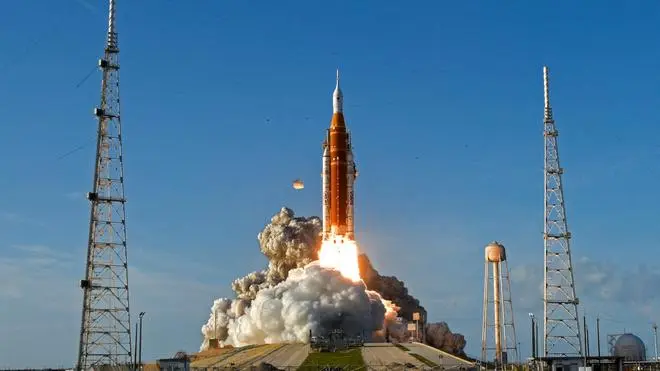
Despite Donald Trump’s best efforts to end the American empire, the deep state (or the deep space state) is still hard at work, what with the successful 10-day Artemis II mission, in which the Orion spacecraft successfully went where Pink Floyd had once promised to meet: the dark side of the Moon. It was NASA’s first successful moon mission since the Apollo series in the 1960s-70s. We saw beautiful photos of the Earth and of the Sun’s corona around the Moon. The Orion managed to re-enter the atmosphere at 40,000 kmph. The Moon was once again operationally in reach, and the mission established American dominance in space, leaving the Chinese and others far behind.
A space race exists, not only for extending humanity’s presence beyond Earth, as Elon Musk, who heads the largest private company SpaceX (with whom NASA undertook the Artemis II mission), likes to say; but also, to dominate the Earth militarily and control the planet’s telecommunications. There is a lot of money to be made in satellite manufacturing and launching. The global space economy is already over USD 600 billion, and Morgan Stanley expects it to reach USD one trillion by the 2040s. Nearly 80 per cent will come from navigation, broadcasting, the internet, as well as from observation of the climate, agriculture, surveillance, etc.
Most exciting will be the journeys to the stars, for which the Moon is the key; both the USA and China-Russia are planning bases on the Moon. Russia’s space programme, which sent the first man in orbit (and before that, the first dog, Laika), has fallen behind. While Americans are focused on the Moon and on Mars, the Russians are reviving their interest in Venus. Reports also suggest, however, that Russia is interested in placing nukes in space: to target enemy satellites, missiles, etc. Some might characterise its programme as disruptive.
The most low-profile programme is that of the China Aerospace Science and Technology Corporation. It developed China’s own GPS, the BeiDou, which was used by Iran during the US-Israeli war to deliver a strategic defeat to a declining superpower. Unlike the USA, where space exploration is market-driven by companies like SpaceX and Blue Origin, China’s is entirely State-sponsored and focused on developing an infrastructure in space. Information is scarce.
China in 2022 placed in orbit its Tiangong space station, a three-module station that is not as large as the 15-nation International Space Station (ISS) but is all its own. (Indian astronaut Shubhanshu Shukla visited the ISS on a SpaceX vehicle for a couple of experiments; the seat cost Rs.550 crore.) The Tiangong is larger than the planned Bharatiya Antariksh Station, which will be two-module and is scheduled to be fully operational by 2035. Tiangong will have a human presence, but China will use robots to build the International Lunar Research Station (ILRS) on the Moon, in collaboration with Russia. China is slow and steady but making great strides.
America’s next step in their conquest of the Moon is Artemis II next year, though they won’t yet land; their aim is to master two difficult maneuvers—the rendezvous and docking, with lunar landers (by SpaceX and Blue Origin); and the hardest problem that NASA faces, orbital refueling. This requires several starships to launch, and to transfer fuel so that one fully fueled vehicle can proceed to the Moon. NASA estimates that at least 10 launches will be required per mission.
Beyond this, Artemis IV in 2028 will aim at putting a human crew on the Moon. Base-building will happen in the 2030s, as will preparations for Mars Missions.
China also plans to land crews by 2030, and robots will construct the ILRS from 2028 to 2035. Russia will set up a nuclear power station for the ILRS. Like the USA, China will use water from the Moon’s south pole—which was discovered by the ISRO. Even if NASA is the first to reach the Moon in this race, China will likely be the first to establish a Moon base. China has developed 20-year plans for its programme and will prepare for Mars in the 2030s.
India’s space lag
India, though one of only four nations to send a vehicle to the Moon, is far behind the other three. ISRO has developed a cost-efficient space programme and has carved out a tiny part of the global space economy. India simply has far fewer resources. Our goals include a human space flight, Gaganyaan, sometime next year (or, if we’re lucky, later this year). The mission will last a few days.
India aspires to a Moon landing by 2040. Given China’s likely early establishment of a lunar base, and given our bilateral distrust, who knows how things will be turn out by 2040. India must have a successful Gaganyaan mission and crucially, India must develop a more powerful heavy lift rocket than what ISRO currently uses. India will also need international partnerships, like our partnership with Japan’s JAXA on a Lunar Polar Exploration (LUPEX) mission, hopefully next year. We will be looking for ice on the lunar south pole, again, this time with a larger rover than Chandrayaan in 2023.
One wishes India would speed things up. To this end, this columnist has even previously suggested that India should appoint a space scientist as its National Security Adviser (NSA). No one will likely take this suggestion seriously, only because this is a prized bureaucratic post coveted by both diplomats and spies.
Who knows why it should be so. Our Foreign Minister and spy chiefs should be enough to handle their work. Our current NSA is Pakistan-obsessed and obsessed with Akhand Bharat; hence, India is missing the big picture. Though Iran showed the world how to beat a superpower, the idea of dominating the seas remains the paradigm of being a global power. In the future, space dominance will be what naval dominance used to be. Our resources and our security need a re-orientation for the future; not a re-litigation of the past.
Aditya Sinha is a writer living on the outskirts of Delhi.
Also Read | Ajit Doval: Will he? Won’t he?
Also Read | Trump indicts the American century