







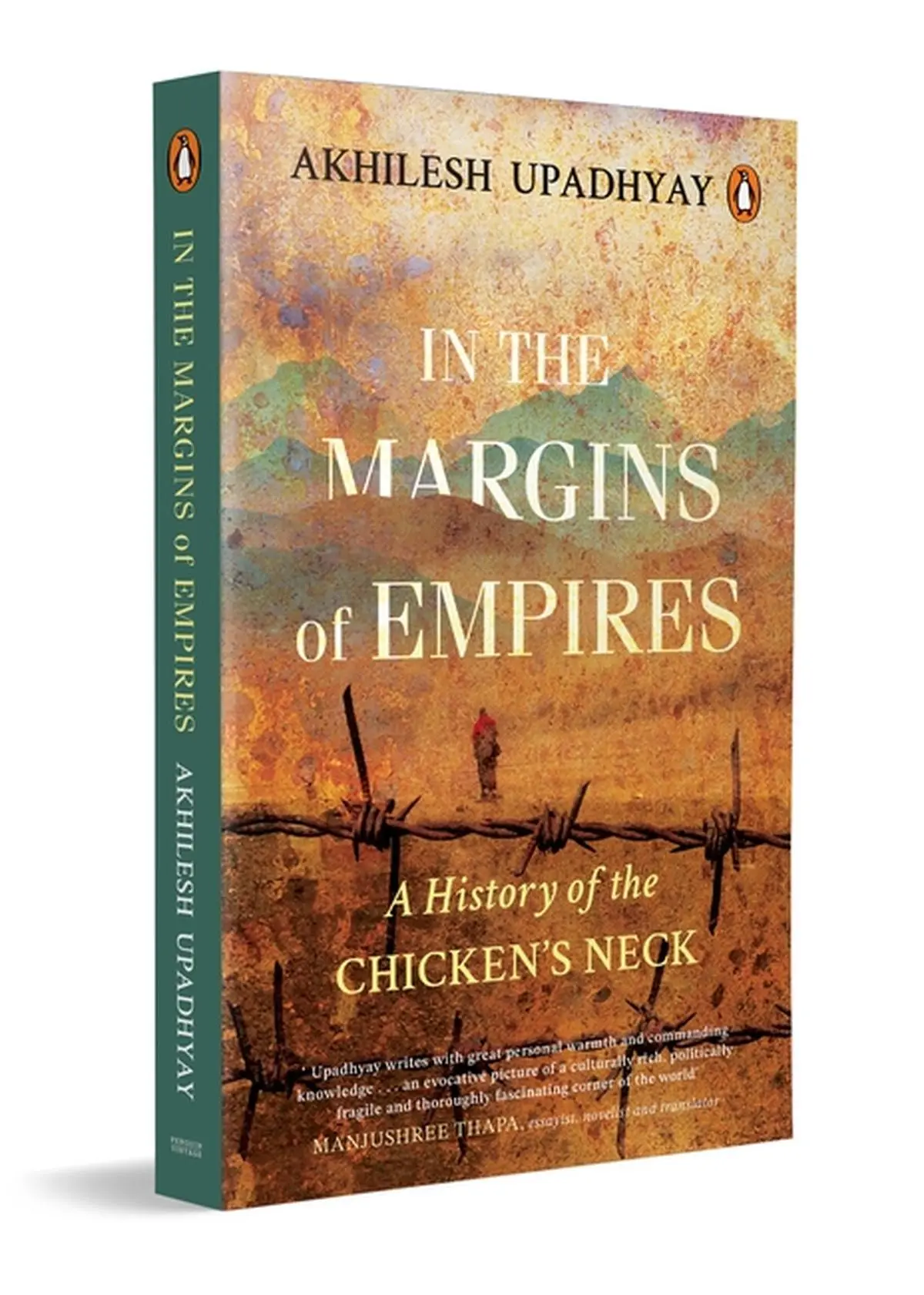
In South Asian political discourse, the Himalayan borderlands exist either as thin red lines on maps or as fragile strategic spaces subjected to constant state surveillance. Small nation states in the region are routinely subsumed within narratives of great-power competition, with their distinct histories flattened into footnotes of the India-China rivalry. Akhilesh Upadhyay, veteran journalist and former editor of The Kathmandu Post, sets out to challenge this dominant analytical lens by reorienting attention to the Eastern Himalayan borderlands of Nepal, Bhutan, Sikkim, Tibet, and North Bengal in his book In the Margins of Empires: A History of the Chicken’s Neck.
He asserts that these regions embody histories and lived experiences irreducible to strategic abstractions. At a time when the Himalaya is witnessing heightened securitisation through militarisation, infrastructure expansion, and pervasive surveillance, Upadhyay urges readers to look beyond familiar statist tropes. He contends that imperial and postcolonial gazes frame the prevailing accounts of the region, portraying the Himalaya either as an exotic frontier or a constant site of military concern. The book’s strength lies in unsettling this gaze by assembling layered histories of cross-border movements, kinship, trade, cultural exchanges, demographic shifts, and resistance.
Throughout the book, Upadhyay eschews chronological narration and instead curates a series of vignettes that traverse time and space, capturing the fluidity that historically characterised the Himalayan borderlands. This deliberate non-linear structure reinforces a central claim of the book by showing that the rigid fixity imposed by modern nation states contrasts sharply with centuries of mobility across the Himalaya. Upadhyay’s journalistic background, grounded in decades of on-the-ground reporting, lends ethnographic depth to his examination of contrasting realities viewed from central (state) and peripheral (borderlands) vantage points.
These strengths are evident in the chapter titled “A Paradox Called Siliguri”, where Upadhyay situates the Siliguri Corridor not merely as India’s strategic “choke point” but as a historically palimpsestic region, shaped by Partition, the Chinese occupation of Tibet, Sikkim’s integration into India, and the Doklam standoff. Bhutan’s concerns over the Chumbi Valley, Nepal’s strategic balancing, and Tibetan resistance are woven into a richly textured Himalayan context.
The analysis illustrates that strategic anxieties emerge from overlapping histories rather than geography alone. Building on this argument and drawing from the empirical backdrop of Nepal, Sikkim, and Bhutan, Upadhyay reminds readers that the Eastern Himalayan region has “intricate histories and rivalries of its own” unfolding in the shadow of Sino-Indian competition. His nuanced attention to ethnic and political complexities across this Himalayan triad adds depth to the narrative, even as it gestures towards tensions that the book does not always fully resolve.
In the Margins of Empires
A History of the Chicken’s Neck
By Akhilesh Upadhyay
Pages: 328
Price: Rs.499
It is in the chapter titled “Yak Trails and Trade Tales” that the book achieves its stated ambition to make the borderland the focal point of discourse on the Himalaya. By centring on the village of Olangchung Gola in eastern Nepal, Upadhyay shows how external political transformations following Gorkha territorial expansion, British imperial interventions, the Chinese annexation of Tibet, and border closures reconfigured the Himalayan highlands. Once a vibrant trading hub linking Tibet, Nepal, Sikkim, and beyond, Olangchung Gola now grapples with issues of out-migration and economic decline, a pattern mirrored across the Himalayan borderlands.
The chapter also demonstrates how sovereignty operates through law, exclusion, and administrative neglect. The abolition of the kipat system (characterised by collective ownership of land), the social and economic subjugation of highland communities in Nepal, and the displacement of the Lhasa Newars in the aftermath of the Chinese occupation of Tibet signify how distant power centres actively reshape frontier lives. Here, borderlands are neither romanticised nor reduced to strategic abstractions. Instead, they emerge as social worlds where the reproduction of territorial sovereignty fundamentally impacts livelihoods, cultural identity, and collective memory.
The subsequent chapters broaden the geographical lens, though with diminishing critical returns. “Missionaries, Monks, Traders, and Spies” traces Kalimpong’s rise as a hub of trade and intelligence and its decline after the 1962 Sino-Indian War. This chapter recounts in considerable detail Tibetan resistance movements, Cold War geopolitics, CIA involvement, and Nepal’s role in ending the Mustang Resistance Force. While historically significant, the discussion suffers from repetition and structural looseness, particularly in its retelling of the post-1950 history of Tibet. Much of this terrain has been extensively covered in existing scholarship, and this chapter primarily summarises the literature without offering sustained new interpretations. The ethnographic sensibility that animated the earlier chapters recedes here and is replaced by a dense but familiar historical narrative.
The chapter titled “Between the Thrones” compares the trajectories of Sikkim and Bhutan, foregrounding identity politics, migration, and the enduring influence of Tibet. Upadhyay navigates the complex histories of Nepali eastward migration, the shifting ethnic power dynamics in Sikkim, and the expulsion of Lhotshampas from Bhutan with commendable clarity. This chapter traces how colonial legacies, demographic transformations, and regional geopolitics produced divergent political outcomes. The discussion of Doklam and Bhutan’s constrained negotiations with China underscores how small-state insecurities persist despite formal sovereignty.
However, a deeper interpretive engagement would have strengthened the analysis. While the centre and periphery are presented as mutually constitutive, the structural asymmetry between them, stemming from state sovereignty and its monopoly over violence, receives limited analytical scrutiny in the book. Borderlands may shape events, but they do so under conditions not of their own choosing. This asymmetry becomes visible in moments of crisis, as evident, for instance, in how sovereign states have historically responded to political resistance and dissent in these regions.
The epilogue shifts decisively to the present, where Upadhyay argues that Himalayan states now pursue strategic hedging rather than Cold War–style non-alignment, seeking aid and development assistance from India, China, and the US. He also underscores the limits of this strategy, which offers no durable security in the face of unresolved border disputes. The enduring Tibet question, including the uncertainties surrounding the succession of the 14th Dalai Lama, continues to shape regional political discourse. Climate change, out-migration, and the deepening securitisation of the Himalaya further complicate the region’s future. The epilogue is most effective when it resists prediction and instead foregrounds uncertainty as a constitutive condition of contemporary Himalayan politics.
The long shadow of geopolitical history
The analytical core of the book challenges state-centric discourse without dismissing the realities of national security. Its limitation, however, is that even as it critiques centre-driven narratives, geopolitics repeatedly recentres itself, often limiting deeper engagement with borderland subjectivities. Geopolitical history tends to overshadow sustained attention to borderland communities themselves, the “peripheries within peripheries” that the book initially promised to centre.
The communities negotiating the precarities of these spaces appear primarily as objects conditioned by geopolitical forces rather than as actors actively entangled within them. While Upadhyay acknowledges that nomads, traders, and monks have shaped Himalayan history for centuries, they largely come across as illustrative figures. The analysis documents complexity but does not fully explore how people living on the margins actively negotiate, resist, or internalise the strategic logics imposed upon them.
Despite these shortcomings, In the Margins of Empires is a valuable contribution to Himalayan and South Asian studies. The book succeeds in fostering critical conversations on the Eastern Himalaya, offering a foundation for future scholarship to move beyond strategic abstractions and engage with the political lives of those who inhabit the region’s fractured edges.
Gokul K.S. is an international relations scholar whose work engages with visual politics, Tibetan exile, and South Asian politics.
Also Read | The Brahmaputra river is older than the Himalayas: Sanjoy Hazarika
Also Read | Dammed in the Himalayas