


For nearly four decades, several political aspirants have stepped forward to project themselves as a credible alternative to the deeply entrenched Dravidian duopoly in Tamil Nadu. Yet, when a self-styled agent of change finally emerged—seeking a mandate on the amorphous promise of maatram (change)—the verdict stopped agonisingly short of a decisive majority. This shortfall and the negotiations under way to fill it are the point at which this piece goes to press.
A whimsical electorate that has been swayed more by mood than by the mechanics of how the promised change will be implemented has produced a result in the State that is as curious as it is consequential. Riding a palpable groundswell of fan frenzy, the film star C. Joseph Vijay and his fledgling party, the Tamilaga Vettri Kazhagam (TVK), scripted a stunning debut, securing 108 seats in the 234-member Assembly. Vijay himself won both the seats he contested, but his party fell just 11 seats short of the simple majority needed to form government.
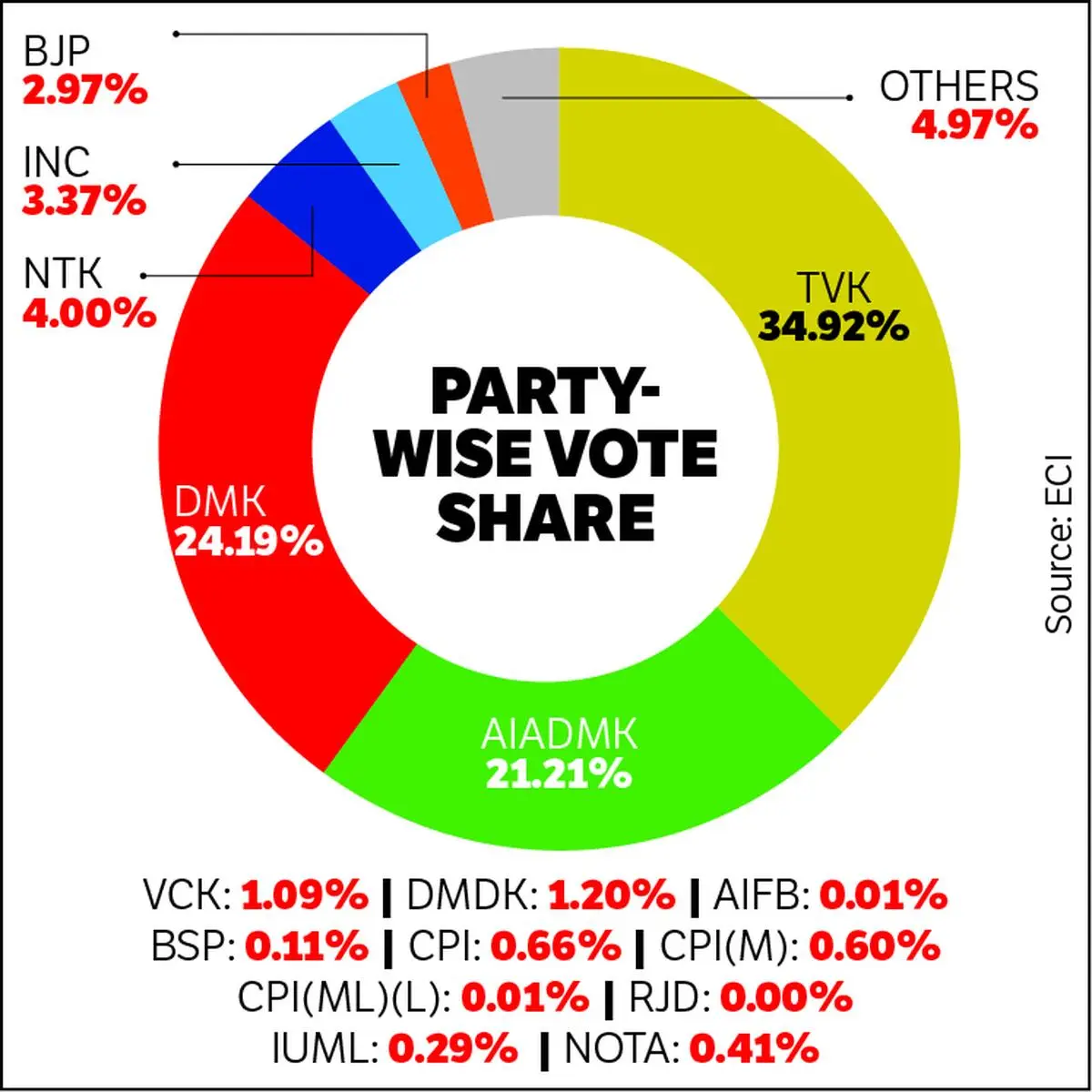
Vijay scripted a magical story, securing a staggering 1.72 crore votes, or 34.92 per cent of the votes, far ahead of the second-placed Dravida Munnetra Kazahagam’s (DMK) 1.19 crore votes. In doing so, he eclipsed the once-iconic feat of M.G. Ramachandran (MGR), the matinee idol and founder of the All India Anna Dravida Munnetra Kazhagam (then ADMK), who had similarly stormed to power in 1977, his alliance ousting the DMK by winning 144 seats and garnering a 33.52 per cent vote share.
That Vijay’s remarkable victory was not an absolute one underscores a lingering hesitation among a substantial segment of the electorate that remains unconvinced of his political depth and administrative readiness. But the large segment that did vote for him does not appear to have had such fears. “Just like that, let’s have change,” said a water-can supplier in Chennai who voted for Vijay, capturing the impulsive undercurrent behind the surge.
This sentiment of asking for change “just like that” was a familiar strain, especially among the Instagram-influenced Generation Z and Gen X voters. That said, Vijay’s appeal appears to have cut across conventional social boundaries, capturing a broad spectrum of voters across caste, class, religion, gender, and regional loyalties.
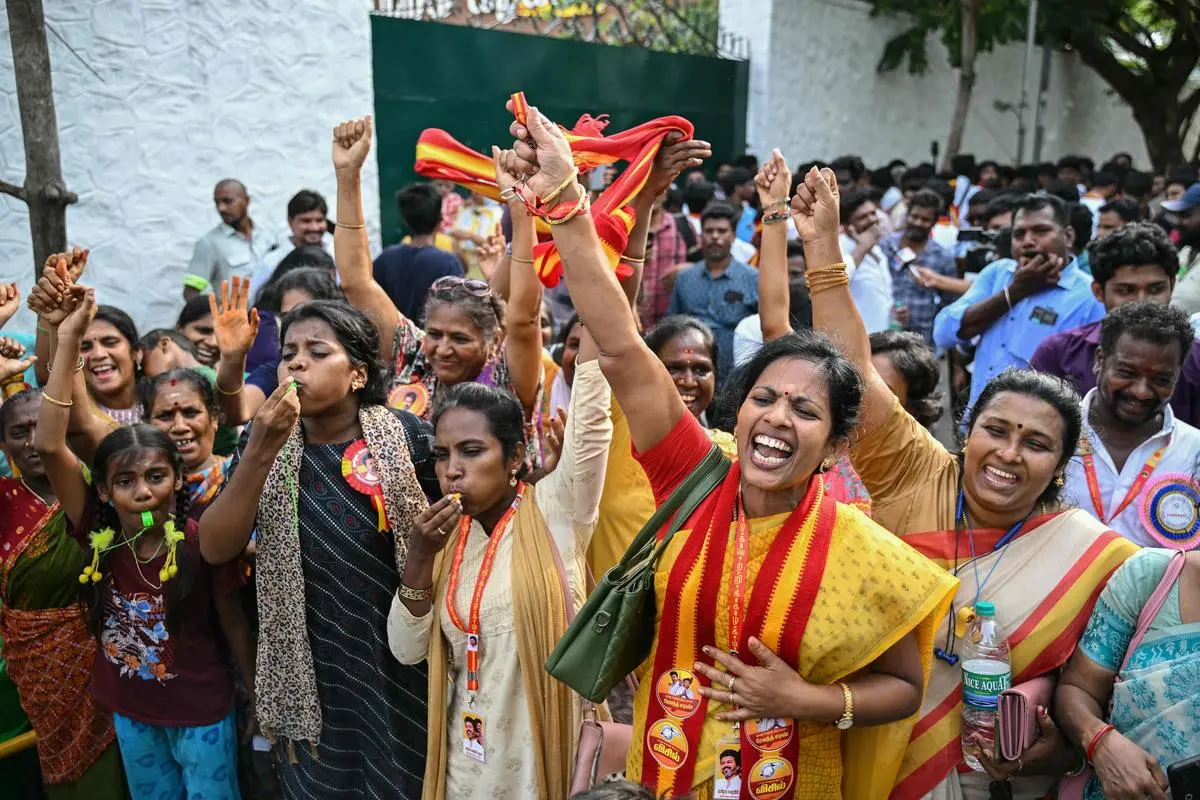
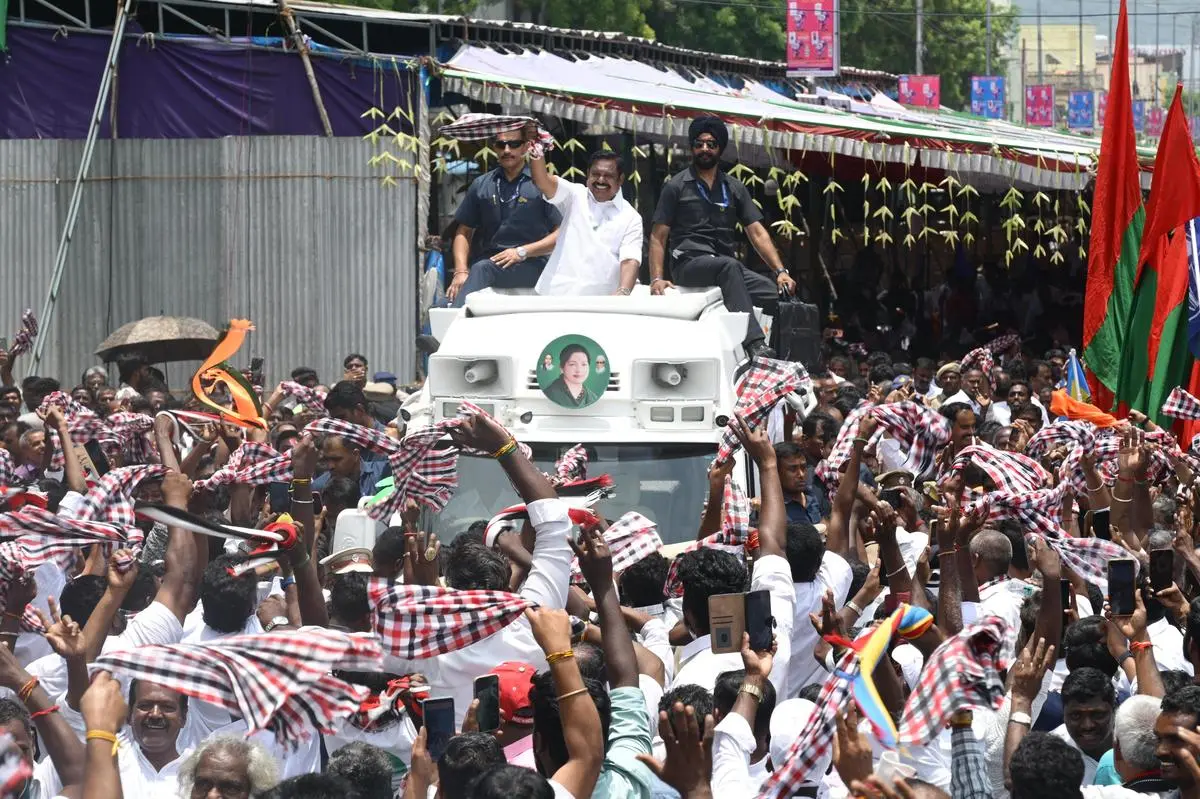
TVK supporters celebrate after the party began leading in the Tamil Nadu Legislative Assembly election, in Chennai, on May 4. | Photo Credit: R. SATISH BABU/AFP
Vijay’s style of “parachute politics” took the wind out of the sails of both the DMK and the AIADMK, who have dominated the political landscape for nearly half a century. The DMK-led alliance, finishing with 73 seats, now finds itself on the opposition benches while the AIADMK, reduced to 47 seats, has forfeited the opposition space. Although both parties saw a significant erosion of their traditional vote banks, with the DMK getting routed in Chennai, the slide was more pronounced for the AIADMK, which managed to retain its traditional vote base to a certain extent only in the western districts. In Chennai, the TVK swept 14 of the 16 seats, breaching what has long been considered the DMK’s formidable urban bastion.
Vijay the giant-killer
The “Vijay factor” swept away a formidable line-up of seasoned politicians across the two major alliances. Among the big names to be toppled were DMK president and outgoing Chief Minister M.K. Stalin and several of his Cabinet Ministers, including P.T.R. Palanivel Thiagarajan, Ma. Subramaniam, Anbil Mahesh, and T.R.B. Rajaa.
Tamil Nadu Congress Committee president K. Selvaperunthagai also lost, as did BJP State president Nainar Nagendran, former Governor Tamilisai Soundararajan, and Union Minister L. Murugan. Naam Thamizhar Katchi (NTK) leader S. Seeman also faced a drubbing in his home district of Karaikudi.
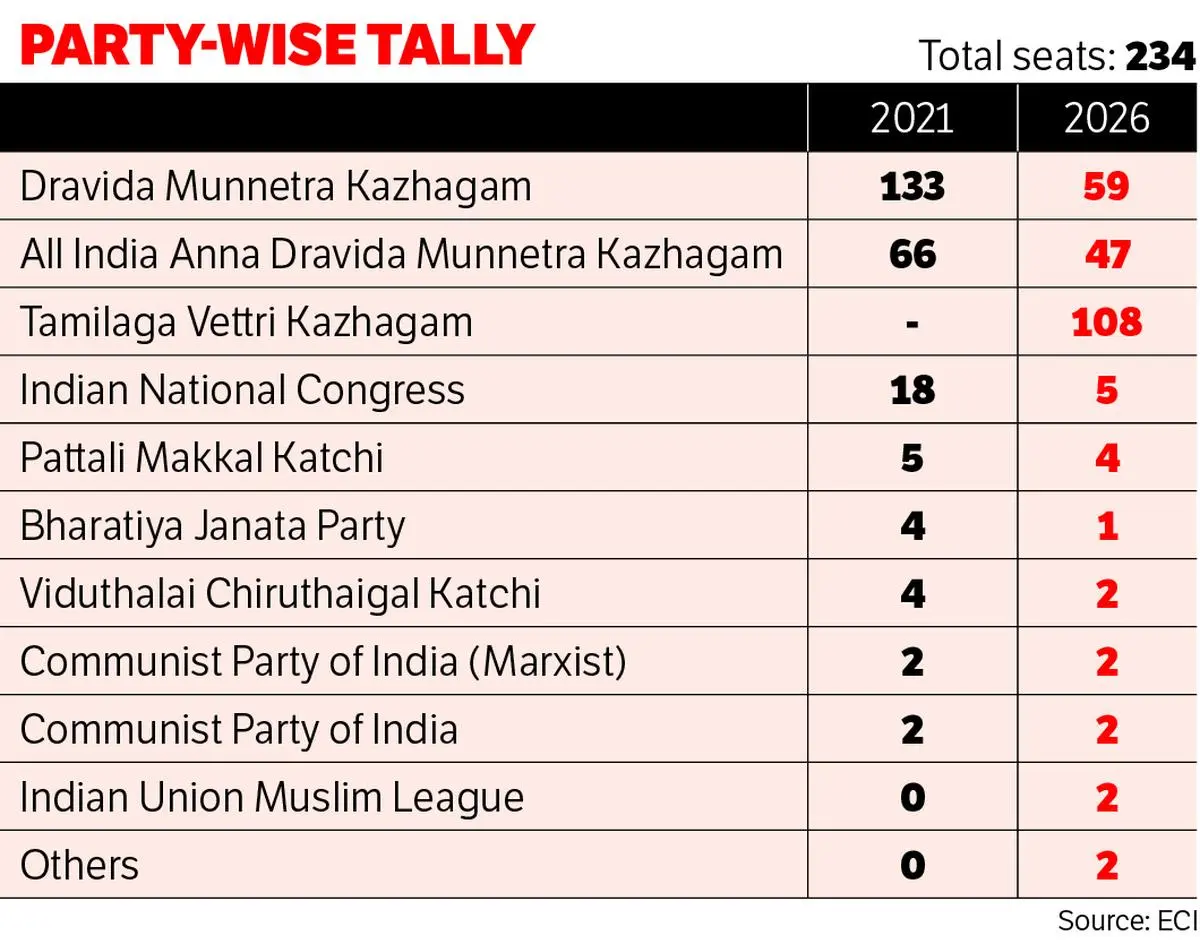
Interestingly, all these established figures were defeated by relatively unknown and politically untested TVK candidates; the mandate was for Vijay and the party’s whistle symbol and not for anybody else. The TVK secured 32 seats in cities and 29 in municipal towns, underscoring its strong urban traction. The surge was most dramatic in Chennai, where the only survivors from the opposition were P.K. Sekar Babu in the Harbour seat and Udhayanidhi Stalin in Chepauk.
Stalin’s defeat in Chennai’s Kolathur seat at the hands of the TVK’s V.S. Babu, a former DMK functionary, marks a significant moment. He joins P.S. Kumarasamy Raja, M. Bhaktavatsalam, and Jayalalithaa in the list of sitting Chief Ministers who have lost an election.
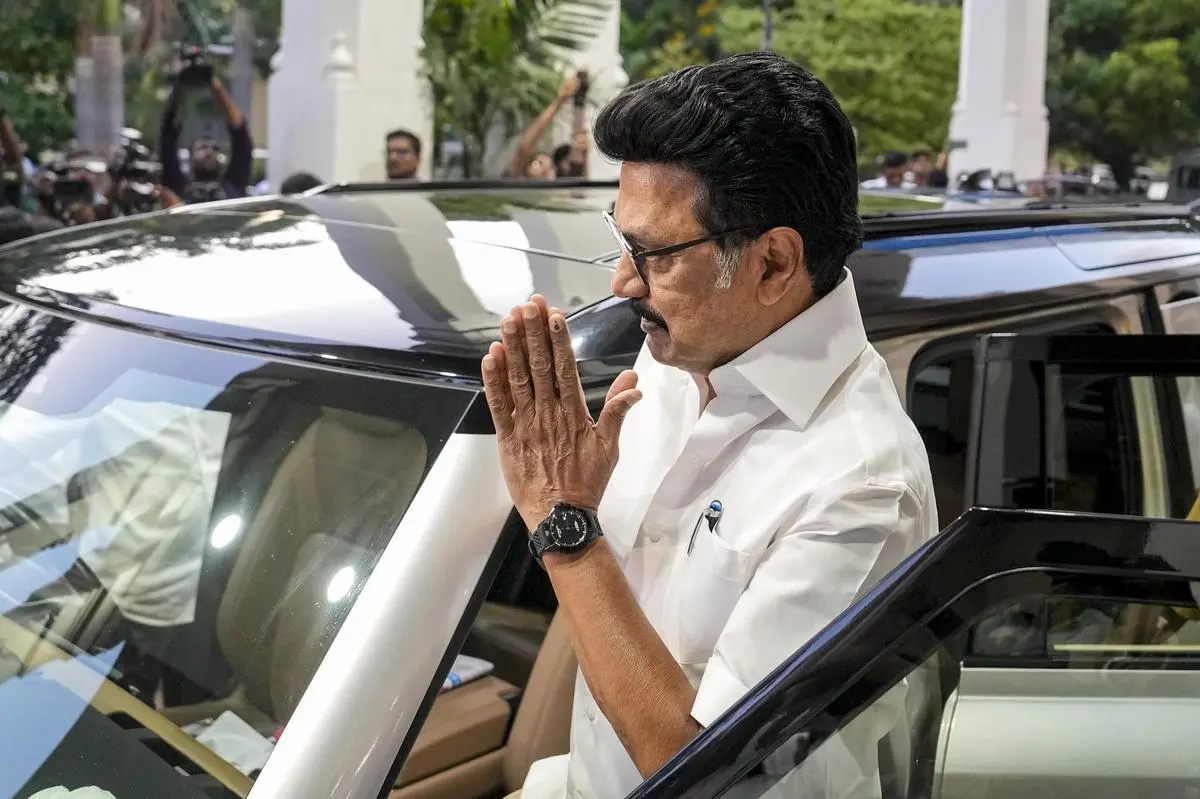
DMK leader and outgoing Chief Minister M.K. Stalin after attending a meeting of the party’s newly elected MLAs, at the party headquarters in Chennai on May 7. | Photo Credit: R. SENTHILKUMAR/PTI
While the broader picture shows a straightforward rejection of both the DMK and the AIADMK, with the vote shares of the parties dropping sharply by 13.5 percentage points and 12 percentage points, respectively, the AIADMK’s decline in vote share to 21.21 per cent and relegation to third position in most constituencies is bound to be a cause for concern.
DMK holds on to core base
The DMK garnered 24.19 per cent of the votes, which indicates that its core ideological and social base remains with it; it lost the support of the floating voters and the ideology-neutral voter base. The AIADMK, however, lost much more of its traditional vote base.
This multidirectional fragmentation of votes proved effective for the TVK, which could gain from the anti-incumbency sentiment and corner the generic anti-DMK vote even while roping in a significant chunk of first-time, women, and youth voters.
The party also benefited from a high-pitched campaign launched by the BJP, the AIADMK, and the Pattali Makkal Katchi (PMK) that accused the DMK government of not curbing violence against women and drug abuse. Equally, Vijay also reaped the anti-BJP vote; his candidates defeated a host of BJP leaders, and the saffron party managed to win only one seat, namely Udhagamandalam.
How did Vijay achieve a political coup that movie stars before him failed to execute? How did he transition so quickly from a silver screen hero to a mass political leader? The answer lies in the era in which he entered politics: the era of social media. He was able to successfully sell a dream of “change” through a sustained campaign on Instagram, X, YouTube, and WhatsApp, which captured the imagination of young people. He also made it possible for supporters to register online for party membership, and they all became his loyal consumers.
The social media onslaught projected a carefully choreographed image of Vijay and a simple narrative that positioned the DMK as his principal political adversary and the BJP as his ideological foe. The strategy was amplified online, with party workers and fans promoting the narrative through a sustained digital campaign.
Digital frenzy
The veritable digital frenzy that followed was driven primarily by Vijay’s personality cult. Memes and reels, short videos, and messages turned the campaign into an all-pervasive online presence, blurring the line between fandom and political mobilisation. The digital drive did not merely complement his campaign; it was its central engine.
By displacing the traditional rivalry between the DMK and the AIADMK and replacing it with a new DMK versus TVK binary, the new party was able to push the AIADMK to third place and to the margins of the electoral discourse. At the same time, the intensity of the reconfigured contest cut into the DMK’s margins in closely fought constituencies.
The DMK rejected the narrative and kept emphasising that the real conflict was between it and the AIADMK. Stalin took it a step further by framing the election as a battle between New Delhi and Tamil Nadu. He referred to the BJP as “New Delhi bosses” to underline the party’s alleged hold over the AIADMK and emphasised the Centre’s alleged anti-Tamil bias.
However, it was Vijay’s narrative that struck a chord with the masses. Interestingly, Vijay was continuously harsh on the DMK but silent on the BJP except for an enigmatic one-liner about the saffron party being his ideological competitor. In fact, it was only in his last public meeting in Chennai that he openly criticised the BJP, and this came across as an attempt to cover all bases, since projecting his secular credentials was important as Tamil voters have been historically and culturally averse to Hindutva majoritarianism.
Unorthodox campaign
Vijay’s campaign was hybrid, unconventional, and even erratic, and largely concentrated in select urban centres. Although he claimed that the State government was hampering his in-person rallies, he seemed to have drawn a lesson from the Karur stampede and minimised his physical presence, not visiting nearly 90 per cent of the constituencies and, on occasion, withdrawing midway from scheduled engagements.
Instead, he relied on his larger-than-life star image and digital presence, even using holograms. This was in sharp contrast with the traditional grind of campaigning, where leaders meet voters, endure the scorching heat, travel over long and relentless campaign stretches, and address large public meetings.
Not just his victory, Vijay’s campaign also broke new ground in Tamil Nadu’s politics. He showed that a party can be propelled by image, narrative, and digital mobilisation alone, rather than depend on a sprawling organisational machinery or rigid ideological scaffolding.
Vijay’s virtual outreach marks a shift away from exhaustive ground operations and alliance arithmetic, but this might have been possible only because of his star persona. The online-led campaign also worked because his core demographic was first-time voters aged 18 and young adults up to 30, around 1.16 crore in number and who account for nearly one-fifth of the 5.67-crore-strong electorate. They formed the backbone of his political surge.
For many first-time voters, the digital feeds were immersive and hyperreal, blurring the line between fact and fabrication, which introduced a disquieting dynamic. For instance, there was even a fake news magazine cover predicting a Vijay victory that went viral in a way that the unmasking of the fraud could not. Prof. Ramu Manivannan, a sociopolitical analyst, said: “This sort of campaigning conditions the collective psyche of a society that gets confused between reality and fantasy.”
The remote campaign method made it unnecessary for leaders to even meet the people; across Tamil Nadu, very few voters knew who represented the TVK in their constituency. Programmes and policies also ceased to matter: the vote was for Vijay and him only. While digital campaigning is very much the future of politics, and old-school parties will have to catch up with the TVK campaigners, the other aspects of digitalisation could be damaging to democracy.
Another disturbing element of Vijay’s campaign was his strategic appeal to children, asking them to coax, wheedle, and throw tantrums to force their families to vote for him. This was in contravention of the strict Election Commission of India rules that forbid the use of children in any way whatsoever in election campaigns.
The Vijay cult might resemble that of MGR’s, but it is ideology-neutral and politics-neutral in a way MGR’s was not. So, Tamil Nadu’s 60-year-old ideology-driven politics has been rewired.
Third force emerges
This election also marks the first time that a third force of significance has emerged to upset both the established players. In 1967, the DMK came to power defeating the Congress, which it repeated in 1971. Then, after four decades of DMK-AIADMK rivalry, the movie star Vijayakanth and his Desiya Murpokku Dravida Kazhagam (DMDK) came up as a challenger in 2011, snatching the No.2 spot from the DMK by winning 29 seats. In 2016, the DMDK-led Makkal Nala Kootani combine, with the two Left parties and the Viduthalai Chiruthaigal Katchi (VCK), made a strong pitch but could not win a single seat. In 2011 and 2016, the AIADMK was victorious.
It is easy to see the appeal of Vijay among today’s youth who seek a change from the two Dravidian majors. And that has been reflected in the colossal mandate for the TVK.
In 2021, the DMK-led alliance rode a strong wave of anti-incumbency against the AIADMK’s decade-long rule to win 159 seats and a commanding 45.4 per cent of the vote share. The AIADMK-BJP combine won 75 seats and 39.7 per cent of the vote to form the opposition. Seeman’s NTK remained a distant third, polling around 7 per cent but failing to open its account.
The DMK swept the 2019 Parliament election too, winning 38 of 39 seats, and followed it up by winning all 39 seats in 2024, as well as the lone seat in Puducherry. Emboldened by these back-to-back victories, the DMK hoped to get a second consecutive term this year. The party’s tenure was marked by stability, strong economic growth, infrastructure development, and welfare. Strategically, it included the DMDK in its alliance to capture the support of the roughly 8 per cent of Telugu-speaking voters. But that failed; of the 10 seats the DMDK contested, only its leader, Premalatha Vijayakanth, won from Vriddhachalam.
Ironically, the DMK’s vulnerability emerged during the prolonged seat-sharing talks. The Congress demanded a share in power, which the DMK rejected. Then, it negotiated for more seats and was finally given 28 (it won 5). The VCK’s demand for more seats became embarrassing. VCK chief Thol. Thirumavalavan, the MP from Chidambaram, announced his candidacy from Kattumannarkoil constituency, speaking of a need to be present in State politics. The DMK thwarted this attempt. Coming on top of its continued refusal to give the VCK a share in power, this possibly hurt its clout among Dalit voters.
Already, there was growing disenchantment among Dalits, particularly the Parayars, a Scheduled Caste, against the government’s lack of action after a series of caste atrocities. In Vengaivayal village, human waste was mixed in an overhead tank supplying drinking water to a Dalit habitation. In Nanguneri, Dalit students were brutally attacked. The government was also reluctant to enact a dedicated law against honour killings. All these became stark symbols of its failure to address Dalit issues. In the northern districts, the Parayars are a dominant vote bank and form the VCK’s base. The DMK-VCK alliance, forged on mutual trust and shared ideology, had faltered at a critical juncture.
The 64 seats the DMK alliance won in 2021 in the northern region fell to 15. The TVK bagged 19, suggesting a clear shift of the Parayar vote. In Madurai East, an entire Parayar-dominated village voted for the TVK. The VCK won only two of the eight seats it contested this time, with Thirumavalavan expressing displeasure about his cadre’s failure to cooperate in some constituencies.
AIADMK leader Edappadi K. Palaniswami concluding his election campaign in Salem on April 21, 2026. The results have come as a huge setback for the party, which was already out of power for five years. | Photo Credit: E. LAKSHMI NARAYANAN
Also, despite a majority of Christian and Muslims in the south and central delta regions backing the DMK, a modest segment shifted to the TVK, which explains the defeat of DMK Minister Palanivel Thiagarajan in Madurai Central, which has a large Muslim population.
AIADMK’s woes
For the AIADMK, it was a question of entering the fray already weighed down by its alliance with the BJP. It could offer no convincing political rationale for renewing this partnership, particularly after it had decided to part ways with the BJP in the 2024 parliamentary election. It proved to be a costly mistake.
In effect, the BJP became for the AIADMK what the Congress has long been for the DMK: an electoral liability.
The AIADMK, however, regained a chunk of the votes it had lost in the northern districts, thanks to its ally, the PMK. The Vanniyar community, which dominates the north, forms the PMK’s vote base. The alliance won 18 seats, with the PMK winning 4, one of which was Dharmapuri, where Sowmiya Anbumani, the wife of PMK president Anbumani Ramadoss, won.
But the alliance suffered a setback in the south and central districts. V.K. Sasikala, Jayalalithaa’s aide, who belongs to the dominant Kallar caste, cut into the votes of the AIADMK ally, the AMMK, led by T.T.V. Dhinakaran.
The AMMK managed only a single seat while the AIADMK lost its deposit in 15 segments.
he western districts, a traditional AIADMK stronghold, offered relatively better support. Here the alliance won 18 seats against its 2021 tally of 44.
Compounding the AIADMK’s woes was the challenge posed by former leaders O. Panneerselvam, K. Vaidyalingam, and Manoj Pandian, all of whom joined the DMK and won.
It is rare for a political party to get over 35 per cent of the votes in a debut election. MGR got a 30.4 per cent vote share in his maiden outing. The only aspirant to get 46 per cent of the votes and 201 seats at launch was another matinee idol, N.T. Rama Rao, in 1983 in undivided Andhra Pradesh.
Vijay is neither NTR nor MGR, but he has taken two formidable Dravidian parties to the cleaners. His victory indicates a generational shift in terms of voter preferences and a shift in the political landscape of an ideologically rooted State. The expectations are high, and both supporters and rivals alike are keenly watching to see if he can deliver stable governance and continue to guide Tamil Nadu on its strong development trajectory.
Also Read | A phenomenon called Vijay
Also Read | DMK versus TVK: Coming to cinemas near you