






The Supreme Court’s judgment on the bail pleas of seven Muslims accused in the so-called “larger conspiracy” case arising from the 2020 Delhi riots amounts to a textbook travesty of justice—an order that dresses up prejudice as principle and calls it “constitutional discipline”.
Between 23 and 26 February 2020, riots tore through parts of North East Delhi after tensions escalated between pro-Citizenship Amendment Act (CAA) groups and those opposing it. Fifty-three people died, two-thirds of them Muslim.
Yet instead of pursuing those whose incitement was visible, documented, and televised—like BJP leader Kapil Mishra—the Delhi Police constructed an alternative narrative: the “larger conspiracy” case. The story became not that violence was provoked and enabled in real time, but that it was engineered in advance by a small group of students, activists, and local political organisers. The police criminalised the anti-CAA movement, an effort to chill dissent.
The alleged conspirators were slapped with charges under the Unlawful Activities (Prevention) Act (UAPA), a statute designed to fight terrorism that makes bail nearly impossible. Among those accused were former JNU student leader Umar Khalid and activist Gulfisha Fatima. Many of them have spent between four and five-and-a-half years in prison without trial.
Their bail pleas languished, most notably in the Delhi High Court, where hearings dragged on for the court’s own administrative reasons and verdicts were delayed despite completed hearings—something rarely seen in non-politically sensitive cases. Their liberty seemed an inconvenience for those sitting on the bench.
Bail with a gag order
Now the Supreme Court has delivered its verdict. In a long pronouncement by presiding judge Justice Aravind Kumar, five get bail—Fatima, Meeran Haider, Shifa-ur-Rehman, Mohd. Saleem Khan, and Shadab Ahmed—but with conditions so restrictive that “freedom” amounts to parole with a blanket gag order.
Khalid and Sharjeel Imam were denied bail, despite having spent about five-and-a-half years behind bars.
Justice Kumar’s judgment was not an adjudication governed by precedents or long-followed bail jurisprudence. It was adjudication by whim, where the conclusion was foregone, at least for some from the beginning, and the reasoning engineered to fit it.
The procedural history of these bail pleas in Delhi’s constitutional courts should itself stand as a case study in how executive pressure meets judicial timidity, and how liberty dies by adjournment.
Two successive Chief Justices of the Delhi High Court, Justice Satish Chandra Sharma and Justice Manmohan, remained silent while administrative delays crippled the bail hearings in a case watched across the world—one that demanded justice not merely to be done but seen to be done. Both now serve as Supreme Court justices.
Four High Court judges sat on completed hearings for months, without passing a verdict, defying the Supreme Court’s own mandate prescribing expeditious pronouncement of judgments in fully heard cases. Two of them were promoted as Chief Justices of two High Courts.
Also Read | Democracy’s temporal tyranny
Two Chief Justices of India, D.Y. Chandrachud and B.R. Gavai, who postured as champions of liberty, avoided hearing the matter themselves despite unmistakable signs of executive pressure at the court below. Instead, both invoked their roster powers, sometimes disregarding the court’s own rules and conventions, to assign these urgent bail pleas to junior judges whose known inclinations in such matters raised credible apprehensions of bias.
When future historians document how institutions bent in this era, these cases and judges will be among the prominent exhibits.
“Masterminds” and “foot-soldiers”
Justice Kumar, writing for himself and Justice N.V. Anjaria, declared that Khalid and Imam “stand on a qualitatively different footing” from the remaining five and deserved different treatment. This “hierarchy of roles” analysis is the judgment’s most striking move.
The court drew a neat distinction between alleged “masterminds” and alleged “foot-soldiers”. The five granted bail were described as “local-level facilitators”—their alleged conduct portrayed as “site-specific and operational”, confined to particular neighbourhoods. Khalid and Imam, on the other hand, were positioned as the central minds of the conspiracy: planning, mobilisation, strategic direction—conduct said to extend well beyond episodic or localised acts.
The Supreme Court insisted that the UAPA’s strict bail embargo must apply individually, not in a blanket fashion. It even romanticised this as “constitutional discipline”. But constitutional discipline, at least in a constitutional court, cannot mean a discipline that produces prolonged incarceration as a default condition.

Family members of activists Umar Khalid, Sharjeel Imam, Gulfisha Fatima, Mohd. Saleem Khan, and Meeran Haider take part in a freedom march, in New Delhi, on September 13, 2025. | Photo Credit: PTI
While granting bail to the five, the order stated that the grant “does not reflect any dilution of the seriousness of the allegations”, calling it a “calibrated exercise of constitutional discretion” crafted to preserve both liberty and national security. That phrase sounds statesmanlike—until one reads the conditions.
The five must execute heavy bonds, remain within Delhi, surrender passports, and report to the Crime Branch twice a week. But the true violence lies elsewhere: the court prohibited them from publishing or disseminating any statement—print, electronic, or social media—about the case or its “participants” until the trial ends. It barred them from attending any gathering, rally, or meeting, physical or virtual, until the trial concludes. All possible future speech is gagged.
What is this bail, if not a compelled exile from public life? The Supreme Court has fashioned a new civic category: the “free” citizen who must not speak, must not assemble, must not participate—a citizen with liberty but without voice, stripped of the constitutional right to dissent.
Neutralising Najeeb
The UAPA is draconian because it normalises incarceration. Section 43D(5) requires that bail be denied if there are “reasonable grounds” for a court to believe that the accusation is “prima facie true”.
The 2019 Watali judgment of the Supreme Court interpreted this to mean courts must take the prosecution’s story largely at face value, avoid detailed scrutiny, and refuse to test the credibility or admissibility of the material produced to allege the crime.
The bail stage becomes a ritual. If the State constructs an elaborate narrative and fills evidentiary gaps with conjecture, inference, and derived conclusions rather than solid proof, the court ought not probe deeply and must accept it at face value. Justice Kumar’s judgment now states explicitly that the defence’s arguments are not to be evaluated.
The Watali judgment became a potent weapon in the hands of the State, thanks to Justice A.M. Khanwilkar, who went on to become the Lokpal of India post retirement. Given this heavy tilt toward the investigating agency, some felt Khalid and Imam’s case had low chances. But the aspect of prolonged incarceration stood as a glimmer of hope.
Perhaps given the poor conviction rate under the law and increasing incarcerations due to this draconian bail provision and its interpretation, a partial constitutional correction emerged in K.A. Najeeb in 2021, where a three-judge bench held that prolonged incarceration and an unlikely conclusion of trial within reasonable time can justify bail under the UAPA. The court rooted this in Article 21 of the Constitution, which guarantees the right to a speedy trial, and recognised that a legal system cannot justify indefinite pre-trial imprisonment by hiding behind its own delay.
In the Khalid-Imam order, Justice Kumar’s bench insisted that Najeeb is only a “principled safeguard against unconscionable detention”, not a blanket rule mandating bail after a set time. The judgment repeated, again and again, that courts must also consider the State’s obligation to protect public safety and national security. It warned against a “mechanical override” of the statutory embargo based on delay alone.
To overcome the Najeeb judgment, Justice Kumar’s judgment stated that it had to “balance” between the “seriousness of the offence”, the “gravity of the alleged offence”, and the question of delay flowing from a constitutional right. Since when has the “seriousness” of an allegation trumped a constitutional right?
Najeeb itself was a UAPA case. The court noted in that judgment that it was “conscious” of the seriousness of allegations there too. Yet it held that when a trial is nowhere on the horizon, continued incarceration becomes constitutionally intolerable.
Here, the Supreme Court has performed a sleight of hand: it acknowledges Article 21 as a principle, but deactivates it in application by repeatedly declaring the allegations too grave, the accused too central, the security context too heavy.
By carving out “seriousness of offence” as a ground to deny bail despite prolonged incarceration, Justice Kumar’s judgment has sought to provided an option for judges to overlook the landmark Najeeb judgment even if a clear violation of the accused’s fundamental right to a speedy trial is established. It is a step backward for the fundamental right to liberty.
As first pointed out by advocate Paras Nath Singh, a two-judge Supreme Court bench of Justices J.B. Pardiwala and Ujjal Bhuyan held in its July 2024 judgment in Sheikh Javed Iqbal that seriousness of charges alone cannot be a factor to deny bail to undertrials. It also held that the more serious the charges, the higher the need for a faster trial. Justices Kumar and Anjaria did the exact opposite—which, as a bench of equal strength, they could not have done.
Even yesterday, in the PMLA case of Arvind Dham, another two-judge bench of the Supreme Court consisting of Justices Sanjay Kumar and Alok Aradhe held that “the right to speedy trial, enshrined under Article 21 of the Constitution, is not eclipsed by the nature of the offence”.
Invoking this “seriousness card” and by relying on its half-baked reasons, Justice Kumar’s bench denied bail to Khalid and Imam, stating that their “continued detention has not crossed the threshold of constitutional impermissibility so as to override the statutory embargo [43D(5)]”.
In other words, Justices Kumar and Anjaria did not find the five-and-a-half year long incarceration of the two long enough, unconstitutional enough, to override the draconian bail bar and grant relief under Article 21 of the Constitution.
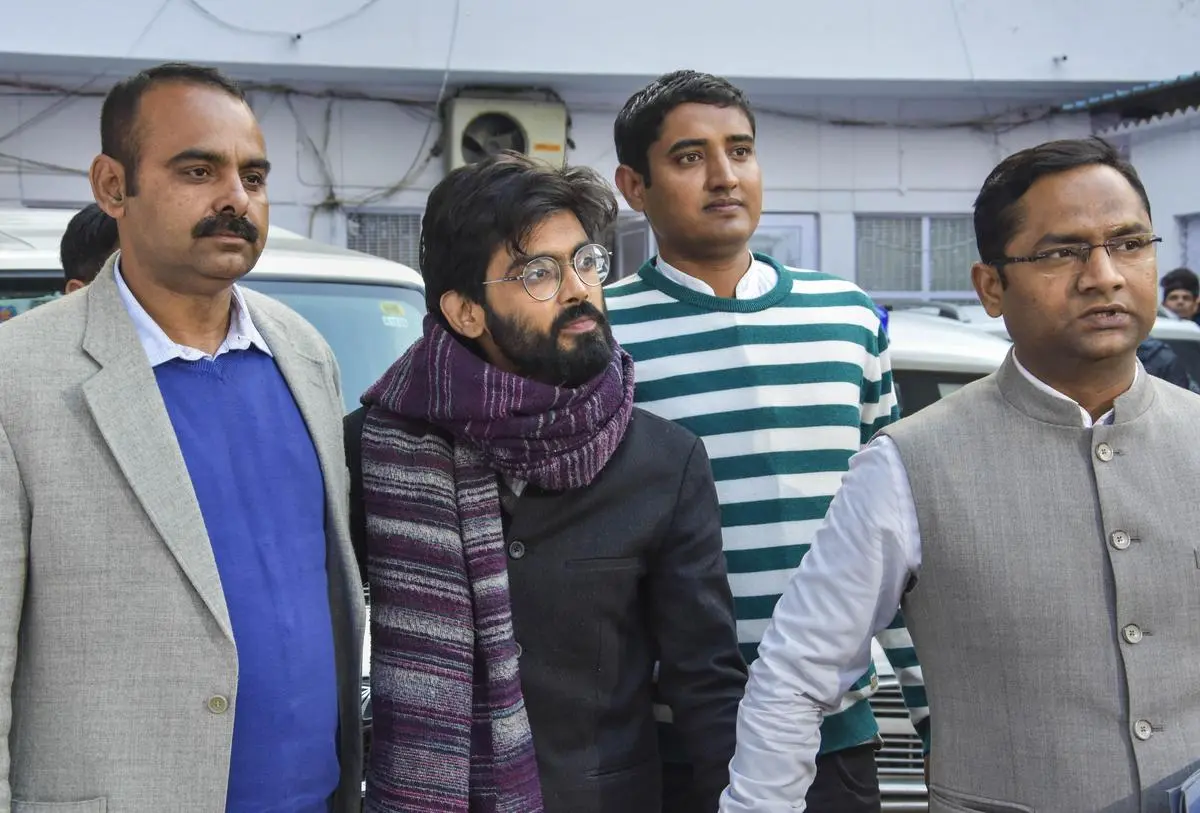
Sharjeel Imam being taken to a court at Chanakyapuri, in New Delhi, on January 29, 2020. | Photo Credit: PTI
Then comes a line of great benevolence. The judgment stated that upon completion of examination of the protected witnesses, or after one year from the date of the order (whichever is earlier), Khalid and Imam may “renew” their prayer for bail before the jurisdictional court, where it should be considered “without being influenced” by the present order.
Anyone remotely familiar with the tempo of criminal trials in India knows what this means. There are around 900 witnesses, including 46 protected witnesses. The judges know. The State knows. Everyone knows. “Renew after one year” if 46 witnesses are examined is an impossibility. The prosecution too would have no interest in producing these witnesses before the court since they most likely will not hold up and the case will fall flat.
Effectively, Justice Kumar’s judgment has denied Khalid and Imam bail for a year.
Protest recast as terrorism
The most dangerous part of Justice Kumar’s judgment is not merely that it denies bail on such flimsy grounds; it is that it expands the moral universe of “terrorism”.
The defence argued that the prosecution was conflating protest and civil disobedience with terrorism. There were no bombs, no conventional terror weapons, no classic insurgent methods, no recovery from the accused. But the court responded by giving Section 15 of the UAPA, which defines “terrorist act”, the widest possible embrace.
Parliament, it said, consciously employed the phrase “by any other means of whatever nature” while defining terrorist act, and that phrase cannot be rendered otiose. The emphasis, it said, is not on weaponry alone, as the defence put it, but on “design, intent, and effect”.
“To construe Section 15 as limited only to conventional modes of violence would be to unduly narrow the provision, contrary to its plain language,” the judgment stated.
It then explained what this means: “by any other means of whatever nature” would also cover acts that disrupt “supplies or services essential to the life of the community”, and Parliament’s conception of terrorism includes “conduct that destabilises civic life or societal functioning, even in the absence of immediate physical violence”.
This formulation should chill anyone who still believes the Constitution protects dissent as a lived right rather than a decorative phrase.
Once “destabilises civic life” becomes a usable idea of terrorism, practically every serious and effective protest—by definition disruptive, by definition inconvenient, by definition designed to force the State to notice—becomes capable of being prosecuted as a “terrorist act”.
This is dangerous. Any form of public protest will ordinarily “destabilise civic life or societal functioning” even if briefly. A protest against air pollution at India Gate might lead to some inconvenience to civic life for a brief period. If this logic of the court is adopted, this too shall be considered “terrorist activity”.
Also Read | CAA-NRC protests: A nation awakened
The defence tried to argue that the phrase “by any other means” would mean similar means to those already described in the section—arms, munitions, bombs. Justice Kumar’s bench rejected this argument and chose to expand the definition to something as vague as the above.
Given the fast-eroding situation of civil liberties in India, well-documented nationally and internationally, one should wonder what was weighing on Justice Kumar and Justice Anjaria’s mind when they sounded this death knell for the constitutional right to protest.
The court tried to qualify this by saying dissent occupies a “protected space” in a constitutional democracy. But then it added that protection does not extend in a case like this, which Watali requires it to assume as prima-facie true.
With one interpretive stroke, the Supreme Court has possibly given the State a terrifying gift: the ability to charge democratic dissent as terrorism, and then use the bail bar to ensure that the punishment is the process.
What Justices Kumar and Anjaria’s judgment implicitly tells the government is that the UAPA story ought to be pleaded with sufficient seriousness so that democratic protest can become terrorism, disruption can become terror, and liberty can be postponed indefinitely because of its own interpretations. The story ought to sound great, the material collected ought to be stretched just enough for a court to accept it at face value.
Justice Kumar’s judgment is not constitutional adjudication. It is adjudication by whim, like that of a khap panchayat, where the outcome is moralised, the rights are sermonised, precedents are pushed aside, and the citizen is reminded, once again, that the Constitution is not a shield, but a text the judge cites according to his inclination at the moment.
Saurav Das is an investigative journalist writing on law, judiciary, crime, and policy.