



惯性聚合 高效追踪和阅读你感兴趣的博客、新闻、科技资讯
阅读原文 在惯性聚合中打开

推荐订阅源

博客园 - 聂微东
S
Schneier on Security
cs.CL updates on arXiv.org
Latest news
Latest news
Cyberwarzone
Cyberwarzone
Cisco Talos Blog
Cisco Talos Blog
T
The Exploit Database - CXSecurity.com
T
Tenable Blog
I
Intezer
T
Threat Research - Cisco Blogs
Threat Intelligence Blog | Flashpoint
C
Cybersecurity and Infrastructure Security Agency CISA
P
Privacy International News Feed
P
Palo Alto Networks Blog
The Register - Security
IT之家
IT之家
Google DeepMind News
C
Cyber Attacks, Cyber Crime and Cyber Security
L
LINUX DO - 最新话题
S
Securelist
WordPress大学
WordPress大学
Exploit-DB.com RSS Feed
Hugging Face - Blog
Hugging Face - Blog
N
News and Events Feed by Topic
H
Help Net Security
Project Zero
Project Zero
K
Kaspersky official blog
博客园 - 三生石上(FineUI控件)
L
LINUX DO - 热门话题
大猫的无限游戏
大猫的无限游戏
G
GRAHAM CLULEY
F
Full Disclosure
博客园 - 叶小钗
OSCHINA 社区最新新闻
OSCHINA 社区最新新闻
TaoSecurity Blog
TaoSecurity Blog
N
News | PayPal Newsroom
Forbes - Security
Forbes - Security
博客园 - 司徒正美
I
InfoQ
Recent Announcements
Attack and Defense Labs
P
Privacy & Cybersecurity Law Blog
S
Security @ Cisco Blogs
人人都是产品经理
人人都是产品经理
The GitHub Blog
The GitHub Blog
Simon Willison's Weblog
G
Google Developers Blog
N
Netflix TechBlog - Medium
U
Unit 42
阮一峰的网络日志
阮一峰的网络日志

India’s National Fortnightly Magazine

SIR West Bengal Voter Exclusion Case 2026 TN Assembly Polls 2026: Senthil Balaji and SP Velumani Clash for Western Belt Supremacy Women’s Reservation Act Amendments Raise Delimitation Fears Healthcare’s Breaking Point India’s Elderly Boom: Care Gaps and Policy Failures AI chatbots fill mental health gaps in India, but risks grow Substandard Drugs in India: The Hidden Public Health Threat India Healthcare Costs Crisis: Who Pays the Price? ASHAs hold India’s fragile health system together but are woefully underpaid Partha Chatterjee’s For a Just Republic and the Limits of the People-Nation India’s Missing Middle: Trapped Between Health Insurance and Care Hungary Election 2026: Orbán Defeated, Magyar Wins Big Shailaja Paik on Dalit Women, Caste, and the Politics of Erasure in India Free Speech Crackdown in India: Is Dissent Under Threat? Ambedkar Jayanti and the New Publicness of Protest Politics Implementing Women’s Reservation: Why a Hybrid 651-Seat Lok Sabha Model Outperforms Mass Expansion Ambedkar and Free Speech: Who Controls Dissent in 2026? How a Maharashtra Village Turned Tea with Dalits into a Statewide Equality Mission Women’s Reservation, Delimitation Bills Spark Secrecy Row Reforming Tamil Nadu's Local Governance: Why MLAs Aren't Fixers in 2026 Sewage, Neglect, and Governance Failure Mark India's Water Crisis West Bengal voter list controversy explained | Why names are being deleted Pattukkottai Kalyanasundaram: Tamil Cinema and Left Politics Delhi’s PM-UDAY Reset: Regularising Unauthorised Colonies on an “as is” Basis Will Vijay’s TVK disrupt DMK and AIADMK? | Tamil Nadu election 2026 Constitutional Morality vs Social Morality in India 2026 Amit Shah’s Anti-Conversion Promise Opens a New Faultline in Punjab Politics Why Indian Shias Protest for Iran: History of Solidarity (2026) West Bengal Voter List Row 2026: “Votercide” Debate The Hidden Ecosystem Inside our Homes Asha Bhosle’s Death Marks the End of an Era in Indian Playback Music Women’s Health in India: Inequality by Design How Algorithms Turn Feminism into a Marketable Aesthetic An Unanswered People: Adivasi Poetry’s Fight for Language and Land Rereading Kari in the Age of Identity Debates Absolute Jafar: Nostalgia and restlessness in frames Anita Nair’s Why I Killed My Husband Review: Powerful Themes, Uneven Storytelling Why the FCRA Amendment Bill 2026 Has Triggered a Political Storm Iran’s Staying Power Redraws the US-Israel War Calculus Snake Metaphors in Indian Politics 2026: Venomous Rhetoric From Grief to Politics: Porkodi Armstrong and the Battle for Dalit Power in North Chennai West Bengal election 2026: Will Babri Masjid split the Muslim vote? West Bengal Communal Politics and the 2026 Election Battle Raghav Chadha-AAP Rift Explained: Rise to Fallout (2026) Why India Is Not Energy-Secure Amid Global Oil Shocks Mulla Shah Mosque: Jahanara Begum's forgotten legacy Strait of Hormuz Ceasefire: Pause, Not Peace Dharavi’s Kumbharwada Potters fear Adani-led Redevelopment will Destroy their Livelihoods How India’s Poor Lose Years Waiting in Queues (2026) India IT Rules 2026: Threat to Free Speech? Iran War Ceasefire Signals a Shift Toward Multipolar Deterrence US Foreign Policy: Empire, Coups, and Control (2026) CBFC Ban on Gaza Film Raises New Alarm Over Censorship Queer Dalit identity and the limits of visibility 2026 Assembly Polls: Congress vs BJP Power Test Israel's Relentless Bombing Creates Displacement Crisis in Lebanon Iran War Ceasefire Marks End of US Dominance Era Imported Inflation in India: Navigating Gulf Crisis Kerala Assembly Election 2026: LDF Anti-Incumbency vs UDF Momentum Petronet LNG: A Public Company Built to Escape Public Accountability Gujarat Local Polls: AAP Rise Deepens Congress Crisis Who Defines You? | The Frontline Newsletter SIR controversy deepens fear of Muslim disenfranchisement in Bengal Kerala Election 2026: LDF, UDF, and the BJP “B Team” Charge Delhi’s LPG Crisis Exposes How Migrants Are Locked Out At 100, Krishnammal Jagannathan’s Life Marks a Legacy of Dalit Land Rights and Resistance Who will win Kerala Assembly Election 2026? LDF or UDF? Assam Polls: Cash Transfers Mask Stagnant Incomes and Job Distress Jaishankar and India's Diplomacy Crisis West Bengal SIR 2026: Voters Treated as Suspects Sathankulam Verdict: How a Rare Death Penalty Challenges India’s Custodial Torture Crisis How three 2026 bills redefine identity, marriage, and freedom in India After Nitish Kumar, Bihar BJP faces its biggest test: caste coalition without a ‘Mr Clean’ Nuclear Deterrence in South Asia: Fragile Stability Actor Vijay and Politics: An Emerging Landscape Dharavi’s Idli-Vada Economy Faces Disruption Under Redevelopment Child Marriage Annulment in India: Khushbu’s Fight (2026) India’s Role in Palestine: Why West Asia Peace Needs Action 2026 Rethinking Iran beyond Western narratives N Rangasamy’s 2026 Puducherry Poll Strategy and Power Play Khalid Jawed on Urdu’s Future and Cultural Loss (2026) Kashmir Encounter Killing Sparks AFSPA Debate 2026 Birds and grief in Hamnet and H is for Hawk GST Federalism Crisis 2026: How States Lost Fiscal Power US-Iran War 2026: Petrodollar Stakes Behind Hormuz Clash White Savior Complex in Arab Regimes Drives Ukraine Deals Not Self Reliance UPA Corruption Narrative vs Court Verdicts 2026 Mathur Sathya Case Exposes Patriarchy in Progressive Politics Personality Cult in Indian Politics 2026: Why Leaders Remain Untouchable India Needs a New Economic Model Beyond Neoliberalism Why J&K MLAs Are Fighting the Lieutenant Governor Over Security Pawar Family Rivalries Stall NCP Factions Merger in Maharashtra DMK manifesto 2026: Key promises, alliances, & welfare politics State Assembly Elections 2026: How Voter Dynamics Are Shaping India Iran-Israel War: Hegel’s Recognition Theory Explains the Escalation Coal, Capital, and Compliance: Fairmine Under NGT Lens Hindu Rashtra Debate: 2026 State Elections Test Secular India Tamil Nadu Election 2026: How Gender and Gen Z Voters are Reshaping the Dravidian Power Struggle Gujarat's proposed marriage registration amendment 2026 polices choice Will NEET Break More Students Than It Makes Doctors?
Herodotus to Iran: Why Civilizations Don’t Die
2026-04-26 · via India’s National Fortnightly Magazine

Dear Reader,

Once upon a time, in an ancient land, wrote Herodotus (484-425 BC) in his TheHistories (430 BC), there was a custom that if an important decision was to be made in a group, it would have to be discussed drunk. The following day, “the master of the house where the discussion was held submits their decision for reconsideration when they are sober. If they still approve it, it is adopted, if not, it is abandoned. Conversely, any decision they make when they are sober, is reconsidered afterwards when they are drunk.” (section 133 of The Histories Book I by Herodotus).

The man considered “The Father of History” was referring to the customs of ancient Persians. As a pioneer in the craft of writing history, Herodotus took enormous liberties with facts (which made for very entertaining reading), but we can be more or less certain about the veracity of this account, because its writer was well-accustomed with the Persian ways, having lived in a Greek city, Halicarnassus, that was under Persian rule, and at the height of Persian power.

The little custom Herodotus mentioned spoke volumes about the kind of liberated, open-minded, rational and enlightened society that ancient Persia was. He further wrote, “They (Persians) consider telling lies more disgraceful than anything else, and, next to that, owing money. There are many reasons for their horror of debt, but the chief is their conviction that a man who owes money is bound also to tell lies (The Histories Book I, section 138). It was a proud and honourable civilisation.

Persia’s era of greatness—unparalleled in its combination of cultural sophistication, artistic elegance, and military might—began with king Cyrus (590/600-530 BC) and the Achaemenid dynasty that ruled Persia for nearly 200 years (550-330 BC). Cyrus, one of the greatest figures of ancient times, combined able statesmanship with tremendous military prowess to establish the beginning of the golden period of ancient Persia. Herodotus gives a detailed account of his birth and childhood, much of which reads like a dark fairy tale—an insecure king troubled by a dream about his grandson usurping him; a babe left in the woods to die, but rescued and reared by a rough but kindly rustic couple; subsequently reunited with his royal family to carry out his prophesied destiny etc—but we won’t get into such apocryphal details, and stick to historical facts (as much as is available).

Having wrested the kingdom from the weakening grasp of the Medes, Cyrus expanded the boundaries of Persia, conquering large tracts of land in western Asia, including Assyria, Babylonia, Lydia, Sardis, Asia Minor, and established one of the most efficient systems of governance over a vast land. But what was most unique was, that unlike a typical ruthless expansionist, he was “the most amiable of conquerors who founded his empire upon generosity” (The Story of Civilization: Part 1—Our Oriental Heritage by Will Durant). He was kind to the vanquished, allowed them to freely pray to their gods, and preserved their own culture and practices, believed in plurality, and integrated various cultures into the broader Persian society. He himself made it a point to pay obeisance to the gods of the conquered, which endeared him even to those who suffered defeat at his hand. “Like Napoleon he accepted indifferently all religions, and—with much better grace—humoured all the gods.”

However, he was also overly ambitious, and sometimes capable of extreme cruelty. It was his ambition that ultimately handed him his only defeat in battle and killed him. Pushing inexorably into central Asia, he met a formidable opponent in Tomyris, the fierce queen of Massagetae. Enraged at Cyrus for having killed her son in battle, she set upon the Persian army with relentless fury, defeating and killing its seemingly invincible king in 530 BC.

Cyrus was succeeded by his son Cambyses (reign 530-522), who had inherited only his father’s vast kingdom and not the sagacious temperament to rule it. Cambyses’ successor’s identity remains shrouded in mystery. According to some historical sources, including Herodotus, the Persian throne was briefly occupied by a magus impersonating Cyrus’s younger son, Smerdis, who was believed to have been killed by Cambyses. However, it was the next man who ascended the throne, who truly deserved the sobriquet “King of Kings”—Darius the Great (reign 522-486 BC), arguably the greatest monarch of the ancient world.

Under his rule, the Persian empire reached its pinnacle, covering an area that included Egypt, Syria, Palestine, Phoenicia, Phrygia, Lydia, Ionia, Cilicia, Cappadocia, Armenia, Assyria, what we now call Afghanistan, Balochistan, Sogdiana, Bactria, all the way to the west of the Indus. “Never before had history recorded so extensive an area brought under one government,” wrote Durant.
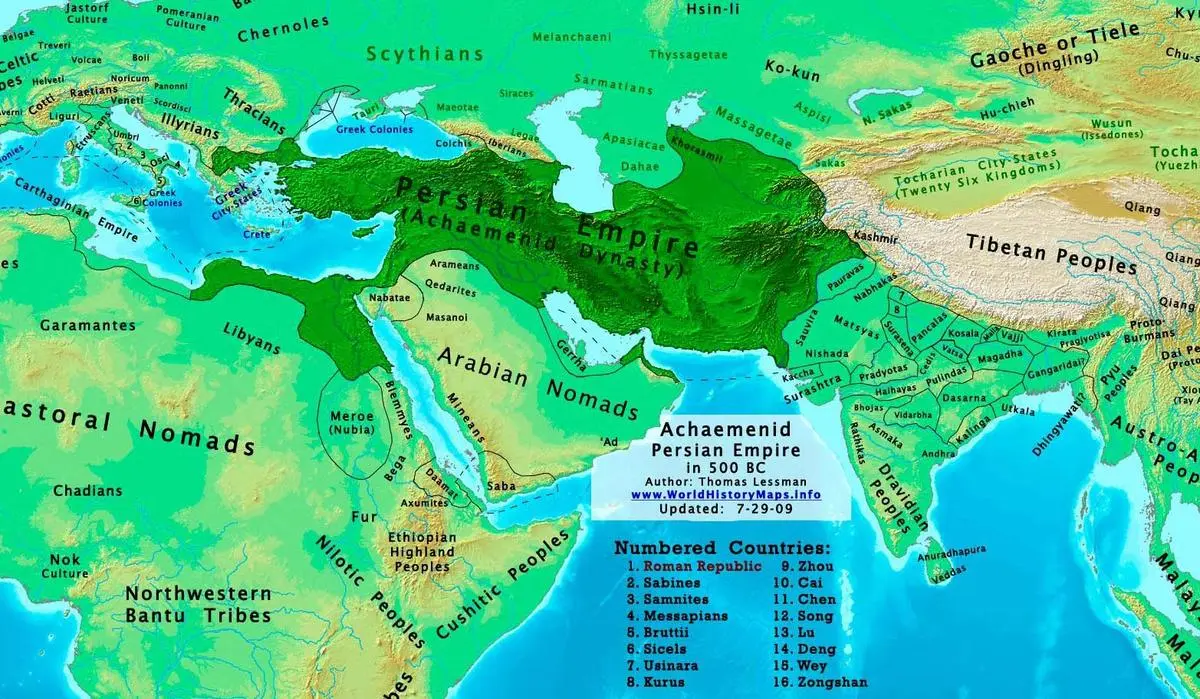
This map shows the extent of the ancient Persian empire at its peak under Darius.

This map shows the extent of the ancient Persian empire at its peak under Darius. | Photo Credit: worldhistorymaps.info

Like Cyrus, Darius ruled with generosity and empathy, and encouraged a tolerant, multi-cultural society. Persia soon emerged as a seat of culture and sophistication. Persepolis, the capital of the Achaemenid empire, was the symbol of grandeur and might. Darius implemented administrative measures far ahead of his time. He established an efficient bureaucracy for de-centralised control of his vast empire, introduced a standardised form of taxation, and a uniform currency—the Gold Daric. By building roads and improving connectivity, he facilitated commerce, and maintained law and order through a codified legal system. In short, Persia was the centre of the civilised world.

After Darius, there were nine more “King of Kings” who ruled Persia. Some were competent; some were disastrous as rulers. There were failed attempts at invading Greece, and revolts in conquered lands—particularly, Egypt, Cyprus, Phoenicia and others; there were also remarkable strategic victories in foreign policies, like Persia’s role in the Greek Corinthian war, under the shrewd leadership of King Artaxerxes II (reign 405-359 BC), because of which several Greek cities were gained by Persia. But through it all the power and prestige of Persia prevailed... until a young 26 year old king from the rugged terrain of Macedonia, proclaiming himself the son of Zeus, resolved to outdo his mythical step-brother Heracles, and set off to conquer the world. In 330 BC he defeated Darius III and ended the glorious Achaemenid empire.

But Alexander never wanted to destroy any civilisation; he was, after all, tutored by one of the greatest minds in history, Aristotle. In fact, after defeating Darius, so overwhelmed was he by the grandeur of Persia, that he himself adopted some of the ways of his fallen foes.

However, 2,356 years later, another powerful ruler with Caligula-like delusions threatened to end a civilisation whose legacy continues despite the vicissitudes of time and the whims of history. Frustrated at Iran’s refusal to lie on its back and accept defeat in a war he started, on April 7 he warned on social media: “A whole civilization will die tonight, never to ​be brought back ​again. I don’t want that ‌to ⁠happen, but it probably will.” It did not happen; and nor will it. That mad ruler now perhaps realises that it is not possible to kill a civilisation, when it has the full weight of history behind it.

Till I see you again,

Suhrid Sankar Chattopadhyay

Associate Editor, Frontline

This article is part of Frontline’s monthly newsletter “Once Upon a Time”. Subscribe to receive stories from history delivered to your inbox every month.