


As voting for the 2026 State elections concludes by the end of April, with the single-phase election in Tamil Nadu on April 23 and two phases in West Bengal on April 23 and April 29, parties such as the Congress, the BJP, the Samajwadi Party (SP) and the Bahujan Samaj Party (BSP) are now turning their focus on eastern Uttar Pradesh, which is home to over 160 seats that will be crucial for winning the 2027 Uttar Pradesh Assembly election.
While Adityanath, the BJP’s Chief Minister, seeks a third term in the State, the outcome of the 2024 Lok Sabha election, which was shocking for the BJP, looms large as a resurgent SP seeks to repeat the magic of its Pichhda, Dalit, Alpsankhyak pitch aimed at the votes of backward castes, Dalits, and minorities.
In 2024, the BJP suffered huge setbacks in eastern Uttar Pradesh, popularly known as Purvanchal, even though the region is home to the Assembly and Lok Sabha constituencies of Adityanath and Prime Minister Narendra Modi, namely Gorakhpur and Varanasi.
For the BJP, the loss that rankled the most in 2024 was Faizabad, where it was defeated despite the inauguration of the Ram temple at Ayodhya, which is part of the constituency. It is located in central Uttar Pradesh, popularly known as Awadh. In 2024, the BJP won only 19 of the 46 Lok Sabha seats in Purvanchal-Awadh.
This was a sign that the opposition had indeed gained the upper hand in Uttar Pradesh, where the BJP had established supremacy after decades of Mandal-Kamandal politics, which saw the rise of the SP followed by a new experiment in Dalit politics, with Mayawati becoming Chief Minister four times.
The BJP tried to reset the game in eastern Uttar Pradesh with Modi’s decision to contest from Varanasi in 2014. Its prospects were further boosted when Adityanath, head of the Gorakhnath math, was elected as the Chief Minister after the party posted a spectacular win in the 2017 Assembly election, winning 312 out of 403 seats.
BJP’s hits and misses
Since 2014, the BJP has been recording stellar performances for the most part, winning 71 and 62 seats in the 2014 and 2019 Lok Sabha elections respectively and 255 seats in the 2022 Assembly election. However, the 2024 results rang alarm bells after the BJP was reduced to 33 seats.
Data for the 2024 Lok Sabha election showed that the ruling party trailed in nearly 210 of the 403 Assembly seats. The fall was sharper in eastern Uttar Pradesh, where the SP led in the majority of the segments in constituencies such as Faizabad, Azamgarh, Jaunpur, Ambedkar Nagar, and Basti. In 2017, the BJP won 115 seats in the region but could not repeat its performance later and did worse in the 2024 Lok Sabha election.
The BJP did show signs of recovery later in the byelections held in the end of 2024, when it bagged six of nine seats, and also by winning the Milkipur seat in early 2025, after it was vacated by Awadhesh Prasad, who had won the Faizabad Lok Sabha seat earlier.
In 2025, the BJP appointed Union Minister Pankaj Chaudhary, a seven-term MP from Maharajganj in Purvanchal, as its State chief. Chaudhary belongs to the Kurmi caste, a politically significant Other Backward Classes community, and his appointment was expected to help the BJP checkmate the SP’s attempts to expand its support base beyond Yadavs and Muslims.
At the same time, the BJP is also aware that its forward-caste support base is restive, especially after the recent uproar against the University Grants Commission Equity Regulations, which recommend strict measures to check and punish caste discrimination on university campuses. The party also needs to keep the Brahmins in good humour given the old Thakur versus Brahmin rivalry in Uttar Pradesh, especially in Purvanchal, since the Brahmins account for 10-12 per cent of the votes.
Restive Brahmin base
When disgruntled Brahmin MLAs of the BJP held a meeting in Lucknow in December last year, SP leader Akhilesh Yadav tried to fish in troubled waters, stating that the BJP did not respect the “tilak” (mark on forehead). He added that a self-respecting society always chooses honour over power.
Earlier, at a conference of Brahmins organised by his party in Lucknow, Yadav had hailed the community’s contribution and said that his party always honoured the Brahmin community and expressed confidence that its support would ensure the SP’s win in 2027.
Recently, a video clip went viral in which former BJP MP Anil Shukla Warsi was seen protesting at a police station in Kanpur after five BJP supporters were booked in a case under the Scheduled Castes and the Scheduled Tribes (Prevention of Atrocities) Act. In the video, he is seen confronting Deputy Chief Minister Brajesh Pathak, saying: “You were made Deputy CM to protect and provide security to Brahmins, and here Brahmins are being abused, and fake cases are being registered.” Shukla was previously with both the BSP and the SP.
In February, the media reported that Brajesh Pathak hosted and honoured 101 Brahmin boys at his official residence in Lucknow, weeks after some Brahmin boys were reportedly mistreated in Prayagraj, which kicked off a political storm.
Soon after this, on February 22, Om Prakash Rajbhar, a Cabinet Minister in Adityanath’s government, held a Samajik Samrasta (social harmony) rally in the SP bastion of Azamgarh and followed it up with a similar rally in March in Maharajganj. Rajbhar is a popular leader of his community, which can influence the outcome in several constituencies in at least 10 Purvanchal districts.
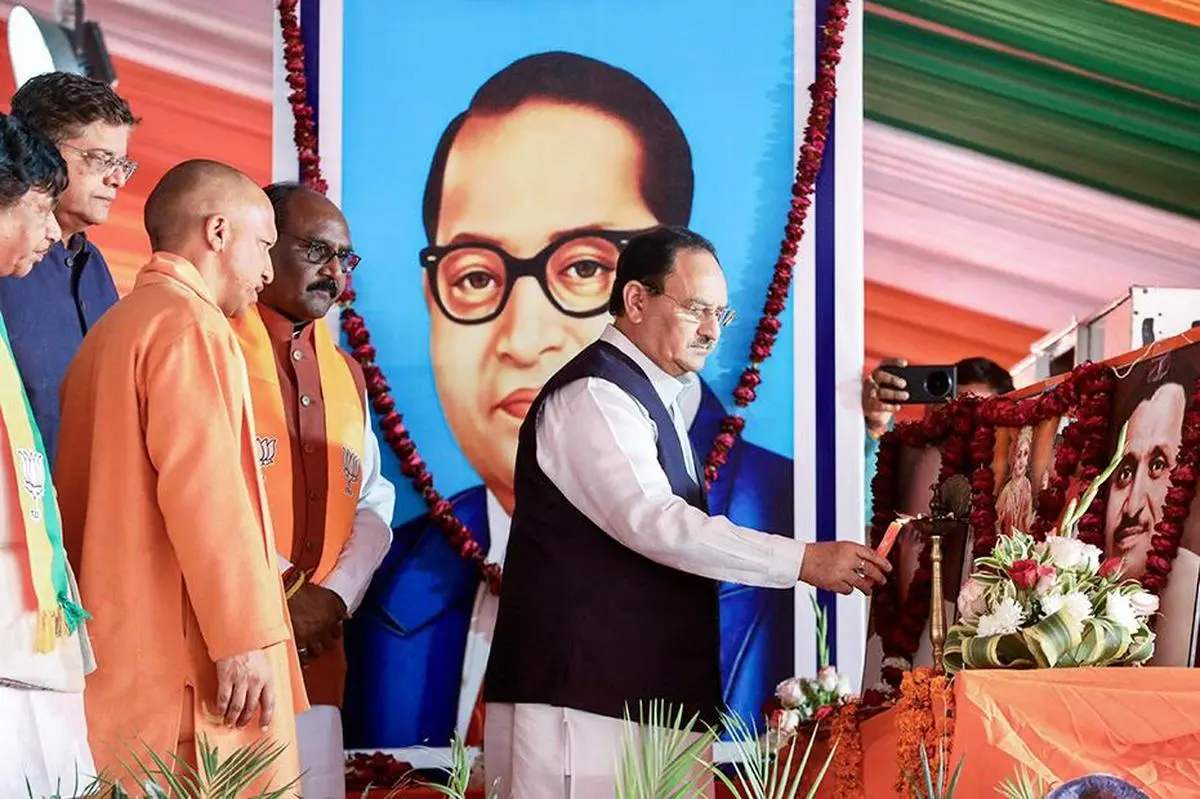
BJP leader J.P. Nadda and Uttar Pradesh Chief Minister Adityanath at a “Scheduled Caste Mahasammelan” organised by the party as part of its Dalit outreach, in Agra on March 7, 2024. | Photo Credit: ANI
Seeking to rebrand its 2007 Brahmin “bhaichara” (brotherhood) strategy, BSP leader Mayawati has again entrusted her key aide Satish Chandra Misra with the task of reaching out to the community, which is not only a voting bloc but also acts as an influencer in deciding the voting pattern of many other castes.
In 2007, one of the BSP’s election slogans was “Brahmin Shankh Bajayega, Haathi Badhta Jayega [the Brahmin will blow the conch shell, the elephant (the BSP’s symbol) will march ahead]”. Mayawati’s party is confident that it is still the first choice of Dalits despite the BJP having made some inroads into this voter base, particularly among the non-Jatav Dalits.
Wooing the Dalit voter
Congress leader Rahul Gandhi’s “dine with Dalit” programmes in the past and measures like making Charanjit Singh Channi the first Dalit Chief Minister of Punjab have created some goodwill for the party among Dalits. Dalits, Muslims, and Brahmins once formed the Congress’ core vote base.
While the Congress could not win the 2022 Assembly election in Punjab, Channi did manage to win the Jalandhar Lok Sabha seat in 2024. In Rajasthan, the Congress’ Bhajan Lal Jatav defeated the BJP in the Karauli-Dholpur Lok Sabha seat, and in Haryana, former Union Minister Selja Kumari won from Sirsa.
In Uttar Pradesh, Tanuj Punia, the son of Congress leader P.L. Punia, defeated the BJP in Barabanki. P.L. Punia was once a close aide of Mayawati. In Rajasthan, another Dalit candidate from the Congress, Sanjana Jatav, won from Bharatpur, the home district of the BJP’s Chief Minister Bhajan Lal Sharma.
The Congress will be deploying these leaders to drum up support for the party among Dalits in Uttar Pradesh. Hence, the anniversaries of the Dalit icon B.R. Ambedkar and even BSP founder Kanshi Ram are events all non-BSP parties are latching on to reach out to Dalits, especially in eastern Uttar Pradesh.
On Ambedkar’s birth anniversary on April 14, the BJP organised programmes at about 1.6 lakh booths. Earlier, it announced the Dr Ambedkar Statue Development Scheme under which each Assembly constituency will be allocated Rs.1 crore for the conservation and beautification of memorials named after Ambedkar and other Dalit icons. Meanwhile, Akhilesh Yadav participated in community meals with Dalits and carried out door-to-door programmes to reach out to Dalits.
The BJP has also drawn up plans to hold chaupal (village gathering) meetings across all reserved seats in the State to woo Dalit voters.
Aware of this, Mayawati has now taken to social media claiming that she is the “sole owner” of Kanshi Ram’s legacy and projecting the BSP as the only party working on Ambedkar’s vision.
Every vote matters
As every vote matters, Adityanath recently visited villages dominated by the Tharu tribal community, granted them land ownership, and announced that all cases registered against members of the Tharu community during the SP government of 2012–17 would be withdrawn.
The Tharu community, historically forest-dwellers, has a significant presence in Bahraich, Lakhimpur Kheri, Balrampur, and Pilibhit. To promote their financial status, the Uttar Pradesh government also introduced a homestay scheme called Tharu Hats in areas where the community has a sizeable presence.
With every major party refining its caste calculus, Purvanchal is set to emerge as the theatre of high-decibel political campaigning.
While the BJP is keen to defend its decade-long dominance in the State, a resurgent SP sees an opening at this time and the BSP seeks a last chance for revival. For the Congress, it is another opportunity to regain relevance in a State it dominated a long time ago.
Also Read | Why are all parties in Uttar Pradesh fighting over Kanshi Ram now?
Also Read | BJP faces fresh caste pinpricks in Uttar Pradesh