
惯性聚合 高效追踪和阅读你感兴趣的博客、新闻、科技资讯
阅读原文 在惯性聚合中打开

推荐订阅源

B
Blog RSS Feed
C
CERT Recently Published Vulnerability Notes
P
Proofpoint News Feed
Y
Y Combinator Blog
T
The Blog of Author Tim Ferriss
云风的 BLOG
云风的 BLOG
H
Help Net Security
Recorded Future
Recorded Future
The Register - Security
F
Full Disclosure
N
Netflix TechBlog - Medium
Cyber Security Advisories - MS-ISAC
酷 壳 – CoolShell
酷 壳 – CoolShell
H
Hackread – Cybersecurity News, Data Breaches, AI and More
爱范儿
爱范儿
Security Archives - TechRepublic
Simon Willison's Weblog
Cisco Talos Blog
Cisco Talos Blog
I
InfoQ
T
Tenable Blog
T
Tor Project blog
人人都是产品经理
人人都是产品经理
D
DataBreaches.Net
NISL@THU
NISL@THU
Google DeepMind News
博客园 - 叶小钗
B
Blog
V
V2EX
Jina AI
Jina AI
L
LangChain Blog
月光博客
月光博客
W
WeLiveSecurity
U
Unit 42
AWS News Blog
AWS News Blog
C
Cyber Attacks, Cyber Crime and Cyber Security
博客园 - 聂微东
V
Visual Studio Blog
A
Arctic Wolf
T
Tailwind CSS Blog
The Cloudflare Blog
SecWiki News
SecWiki News
S
SegmentFault 最新的问题
Hacker News - Newest:
Hacker News - Newest: "LLM"
宝玉的分享
宝玉的分享
MyScale Blog
MyScale Blog
cs.CL updates on arXiv.org
S
Securelist
www.infosecurity-magazine.com
腾讯CDC
雷峰网
雷峰网

India’s National Fortnightly Magazine

SIR West Bengal Voter Exclusion Case 2026 TN Assembly Polls 2026: Senthil Balaji and SP Velumani Clash for Western Belt Supremacy Women’s Reservation Act Amendments Raise Delimitation Fears Healthcare’s Breaking Point India’s Elderly Boom: Care Gaps and Policy Failures AI chatbots fill mental health gaps in India, but risks grow Substandard Drugs in India: The Hidden Public Health Threat India Healthcare Costs Crisis: Who Pays the Price? ASHAs hold India’s fragile health system together but are woefully underpaid Partha Chatterjee’s For a Just Republic and the Limits of the People-Nation India’s Missing Middle: Trapped Between Health Insurance and Care Hungary Election 2026: Orbán Defeated, Magyar Wins Big Shailaja Paik on Dalit Women, Caste, and the Politics of Erasure in India Free Speech Crackdown in India: Is Dissent Under Threat? Ambedkar Jayanti and the New Publicness of Protest Politics Implementing Women’s Reservation: Why a Hybrid 651-Seat Lok Sabha Model Outperforms Mass Expansion Ambedkar and Free Speech: Who Controls Dissent in 2026? How a Maharashtra Village Turned Tea with Dalits into a Statewide Equality Mission Women’s Reservation, Delimitation Bills Spark Secrecy Row Reforming Tamil Nadu's Local Governance: Why MLAs Aren't Fixers in 2026 Sewage, Neglect, and Governance Failure Mark India's Water Crisis West Bengal voter list controversy explained | Why names are being deleted Pattukkottai Kalyanasundaram: Tamil Cinema and Left Politics Delhi’s PM-UDAY Reset: Regularising Unauthorised Colonies on an “as is” Basis Will Vijay’s TVK disrupt DMK and AIADMK? | Tamil Nadu election 2026 Constitutional Morality vs Social Morality in India 2026 Amit Shah’s Anti-Conversion Promise Opens a New Faultline in Punjab Politics Why Indian Shias Protest for Iran: History of Solidarity (2026) West Bengal Voter List Row 2026: “Votercide” Debate The Hidden Ecosystem Inside our Homes Asha Bhosle’s Death Marks the End of an Era in Indian Playback Music Women’s Health in India: Inequality by Design How Algorithms Turn Feminism into a Marketable Aesthetic An Unanswered People: Adivasi Poetry’s Fight for Language and Land Rereading Kari in the Age of Identity Debates Absolute Jafar: Nostalgia and restlessness in frames Anita Nair’s Why I Killed My Husband Review: Powerful Themes, Uneven Storytelling Why the FCRA Amendment Bill 2026 Has Triggered a Political Storm Iran’s Staying Power Redraws the US-Israel War Calculus Snake Metaphors in Indian Politics 2026: Venomous Rhetoric From Grief to Politics: Porkodi Armstrong and the Battle for Dalit Power in North Chennai West Bengal election 2026: Will Babri Masjid split the Muslim vote? West Bengal Communal Politics and the 2026 Election Battle Raghav Chadha-AAP Rift Explained: Rise to Fallout (2026) Why India Is Not Energy-Secure Amid Global Oil Shocks Mulla Shah Mosque: Jahanara Begum's forgotten legacy Strait of Hormuz Ceasefire: Pause, Not Peace Dharavi’s Kumbharwada Potters fear Adani-led Redevelopment will Destroy their Livelihoods How India’s Poor Lose Years Waiting in Queues (2026) India IT Rules 2026: Threat to Free Speech? Iran War Ceasefire Signals a Shift Toward Multipolar Deterrence US Foreign Policy: Empire, Coups, and Control (2026) CBFC Ban on Gaza Film Raises New Alarm Over Censorship Queer Dalit identity and the limits of visibility 2026 Assembly Polls: Congress vs BJP Power Test Israel's Relentless Bombing Creates Displacement Crisis in Lebanon Iran War Ceasefire Marks End of US Dominance Era Imported Inflation in India: Navigating Gulf Crisis Kerala Assembly Election 2026: LDF Anti-Incumbency vs UDF Momentum Petronet LNG: A Public Company Built to Escape Public Accountability Gujarat Local Polls: AAP Rise Deepens Congress Crisis Who Defines You? | The Frontline Newsletter SIR controversy deepens fear of Muslim disenfranchisement in Bengal Kerala Election 2026: LDF, UDF, and the BJP “B Team” Charge Delhi’s LPG Crisis Exposes How Migrants Are Locked Out At 100, Krishnammal Jagannathan’s Life Marks a Legacy of Dalit Land Rights and Resistance Who will win Kerala Assembly Election 2026? LDF or UDF? Assam Polls: Cash Transfers Mask Stagnant Incomes and Job Distress Jaishankar and India's Diplomacy Crisis West Bengal SIR 2026: Voters Treated as Suspects Sathankulam Verdict: How a Rare Death Penalty Challenges India’s Custodial Torture Crisis How three 2026 bills redefine identity, marriage, and freedom in India After Nitish Kumar, Bihar BJP faces its biggest test: caste coalition without a ‘Mr Clean’ Nuclear Deterrence in South Asia: Fragile Stability Actor Vijay and Politics: An Emerging Landscape Dharavi’s Idli-Vada Economy Faces Disruption Under Redevelopment Child Marriage Annulment in India: Khushbu’s Fight (2026) India’s Role in Palestine: Why West Asia Peace Needs Action 2026 Rethinking Iran beyond Western narratives N Rangasamy’s 2026 Puducherry Poll Strategy and Power Play Khalid Jawed on Urdu’s Future and Cultural Loss (2026) Kashmir Encounter Killing Sparks AFSPA Debate 2026 Birds and grief in Hamnet and H is for Hawk GST Federalism Crisis 2026: How States Lost Fiscal Power US-Iran War 2026: Petrodollar Stakes Behind Hormuz Clash White Savior Complex in Arab Regimes Drives Ukraine Deals Not Self Reliance UPA Corruption Narrative vs Court Verdicts 2026 Mathur Sathya Case Exposes Patriarchy in Progressive Politics Personality Cult in Indian Politics 2026: Why Leaders Remain Untouchable India Needs a New Economic Model Beyond Neoliberalism Why J&K MLAs Are Fighting the Lieutenant Governor Over Security Pawar Family Rivalries Stall NCP Factions Merger in Maharashtra DMK manifesto 2026: Key promises, alliances, & welfare politics State Assembly Elections 2026: How Voter Dynamics Are Shaping India Iran-Israel War: Hegel’s Recognition Theory Explains the Escalation Coal, Capital, and Compliance: Fairmine Under NGT Lens Hindu Rashtra Debate: 2026 State Elections Test Secular India Tamil Nadu Election 2026: How Gender and Gen Z Voters are Reshaping the Dravidian Power Struggle Gujarat's proposed marriage registration amendment 2026 polices choice Will NEET Break More Students Than It Makes Doctors?
Geeta Parag’s Kabir Songs Challenge Caste and Patriarchy (2026)
2026-04-19 · via India’s National Fortnightly Magazine
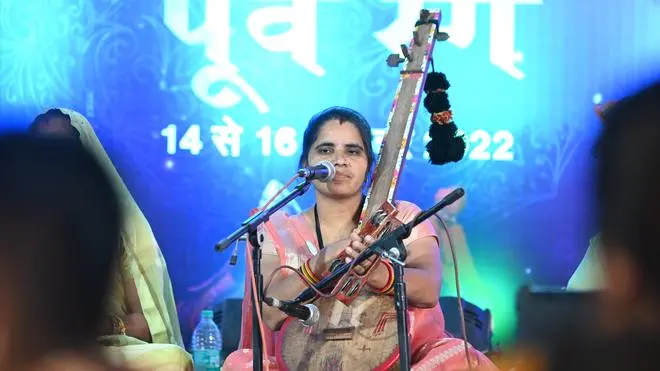
Folk singer Geeta Parag says she lives by the doha: “Kabeera khada baazaar mein, maange sabakee khair, na kaahoo se dostee, na kaahoo se bair” (Kabir stands in the market, wishing well for all—neither friendship with anyone, nor enmity with anyone).
Folk singer Geeta Parag says she lives by the doha: “Kabeera khada baazaar mein, maange sabakee khair, na kaahoo se dostee, na kaahoo se bair” (Kabir stands in the market, wishing well for all—neither friendship with anyone, nor enmity with anyone). | Photo Credit: Nilesh Parag

Geeta Parag is a folk singer from the Malwa region of Madhya Pradesh. She sings in the nirgun tradition, a branch of the Bhakti movement focusing on devotion to a formless, attribute-less God, rejecting idol worship and ritualism. The tradition is anchored by saint-poets like Kabir, Guru Nanak, Dadu Dayal, and Ravidas. Geeta uses Kabir’s poetry to speak about caste, gender, and faith. She lives in Tonk Khurd and performs with her family, often opening her gatherings with Kabir’s verses, and her music draws from everyday life and carries a clear social voice.

Geeta Parag began singing under strict limits at home and in her village. Her husband once opposed her work, and the community often spoke against her. Over time, with support from her guru Padma Shri Prahlad Singh Tipaniya, she took the stage and built her confidence. Public performances slowly changed how people around her saw her work. Her songs speak against caste and patriarchy, even within traditions that men have long controlled. She draws strength from Bhakti poets and saints, and brings their ideas into present-day struggles. Alongside music, she works as an Anganwadi teacher and manages her household, which keeps her grounded in the realities she sings about.

Her reach has grown through concerts, recordings, and social media, where her songs have found new listeners. She now performs across regions and has received public recognition, while audiences respond strongly to her work. In this interview with Frontline, she speaks about her journey, her music, and the resistance she faced along the way.

When did you develop an interest in singing?

As a child, I had no interest in playing with girls my age. I used to spend time with older women, listening to bhajans. After I got married, my mother-in-law, who is part of the Kabir Panth, brought me to nirgun poetry. Kabir Panthis are those who follow the teachings of Kabir. At first, I disliked nirgun singing. I did not even know what the word meant. My mother-in-law used to play cassettes from 5 am and it bored me. My sleep used to get disturbed. I was 16 or 17 at the time.

I used to sit with a ghoonghat and sing bhajans with the other women and my mother-in-law. Once there was a programme in our village where I heard a bhajan and it moved me. Only men used to sing in our village. Listening to those verses, I felt that Kabir’s poetry had a deep power, and I slowly began to understand it. Narayan Delmia visited our house and saw that we could sing well. He offered to teach us, which made me and my mother-in-law very glad. He used to come every eighth day because he knew that women would not be allowed to go out to learn.

Do you write your own songs?

I sing the nirgun poetry our ancestors have been singing for ages. I am trying to write nirgun poetry myself, and my mother-in-law has inspired me. I do not know which verse of Kabir touched me so deeply that I changed completely.

Your journey has not been without struggles. What were the key challenges?

To this day, women are not allowed to step out of the house without their husband’s permission. We (my mother-in-law and I) were eager to learn and we did. But society started questioning us—whether we should be allowed to continue, because it would look bad on the community if women went out to sing. People said terrible things about us, and my husband was also against it. But we had grown attached to the singing of the saints and did not know how to let go.

My husband fought a lot with me, fearing what his friends would say. I used to cry a lot at night. When he came back from the printing press, where he works, I used to make sure all the household chores were done so that there would be nothing to complain about. Even when he got angry, I heard it all silently. Yet he was not convinced. Now he plays the timki when I sing, but this came after much penance and because I was firm about not giving up singing at any cost.

I live by the doha: “Kabeera khada baazaar mein, maange sabakee khair, na kaahoo se dostee, na kaahoo se bair” (Kabir stands in the market, wishing well for all—neither friendship with anyone, nor enmity with anyone).

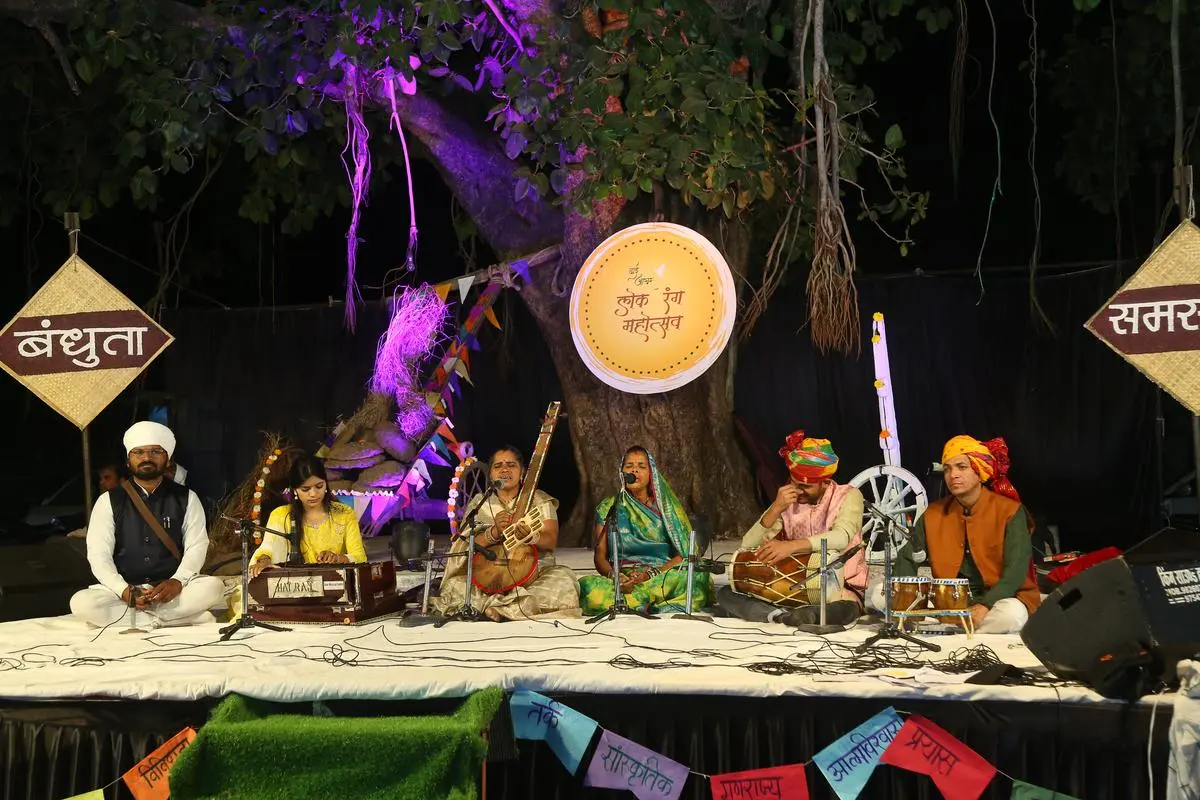
Geeta Parag says in Dewas, women have started taking singing as a serious choice.

Geeta Parag says in Dewas, women have started taking singing as a serious choice. | Photo Credit: Nilesh Parag

To what extent is your music a response to the pressures faced by Dalit women in the arts?

Every new thing scares us. All I think about is: when they did not spare Mirabai, then who am I to complain? History does not remember Roopa Bai, Tola Bai, and Karma Bai as female Bhakti saints because they did not fight as much as Mirabai did. People discriminate on the basis of gender and caste. People will pull your leg, but you have to march ahead.

Has the audience always been welcoming?

Once there was an event in my guru’s village and he asked me to sing. The audience’s applause made me very happy. I did not know what singing well meant; I was simply singing bhajans. When people came up and praised me, I saw that maybe I could keep doing this. My husband came to this event but was still not convinced. Whenever there was a programme, he would come with me but sit at the back and hide his face, afraid his friends would see him.

I remember my first performance to this day, because more than knowledge of Kabir, there is a way of living that a Kabir Panthi follows. He teaches us a new way of living. We did not just sing; we also looked into what we were singing about and lived it through practice. Singing was not entertainment for us but a way of life.

Is Kabir taught enough to students? What about other Bhakti and Sufi saints?

I have taught in anganwadi schools for 15 years, and I believe Kabir, Ravidas, and other Bhakti and Sufi saints are not taught enough, even when this generation needs it the most. They appear in class VIII textbooks, but more is needed.

Kabir says beautiful things. For example: “Jaati na pucho saadhu ki, pooch lijiye gyaan. Mol karo talwaar ka, pada rahan do myaan” (Do not ask a saint about his caste; ask for his knowledge instead. Value the sword for its sharpness; let the scabbard be). There is another verse: “Sab kaahoo ka leejie, saancha shabd nihaar. Pakshapaat na keejie, kahain kabeer vichaar” (No matter who speaks, if they tell the truth, accept it. One should never be biased while accepting the truth or doing justice). Kabir’s caste does not matter in front of his knowledge; he deserves to be taught more widely. Kabir taught me how to live without judgement, without bias, and with peace.

What do you want to say to people who fear following their passion in the face of adversity?

It is important to stand by what you believe in. Looking at others, one gets inspired. In Dewas, women have started taking singing as a serious choice. In an area where women wear the ghoonghat, a female-led music festival called the Malwa Mahila Kabir Yatra is held every year and only women take part. The men who used to taunt my husband and say that I sing with males while their wives sit “like queens at home” now ask their wives to follow my example. People will criticise, but until when? They will change one day.

I remember when I was asked to a programme in Dewas by my guru and fliers were put up across the city; many people came up to my husband asking about me. My guru, Prahlad Singh Tipaniya, sat with my husband and explained the meaning of art, nirgun poetry, and singing as something deeper than performance. It was after this that my husband started believing in my talent. I used to be scared, but that fear was nothing next to the thought of being kept away from Kabir.

The single biggest motivation for me is my mother, who has a single child and “unfortunately” a daughter in the eyes of society, saying: “I do not want anyone else; my daughter gave me everything.”

Aparna Vats is an intern with Frontline.

Also Read | Ilaiyaraaja: A symphonic return of the king

Also Read | Zakir Hussain (1951-2024): Recollections of the tabla maestro—musical and personal